
Should I Buy Flood Insurance?

altext

When we bought our house, the lender said we weren’t in a flood zone so we didn’t need to buy flood insurance on top of our homeowner’s insurance. I figured if the bank isn’t worried about it, then I shouldn’t be either. Apparently this might not be the best idea.

Virtually every home is in a flood zone
Unless you live on the top of a mountain, just about any area is susceptible to flooding. Heavy rains can make instant rivers where there wasn’t even a trickle before. All it takes is for a big storm to come after the ground is already saturated. Or you could simply ask some of the people who experienced Hurricane Katrina. Dams and levees fail. Just a few inches of water can cost tens of thousands of dollars worth of damage. In fact, 25% of flood claims come from low and moderate risk areas (areas not required to have insurance by lenders). Check out your local flood map here.

Where do I buy flood insurance?
Flood damage is not covered under homeowner insurance policies. You must buy it separately through the National Flood Insurance Program (NFIP), which is run and backed by the US government. However, nearly everyone is eligible to buy flood insurance regardless of risk level (although the premiums will vary).

The policies are available through private insurance companies and agents. You can find agents here for a free quote. Some insurance companies hint that they can offer discounted quotes, but this is not true. The price should be the same no matter who you go through. I actually tested this by asking 5 different agents both local and nationwide for quotes, and they were all exactly the same once adjusted for the same coverage and deductible. Therefore, I would simply get a quote from the same insurer I have for homeowner’s insurance.

How Much Will It Cost?
Chances are if your lender didn’t make you buy it for your mortgage, then your premiums won’t be too bad. You can estimate your flood risk and premium here. Remember, you have a few choices: Your building coverage amount (up to $250,000), your contents coverage amount (up to $100,000), and the deductibles for each (from $500 to $50,000). If you are in a moderate-to-low risk area, you might get coverage for $200-$500 per year.

With a few exceptions, there is a 30-day wait before the policy takes effect, so don’t be thinking you can just buy it at the last minute. Even if you aren’t a homeowner, flood insurance is available to renters who want to cover their contents.

So, it would seem that almost all homeowners should at least consider getting flood insurance even they are not required to. It can’t hurt to get a quote and research your flood exposure.

Do You Buy The Loss Damage Waiver For Rental Cars?

If you’re like me, you don’t rent cars very much outside of work. But when I do, I’m always of mixed emotion when it comes down to the inevitable question: Do you want to buy the Loss Damage Waiver (LDW)? It costs around $20/day, but it basically absolves you of any liability if the car becomes dented, breaks down, gets scratched, blown up, or whatever.

Your Existing Car Insurance Might Extend To Rental Cars
This is the most basic thing to know, but according to a survey by Progressive only about 25% of people bother to ask. Find out if your own insurance will act as your primary rental car insurance! My policy with State Farm does extended to the occasional rental car, but the deductible still applies.

But That Might Not Help…
I have high insurance deductibles, and I’m not worried about a full-on accident. I’m more worried about scratches and dents. If it was my own car, I’d never care about a dented bumper. But a rental car company can charge me $500+ for a new bumper, and also $75 a day that the car is unavailable for rental while they fix it (“loss-of-use” fees). Or they might just charge me $100 for a scratch because they want to squeeze every penny out of me… 2 months after I return the car.

In addition, your own auto insurance may cover collision (damage to the vehicle), but not other things like those “loss-of-use” or other administrative fees. Finally, making a claim on your insurance may jack up your future rates, which is partially why my deductibles are so high in the first place.

Credit Card Secondary Coverage To The Rescue?
The next layer of protection to consider is that offered by your credit card company. All of the biggies – Visa, MasterCard, American Express, and Discover offer some sort of coverage. According a review of the policies done on Wikipedia:

The main difference among the four credit card companies listed below is that MasterCard and Amex cover collisions, theft, vandalism and weather; Visa covers collisions and theft, but omits vandalism and weather; while Discover covers only collisions. However MasterCard is not useful in areas with dirt or gravel roads [paved roads only].

However, details can still vary depending on the specific type (Classic, Gold, Platinum, etc.). Look for specific wording in the paperwork that they mail you with the tiny print on amazingly thin paper. Here’s an excerpt from MasterCard coverage:

MasterRental will pay for covered damages on a secondary basis for which you are, or any other authorized driver is, legally responsible to the rental agency.

Covered damages include:
–Physical damage to and theft of the vehicle, not to exceed the limits outlined below.
– Reasonable loss-of-use charges imposed by the vehicle rental company for the period of time the rental vehicle is out of service. Loss-of-use charges must be substantiated by a location- and class-specific fleet utilization log.
– Reasonable towing charges to the nearest factory-authorized collision repair facility.

If you have, or an authorized driver’s primary automobile insurance or other indemnity has, made payments for a covered loss, MasterRental will cover your deductible and any other eligible amounts not covered by other insurance.

Secondary insurance means that they will cover what your primary insurance doesn’t. Together, this seems like a pretty solid combination. Of course, I’ve never made a claim through any of these card companies so I have no idea how easy they are to deal with. (Anyone have stories?)

An Immature Reason To Buy The LDW
I couldn’t find the clip online, but I remember a stand-up act by Jeff Foxworthy or somebody about rental car insurance that went something like this…. “You mean for 15 bucks I can drive this car like a maniac? Heck yeah I want that insurance! Time to grab some airtime!” I must say that the only time I’ve ever been in a car that did a doughnut in a empty parking lot…. that was a rental car. Of course I don’t drive like that. However, I will admit that have tested to 0-60 times of a few of my rental cars. Too bad in a Chevy Aveo that’s about 38 seconds downhill…

In the end, I have gone both ways depending on my mood. I have bought the waivers on short rentals because I just didn’t want to deal with any potential hassles. Most times, I have refused. I am making another rental later this week, so that’s why I’m pondering this…

PayPal Money Market Account Review: Is It Safe?

For a while now, online payment service PayPal.com has offered an extra reason to keep money in their accounts – a money market fund paying around 5% interest annually. I get asked about it regularly, and here I will explain in detail why I do not recommend keeping any significant amount of money in this account.

Now, when you think about a money market account, what are the top three things you look for? Here are mine, from most important down to least important:

  1. Safety. This is cash savings, so the top priority is that you don’t want any risk or chance of loss.
  2. Liquidity. This is not a certificate of deposit; You want to be able to access the money at any time.
  3. Yield. You want to earn a competitive rate of interest.

I’ll address them in reverse order:

Yield
Its 7-day average yield as of 8/16/07 was 5.04%. This isn’t bad, and historically the fund has offered competitive rates, although they are not necessarily the highest. In looking at the prospectus [pdf], these higher yields appear to be the result of temporary fee waivers. Without the ongoing fee waivers, the yield would be about 0.70% lower. Whether or not they will keep the yield competitive with these waivers in the future is unknown.

Safety Concerns
As with all money market mutual funds, they are not FDIC insured. PayPal is not a bank. However, the money market fund is still subject to the same restrictions as any other retail money market fund, and must invest in the highest rated securities out there. In addition, PayPal is a subsidiary of eBay, and the fund is run by Barclays Global Investors, a big name that manages trillions of dollars of assets. A retail money market mutual fund has never gone below the standard $1 per share for an individual investor, and I don’t expect it to here.

However, there is also the different safety concern of what happens if someone fraudulently gains access to your account. If someone hijacks your bank account, what can they really do? They can’t just go out and buy something. In order to set up an online transfer, they still need to provide account and routing numbers to a bank account with the same name on the account. Even if you do lose money, you are protected by Federal Reserve Board?s Regulation E and have your personal liability capped.

On the other hand, PayPal is inherently risky because it allows the instant ability to spend your money! In fact, they can send money to anyone with an e-mail address. If someone steals your password, they can start sending money right away to various vendors and other users. Such fraud can be very hard to track. And then who decides if you get your money back? PayPal.

There are countless complaints of people who’ve been on the bad end of a PayPal dispute. I’d be very careful. Worst case – you lose money!

Liquidity
Again, here PayPal gets to write it’s own rules. It is not a bank, and is not subject to the many regulations that a bank has to follow. They can freeze your account at any time. PayPal froze my account once for no good reason. (Unless you count a complaint of one nervous buyer who mistyped his tracking number and thought I was scamming him.) This can lead to weeks if not months of faxing them different documents in order to prove you’re you, or you didn’t scam someone else, or whatever. Meanwhile, you can’t withdraw any of your money, and they may even take some of it away from you.

The point here is that you are not guaranteed access to your money. Again, PayPal is sole judge and jury.

Conclusions
The PayPal Money Market Fund account, while offering a decent interest rate and a little bit of added convenience, fails to satisfy the two most critical requirements of a cash savings vehicle – to maintain the highest levels of both safety and liquidity. Sure, if you use PayPal a lot, you might sign up for it to earn a bit of interest on your in-transit money, but I wouldn’t keep large sums of money in such an account.

There are so many other FDIC-insured, highly-regulated banks that offer similar levels of interest and easy online access, why would you want to?

Health Insurance Benefits: Should I Choose the HMO or PPO Plan?

Starting a new job means signing up for benefits. In terms of health insurance, this has usually boiled down to choosing either an HMO or PPO plan for us. I still have never been offered the option of a High Deductible Health Plan (HDHP) with a Health Savings Account, even though I think it would be neat to have one.

After reading through all the paperwork and talking to the benefits administrator, talking with my parents (who’ve had lots of different insurance companies), and reading various articles online – here is my limited understanding of the differences, at least in my case. Please add your own thoughts too.

Health Maintenance Organizations (HMOs)

  • Usually have the lowest premiums and lower annual deductibles. In return, you must submit to various cost-saving restrictions.
  • You must get care from providers in your HMO network. You can’t use a doctor from outside the network unless in some special case it is explicitly approved (unless you pay for it yourself).
  • You must find a primary care physician (PCP) who acts as a gatekeeper to other (in-network) specialists. For instance, your PCP decides if you need to see a cardiologist, dermatologist, urologist, whatever. Although this is designed to limit unneeded care, it can also be frustrating if you disagree with your PCP. It also underscores the importance of finding a good PCP.
  • Often have less paperwork and forms to fill out.
  • You are still covered for emergencies at whatever hospital can best provide care at the time, although they may transfer you shortly afterwards to an in-network hospital.

Preferred Provider Organizations (PPOs)

  • Usually have higher premiums and higher annual deductibles than HMOs. In exchange it offers more flexibility.
  • You can see any doctor, but the costs for you are lower if you see an in-network provider vs. an out-of-network provider. In-network doctors have agreed to a discounted fee schedule for people in the PPO, essentially providing a bulk discount. This is the PPO method of limiting costs.
  • Even if you disagree with your PCP, you can still go to whoever you want (in-network or not).

In the end, I guess one has to balance the details of each HMO and PPO plans carefully with the price differential. How much choice do you give up by going with your specific HMO? Do they have a history of complaints? In looking at cost, it’s important to understand the whole picture beside just premiums – there are also annual deductibles, co-pays, and lifetime maximum benefits.

In our case, the HMO and the PPO are by the same big insurance company, so that simplifies things for us. In addition, our family actually already has an PCP that they’ve been going to for a while, so I’m pretty sure we’re going to go with the HMO over the PPO. The HMO is $200 cheaper per month, has no annual deductible, and has lower co-pays. Otherwise, I think the best bet is to ask co-workers and friends who have the same insurance plan about their experiences and if they know of a good PCP.

4 Ways To Tell If You’re On Track For Retirement

August’s issue of Money Magazine asks: Are You Doing The Right Things (For Retirement)? Although a bit mundane, it’s offers a quick gut check. Here are the questions and my answers:

1) Are you maxing out your 401(k)?

I think I put in $10,000 last year, which wasn’t the max. This year I haven’t been on pace for the $15,500 maximum either, but I do plan on reaching it by year’s end. I’ll need to run the numbers to see how much I’ll need to increase my contributions in order to catch up in time.

Maxing out a 401(k) does seem like a tall order for the average U.S. household though, considering the median income is about $46,000 a year.

2) Are you keeping tabs on your progress?

Yup, every month. Next update is coming up soon.

3) Are you grabbing every tax break you can?

This is mostly directed at IRAs. I’m probably not going to be eligible for a Roth IRA this year due to the income restrictions. However, I will likely fund a non-tax-deductible IRA, which has the potential to be converted to a Roth in 2010. Otherwise, I’ll settle for the watered-down tax advantages and stick some bonds in there. 🙂

4) Have you created a safety net?

In an addition to an emergency fund (they say 3 months), the article states you should have adequate life and disability insurance. Life insurance is something I definitely want to get within the next year, and definitely before we buy a house.

Reader Poll: How Large Is Your Emergency Fund?

Unless you have unlimited ATM access to the Bank of Mom and Dad, most of us keep some money around for the unexpected. I haven’t been worrying about this much, as we have over $80,000 in cash split between our savings accounts at Washington Mutual (5% APY) and FNBO Direct (0.85% APY). (See bank reviews and more here.) Although this is for a mortgage down payment, technically all of it could be tapped if needed.

But, if we do buy a place, we’ll need to decide exactly how much we want to keep in cash. Instead of absolute numbers, I like measuring it in terms of “months of basic expenses”. This expense total will be different for everyone, but it is essentially what you would spend if you had no income anymore. For most people, they would still need to pay things like rent, utilities, and insurance. But maybe they would spend less on dining out, travel, or entertainment.

You can help us decide by sharing your own situation. Just divide your current Emergency Fund balance by your Basic Expenses, and vote below. One is for what you actually have saved, and one is what you think you should have saved. You can view the results right after voting.

{democracy:4}
{democracy:5}

If you’re curious, you can also check out the results of the last poll: Do You Have A Speculation Portion Of Your Portfolio?

Emergency Room Summary Of Charges Arrived

Yesterday I received the list of charges for my emergency room visit earlier this month (for what was found to be a kidney stone). I added my best guess for what each of the charges were for:

Summary of Charges
Emergency Room (Doc + Room) $926.00
Laboratory (Blood Tests) $137.00
Pharmacy (Morphine + Others) $91.26
Professional Fees (Nursing?) $387.00
Radiology (CT Scan + Radiologist reading) $2,375.61
Total $3,916.87

Of course, this is just what was submitted to my insurance, not what I’m actually going to have to pay. My insurance company may have negotiated lower prices, and I have an overall maximum out-of-pocket cap of $1,200 per year. I estimate my eventual bill to be between $500 and $1,000. I guess no Costco Vizio LCD TV this year for Jonathan 😉 I’m still just happy to be living a pain-free life right now, and am keeping myself well hydrated.

Finding Health Insurance Options For Young Adults

Several people have asked me for some tips on how to find health insurance. I didn’t mean to scare anyone, but if my intense pain reminds someone to get insurance, at least something good came out of it! I did do some searching myself last year – the good news is that if you are young and in good health, you can get some high-deductible insurance for around $100 a month. The deductibles may still reach in the thousands, but $5,000 would be the least of your worries if you had just one serious incident. A reader got billed $3,075 for each CT scan taken!

Full-time Students
If your parents have family health insurance, you can usually remain covered under their plan until age 23 as long as you are a full-time student. For some states the age limit is even higher now. I know I did this as long as I could.

Otherwise, many universities will offer their own insurance package at a reduced cost. I knew someone over 40 who took a few units of community college every semester solely to qualify for the school’s cheap health coverage because it was cheap and took everyone regardless of pre-existing medical conditions. In my experience the quality of the plans varies wildly though, so I’d call around and compare first before signing up for rocks for jocks. I wonder if any online colleges are part of an affordable group plan?

Plans For Young Adults
A popular comparison site for health insurance is eHealthInsurance. I like it because they list a lot of the major insurers like Blue Cross Blue Shield, and you don’t have to give them your name or other personal information before seeing the plan’s specifics like monthly premium, deductible, and coinsurance percentage. They do require birth date and zip code. The quotes are usually for those in good health, so if you have pre-existing health problems the actual cost will be higher. Here are some sample results for a 28 year old male non-smoker in Oregon:

Cheapest:

altext

Middle of the road: Lower deductible, higher monthly premium:

altext

Another option to check out for those in CA, CO, GA, CT, NH, and NV is Tonik Health. It’s specifically for young hip folks (could they make the website any more tacky?), and they have plans starting from about $75 a month.

In certain states like Massachusetts, there may be special programs available directly from the state targeting young adults.

Otherwise, one might try a local independent insurance broker. (Yellow Pages?) I’ve never used one, but if you have specific needs or requests they might be able to better tailor a custom package. I did ask my State Farm insurance agent for a quote back when I was looking around, and it was pretty competitive.

My Very First Emergency Room Visit

This week was filled with wonderful firsts. I had:

  • my first time cowering for an hour in the fetal position,
  • my first emergency room visit,
  • my first morphine shot,
  • my first CT scan,
  • …and my very first kidney stone!!

Ironically, I was just talking to a friend about how they planned to quit their corporate job and wander around the world for a while, working odd jobs like ski resort seasonal worker, bartender, or barista. Being the ever-practical geek, I pointed out that she should be sure to buy some health insurance or use COBRA. “I’ll just be real careful”, was the dreaded reply. Careful only gets you so far… (And I’m still waiting on my stone to pass!)
I haven’t gotten the hospital bill yet, but I’m sure it would be thousands of dollars without insurance. I’ll have to do the math and see if my decision to stay on my wife’s employer plan for $200 a month instead of going for the high-deductible HSA plan for $100-$150 per month was a good idea mathematically.

According to this PBS article Young Adults Fastest-Growing Group of Uninsured, the out-of-pocket costs can be pretty crazy:

Average day in hospital: $7,157
Burst appendix: $48,151
Fractured ankle, and a tib-fib fracture: $101,790

Geez, now I really want to see my bill.

Create Your Own Pension With Immediate Annuities

People love pensions because of the security that they offer – a steady, guaranteed stream of income that you can’t outlive. Another way to achieve this reliability is to buy an immediate annuity, also called an income annuity. It lets you convert a lump-sum payment into a regular stream of income payments that can last for your lifetime, or the longer of you or your spouse’s lifetime.

Although there are many factors that come into play, very generally immediate annuities pay about 6-7% of the lump-sum back to you every year. So if you bought a $500,000 lifetime annuity, you might get $35,000 every year until you die. You can also play with the quotes at ImmediateAnnuities.com for different ages and survivorship scenarios.

This is much higher than the “safe withdrawal rate” of 4% that many financial folks quote as the amount of your nest egg that you can spend each each without running out of money before expiring. 4% of $500,000 is only $20,000 per year. More info on safe withdrawal rates can be found here.

But remember, with an annuity the $500,000 is gone. If you live another 50 years or just one, after you die there is nothing left to inherit. Also, annuity providers are like life insurance companies in that you really need to make sure they are stable enough that they’ll be around to pay you! Look for ratings from A.M. Best Company, Moody?s, and Standard & Poor?s.

The last article I mentioned when talking about how pensions will be gone soon also suggested annuities as a possible reform to current retirement plans:

If defined benefits are on their last legs, then it would make sense to try to incorporate their best features into 401(k)’s. The drawback to 401(k)’s, remember, is that people are imperfect savers. They don’t save enough, they don’t invest wisely what they do save and they don’t know what to do with their money once they are free to withdraw it. Quite often, they spend it.

Here there is much the government could do. For instance, it could require that a portion of 401(k) accounts be set aside in a lifelong annuity, with all the security of a pension. Behavioral economists like Richard Thaler have demonstrated that you can change people’s behavior even without mandatory rules. For instance, by making a high contribution rate the “default option” for employees, they would tend to deduct (and save) more from their paychecks. If you make an annuity a prominent choice, more people will convert their accounts into annuities.

If you think of pensions as annuities, you can use this to get a feel for how much those pensions are worth! For example, let’s say you’re a teacher and about to retire with a pension paying 70% of the average of your highest 3 years of income. If that number is $50,000, then you’ll be receiving $35,000 every year. If you refer back a few paragraphs, you’ll remember that’s the same as having saved up half a million dollars! Now you see how pensions are so expensive.

Although I’m still far from retiring, I have started considering using part of my savings to by an immediate annuity in order to cover my most basic spending needs and reduce the risk of retiring early in the event of a turbulent stock market. It would be almost like buying my own Social Security safety net 🙂 But I’ll also need to learn more about how this plan should affect my current asset allocation. Some papers that are on my (really, really, long) reading list can be found here.

(There are also probably some tax considerations that I’m ignoring here.)

Americans Assess Their Saving Habits: Unexpected Expenses

Here is an interesting survey from the Pew Research Center – Americans Assess Their Saving Habits. A lot of the results are what you would guess:

  • Most people (77%) say they are always trying to save money.
  • Most people (63%) also say they aren’t saving enough.
  • Housing, cars, and utility bills are the hardest to afford.
  • Dining out, entertainment, and shopping are the most common areas that people splurge on.

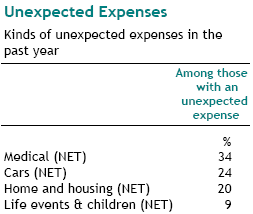
What caught my eye was the section on unexpected expenses. About a third of adults say they had an unexpected expense in the past year that “seriously set them back financially.” Among this group, here is the breakdown of the top 4 most common expenses:

altext

By these numbers, the average American this year will have:

  • 11% chance of having a significant unexpected medical bill, and a
  • 8% chance of having a significant unexpected car expense, and a
  • 7% chance of having a significant unexpected housing-related expense

My conclusion? Expect the unexpected. It’s only February and we’ve already had unexpected family-related expenses in 2007. I think an allowance for such occurrences should be included in our budgets specifically, and not just reserved as a reason to use the emergency fund.

Do you budget for the unexpected? Or do you just let it happen and deal with the ups and downs?

Why Your CLUE Report Is Important

Follow-up: Not being a homeowner, I may not have adequately expressed the importance of knowing what’s on your free CLUE report. For a better explanation, see this MSN article titled “Insurers keep a secret history of your home“. If they decide your house is high-risk, even if you don’t file a claim, finding homeowners insurance may become next to impossible. This is also something to be wary of when buying a house. Link via Consumerist.

Don’t tell your insurer about problems unless you’re sure you’ll file a claim. This last piece of advice is unfortunate, because insurers and insurance agents can be a decent source of counsel on whether it’s worth filing a claim. Since any damage you report could get passed on to the CLUE database, however, it’s smart now to err on the side of caution.