Best Interest Rates on Cash Roundup – May 2024

Here’s my monthly roundup of the best interest rates on cash as of May 2024, roughly sorted from shortest to longest maturities. There are lesser-known opportunities available to individual investors, often earning you a lot more money while keeping the same level of safety by moving to another FDIC-insured bank or NCUA-insured credit union. Check out my Ultimate Rate-Chaser Calculator to see how much extra interest you could earn from switching. Rates listed are available to everyone nationwide. Rates checked as of 5/8/2024.

TL;DR: Mostly only minor changes since last month. Still 5%+ savings accounts and short-term CDs, with long-term CD rates holding roughly steady since last month. Compare against Treasury bills and bonds at every maturity, taking into account state tax exemption.

Fintech accounts
Available only to individual investors, fintech companies often pay higher-than-market rates in order to achieve fast short-term growth (often using venture capital). “Fintech” is usually a software layer on top of a partner bank’s FDIC insurance.

  • 5.26% APY ($1 minimum). Raisin lets you switch between different FDIC-insured banks and NCUA-insured credit unions easily without opening a new account every time, and their liquid savings rates currently top out at 5.26% APY across multiple banks. See my Raisin review for details. Raisin does not charge depositors a fee for the service.
  • 5.36% APY (before fees). MaxMyInterest is another service that allows you to access and switch between different FDIC-insured banks. You can view their current banks and APYs here. As of 5/8/24, the highest rate is from Customers Bank at 5.36% APY. However, note that they charge a membership fee of 0.04% per quarter, or 0.16% per year (subject to $20 minimum per quarter, or $80 per year). That means if you have a $10,000 balance, then $80 a year = 0.80% per year. This service is meant for those with larger balances. You are allowed to cancel the service and keep the bank accounts, but then you may lose their specially-negotiated rates and cannot switch between banks anymore.

High-yield savings accounts
Since the huge megabanks STILL pay essentially no interest, everyone should have a separate, no-fee online savings account to piggy-back onto your existing checking account. The interest rates on savings accounts can drop at any time, so I list the top rates as well as competitive rates from banks with a history of competitive rates and solid user experience. Some banks will bait you with a temporary top rate and then lower the rates in the hopes that you are too lazy to leave.

  • The top rate at the moment is at My Banking Direct at 5.55% APY . Poppy at 5.50% APY (3-month rate guarantee). I have no personal experience with them, but they are the top rates at the moment. CIT Platinum Savings at 5.00% APY with $5,000+ balance.
  • SoFi Bank is at 4.60% APY + up to $325 new account bonus with direct deposit. You must maintain a direct deposit of any amount each month for the higher APY. SoFi has historically competitive rates and full banking features. See details at $25 + $300 SoFi Money new account and deposit bonus.
  • Here is a limited survey of high-yield savings accounts. They aren’t the top rates, but a group that have historically kept it relatively competitive such that I like to track their history. Sad to see Ally Bank falling even further behind.

Short-term guaranteed rates (1 year and under)
A common question is what to do with a big pile of cash that you’re waiting to deploy shortly (plan to buy a house soon, just sold your house, just sold your business, legal settlement, inheritance). My usual advice is to keep things simple and take your time. If not a savings account, then put it in a flexible short-term CD under the FDIC limits until you have a plan.

  • No Penalty CDs offer a fixed interest rate that can never go down, but you can still take out your money (once) without any fees if you want to use it elsewhere. Raisin has a 9-month No Penalty CD at 5.10% APY with $1 minimum deposit and 30-day minimum hold time. Marcus has a 13-month No Penalty CD at 4.70% APY with a $500 minimum deposit. Also available at 7- and 11-months. Consider opening multiple CDs in smaller increments for more flexibility.
  • NexBank has a 1-year certificate at 5.40% APY ($25,000 min). There is a 180-day interest penalty if you withdraw your CD funds before maturity.
  • CIBC Agility Online has a 13-month CD at 5.36% APY ($1,000 min). Reasonable 30-day penalty if you withdraw your CD funds before maturity.

Money market mutual funds + Ultra-short bond ETFs
Many brokerage firms that pay out very little interest on their default cash sweep funds (and keep the difference for themselves). Note: Money market mutual funds are highly-regulated, but ultimately not FDIC-insured, so I would still stick with highly reputable firms. I am including a few ultra-short bond ETFs as they may be your best cash alternative in a brokerage account, but they may experience losses.

  • Vanguard Federal Money Market Fund is the default sweep option for Vanguard brokerage accounts, which has an SEC yield of 5.26% (changes daily, but also works out to a compound yield of 5.39%, which is better for comparing against APY). Odds are this is much higher than your own broker’s default cash sweep interest rate.
  • The PIMCO Enhanced Short Maturity Active Bond ETF (MINT) has a 5.33% SEC yield and the iShares Short Maturity Bond ETF (NEAR) has a 5.24% SEC yield while holding a portfolio of investment-grade bonds with an average duration of ~6 months.

Treasury Bills and Ultra-short Treasury ETFs
Another option is to buy individual Treasury bills which come in a variety of maturities from 4-weeks to 52-weeks and are fully backed by the US government. You can also invest in ETFs that hold a rotating basket of short-term Treasury Bills for you, while charging a small management fee for doing so. T-bill interest is exempt from state and local income taxes, which can make a significant difference in your effective yield.

  • You can build your own T-Bill ladder at TreasuryDirect.gov or via a brokerage account with a bond desk like Vanguard and Fidelity. Here are the current Treasury Bill rates. As of 5/7/24, a new 4-week T-Bill had the equivalent of 5.37% annualized interest and a 52-week T-Bill had the equivalent of 5.15% annualized interest.
  • The iShares 0-3 Month Treasury Bond ETF (SGOV) has a 5.27% SEC yield and effective duration of 0.10 years. SPDR Bloomberg Barclays 1-3 Month T-Bill ETF (BIL) has a 5.21% SEC yield and effective duration of 0.08 years.

US Savings Bonds
Series I Savings Bonds offer rates that are linked to inflation and backed by the US government. You must hold them for at least a year. If you redeem them within 5 years there is a penalty of the last 3 months of interest. The annual purchase limit for electronic I bonds is $10,000 per Social Security Number, available online at TreasuryDirect.gov. You can also buy an additional $5,000 in paper I bonds using your tax refund with IRS Form 8888.

  • “I Bonds” bought between May 2024 and October 2024 will earn a 4.28% rate for the first six months. The rate of the subsequent 6-month period will be based on inflation again. More on Savings Bonds here.
  • In mid-October 2024, the CPI will be announced and you will have a short period where you will have a very close estimate of the rate for the next 12 months. I will have another post up at that time.

Rewards checking accounts
These unique checking accounts pay above-average interest rates, but with unique risks. You have to jump through certain hoops which usually involve 10+ debit card purchases each cycle, a certain number of ACH/direct deposits, and/or a certain number of logins per month. If you make a mistake (or they judge that you did) you risk earning zero interest for that month. Some folks don’t mind the extra work and attention required, while others would rather not bother. Rates can also drop suddenly, leaving a “bait-and-switch” feeling.

  • OnPath Federal Credit Union pays 7.00% APY on up to $10,000 if you make 15 debit card purchases, opt into online statements, and login to online or mobile banking once per statement cycle. Anyone can join this credit union via $5 membership fee to join partner organization. You can also get a $100 Visa Reward card when you open a new account and make qualifying transactions.
  • Credit Union of New Jersey pays 6.00% APY on up to $25,000 if you make 15 debit card purchases, opt into online statements, and make at least 1 direct deposit, online bill payment, or automatic payment (ACH) per statement cycle. Anyone can join this credit union via $5 membership fee to join partner organization.
  • Andrews Federal Credit Union pays 6.00% APY on up to $25,000 if you make 15 debit card purchases, opt into online statements, and make at least 1 direct deposit or ACH transaction per statement cycle. Anyone can join this credit union via partner organization.
  • Pelican State Credit Union pays 6.05% APY on up to $20,000 if you make 15 debit card purchases, opt into online statements, log into your account at least once, and make at least 1 direct deposit, online bill payment, or automatic payment (ACH) per statement cycle. Anyone can join this credit union via partner organization membership.
  • Orion Federal Credit Union pays 6.00% APY on up to $10,000 if you make electronic deposits of $500+ each month (ACH transfers count) and spend $500+ on your Orion debit or credit card each month. Anyone can join this credit union via $10 membership fee to partner organization membership.
  • All America/Redneck Bank pays 5.15% APY on up to $15,000 if you make 10 debit card purchases each monthly cycle with online statements.
  • Find a locally-restricted rewards checking account at DepositAccounts.

Certificates of deposit (greater than 1 year)
CDs offer higher rates, but come with an early withdrawal penalty. By finding a bank CD with a reasonable early withdrawal penalty, you can enjoy higher rates but maintain access in a true emergency. Alternatively, consider building a CD ladder of different maturity lengths (ex. 1/2/3/4/5-years) such that you have access to part of the ladder each year, but your blended interest rate is higher than a savings account. When one CD matures, use that money to buy another 5-year CD to keep the ladder going. Some CDs also offer “add-ons” where you can deposit more funds if rates drop.

  • Credit Human has a 59-month CD at 4.70% APY. 48-month at 4.70% APY. 35-month at 4.75% APY. 23-month at 5.30% APY. 1-year at 5.05% APY. $500 minimum. The early withdrawal penalty (EWP) for CD maturities of 36 months or more is 365 days of interest. For CD maturity of 1 year, the EWP is 270 days of interest. This is actually a credit union, but is open nationwide with a American Consumer Council (ACC) membership. Try promo code “consumer” when signing up at ACC for a free membership.
  • First Internet Bank has a 5-year CD at 4.50% APY. 4-year at 4.45% APY. 3-year at 4.61% APY. 2-year at 4.76% APY. 1-year at 5.26% APY. $1,000 minimum. The early withdrawal penalty (EWP) for CD maturities of 2 years or more is 360 days of interest. For CD maturity of 1 year, the EWP is 180 days of interest.
  • BMO Alto has a 5-year CD at 4.50% APY. 4-year at 4.50% APY. 3-year at 4.50% APY. 2-year at 4.65% APY. 1-year at 5.05% APY. No minimum. The early withdrawal penalty (EWP) for CD maturities of 1 year or more is 180 days of interest. For CD maturities of 11 months or less, the EWP is 90 days of interest. Note that they reserve the right to prohibit early withdrawals entirely (!). Online-only subsidiary of BMO Bank.
  • You can buy certificates of deposit via the bond desks of Vanguard and Fidelity. You may need an account to see the rates. These “brokered CDs” offer FDIC insurance and easy laddering, but they don’t come with predictable early withdrawal penalties. Right now, I see a 5-year non-callable CD at 4.60% APY (callable: no, call protection: yes). Be warned that now both Vanguard and Fidelity will list higher rates from callable CDs, which importantly means they can call back your CD if rates drop later.

Longer-term Instruments
I’d use these with caution due to increased interest rate risk (tbh, I don’t use them at all), but I still track them to see the rest of the current yield curve.

  • Willing to lock up your money for 10 years? You can buy long-term certificates of deposit via the bond desks of Vanguard and Fidelity. These “brokered CDs” offer FDIC insurance, but they don’t come with predictable early withdrawal penalties. You might find something that pays more than your other brokerage cash and Treasury options. Right now, I see a 10-year CDs at 4.50% (callable: no, call protection: yes) vs. 4.47% for a 10-year Treasury. Watch out for higher rates from callable CDs where they can call your CD back if interest rates drop.

All rates were checked as of 5/8/2024.

Photo by micheile henderson on Unsplash
Robinhood ACAT Bonus: 1% of Taxable Brokerage Assets Transferred w/ No Cap, 2-Year Hold

Offer is back, new deadline is June 28th. Robinhood has brought back their 1% ACAT Transfer bonus of a flat 1% of the transferred amount with no cap. That means a transfer of $10,000 in asset value from an external brokerage account will earn a $100 bonus, a $100,000 transfer will earn a $1,000 bonus, and a $1,000,000 transfer will earn a $10,000 bonus. The bonus should arrive about 2 weeks after the completed transfer, but note that you must keep the assets there for 2 years otherwise they will claw it back. Here is the full PDF fine print. Here is the online FAQ.

For eligible Robinhood customers who complete an ACATS transfer within the Offer Period, Robinhood will deposit 1% of the net transferred asset value to the customer’s Brokerage Account, subject to a two-year earn-out as discussed below. “Net transferred asset value” is the total value of the initiated ACATS minus the value of any outflows from April 30, 2024 at 12:00:00 AM ET until the ACATS is settled, excluding outflows that led to a chargeback. The Bonus will be provided within approximately two weeks from when the customer’s eligible ACATS transfers are completed. The Offer Period begins April 30, 2024 and ends June 28, 2024; however, Robinhood may change these dates at any time without notice. Transferred assets are eligible if they are initiated during the Offer Period.

As with all similar ACAT transfer offers, you can transfer over your existing stock holdings and the cost basis should also transfer over with no tax consequences. You don’t have to move cash. You just keep your same old shares of Apple or Coca-Cola or S&P 500 index ETFs or whatever at a different broker. If you already wanted to hold cash, you could also own things like Treasury bill ETFs or ultra-short term bond ETFs and earn interest on top of the bonus, but in that case this bonus isn’t that great because you’re only getting 1% spread over two years.

I’ve explored some of my Robinhood concerns during their 3% IRA transfer promotion. Here is some of that same information copy-and-pasted here.

Robinhood doesn’t allow all asset types, so you can’t own mutual funds, individual bonds, and closed-end funds. Robinhood is not a full-featured brokerage firm. Here is the full list of what is and isn’t allowed. They support the following:

  • U.S. exchange-listed stocks and ETFs
  • Options contracts for U.S. Exchange-Listed Stocks and ETFs
  • ADRs for over 650 globally-listed companies

This means that if you want to move your balance over to Robinhood, you will have to sell any mutual funds (or convert them to ETFs), individual bonds, brokered CDs, and so on. I converted my Vanguard mutual funds to ETFs, and it took 1-2 business days.

SIPC insurance limits and excess insurance. Robinhood is a member of the Securities Investor Protection Corporation (SIPC), which steps if a broker fails. Robinhood has also purchased additional excess SIPC insurance on the private market. From the Robinhood site:

Robinhood Financial LLC and Robinhood Securities, LLC are both members of SIPC, which protects securities for customers of its members up to $500,000 (including $250,000 for claims for cash). Explanatory brochure available upon request or at www.sipc.org.

We’ve purchased an additional insurance policy for Robinhood Markets, Inc., Robinhood Financial LLC, and Robinhood Securities, LLC to supplement SIPC protection. The additional insurance becomes available to customers in the event that SIPC limits are exhausted. This additional insurance policy provides protection for securities and cash up to an aggregate of $1 billion, and is limited to a combined return to any customer of $50 million in securities, including $1.9 million in cash. Similar to SIPC protection, this additional insurance doesn’t protect against a loss in the market value of securities.

From SIPC.org::

SIPC protects against the loss of cash and securities – such as stocks and bonds – held by a customer at a financially-troubled SIPC-member brokerage firm. The limit of SIPC protection is $500,000, which includes a $250,000 limit for cash.

Is SIPC a U.S. Government Agency?
No. SIPC is not an agency or establishment of the United States Government. SIPC is a non-profit membership corporation created under the Securities Investor Protection Act.

My brokerage firm has excess SIPC insurance. How does that work?
Excess SIPC insurance is insurance provided by a private insurer and not by SIPC. The insurance is intended to protect brokerage customers against the risk that customers will not recover all of their cash and securities in the proceeding under the Securities Investor Protection Act (SIPA). Under many of these policies, customer eligibility for recovery is not determined until after the SIPA liquidation of the customer’s brokerage firm has concluded and the amount of the customer’s recovery in that proceeding has been established.

Some people have concerns that Robinhood is a smaller company with a history of questionable judgment and violating securities regulations. Robinhood holds the current record for highest FINRA fine ever. As a result, you may choose to limit the amount transferred to Robinhood to under $500,000 in assets (and $250,000 cash) per eligible account type. Here are the different “capacities”. For example, you could have an individual taxable account, a traditional IRA, and a Roth IRA at Robinhood and each one would have $500,000 in coverage. I will be staying under these limits as well, but my IRA balance simply isn’t that big anyway.

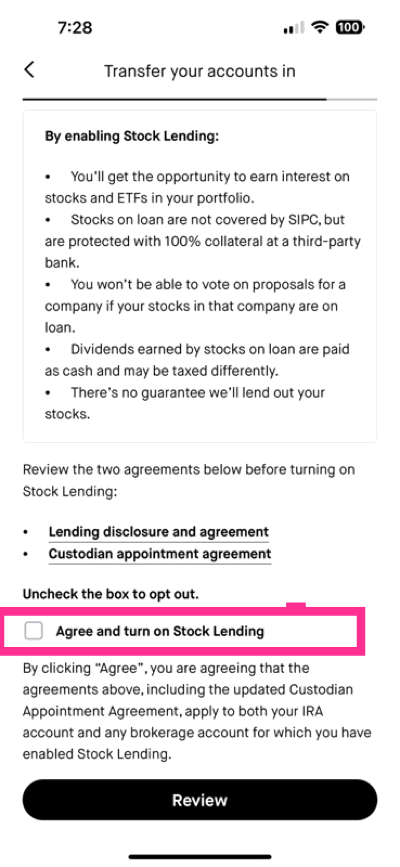
Note that if you opt-in (or don’t opt-out) to Stock Lending during the account transfer or account opening process, any securities that are loaned out are no longer protected by the SIPC. This is usually offset by a promise of 100% collateral, but that assumes trust that Robinhood will post that collateral. See Gamestop short squeeze for a very recent example of Robinhood… not posting enough collateral. Therefore, I also don’t recommend Stock Lending with Robinhood.

Robinhood limitations on beneficiaries. Robinhood only allows a primary beneficiary who is an adult. That means no trusts, no minors, and no “per stirpes” instructions. See article.

Whom can I designate as my beneficiary?
To be eligible as a TOD or IRA beneficiary, the individual must be a person who is at least 18 years old, a US Citizen, or otherwise be legally permitted to open a Robinhood account.

Robinhood will also reimburse your transfer fees up to $75 if you transfer at least $7,500 worth of assets. After the transfer is completed, you must contact then via the live chat function and they will reimburse you after you upload a screenshot of the fee charged.

When you transfer out eventually, Robinhood does charge a $100 Outgoing ACAT fee. Ideally, there will be another broker to reimburse that fee in the future, but who knows. Here is their full fee schedule [pdf].

Customer service tips. Robinhood does not have a traditional phone number to reach customer service. You have to go the help section, search for a topic, and then look for the “Contact Us” button at the bottom of the page (presumably after you have read the canned answer and still need help). Then you can either have a Live Chat or request a Callback where they will call you back on the phone at a later time.

Security and Privacy tips. To access these settings on the iPhone app, click on the head/body icon on the bottom right, then the three lines icon on the top left, and then “Security and privacy”. On the plus side, Robinhood supports a variety of 2FA options: SMS, Device passkeys, and Authenticator apps. Scroll down further and you can also opt out of their data sharing.

Bottom line. Two years is a longer hold period than some other broker offers, but 1% of assets is still pretty solid overall and worth considering for transferring some buy-and-hold index funds where you don’t want to move them again for a while. (For example, you might get 0.4% of assets elsewhere, but also only have to keep it there for 90 days and be free to chase another bonus afterward.) Some people may also choose to consolidate their taxable brokerage accounts at Robinhood if they already took advantage of the 3% IRA offer. The deadline for this revived offer is currently June 28th, 2024. The bonus value will most likely be reported as taxable income on a 1099-INT as interest earned, but may also end up as 1099-MISC income. (I am reminded again how good the 3% IRA offer was, as the bonus was a non-taxable increase in your Roth IRA balance as compared to this 1% offer that is at best taxable ordinary income.)

Evergreen Money “Liquid Treasuries” Review: Checking Account + T-Bill Combo, $250 Bonus

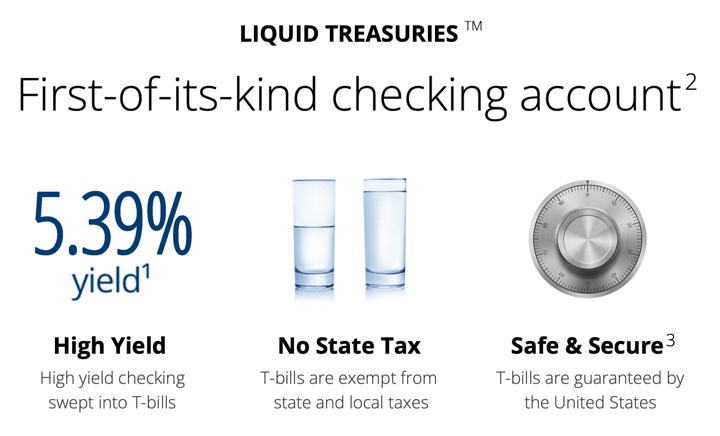
Evergreen Money is a new fintech startup focused on tax-smart money management by Bill Harris, previously CEO of Intuit, PayPal, and Personal Capital (now Empower). Here a short video clip of his Bloomberg TV appearance. They are starting out with their “Liquid Treasuries” product, which combines a bank account and Treasury Bills using two different accounts:

  • Traditional checking account through Coastal Community Bank, member FDIC. You get the usual fintech bank stuff: ATM/debit card, ACH routing/account numbers. Currently pays 5.00% APY as of 4/1/2024. As with all checking accounts, the APY may change at any time.
  • US Treasury Bills held inside a brokerage account through Jiko Securities, Inc, member SIPC. US Treasury Bill are fully backed by the US government. Current yield for a 4-week T-Bill is ~5.48% and the interest is exempt from state and local taxes.
  • There is a 0.03% monthly fee for their Treasury Bill service, which works out to a 0.36% annual fee.

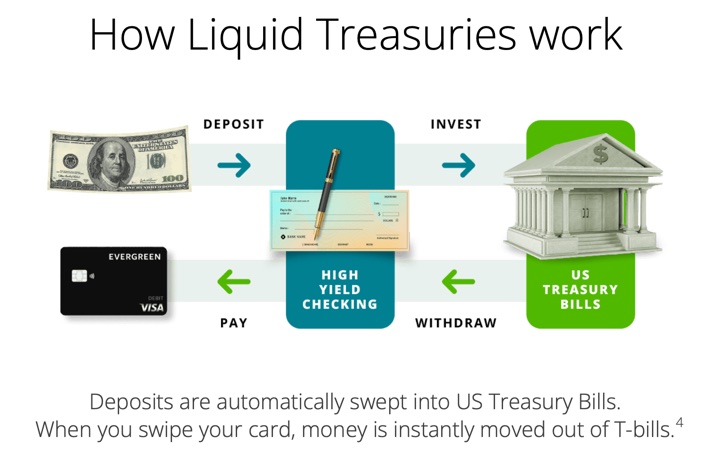
Here’s a visualization of how this works:

At a very high level, this is already how my Fidelity Brokerage and Cash Management Account works. Their money market mutual fund holds mostly Treasury bills and repos, which are also very safe, and then when I need money to pay for stuff, they sell some of those securities and my kids have new goggles to lose. Fidelity also charges a similar 42 basis points (0.42% annual expense ratio) for SPAXX.

However, I can see the appeal here because the Treasury Bill interest would be “pure” and 100% exempt from state and local income taxes. Very often, money market fund interest (like SPAXX) is not 100% exempt from state taxes as it holds a lot of stuff that isn’t T-Bills, and even something like the Fidelity Treasury Only Money Market Fund (FDLXX) that I manually buy was only about 90% exempt in 2023.

There is currently a $10,000 minimum to open account at Evergreen Money. T-Bills are sold in $100 minimum increments, so if you kept at least $10,000 there (which they technically require), they could probably get pretty close to maintaining 99%+ of assets in T-Bills.

You could also create your own ladder of T-Bills, either directly at TreasuryDirect.gov or via a broker with an auto-roll feature like Fidelity, but that is still some degree of work to manage. If you have significant cash assets, this might probably be worth saving the expense ratio, whereas 0.36% on $10,000 is $3 a month ($36 a year).

$250 New Client Bonus. Currently, if you open and fund with the $10,000 minimum buy 6/30/24, they will give you a $250 bonus. There doesn’t appear to be a minimum hold period, but it will take 15 days for the credit to post and I’m not sure if they will close your account if you go below $10,000. Their Rates and Fees page lists a “Minimum Relationship Balance Requirement: $10,000 (We may waive this at our discretion)”. The fine print:

To qualify for the $250 New Client Bonus, you must open a new Liquid Treasuries account and fund it with deposit(s) of at least $10,000 between 12:00 AM Eastern Time on April 11, 2024 and 11:59 PM Eastern Time and June 30,2024. The full $10,000 must be cleared and posted to your account prior to 11:59 Eastern Time on June 30, 2024 to be eligible for the bonus. The one-time bonus will appear as a credit to your account within 15 calendar days from the date the qualifying deposit has cleared and posted. Evergreen employees and paid testers are not eligible. You are responsible for any taxes owed. This offer is non-transferable and Evergreen reserves the right to change or cancel this offer at any time.

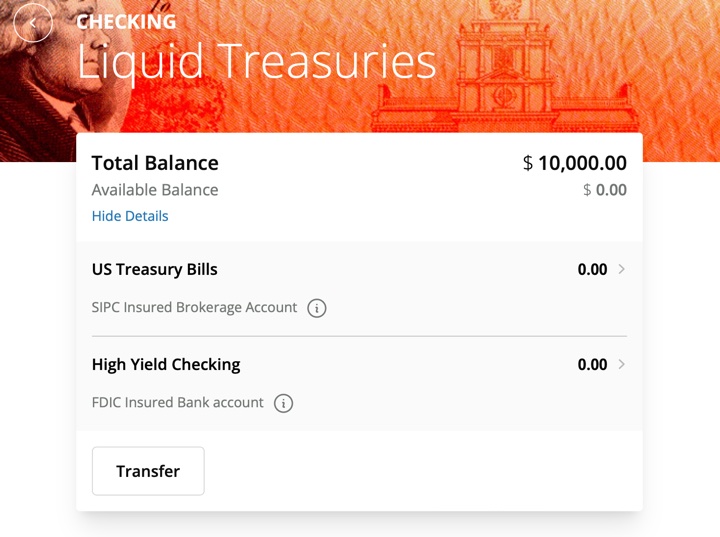
You know I can’t help myself with these things, so I decided to open an account and try it out. Expect the usual fintech ID verification process where you have to take a picture of your ID with your smartphone. I also had to send in a bank/credit card/utility bill with my name and address on it. Here’s a screenshot of my account (funds are still in-transit).

Despite the fact that the EvergreenMoney.com website has a very generic feel, after doing my own due diligence, they do appear to be a legit company trying something different (although Jiko has done the T-Bill thing with the Public brokerage app). I do wonder why Jiko is licensing out their technology when they themselves offer a very similar product called Spendable T-Bills. I am guessing Evergreen Money has the marketing budget, as they are on a hiring binge with many job openings on LinkedIn in Miami, Florida. I wonder what features they will add next. Thanks to reader Larry for the tip.

SoFi Invest ACAT Transfer Bonus Promotion: $100 to $10,000, Both New and Existing Accounts

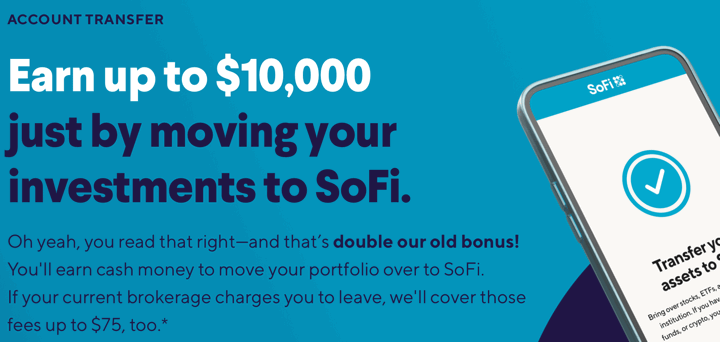
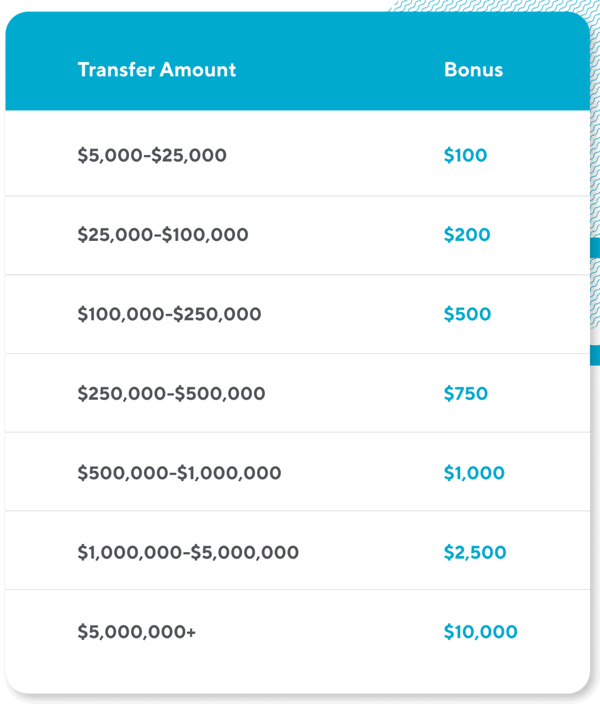
SoFi Invest is offering an increased ACAT transfer bonus up to $10,000 for transferring in new assets. Some of the tiers are double what they used to be, but the minimum holding period was also increased. Valid for both taxable brokerage accounts and IRAs (Traditional, Roth, or SEP).

$25 Referral bonus. As this promo includes existing accounts, you should consider grabbing this new account referral bonus first, worth $25 of stock with an initial deposit of only $10.

Get $25 worth of your favorite stock to start building your portfolio when you fund your SoFi Active Invest account** with at least $10*.

New SoFi Invest accounts (both new and existing accounts are eligible)

  • $100 bonus with $5,000 to $19,999 in new assets
  • $200 bonus with $20,000 to $99,999 in new assets
  • $500 bonus with $100,000 to $249,999 in new assets
  • $750 bonus with $250,000 to $499,999 in new assets
  • $1,000 bonus with $500,000 to $999,999 in new assets
  • $2,500 bonus with $1,000,000+ to $1,999,999 in new assets
  • $10,000 bonus with $5,000,000+ in new assets

Assets are now required to remain in your SoFi account for 2 years. This used to be only for 180 days.

Earn a bonus (as described in the chart below) when you transfer investments from another brokerage firm into a taxable SoFi Invest Active brokerage or Active retirement account (Traditional, Roth, or SEP IRA). Bonus amounts are based on the total net dollar amount (incoming transfers less outgoing transfers) of settled transfers from another brokerage to an individual SoFi Invest account during each calendar month. Bonuses will be paid within 14 days of the last day of the month in which the transferred assets settled in your SoFi Invest account. Bonuses will be paid into the same account you transferred investments into. Transfers into multiple accounts may not be combined. Assets are required to remain in your SoFi account for 2 years. SoFi reserves the right to recoup up to the bonus amount from any withdrawals that take place prior to the 2 year period. SoFi also reserves the right to change or terminate this promotion at any time without notice. Important Tax Information: The value of the reward you receive may constitute taxable income. SoFi Securities LLC may issue a Form 1099 (or other appropriate form) to you that reflects the value of the reward. Please consult your tax advisor. SoFi Securities LLC and its affiliates and associates do not provide tax advice.

Note that SoFi Invest does NOT accept mutual funds.

We do not accept mutual funds. These funds would need to be liquidated prior to initiating an ACAT with SoFi. Please contact your brokerage firm to complete this action, prior to submitting an ACAT.

In addition, SoFi will cover the outgoing transfer fee charged by your existing broker:

If you transfer a brokerage account with total asset value over $5,000 through the ACAT system, SoFi will reimburse up to $75 of ACAT Fees from your outgoing brokerage firm.

General Transfer Tips

  • Before moving, I would download all your old statements and tax cost basis information to make sure it transfers over correctly.
  • An ACAT transfer can take a week or so to complete, so you won’t be able to make any sell transactions during that time.
  • Consider performing a “partial” ACAT transfer where you only move over specifically designated shares (ex. only all 100 shares of BRKB) if you wish to keep some of your original brokerage account open. I would personally transfer over all shares of any specific ticker, so that the tax cost basis carries over neatly.
  • Compare bonuses across different brokers. Look carefully at the tiers, there may be a sweet spot where the percentages are better.

E-Trade ACAT Transfer Bonus Promotion: $125 to $6,000 for Existing Customers

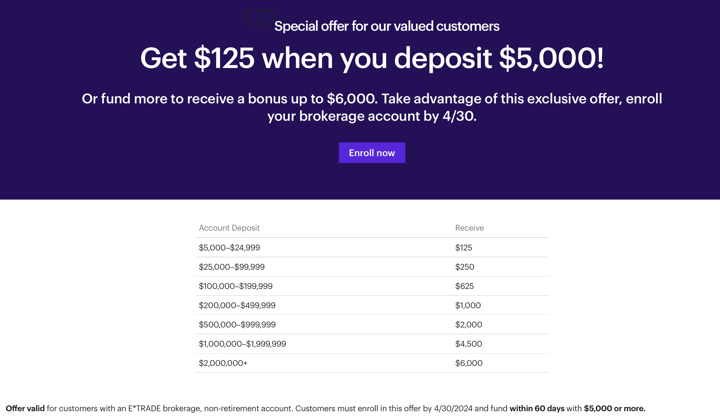
E-Trade is offering an increased transfer offer for existing E-Trade customers of up to $6,000 for transferring in new assets. This specific offer only applies to non-retirement accounts. You must enroll in the offer first after logging into your E-Trade account, fund within 60 days, and keep there for at least 6 months. These tiers are currently better than their offer for new customers.

Existing E-Trade customers (non-retirement taxable accounts only)

  • $125 bonus with $5,000 to $24,999 in new assets
  • $250 bonus with $25,000 to $99,999 in new assets
  • $625 bonus with $100,000 to $199,999 in new assets
  • $1,000 bonus with $200,000 to $499,999 in new assets
  • $2,000 bonus with $500,000 to $999,999 in new assets
  • $4,500 bonus with $1,000,000 to $1,999,999 in new assets
  • $6,000 bonus with $2,000,000+ in new assets

These are relatively good percentages for a more established broker. (Morgan Stanley bought E*Trade in 2020, and is in the Top 10 for assets under management.) Importantly, I don’t see any minimum hold period on the offer page beyond keeping the assets there through the end of the 60-day qualification period after enrollment. (Update: The minimum hold period is 6 months, something but not too bad.)

Overall Brokerage Transfer Tips

  • Many brokers will charge an “Outgoing ACAT fee” of $50 to $100 when you leave them. (Notably, Fidelity and Vanguard do not. Schwab allows free partial transfers.) I recommend contacting your destination broker and asking them to reimburse you for this fee, on top of any bonuses. If you qualify for one of these bonuses, your account is probably big enough for them to consider it. The worst they can say is no. You may have to send them a statement showing the fee.
  • Before moving, I would download all your old statements and tax cost basis information to make sure it transfers over correctly.
  • An ACAT transfer can take a week or so to complete, so you won’t be able to make any sell transactions during that time. As long as you do an in-kind transfer, you’ll just keep the same shares of the same securities as before.
  • Consider performing a “partial” ACAT transfer where you only move over specifically designated shares (ex. only all 455 shares of BRKB) if you wish to keep some of your original brokerage account open. I would personally transfer over all shares of any specific ticker, so that the tax cost basis carries over neatly.
  • Compare bonuses across different brokers. Look carefully at the tiers, there may be a sweet spot where the percentages are better.

Robinhood Gold 2% Match Review: More Details on IRA Transfers and 401k Rollovers

Update January 2025: This promo is back, but at 2% of asset transferred instead of the old 3%. Still a good deal, and many of the details below may be useful.

Update May 2024: This promo is now over. I ended up moving over my spouse’s IRA as well, for another ~$8,000 on ~$300,000 transferred. Total is about $16,000 in bonuses for ~$600,000 transferred.

Update 4/24/24: At some point within the last week, Robinhood has changed their language to say that if as long as you initiate your IRA transfer by 4/30 as a Gold member, you will receive the 3% match.

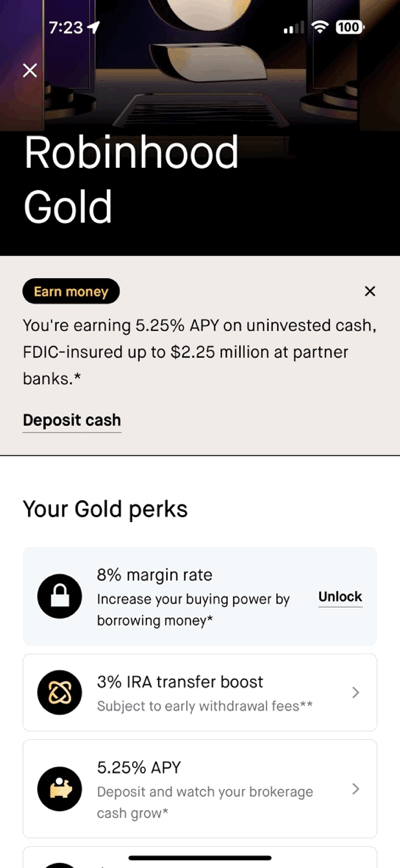
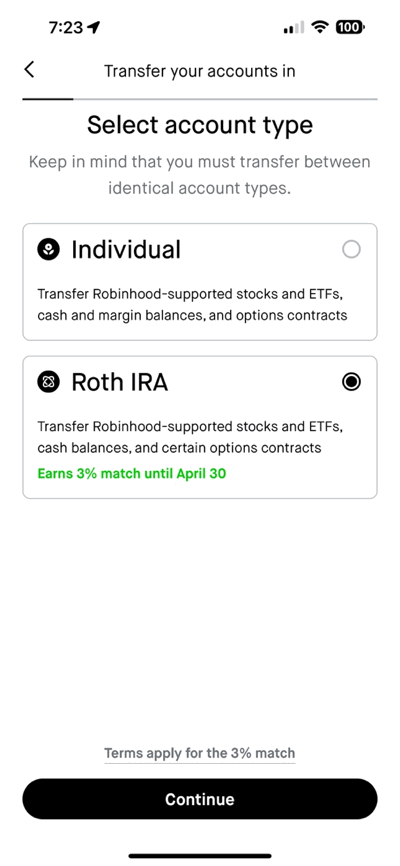
Update: My transfer is complete after 3 business days. $7,885 bonus posted. Robinhood offers an improved 3% match on IRA contributions if you subscribe to their Gold membership, which costs $5 a month. Through 4/30/24, you can also get a 3% match on IRA transfers and 401k/403b/457/401a rollovers. Please start with my initial 3% IRA Match overview, the Robinhood FAQ, and Robinhood Terms & Conditions [pdf]. After doing hours of additional research, this is a follow-up post with a lot of details for other folks that also like to cover all the bases.

I’m have just completed my own transfer, and here’s the full walkthrough:

  • Open a Robinhood brokerage account (done years ago) and put some money inside. If you haven’t opened one before, here is my referral link. It is overwhelmingly likely you’ll only get $5 of stock (as will I), but there is a very tiny chance you’ll get $200.
  • Signed up for Robinhood Gold (first 30-days free, then $5 or $6.99/month). It is important you do this first, before the transfer.
  • Opened a Roth IRA account on 4/10 (leave empty). I declined Securities Lending, as it removes SIPC protection.
  • Requested a transfer from Vanguard Roth IRA on 4/11 (all Vanguard ETFs inside).
  • Received email “Roth IRA account transfer request has been accepted’ on 4/15.
  • Received email “Good news! Your Roth IRA account transfer was completed” very late 4/16 (technically 4/17). So it took 3-4 business days, faster than the estimated 5-7 business day.
  • Robinhood credited the 3% immediately upfront (~$7,885). To keep it, I need to keep the transferred balance + bonus amount in the IRA for 5 years. I also need to keep paying for Robinhood Gold for a full year past the bonus paid date. I plan to turn on automatic dividend reinvestment and not touch it for 5 years.
  • I don’t plan on making future IRA contributions into Robinhood, as I don’t want to keep my IRA there past 5 years. (Let’s say you put in $100,000 in Year 1 and then $7,000 in Year 2, Year 3, Year 4, Year 5. If you attempt to take out any amount at all in Year 6, how can you designate that money as part of the “old” $100,000 and not any of the more recent $7,000 contributions? It would just seem like you’re taking out part of the $7,000 contribution from Year 5 and thus lose that match, right?)

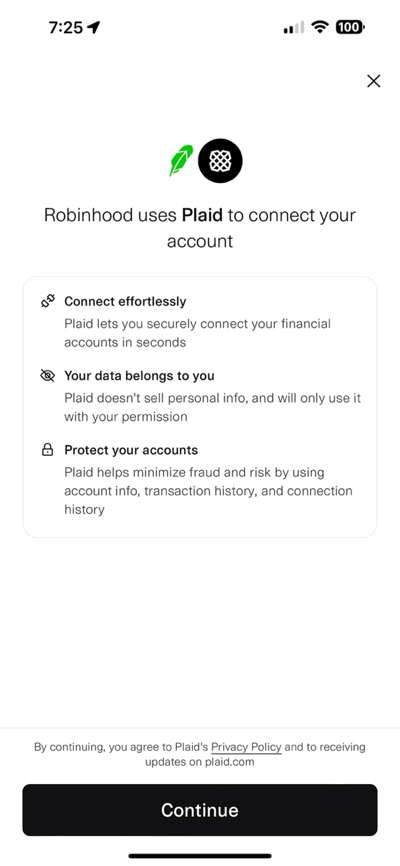
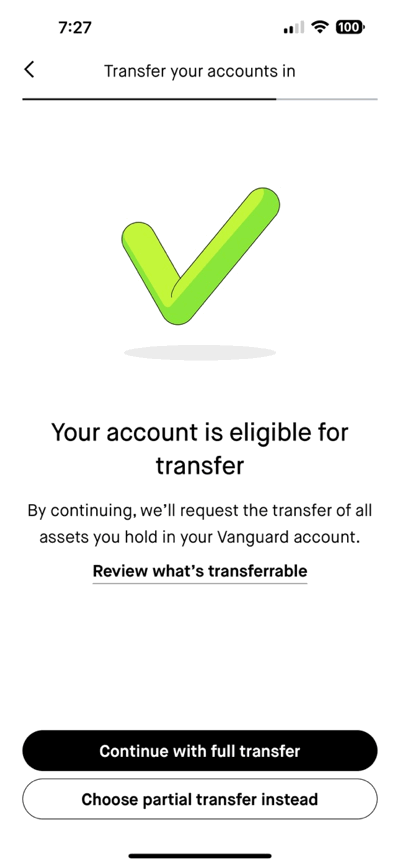
Here are some screenshots from the process:

Robinhood doesn’t allow all asset types, so you can’t own mutual funds, individual bonds, and closed-end funds. Robinhood is not a full-featured brokerage firm. Here is the full list of what is and isn’t allowed. They support the following:

  • U.S. exchange-listed stocks and ETFs
  • Options contracts for U.S. Exchange-Listed Stocks and ETFs
  • ADRs for over 650 globally-listed companies

This means that if you want to move your balance over to Robinhood, you will have to sell any mutual funds (or convert them to ETFs), individual bonds, brokered CDs, and so on. I converted my Vanguard mutual funds to ETFs, and it took 1-2 business days.

SIPC insurance limits and excess insurance. Robinhood is a member of the Securities Investor Protection Corporation (SIPC), which steps if a broker fails. Robinhood has also purchased additional excess SIPC insurance on the private market. From the Robinhood site:

Robinhood Financial LLC and Robinhood Securities, LLC are both members of SIPC, which protects securities for customers of its members up to $500,000 (including $250,000 for claims for cash). Explanatory brochure available upon request or at www.sipc.org.

We’ve purchased an additional insurance policy for Robinhood Markets, Inc., Robinhood Financial LLC, and Robinhood Securities, LLC to supplement SIPC protection. The additional insurance becomes available to customers in the event that SIPC limits are exhausted. This additional insurance policy provides protection for securities and cash up to an aggregate of $1 billion, and is limited to a combined return to any customer of $50 million in securities, including $1.9 million in cash. Similar to SIPC protection, this additional insurance doesn’t protect against a loss in the market value of securities.

From SIPC.org::

SIPC protects against the loss of cash and securities – such as stocks and bonds – held by a customer at a financially-troubled SIPC-member brokerage firm. The limit of SIPC protection is $500,000, which includes a $250,000 limit for cash.

Is SIPC a U.S. Government Agency?
No. SIPC is not an agency or establishment of the United States Government. SIPC is a non-profit membership corporation created under the Securities Investor Protection Act.

My brokerage firm has excess SIPC insurance. How does that work?
Excess SIPC insurance is insurance provided by a private insurer and not by SIPC. The insurance is intended to protect brokerage customers against the risk that customers will not recover all of their cash and securities in the proceeding under the Securities Investor Protection Act (SIPA). Under many of these policies, customer eligibility for recovery is not determined until after the SIPA liquidation of the customer’s brokerage firm has concluded and the amount of the customer’s recovery in that proceeding has been established.

Some people have concerns that Robinhood is a smaller company with a history of questionable judgment and violating securities regulations. Robinhood holds the current record for highest FINRA fine ever. As a result, you may choose to limit the amount transferred to Robinhood to under $500,000 in assets (and $250,000 cash) per eligible account type. Here are the different “capacities”. For example, you could have an individual taxable account, a traditional IRA, and a Roth IRA at Robinhood and each one would have $500,000 in coverage. I will be staying under these limits as well, but my IRA balance simply isn’t that big anyway.

Note that if you opt-in (or don’t opt-out) to Stock Lending during the account transfer or account opening process, any securities that are loaned out are no longer protected by the SIPC. This is usually offset by a promise of 100% collateral, but that assumes trust that Robinhood will post that collateral. See Gamestop short squeeze for a very recent example of Robinhood… not posting enough collateral. Therefore, I also don’t recommend Stock Lending with Robinhood.

Robinhood limitations on beneficiaries. Robinhood only allows a primary beneficiary who is an adult. That means no trusts, no minors, and no “per stirpes” instructions. See article.

Whom can I designate as my beneficiary?
To be eligible as a TOD or IRA beneficiary, the individual must be a person who is at least 18 years old, a US Citizen, or otherwise be legally permitted to open a Robinhood account.

The Robinhood Gold IRA Deposit Match counts as interest earned inside your IRA. From the official Terms and Conditions:

Robinhood processes and treats the Robinhood Gold IRA Deposit Match as interest earned by the IRA account for tax reporting purposes. The interest amount is based on a percentage of contributions made into the IRA Account. The interest earned by the IRA account will not be subject to, or impact, the maximum annual dollar contribution limit or the maximum annual deductible amount. Please note that the Robinhood Gold IRA Deposit Match may be taxable income for conversions of a non-deductible IRA contribution to a Roth IRA. Robinhood does not provide tax advice. You are encouraged to consult with your tax professional about appropriate tax reporting and treatment relating to this bonus award and the deposit of the bonus award in your account. Any taxes resulting from the bonus award are your responsibility.

From the FAQ:

Does the IRA match count toward my annual IRA contribution limit?
No. The IRA match counts as interest income in your IRA and doesn’t count toward your annual IRA contribution limit.

How is the IRA match treated for tax reporting purposes?
The IRA match is treated as interest income in your IRA. We won’t deliver a 1099-INT due to the tax status of IRAs.

This important factor makes the effective value higher than the usual cash bonus that is taxable income. The amount gets to keep growing inside your Roth IRA, tax-free.

Robinhood will also reimburse your transfer fees up to $75 if you transfer at least $7,500 worth of assets. After the transfer is completed, you must contact then via the live chat function and they will reimburse you after you upload a screenshot of the fee charged.

When you transfer out eventually, Robinhood does charge a $100 Outgoing ACAT fee. Ideally, there will be another broker to reimburse that fee in the future, but who knows. Here is their full fee schedule [pdf].

Customer service tips. Robinhood does not have a traditional phone number to reach customer service. You have to go the help section, search for a topic, and then look for the “Contact Us” button at the bottom of the page (presumably after you have read the canned answer and still need help). Then you can either have a Live Chat or request a Callback where they will call you back on the phone at a later time.

Security and Privacy tips. To access these settings on the iPhone app, click on the head/body icon on the bottom right, then the three lines icon on the top left, and then “Security and privacy”. On the plus side, Robinhood supports a variety of 2FA options: SMS, Device passkeys, and Authenticator apps. Scroll down further and you can also opt out of their data sharing.

The deadline is April 30th, and the terms state the transfer has to be “initiated and completed” by that date. As of right now, there’s still a decent buffer as it takes about a week for most IRA transfers. For those with large IRAs, this can be a very significant bonus. You may have reservations about moving your assets to Robinhood, which is certainly understandable. I hope this helps you make a more informed decision for your own situation.

Walmart Weighted Groceries Class Action Settlement

There is a new class action settlement involving Walmart and weighted groceries. The pertinent details are below. My standard recommendation applies – If you are affected and choose to participate, file a claim now quickly before you forget, and then… forget. That way you are pleasantly surprised if and when any money eventually arrives.

  • Who is eligible? Anyone who purchased weighted meat or bagged citrus at a Walmart in the US and Puerto Rico between 10/19/2018 and 1/19/2024.
  • File a claim here: Official Settlement website. Deadline to file is 6/5/24.
  • Read more details here: NY Times article (gift article)
  • With receipts, you can claim up to $500.
  • Without receipts, you can claim between $10 and $25, depending on the number of items you attest to have purchased.

If you’re not interested, that’s fine too. I’ve heard “you’ll only get 17 cents” so many times, and sometimes the payout is indeed quite small, but I’ve also been surprised with hundreds of dollars.

Photo by Moritz Nie on Unsplash

Best Interest Rates on Cash Roundup – April 2024

Here’s my monthly roundup of the best interest rates on cash as of April 2024, roughly sorted from shortest to longest maturities. There are lesser-known opportunities available to individual investors, often earning you a lot more money while keeping the same level of safety by moving to another FDIC-insured bank or NCUA-insured credit union. Check out my Ultimate Rate-Chaser Calculator to see how much extra interest you could earn from switching. Rates listed are available to everyone nationwide. Rates checked as of 4/4/2024.

TL;DR: Future Fed rate cuts appear expected, and some banks are already making rate cuts themselves. Still 5%+ savings accounts and short-term CDs, but long-term CD rates dropped slightly again. Compare against Treasury bills and bonds at every maturity, taking into account state tax exemption.

Fintech accounts
Available only to individual investors, fintech companies often pay higher-than-market rates in order to achieve fast short-term growth (often using venture capital). “Fintech” is usually a software layer on top of a partner bank’s FDIC insurance.

  • 5.26% APY ($1 minimum). Raisin lets you switch between different FDIC-insured banks and NCUA-insured credit unions easily without opening a new account every time, and their liquid savings rates currently top out at 5.26% APY across multiple banks. See my Raisin review for details. Raisin does not charge depositors a fee for the service.
  • 5.36% APY (before fees). MaxMyInterest is another service that allows you to access and switch between different FDIC-insured banks. You can view their current banks and APYs here. As of 4/4/23, the highest rate is from Customers Bank and BankProv at 5.36% APY. However, note that they charge a membership fee of 0.04% per quarter, or 0.16% per year (subject to $20 minimum per quarter, or $80 per year). That means if you have a $10,000 balance, then $80 a year = 0.80% per year. This service is meant for those with larger balances. You are allowed to cancel the service and keep the bank accounts, but then you may lose their specially-negotiated rates and cannot switch between banks anymore.

High-yield savings accounts
Since the huge megabanks STILL pay essentially no interest, everyone should have a separate, no-fee online savings account to piggy-back onto your existing checking account. The interest rates on savings accounts can drop at any time, so I list the top rates as well as competitive rates from banks with a history of competitive rates and solid user experience. Some banks will bait you with a temporary top rate and then lower the rates in the hopes that you are too lazy to leave.

  • The top rate at the moment is at Poppy Bank at 5.50% APY. BrioDirect at 5.35% APY. I have no personal experience with Poppy or Brio, but they are the top rates at the moment. CIT Platinum Savings at 5.05% APY with $5,000+ balance.
  • SoFi Bank is at 4.60% APY + up to $325 new account bonus with direct deposit. You must maintain a direct deposit of any amount each month for the higher APY. SoFi has historically competitive rates and full banking features. See details at $25 + $300 SoFi Money new account and deposit bonus.
  • Here is a limited survey of high-yield savings accounts. They aren’t the highest current rate, but historically have kept it relatively competitive and I like to track their history. This past month, I have seen some quiet, small, ominous rate drops.

Short-term guaranteed rates (1 year and under)
A common question is what to do with a big pile of cash that you’re waiting to deploy shortly (plan to buy a house soon, just sold your house, just sold your business, legal settlement, inheritance). My usual advice is to keep things simple and take your time. If not a savings account, then put it in a flexible short-term CD under the FDIC limits until you have a plan.

  • No Penalty CDs offer a fixed interest rate that can never go down, but you can still take out your money (once) without any fees if you want to use it elsewhere. Raisin has a 9-month No Penalty CD at 5.10% APY with $1 minimum deposit and 30-day minimum hold time. Marcus has a 13-month No Penalty CD at 4.70% APY with a $500 minimum deposit. Consider opening multiple CDs in smaller increments for more flexibility.
  • CFG Bank has a 1-year certificate at 5.40% APY ($500 min). There is a 180-day interest penalty if you withdraw your CD funds before maturity.
  • CIBC Agility Online has a 13-month CD at 5.36% APY ($1,000 min). Reasonable 30-day penalty if you withdraw your CD funds before maturity.

Money market mutual funds + Ultra-short bond ETFs
Many brokerage firms that pay out very little interest on their default cash sweep funds (and keep the difference for themselves). Note: Money market mutual funds are highly-regulated, but ultimately not FDIC-insured, so I would still stick with highly reputable firms. I am including a few ultra-short bond ETFs as they may be your best cash alternative in a brokerage account, but they may experience losses.

  • Vanguard Federal Money Market Fund is the default sweep option for Vanguard brokerage accounts, which has an SEC yield of 5.28% (changes daily, but also works out to a compound yield of 5.41%, which is better for comparing against APY). Odds are this is much higher than your own broker’s default cash sweep interest rate.
  • The PIMCO Enhanced Short Maturity Active Bond ETF (MINT) has a 5.32% SEC yield and the iShares Short Maturity Bond ETF (NEAR) has a 5.10% SEC yield while holding a portfolio of investment-grade bonds with an average duration of ~6 months.

Treasury Bills and Ultra-short Treasury ETFs
Another option is to buy individual Treasury bills which come in a variety of maturities from 4-weeks to 52-weeks and are fully backed by the US government. You can also invest in ETFs that hold a rotating basket of short-term Treasury Bills for you, while charging a small management fee for doing so. T-bill interest is exempt from state and local income taxes, which can make a significant difference in your effective yield.

  • You can build your own T-Bill ladder at TreasuryDirect.gov or via a brokerage account with a bond desk like Vanguard and Fidelity. Here are the current Treasury Bill rates. As of 4/3/24, a new 4-week T-Bill had the equivalent of 5.36% annualized interest and a 52-week T-Bill had the equivalent of 5.04% annualized interest.
  • The iShares 0-3 Month Treasury Bond ETF (SGOV) has a 5.26% SEC yield and effective duration of 0.10 years. SPDR Bloomberg Barclays 1-3 Month T-Bill ETF (BIL) has a 5.21% SEC yield and effective duration of 0.08 years.

US Savings Bonds
Series I Savings Bonds offer rates that are linked to inflation and backed by the US government. You must hold them for at least a year. If you redeem them within 5 years there is a penalty of the last 3 months of interest. The annual purchase limit for electronic I bonds is $10,000 per Social Security Number, available online at TreasuryDirect.gov. You can also buy an additional $5,000 in paper I bonds using your tax refund with IRS Form 8888.

  • “I Bonds” bought between November 2023 and April 2024 will earn a 5.27% rate for the first six months. The rate of the subsequent 6-month period will be based on inflation again. More on Savings Bonds here.
  • In mid-April 2024, the CPI will be announced and you will have a short period where you will have a very close estimate of the rate for the next 12 months. I will have another post up at that time.

Rewards checking accounts
These unique checking accounts pay above-average interest rates, but with unique risks. You have to jump through certain hoops which usually involve 10+ debit card purchases each cycle, a certain number of ACH/direct deposits, and/or a certain number of logins per month. If you make a mistake (or they judge that you did) you risk earning zero interest for that month. Some folks don’t mind the extra work and attention required, while others would rather not bother. Rates can also drop suddenly, leaving a “bait-and-switch” feeling.

  • OnPath Federal Credit Union pays 7.00% APY on up to $10,000 if you make 15 debit card purchases, opt into online statements, and login to online or mobile banking once per statement cycle. Anyone can join this credit union via $5 membership fee to join partner organization. You can also get a $100 Visa Reward card when you open a new account and make qualifying transactions.
  • Credit Union of New Jersey pays 6.00% APY on up to $25,000 if you make 15 debit card purchases, opt into online statements, and make at least 1 direct deposit, online bill payment, or automatic payment (ACH) per statement cycle. Anyone can join this credit union via $5 membership fee to join partner organization.
  • Andrews Federal Credit Union pays 6.00% APY on up to $25,000 if you make 15 debit card purchases, opt into online statements, and make at least 1 direct deposit or ACH transaction per statement cycle. Anyone can join this credit union via partner organization.
  • Pelican State Credit Union pays 6.05% APY on up to $20,000 if you make 15 debit card purchases, opt into online statements, log into your account at least once, and make at least 1 direct deposit, online bill payment, or automatic payment (ACH) per statement cycle. Anyone can join this credit union via partner organization membership.
  • Orion Federal Credit Union pays 6.00% APY on up to $10,000 if you make electronic deposits of $500+ each month (ACH transfers count) and spend $500+ on your Orion debit or credit card each month. Anyone can join this credit union via $10 membership fee to partner organization membership.
  • All America/Redneck Bank pays 5.15% APY on up to $15,000 if you make 10 debit card purchases each monthly cycle with online statements.
  • Find a locally-restricted rewards checking account at DepositAccounts.

Certificates of deposit (greater than 1 year)
CDs offer higher rates, but come with an early withdrawal penalty. By finding a bank CD with a reasonable early withdrawal penalty, you can enjoy higher rates but maintain access in a true emergency. Alternatively, consider building a CD ladder of different maturity lengths (ex. 1/2/3/4/5-years) such that you have access to part of the ladder each year, but your blended interest rate is higher than a savings account. When one CD matures, use that money to buy another 5-year CD to keep the ladder going. Some CDs also offer “add-ons” where you can deposit more funds if rates drop.

  • First Internet Bank has a 5-year CD at 4.55% APY. 4-year at 4.50% APY. 3-year at 4.66% APY. 2-year at 4.82% APY. 1-year at 5.31% APY. $1,000 minimum. The early withdrawal penalty (EWP) for CD maturities of 2 years or more is 360 days of interest. For CD maturity of 1 year, the EWP is 180 days of interest.
  • BMO Alto has a 5-year CD at 4.50% APY. 4-year at 4.50% APY. 3-year at 4.50% APY. 2-year at 4.65% APY. 1-year at 5.95% APY. No minimum. The early withdrawal penalty (EWP) for CD maturities of 1 year or more is 180 days of interest. For CD maturities of 11 months or less, the EWP is 90 days of interest. Note that they reserve the right to prohibit early withdrawals entirely (!). Online-only subsidiary of BMO Bank.
  • You can buy certificates of deposit via the bond desks of Vanguard and Fidelity. You may need an account to see the rates. These “brokered CDs” offer FDIC insurance and easy laddering, but they don’t come with predictable early withdrawal penalties. Right now, I see a 5-year non-callable CD at 4.30% APY (callable: no, call protection: yes). Be warned that now both Vanguard and Fidelity will list higher rates from callable CDs, which importantly means they can call back your CD if rates drop later.

Longer-term Instruments
I’d use these with caution due to increased interest rate risk (tbh, I don’t use them at all), but I still track them to see the rest of the current yield curve.

  • Willing to lock up your money for 10 years? You can buy long-term certificates of deposit via the bond desks of Vanguard and Fidelity. These “brokered CDs” offer FDIC insurance, but they don’t come with predictable early withdrawal penalties. You might find something that pays more than your other brokerage cash and Treasury options. Right now, I see a 10-year CDs at 4.05% (callable: no, call protection: yes) vs. 4.36% for a 10-year Treasury. Watch out for higher rates from callable CDs where they can call your CD back if interest rates drop.

All rates were checked as of 4/4/2024.

Photo by micheile henderson on Unsplash
Global Entry Changes 10/1/24: Adult Fee up to $120, Children Free w/ Adult

The U.S. Customs and Border Protection (CBP) just announced an upcoming fee change for some of its most popular Trusted Traveler Programs, including Global Entry (which includes TSA PreCheck), NEXUS, and SENTRI. Starting 10/1/24, the application fee for Global Entry will rise to $120 every 5 years, up from $100. NEXUS and SENTRI will also have the same $120 fee. TSA PreCheck on its own is still set to stay at $78, but again Global Entry includes TSA PreCheck.

This is potentially actionable news in a few different ways:

  • It’s a good reminder to use up any of those $100 Global Entry/TSA credits on any credit cards you have now. There are over a dozen cards that offer this credit from all the major issuers like all of the major issuers. I’ve never actually paid for a Global Entry (GE) application fee for any of our five household members, thanks to such credits. The cards will probably eventually increase to match, but why not just get it reimbursed in full for sure. There is usually a 12-month window before expiration when you can renew.
  • If you have kids, you may choose to wait until after 10/1 to apply or renew for Global Entry. As long as the parent or legal guardian is already a Global Entry member OR is applying at the same time, it will become free for the child under 18. A reminder that as long as just the parents have TSA PreCheck, the kids will still get TSA PreCheck line access as well when flying. However, Global Entry does not work that way and so everyone needs their own Global Entry membership to use that special line.
  • Note that the biggest hassle right now is trying to find an interview time to actually complete for your Global Entry application, especially after the pandemic. This depends on the availability where you live. We still have one kid without Global Entry (even though we paid for the application) due to this hurdle. For a while, there were simply zero appointments available. Then we had to eventually schedule the appointment for six months out, and it’s still not until June 2024. Things appear a little better now.

Cummins & Atmus Filtration Odd Lot Tender Opportunity (Final Result: $4,819 Profit)

Final update 3/19/24: Cummins has released the final results of this exchange offer. See original post below for past details, although the opportunity has passed. The final proration factor was ~6.99%. However, those with “odd lots” of 99 shares or less were not subject to proration, which created an opportunity for smaller individual investors.

Here are my stats:

  • Bought 99 shares of CMI @265.86 (2/26) for $26,320.14
  • Tendered all 99 shares, exchanged for 1190.95 shares of ATMU.
  • Received 1190 ATMU shares and $25.24 cash for the partial shares of ATMU (3/19).
  • Sold 1190 shares of ATMU @26.15 and 26.14 for $21,076.68 and $10,037.66, respectively (3/19).

Net profit of $4,819.44. This took a total of 23 calendar days, so that works out to an internal rate of return of 1527.59% 🤑 according to my financial calculator. (At 5% APY, my return over 23 days would be about $80.) The absolute ROI is 4819/26320 = 18.3%. Not bad for less than a month! I hope that it worked out just as well for everyone who chose to participate.

Update 3/15/24: This exchange offer is now expired and the preliminary results have been released. The final exchange ratio was 12.0298, which means 99 CMI shares will be exchanged for 1190.95 ATMU shares. Out of the 5,574,050 shares that will be accepted for tender, 1,006,609 of those shares were from odd lot holders. That’s a relatively high amount, but still less than 20% of the total and odd lot holders won’t be pro-rated. On the other hand, everyone else who held more than 99 shares will be pro-rated down to approximately 6.7% of tendered shares.

ATMU has been seeing a lot of short interest, and may even be experiencing a bit of a “short squeeze” right now. This may be partially due to people hedging their bets on the stock. ATMU stock is up about 17% since this exchange was announced in mid-February. You might have made more money simply buying ATMU at the announcement rather than participating in the exchange! (You could have even made more money letting people borrow those shares to short.) As I said, this is as much an educational opportunity as a profit opportunity. I’ll have to keep an eye out for the ATMU shares showing up in my account. The two choices are to (1) sell all shares immediately, or (2) hold the ATMU shares for a couple months until the short interests and other market pressures subside. I’ll probably do the former, but here is another opinion on the latter.

I have no idea what the value of ATMU will be when the shares arrive (rough guess 0-2 weeks) and when I sell, so I won’t bother to post speculative numbers. I will provide a final update after selling.

Original post from 2/25/24:

Back in May 2023, Cummins (CMI) spun off a company called Atmus Filtration Technologies (ATMU) which makes products for commercial vehicles and equipment (think big rigs, agricultural machines, and yellow construction equipment). Cummins still owns about 80% of ATMU and are trying to complete the split-off via an exchange offer to CMI shareholders: tender $100 of CMI and receive $107.53 of ATMU in return.

Similar to the Johnson & Johnson odd lot tender from last year, this ~7.5% premium is meant to incentivize the deal and make sure it happens successfully, and as a result it may be “oversubscribed” with tenders having to be pro-rated. However, there is an “odd lot” provision in the deal, where if you only have 99 shares of less of CMI and tender them all, you won’t be subject to pro-ration. This is a corner of the market where small individual investors have an advantage that the bigger money can’t access.

Please know upfront that I’m not an expert on this stuff, and there are risks involved. The following two articles and the official informational site explain the various details and risks in much better detail.

From the official site above that tracks the share prices for the exact tender ratio (upper limit not in effect at time of writing):

If the Exchange Offer is oversubscribed and Cummins cannot accept all tenders of Cummins Common Stock at the exchange ratio, then all shares of Cummins Common Stock that are validly tendered will generally be accepted for exchange on a pro rata basis in proportion to the number of shares validly tendered, which is referred to as “proration.” Stockholders who beneficially own “odd-lots” (less than 100 shares) of Cummins Common Stock and who validly tender all of their shares will not be subject to proration. Direct or beneficial holders of 100 or more shares of Cummins Common Stock will be subject to proration.

For each $100 of Cummins Common Stock accepted in the Exchange Offer, you will receive approximately $107.53 of Atmus Common Stock, subject to an upper limit of 13.3965 shares of Atmus Common Stock per share of Cummins Common Stock. The Exchange Offer does not provide for a lower limit or minimum exchange ratio. See “The Exchange Offer — Terms of the Exchange Offer” in the Prospectus. IF THE UPPER LIMIT IS IN EFFECT, YOU MAY RECEIVE LESS THAN $107.53 OF ATMUS COMMON STOCK FOR EACH $100 OF CUMMINS COMMON STOCK THAT YOU TENDER, AND YOU COULD RECEIVE MUCH LESS.

To quickly summarize the potential deal:

  • Buy 99 shares* of CMI at your broker, for an approximate cost of $26,133 (as of market close 2/23, will change daily).
  • Tender ALL your shares through your broker. You can’t own 100+ shares and only tender 99. The deadline is supposed to be March 13, 2024, but some brokers may require your tender instructions earlier than that. (At Fidelity, it is 03/12/2024 7:00 PM ET.) Your broker may have an online form to fill out (look for “Corporation Actions”, or you’ll have to call them).
  • If all goes smoothly (not guaranteed!), then you’ll get ~$28,100 of ATMU approximately 7 business days after the deadline. You can then sell the shares for cash if you are not interested in actually holding the stock as an investment. At the 7.5% premium, the potential profit is ~$1,960. You may get less depending on the relative share prices of CMI and ATMU.
  • * You can buy less than 99 shares for less financial commitment (and less upside), but you have to tender them all.

This is the type of deal that I find both interesting and educational, on top of having a positive expected value. Warren Buffett today wouldn’t bother with this deal, but Warren Buffett age 14 might. This is a calculated gamble, rather than a fixed return. There is risk involved, including either the deal being canceled somehow (you end up with 99 shares of CMI at whatever market price) or the limit ratio being reached and you get less than a 7.5% premium of ATMU shares. This is also an area where a broker with good customer service is useful (I use Fidelity). You should perform your own due diligence.

Disclosure: I ended up deciding to participate and bought 99 shares of CMI after publication of this post (which was on a Sunday night). During mid-day trading on Monday, I bought 99 shares at $265.xx a share. This is not a recommendation to buy.

Axos Bank Cashback Checking $300 Bonus w/ Direct Deposit

Updated with new offer. Axos Bank has a $300 bonus with relatively straightforward requirements using promo code FREEDOM300. You must open a new Cashback Checking account by 7/31/2024 and fund within 30 days of account opening. Set up direct deposit of $1,000+ each calendar month, and that will earn you $100 per month for 3 months ($300 total). Historically, they have been pretty flexible on what is considered direct deposit.

The fine print:

To be eligible to earn all or a portion of the cash incentive as part of the “FREEDOM300″ $300 promotion, an Axos Bank CashBack Checking account that includes the promotional code ” FREEDOM300″ must be opened between November 1, 2023, at 12 a.m. PST and July 31, 2024, at 11:59 p.m. PST. Axos Bank reserves the right to limit each primary account holder to one (1) checking account promotional offer per year, and customers who have held primary ownership of an Axos Bank or Axos Bank for Nationwide checking account at any time in the past 12 months may be disqualified from the “FREEDOM300” offer. Promotional terms and conditions are subject to change or removal without notice. Bonus cash may be taxable and reported on IRS Form 1099-MISC. Consult your tax advisor. After meeting the initial requirements mentioned above, the amount of cash bonus earned will depend on meeting the additional requirements outlined below:

To earn up to a $300 bonus, you must be approved for your new Axos Bank CashBack Checking account, fund it within 30 days of account opening, and have qualifying direct deposits that total at least $1,000.00 each calendar month. A cash bonus of up to $300 can be earned in the following manner during the first four (4) statement cycles. A statement cycle is a calendar month consisting of the days your account was open during that month. A maximum of three (3) payouts of $100 for each calendar month that the CashBack Checking account is receiving the direct deposit requirement, the bonus can be earned during the first four (4) statement cycles, and the bonus will be deposited into your Axos Bank CashBack Checking account within 10 business days following the end of the statement cycle in which the direct deposit requirement was met. Your Axos Bank CashBack Checking account must be open and in good standing at the time the bonus is paid to be eligible to receive the bonus, and your Axos Bank CashBack Checking account must remain open for 120 days, or an early closure fee of up to $300 may apply, equal to the amount of the total bonus earned up to $300.

I’ve done a few Axos Bank bonuses in the past (too recent for me to qualify for this), and the good news is that they do pay out reliably in my experience.

First Tech Credit Union: $300 Rewards Checking Account Bonus

Updated with new bonus details. First Tech Federal Credit Union has a new $300 checking bonus. This new promo is set to run through 6/30/24, but is specifically for their new Reward Checking account that pays up to 5.00% APY (on up to $15,000 balance) if you meet a bunch of different hoops including 20 debit card transactions with $500+ in monthly spend. However, you can still get the $300 without meeting the 5.00% APY requirements. This promo is also valid for existing First Tech Rewards checking account owners who have not set up a direct deposit yet.

Here’s how to make it happen:

1) Open a First Tech Reward Checking account. Already have one? You’re set!
2) Set up a new payroll direct deposit to your First Tech Rewards Checking of $1,000+ per month for a minimum of three months.
3) Earn your $300 bonus!

When I applied for a previous promo, First Tech CU paid the $8 membership fee for the partner organization on my behalf so that I could join the credit union, although they mentioned it might be eventually be reported on 1099-INT. I did not experience a hard credit check, although they did a soft check on Experian.

The monthly requirements for earning the 5.00% APY interest (on up to $15,000 balance) are:

  • 20 card transactions with $500+ in monthly spend.
  • Electronic statements
  • ACH / direct deposit $1,000+ monthly

Offer valid for enrollment between February 26, 2024 and June 30, 2024 for members without an existing direct deposit. Members with existing direct deposits or who are already enrolled in a First Tech direct deposit campaign are not eligible. Participant is defined as 18 years of age or older and the primary account owner on a First Tech Rewards Checking (FTRC) account. Direct deposits are considered new if there has been no direct deposit activity in the Participant’s share accounts on which they are the Primary Owner within the previous 18 months. Membership is required and is subject to approval. Fees could reduce earnings on the account. FTRC accounts must be personal accounts. Fiduciary, trust, business, or organization accounts are not eligible. Participant will be enrolled in the promotion upon receipt of new direct deposit transaction into the FTRC account (“Enrollment”). In order to receive any bonus payout, in addition to satisfying the payout conditions set forth in this disclosure, the Membership Savings account must be in good standing (not in default, closed, inactive, or otherwise not in good standing) during the period of time commencing with Enrollment and ending with the applicable date of payout. Any inquiries or disputes must be received by January 31, 2025.

New Direct Deposit Offer: New direct deposit must occur at least on New Direct Deposit Offer: New direct deposit must occur at least once per calendar month from the Participant’s employer payroll into the First Tech Rewards Checking (FTRC) account of which the Participant is the primary account owner. Direct deposits from a non-employer payroll source do not qualify. The monthly aggregate amount of all qualifying direct deposits must equal to at least $1,000 to earn the $300 bonus. Enrollment is the date of the initial direct deposit transaction. During the period of time commencing with Enrollment and ending 120 calendar days after Enrollment (“Enrollment Period”), at least one direct deposit transaction must occur each calendar month starting with the initial direct deposit transaction. A minimum of three direct deposit transactions must be received during the Enrollment Period. (EXAMPLE: If a member’s initial direct deposit is March 1, 2024, additional required direct deposits must occur at least once in each subsequent calendar month following the month in which the initial direct deposit is made, the last direct deposit must be received by June 29, 2024.) Only the Participant will receive credit for the direct deposits. Any qualifying bonus will be deposited to the Participant’s Membership Savings account the first week following the Enrollment Period. Bonuses will be considered dividends and may be reported on IRS form 1099-INT.