Point.me x American Express Membership Rewards: Free Award Flight Search Tool

American Express has partnered with the Point.me award travel tool to provide free flight searches for the airline loyalty programs that work with American Express Membership Rewards points. The special site is AmEx.Point.me, where you must log into your American Express account.

With point.me for Membership Rewards® points, eligible Card Members have access to a real time reward-flight search engine. POINT.ME makes it easy to see all of the options, and choose the flight that works best for you before transferring Membership Rewards® points to eligible airline loyalty programs through your Membership Rewards® account.

I am hopeful for this new service, as Membership Rewards has a lot of transfer partners but it can be hard to find the best flights across them all. (Bilt Rewards has also partnered with Point.me for free award searches.) The searches can take a while to finish, but hopefully it’s still better than searching manually. The full version of the Point.me website usually costs $12 a month or $129 a year for all airlines (first 3 searches free). There is also a more expensive Concierge service where a human expert will handle everything for $200/person.

Loyalty programs have been around for decades, especially in the airline industry. However, booking award travel can feel cumbersome, like you’re jumping through multiple hoops just to book a flight! This is where point.me comes in. We’re the first company to offer a tool that makes it easier to use miles and points for air travel. Not only does our tool show you flight options that are bookable using your points, we also guide you step-by-step to book the flight yourself!

Also see: Top 10 Best Credit Card Bonus Offers.

Top 10 Best Small Business Card Bonus Offers.

Greenlight Debit Card For Kids: Free Subscription for PSECU Members ($60/year Value)

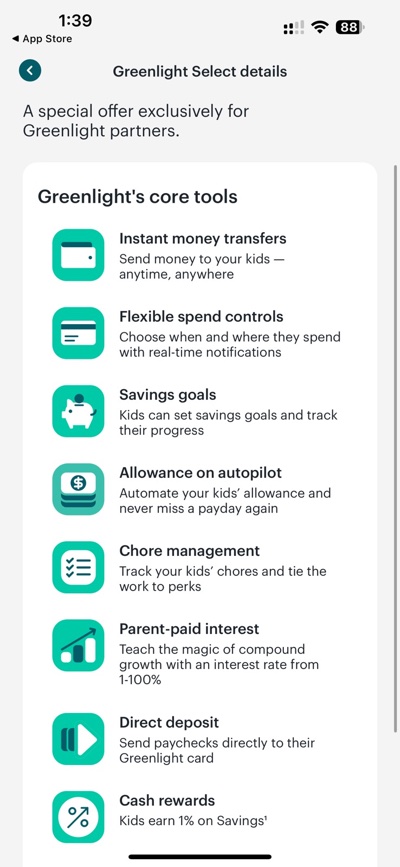
Greenlight is a popular reloadable debit card service for kids, where parents can manage and track their kids spending. You can also add an allowance, payments for recurring chores or one-time jobs, and teach them compound interest via “parent-paid interest”. I suppose its wise to show the kids how handle digital spending before the credit card offers arrive.

I decided to try out the new PSECU perk that offers the basic tier of Greenlight for free. (I did the PSECU $300 checking promo first.) You must enroll at Greenlight.com/PSECU and link a PSECU checking account in order to get the benefit. The “Greenlight Select” membership is a special tier for such partners, but is mostly comparable to the “Greenlight Core” tier on their website, which costs $4.99 a month. Included in the “Greenlight Select” membership:

  • Debit Mastercards for up to 5 kids. Send money instantly and keep tabs on spending with real-time notifications.
  • Educational app. The parents have their app where they get notified of every purchase, and the kids have their own app with educational games and short lessons (optional). Kids can divide their money into “savings” or “giving” baskets as well as create specific savings goals.
  • Parental controls. Created automated allowance payments. Set category and store-level spending limits.
  • 1% APY interest. This is the lowest tier and the lowest interest, although some other apps don’t pay any interest at all. You can get up to 5% APY on $5,000 if you upgrade to the $15/month tier.
  • Roundup feature. You can set it to round up purchases to the next dollar and put the difference in a savings account.
  • No overdraft fees. Does not allow overdrafts, so no overdraft fees.
  • Banking services provided by Community Federal Savings Bank, member FDIC.

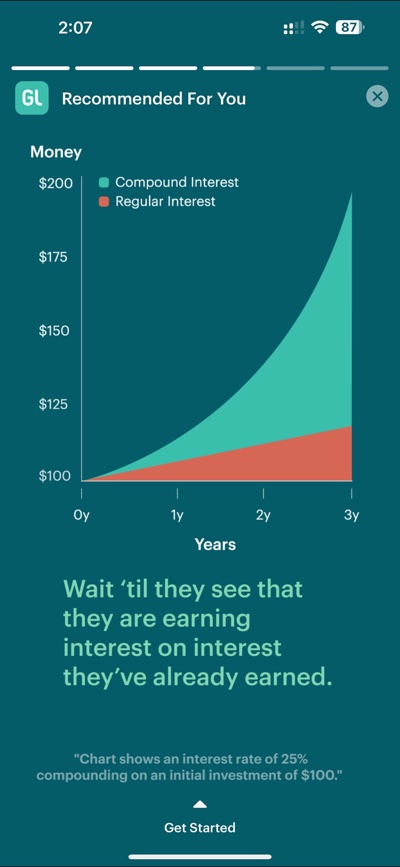
Teaching compound interest with higher interest rates. It can be hard to visualize compound interest at low interest rates, so parents can increase it by paying a higher “interest” rate out of their own pockets. For example, here is an illustration of $100 earning a 25% interest rate (paid by the parent) as opposed to a 5% interest rate. It makes the idea of earning interest on interest more immediate and tangible. Ideally, this can teach them that delayed gratification turns it into future rewards. You can set interest rates from 1% up to 100%.

Unfortunately, to add on investments, I would have to upgrade to the $10 a month tier or higher. If I had a teen ready for investing, I’d probably use the Fidelity Youth account instead (available for age 13-17 only, and my kids aren’t that old yet).

For kids under 13, I think that Greenlight would serve as a nice alternative to piggy banks. (Greenlight has no minimum age requirement.) While I suppose $5 a month isn’t a lot of money for all these features, I still like “free” better. After a few quick internet searches for “Greenlight Select”, I found multiple local banks and credit unions in my area that offered this free tier of service. If you plan on paying for it, there is $30 bonus available with a 1-month free trial (bonus not stackable with this free offer).

Best Interest Rates on Cash Roundup – March 2024

Here’s my monthly roundup of the best interest rates on cash as of March 2024, roughly sorted from shortest to longest maturities. There are lesser-known opportunities available to individual investors, often earning you a lot more money while keeping the same level of safety by moving to another FDIC-insured bank or NCUA-insured credit union. Check out my Ultimate Rate-Chaser Calculator to see how much extra interest you could earn from switching. Rates listed are available to everyone nationwide. Rates checked as of 3/4/2024.

TL;DR: Mostly minor movements. Still 5%+ savings accounts and short-term CDs, but no more 5-year CDs at 5% APY. Compare against Treasury bills and bonds at every maturity, taking into account state tax exemption.

Fintech accounts
Available only to individual investors, fintech companies often pay higher-than-market rates in order to achieve fast short-term growth (often using venture capital). “Fintech” is usually a software layer on top of a partner bank’s FDIC insurance.

  • 5.30% APY ($1 minimum). Raisin lets you switch between different FDIC-insured banks and NCUA-insured credit unions easily without opening a new account every time, and their liquid savings rates currently top out at 5.30% APY. See my Raisin review for details. Raisin does not charge depositors a fee for the service.
  • 5.36% APY (before fees). MaxMyInterest is another service that allows you to access and switch between different FDIC-insured banks. You can view their current banks and APYs here. As of 12/6/23, the highest rate is from Customers Bank at 5.36% APY. However, note that they charge a membership fee of 0.04% per quarter, or 0.16% per year (subject to $20 minimum per quarter, or $80 per year). That means if you have a $10,000 balance, then $80 a year = 0.80% per year. This service is meant for those with larger balances. You are allowed to cancel the service and keep the bank accounts, but then you may lose their specially-negotiated rates and cannot switch between banks anymore.

High-yield savings accounts
Since the huge megabanks STILL pay essentially no interest, everyone should have a separate, no-fee online savings account to piggy-back onto your existing checking account. The interest rates on savings accounts can drop at any time, so I list the top rates as well as competitive rates from banks with a history of competitive rates and solid user experience. Some banks will bait you with a temporary top rate and then lower the rates in the hopes that you are too lazy to leave.

  • The top rate at the moment is at Poppy Bank at 5.50% APY. BrioDirect at 5.35% APY. I have no personal experience with Poppy or Brio, but they are the top rates at the moment. (Milli dropped to 4.75%.) CIT Platinum Savings at 5.05% APY with $5,000+ balance.
  • SoFi Bank is now up to 4.60% APY + up to $325 new account bonus with direct deposit. You must maintain a direct deposit of any amount each month for the higher APY. SoFi has historically competitive rates and full banking features. See details at $25 + $300 SoFi Money new account and deposit bonus.
  • Here is a limited survey of high-yield savings accounts. They aren’t the highest current rate, but historically have kept it relatively competitive and I like to track their history.

Short-term guaranteed rates (1 year and under)
A common question is what to do with a big pile of cash that you’re waiting to deploy shortly (plan to buy a house soon, just sold your house, just sold your business, legal settlement, inheritance). My usual advice is to keep things simple and take your time. If not a savings account, then put it in a flexible short-term CD under the FDIC limits until you have a plan.

  • No Penalty CDs offer a fixed interest rate that can never go down, but you can still take out your money (once) without any fees if you want to use it elsewhere. Raisin has a 4-month No Penalty CD at 5.30% APY with $1 minimum deposit and 30-day minimum hold time. CIT Bank has a 11-month No Penalty CD at 4.90% APY with a $1,000 minimum deposit. Ally Bank has a 11-month No Penalty CD at 4.00% APY for all balance tiers. Marcus has a 13-month No Penalty CD at 4.70% APY with a $500 minimum deposit. Consider opening multiple CDs in smaller increments for more flexibility.
  • Bask Bank has a 1-year certificate at 5.40% APY ($1,000 min). There is a 90-day interest penalty if you withdraw your CD funds before maturity.
  • CIBC Agility Online has a 13-month CD at 5.36% APY. Reasonable 30-day penalty if you withdraw your CD funds before maturity.

Money market mutual funds + Ultra-short bond ETFs
Many brokerage firms that pay out very little interest on their default cash sweep funds (and keep the difference for themselves). Note: Money market mutual funds are highly-regulated, but ultimately not FDIC-insured, so I would still stick with highly reputable firms. I am including a few ultra-short bond ETFs as they may be your best cash alternative in a brokerage account, but they may experience losses.

  • Vanguard Federal Money Market Fund is the default sweep option for Vanguard brokerage accounts, which has an SEC yield of 5.27% (changes daily, but also works out to a compound yield of 5.40%, which is better for comparing against APY). Odds are this is much higher than your own broker’s default cash sweep interest rate.
  • The PIMCO Enhanced Short Maturity Active Bond ETF (MINT) has a 5.34% SEC yield and the iShares Short Maturity Bond ETF (NEAR) has a 5.09% SEC yield while holding a portfolio of investment-grade bonds with an average duration of ~6 months.

Treasury Bills and Ultra-short Treasury ETFs
Another option is to buy individual Treasury bills which come in a variety of maturities from 4-weeks to 52-weeks and are fully backed by the US government. You can also invest in ETFs that hold a rotating basket of short-term Treasury Bills for you, while charging a small management fee for doing so. T-bill interest is exempt from state and local income taxes, which can make a significant difference in your effective yield.

  • You can build your own T-Bill ladder at TreasuryDirect.gov or via a brokerage account with a bond desk like Vanguard and Fidelity. Here are the current Treasury Bill rates. As of 3/4/24, a new 4-week T-Bill had the equivalent of 5.38% annualized interest and a 52-week T-Bill had the equivalent of 4.99% annualized interest.
  • The iShares 0-3 Month Treasury Bond ETF (SGOV) has a 5.19% SEC yield and effective duration of 0.10 years. SPDR Bloomberg Barclays 1-3 Month T-Bill ETF (BIL) has a 5.20% SEC yield and effective duration of 0.08 years.

US Savings Bonds
Series I Savings Bonds offer rates that are linked to inflation and backed by the US government. You must hold them for at least a year. If you redeem them within 5 years there is a penalty of the last 3 months of interest. The annual purchase limit for electronic I bonds is $10,000 per Social Security Number, available online at TreasuryDirect.gov. You can also buy an additional $5,000 in paper I bonds using your tax refund with IRS Form 8888.

  • “I Bonds” bought between November 2023 and April 2024 will earn a 5.27% rate for the first six months. The rate of the subsequent 6-month period will be based on inflation again. More on Savings Bonds here.
  • In mid-April 2023, the CPI will be announced and you will have a short period where you will have a very close estimate of the rate for the next 12 months. I will have another post up at that time.

Rewards checking accounts
These unique checking accounts pay above-average interest rates, but with unique risks. You have to jump through certain hoops which usually involve 10+ debit card purchases each cycle, a certain number of ACH/direct deposits, and/or a certain number of logins per month. If you make a mistake (or they judge that you did) you risk earning zero interest for that month. Some folks don’t mind the extra work and attention required, while others would rather not bother. Rates can also drop suddenly, leaving a “bait-and-switch” feeling.

  • OnPath Federal Credit Union pays 7.00% APY on up to $10,000 if you make 15 debit card purchases, opt into online statements, and login to online or mobile banking once per statement cycle. Anyone can join this credit union via $5 membership fee to join partner organization. You can also get a $100 Visa Reward card when you open a new account and make qualifying transactions.
  • Credit Union of New Jersey pays 6.00% APY on up to $25,000 if you make 15 debit card purchases, opt into online statements, and make at least 1 direct deposit, online bill payment, or automatic payment (ACH) per statement cycle. Anyone can join this credit union via $5 membership fee to join partner organization.
  • Andrews Federal Credit Union pays 6.00% APY on up to $25,000 if you make 15 debit card purchases, opt into online statements, and make at least 1 direct deposit or ACH transaction per statement cycle. Anyone can join this credit union via partner organization.
  • Pelican State Credit Union pays 6.05% APY on up to $20,000 if you make 15 debit card purchases, opt into online statements, log into your account at least once, and make at least 1 direct deposit, online bill payment, or automatic payment (ACH) per statement cycle. Anyone can join this credit union via partner organization membership.
  • Orion Federal Credit Union pays 6.00% APY on up to $10,000 if you make electronic deposits of $500+ each month (ACH transfers count) and spend $500+ on your Orion debit or credit card each month. Anyone can join this credit union via $10 membership fee to partner organization membership.
  • All America/Redneck Bank pays 5.30% APY on up to $15,000 if you make 10 debit card purchases each monthly cycle with online statements.
  • Find a locally-restricted rewards checking account at DepositAccounts.

Certificates of deposit (greater than 1 year)
CDs offer higher rates, but come with an early withdrawal penalty. By finding a bank CD with a reasonable early withdrawal penalty, you can enjoy higher rates but maintain access in a true emergency. Alternatively, consider building a CD ladder of different maturity lengths (ex. 1/2/3/4/5-years) such that you have access to part of the ladder each year, but your blended interest rate is higher than a savings account. When one CD matures, use that money to buy another 5-year CD to keep the ladder going. Some CDs also offer “add-ons” where you can deposit more funds if rates drop.

  • First Internet Bank has a 5-year CD at 4.61% APY. 4-year at 4.55% APY. 3-year at 4.76% APY. 2-year at 4.86% APY. 1-year at 5.36% APY. $1,000 minimum. The early withdrawal penalty (EWP) for CD maturities of 2 years or more is 360 days of interest. For CD maturity of 1 year, the EWP is 180 days of interest.
  • BMO Alto has a 5-year CD at 4.60% APY. 4-year at 4.60% APY. 3-year at 4.60% APY. 2-year at 4.75% APY. 1-year at 5.15% APY. No minimum. The early withdrawal penalty (EWP) for CD maturities of 1 year or more is 180 days of interest. For CD maturities of 11 months or less, the EWP is 90 days of interest. Note that they reserve the right to prohibit early withdrawals entirely (!). Online-only subsidiary of BMO Bank.
  • You can buy certificates of deposit via the bond desks of Vanguard and Fidelity. You may need an account to see the rates. These “brokered CDs” offer FDIC insurance and easy laddering, but they don’t come with predictable early withdrawal penalties. Right now, I see a 5-year non-callable CD at 4.25% APY (callable: no, call protection: yes). Be warned that now both Vanguard and Fidelity will list higher rates from callable CDs, which importantly means they can call back your CD if rates drop later.

Longer-term Instruments
I’d use these with caution due to increased interest rate risk, but I still track them to see the rest of the current yield curve.

  • Willing to lock up your money for 10 years? You can buy long-term certificates of deposit via the bond desks of Vanguard and Fidelity. These “brokered CDs” offer FDIC insurance, but they don’t come with predictable early withdrawal penalties. You might find something that pays more than your other brokerage cash and Treasury options. Right now, I see a 10-year CDs at [n/a] (callable: no, call protection: yes) vs. 4.22% for a 10-year Treasury. Watch out for higher rates from callable CDs where they can call your CD back if interest rates drop.

All rates were checked as of 3/4/2024.

Photo by micheile henderson on Unsplash

Save App Review: 9.07% APY Advertised vs. 0.00% APY Actual Return on Market Savings From 12/2022 to 12/2023

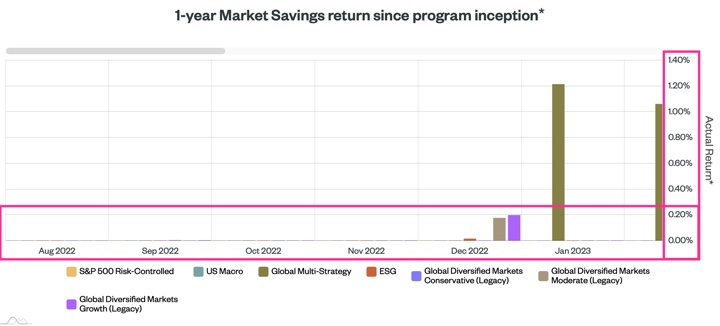
Update February 2024: Save now provides a link to their actual returns for their 1-year Market Savings across all portfolios. But be careful, as much of what is shown at first glance is for products that haven’t actually completed their entire terms. You need to scroll all the way left to find numbers for products that have reached maturity and actually paid out any returns. For example, starting December 2022 and ending December 2023, or January 2023 through January 2024. Screenshot taken 2/29/24.

Update January 2024: I have updated this review with my final return numbers, along with additional details from my bank and brokerage statements. I really wish it were different, but unfortunately my experience was not unique. I have gotten a lot of messages from people who are unhappy that they received a 0% actual return on their Market Savings investments. I hope it can help prospective users make a more educated decision.

Detailed, full review:

The Save app advertises a Market Savings Account that “combines the security of FDIC-insured bank deposits with the upside potential of market returns”. I took a glance at the advertised yields (see below) and quickly filed it under “probably too good to be true”, but still came back and took a shot due to the “free” 6X leverage offered where I could invest $1,000 and get the returns of $6,000 worth of investments.

Here is a screenshot of their advertised rates, taken 2/29/24:

A short theoretical story. Let’s say you have $1,000 and put it into a 1-year CD at an FDIC-insured bank that pays 5% APY. At the end of the year, you’d have $1,050 guaranteed. Now, imagine you went to Vegas and instead bet that $50 interest on red at the roulette table. Worst-case, you’d lose the $50 and still have $1,000. Best-case, you’d double the $50 and end up with $1,100. A 10% annual return! Now, you might charge a fee to others for this “service”. Nothing if they lose, but a little cut if they win. So $1,000 worst-case, and $1,096 if they win ($4 fee for the service).

This gives you a basic idea of what I imagined was going on here, except replace Vegas with some fancy derivatives to give you market exposure to a portfolio of stocks and bonds.

The longer Save version. Here it is, straight from Save:

Every Save® account is connected with a FDIC-insured bank account. Your deposits are never at risk. We only invest the interest on your deposits, so no matter what happens with the ups and downs of the markets, your initial deposit is never at risk for investment loss.

This app is a combination of an FDIC-insured bank account, an SIPC-insured brokerage account, and an SEC-registered investment advisor. Your money is placed into an FDIC-insured account at Webster Bank that doesn’t earn any interest. Instead of paying you interest, they will buy a portfolio of securities that offer exposure to market products like stocks and bonds. These securities are held in a brokerage account with Apex Clearing, the same firm used by brokers like Robinhood, WeBull, etc. As your financial advisor, they will charge you a fee of 0.35% annually for this service. Ex. 0.35% of $1,000 is $3.50 a year. 0.35% of $10,000 is $35 a year.

This is all taken from Save’s official documents: press release, terms and conditions, SEC Form ADV, deposit agreement, and Form CRS.

Upon opening Market Savings and initiating a deposit to the Deposit Account, Save will, on behalf of you:

– deposit your funds in full into the Deposit Account provided by Webster, member FDIC and,
– purchase a strategy–linked security selected based on your risk tolerances within a Client Account

The Market Savings Product is comprised of a Deposit Account with Webster Bank, N.A. and a Client Account with Apex Clearing Corporation.

SAVE Advisers is an investment adviser registered with the SEC. SAVE Advisers provides its clients with combined banking products and wealth management services through a web-based algorithmically driven wrap-fee investment advisory program (the “SAVE Market Savings Wrap Program”).

The SAVE Market Savings Wrap Program is designed for investors with a cash savings investment profile. The investment objective of the SAVE Market Savings Wrap Program is to enhance our clients’ cash savings investment profile by providing attractive returns on capital using Save’s core investment philosophy while preserving their initial investment.

On the Market Savings Wrap Program, Clients will pay a wrap fee at a rate of 35 basis points (0.35%) per annum (one basis point is 1/100 of 1%) on either 1.) the total notional amount of each strategy–linked security or 2.) the total notional value of the Client Deposit Account (whichever is greater).

Save products are intended for conservative investors who are mostly concerned about the protection of their principal investments.

This reminds me of the No Risk Portfolio with 100% Money Back Guarantee. Your market-linked investment may go up 10%, 100%, or whatever, but the worst thing that can happen is it goes to zero (and you still get back your initial investment). According to this WSJ article (paywall), the CEO says the chance of a zero return in any given year is about 15%. This suggests that they are using some sort of leverage. (They also say the returns will count as long-term capital gains, unlike ordinary bank interest.)

The investments in Save portfolios are held for over a year so they are taxed as long-term capital gains.

This reminds me of the structured investments and “equity-linked returns with no downside” offered by many insurance companies. The insurance companies have much more onerous early withdrawal penalties where you can lose more than your initial principal, so this seems like a much lower cost option (even if still not what I want for my primary portfolio).

Where do they get those high advertised returns? Those are back-tested numbers:

Average annual returns are based on hypothetical back-tested performance by Save of the Save Moderate Portfolio from 2006 to present.

What happens if I try to withdraw my investment before the end of my term? There is a early withdrawal fee (a slightly complicated formula), but you’ll always at least get back your initial principal.

I understand that if I terminate my account prior to the completion of an investment term I may forgo all gains and receive back only my initial deposit.

Update: My final results from December 2022 to December 2023. I deposited $1,000 in December 2022, and ended up with… $1,000 in December 2023. I got back my initial $1,000 and that was it. All of the other investments apparently matured at a value of zero. This is despite having been told that I had positive returns in the middle of my term.

After my initial sign-up and $1,000 investment of my own money in December 2022, I did later participate in Save’s referral program and that did later result in additional earnings (my earnings were the same as the referred earnings). If you count this money, then I received a positive return. However, I don’t feel that this is representative of what you (the reader) could necessarily achieve on your own, so I chose to focus only on what I would have gotten without the ability to refer other users. I simply count the $1,000 of my own money and the $5,000 equivalent balance invested due to using someone else’s referral. On that money, my return was the same as everyone else who invested in my portfolio from December 2022 to December 2023: zero.

Save’s referral program is structured in that I earn the same bonus as the reader that signed up. Thus, you can see the returns of every single reader that used me as their referral (thanks again if you did!). I have gone ahead and attached the screenshot of every single referral that I have made with a matured investment, as of the end of March 2024. These are real-world results from real readers. The return percentages are usually based on a $5,000 equivalent investment (i.e. 1% return on $5,000 is $50.)

People with different start times and end times have different returns. Some have had zero returns. Some have had positive returns. The more recent returns are higher, and I hope that they continue to rise. However, I don’t count my chickens until they have hatched (fully matured and paid back any principal and interest).

That was a lot, but now you have all my returns and all the matured returns from all referred readers, down to the penny.

Save did put my initial $1,000 in an FDIC-insured bank account and just kept it there – nice and safe – doing absolutely nothing. No interest was earned. Each month, I got a bank statement and a brokerage statement. Here is a screenshot of my final bank statement showing $1,000 being sent back to me at the end of December 2023, after 12 months.

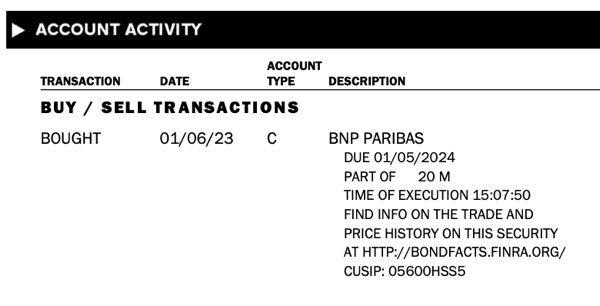
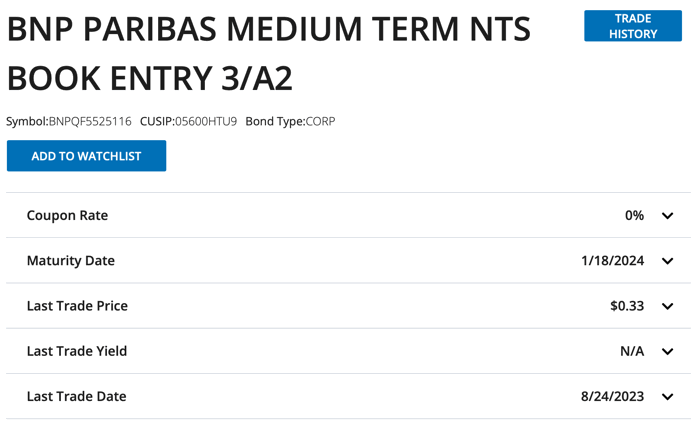
Below is a screenshot from my Save Brokerage statement, which was indeed held at Apex Clearing (a popular clearing firm for many fintechs, used by Robinhood, etc). Inside, they bought some sort of non-transparent, thinly-traded securities that were classified as corporate bonds. Perhaps someone with more advanced market knowledge can tell me more about these things. Example CUSIPs were 05600HTU9 and 05600H2F1.

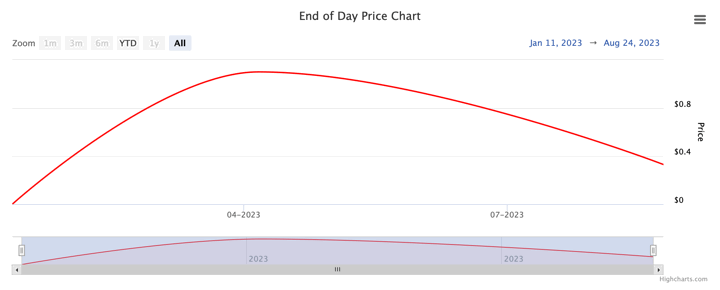
Here is a tiny of bit info from FINRA:

The value of this security varied wildly through the year, from zero to $1 and all the way back to apparently zero?

How much of this security did they buy? In my case, it was about $15 worth per $1,000 invested. In comparison, earning 4% APY from a 1-year $1,000 traditional bank CD would equal $40.

I did sign up using a referral link and deposited $1,000 to qualify for the bonus $5,000 (at the time, lower now) for a total equivalent balance of $6,000. I thought this would be a good value bet, effectively leveraging any returns. Unfortunately, zero times anything is still… zero. I just got back my $1,000. Again, this excludes any referral bonus income.

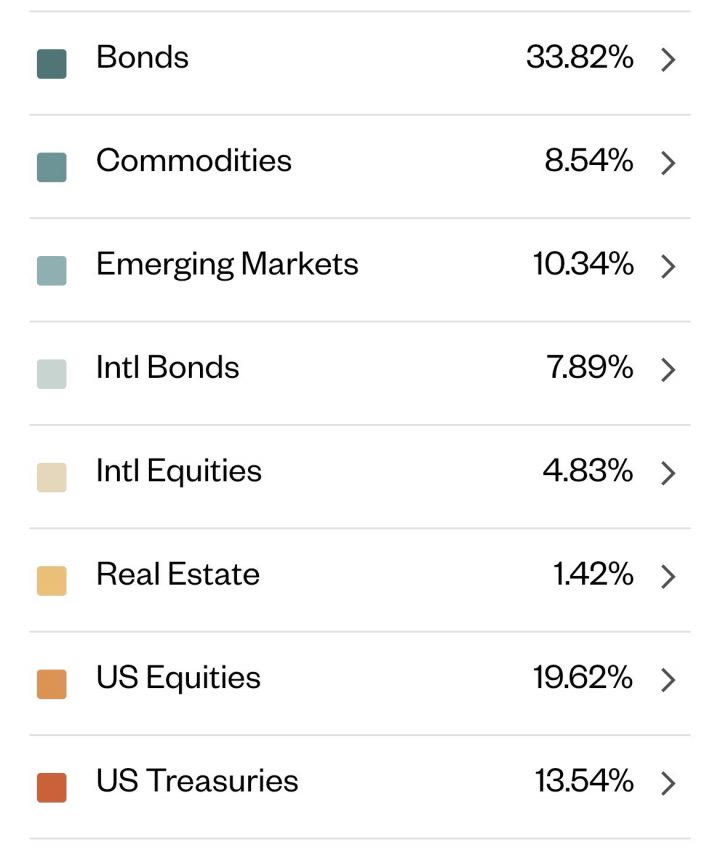
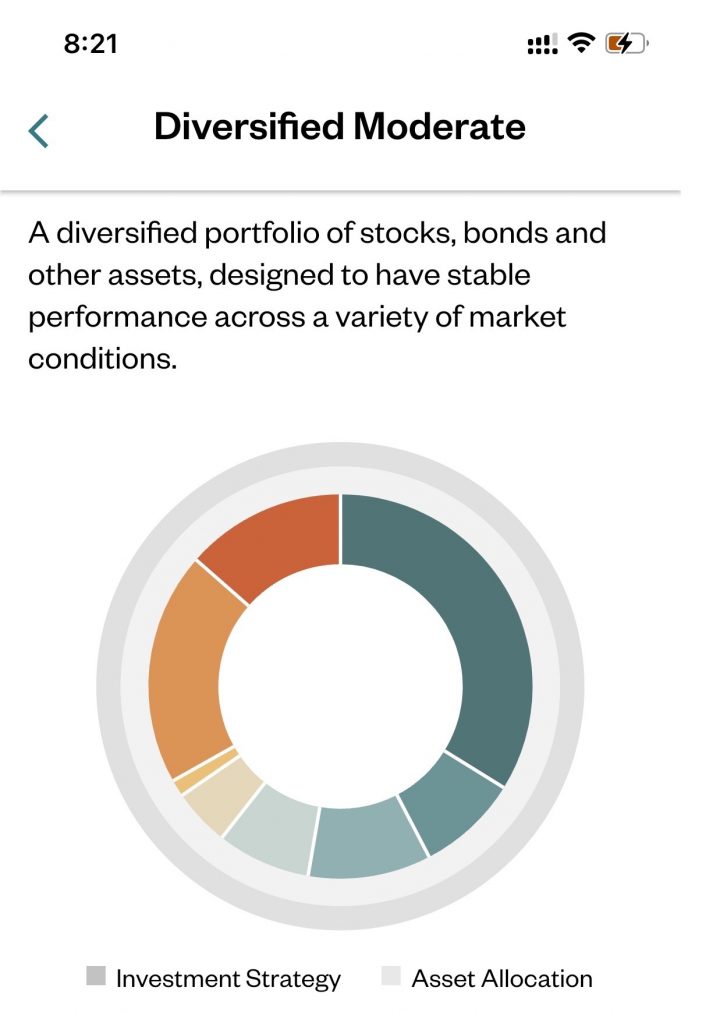
Now, I knew that a zero return was possible. A screenshot of the portfolio strategy that I picked initially is shown below. However, nearly every major asset class had solid positive returns for 2023. Yet, according to Save’s own historical returns page (see top of post), the highest return for any of their multiple portfolios that were held from both (December 2022 to December 2023) or (January 2023 to January 2024) was 1.20%, with the median return being zero. I’m afraid that I simply don’t understand what is inside the securities that they chose to buy, so I will not be investing anything further.

Honestly, I had high hopes for this product. It had potential and it didn’t even have to be that complicated. Again, look at this simple DIY principal-guaranteed investment linked to market returns.

Bottom line. The Save app advertises to folks “higher returns on their savings without the risks of the stock market.” They do appear to keep your principal safe in an FDIC-insured account, so indeed you can’t technically lose money. But it is unclear to me how they invest the rest. Despite their advertised 1-year return numbers, my personal experience was zero return (0.00%) on my 1-year term Market Savings investment that ran from December 2022 to December 2023. This matches their published actual returns for all investors during this time frame. This numbers excludes subsequent income from referral bonuses, which if you did include, would have resulted in a positive return. Other maturities may have experienced different returns, as shown in the screenshots above. I did receive my initial principal back as promised.

Note: Save Advisers pays a Referral Bonus up to $5000/$10,000 [product specific] as more specifically described in the current Referral Program as outlined by the Advisor here: https://joinsave.com/referrals, for each successful client referral. This amount is subject to change at any time.

Upgrade Premier Savings: Up to $200 Deposit Bonus + 5.21% APY

(Update July 2024: The top deposit bonus level is now back to $200.)

Original, outdated post with expired details from when the top tier was worth $500:

Upgrade is offering up to a $500 deposit bonus via referral link when you open their standalone Premier Savings account and make a deposit of at least $15,000 in the first 30 days and leave it there for at least an additional 60 days. No credit check for me. FDIC insurance through Cross River Bank.

Note: This is a separate bonus from the ongoing $200 Upgrade Rewards Checking bonus, which had a direct deposit requirement. You can add on a “Performance Savings” account onto a Rewards Checking account, while this offer is for a different “Premier Savings” account.

Per the fine print, you should be able to get this bonus as long as this is your first “Premier Savings” account. It doesn’t matter if you already got the Rewards Checking bonus (as I did). You just need to make sure you use a referral link with the promotion attached.

If you have never had a Premier Savings account through Upgrade (a “New Customer”), you can receive a Welcome Bonus (defined below) if you (1) use an Existing Customer’s unique referral link to open a new Premier Savings account, subject to account approval, by the Offer Period, (2) make a deposit within 30 days of opening the new account, and (3) after the initial 30-day period, maintain at all times during an additional 60 days the minimum account balance presented to you (a “Qualified Registration”).

The account opening process for my first Upgrade account was very quick and easy, literally under 5 minutes. I did not have to upload any extra documentation and I did not experience any hard credit checks. The account was open and ready the day after application. If you are an existing customer (as I was this time), it was even faster. All my details were pre-filled and so it just took a few clicks. (Update: Some users report having much higher ID verification requirements. So YMMV.)

All of my previously-linked external bank account details were also available to make a transfer. Upgrade uses Finicity (owned by Mastercard) for linking external bank accounts.

Here are the highlights of the Premier Savings account:

  • 5.21% APY as of 2/27/24 with $1,000 minimum balance required to earn interest.
  • No direct deposit requirement (unlike the Performance Savings).
  • No monthly fees.

Napkin math (Effective APY). If you deposit towards the end of the 30-day funding period, your technical minimal holding period is 60 days.

For the $15,000, $30,000, and $100,000 deposit tiers, earning 0.50% on your funds with a 60 day holding period works out to an additional 3.00% annualized yield. If you assume the current 5.21% APY, that adds up to a total effective interest of roughly 8.21% APY annualized for 2 months.

For the $50,000 deposit tier, earning 0.60% on your funds with a 60 day holding period works out to an additional 3.60% annualized yield. If you assume the current 5.21% APY, that adds up to a total effective interest of roughly 8.81% APY annualized for 2 months.

A straightforward deposit promotion with a smooth application and short hold period that doesn’t incur a hard credit check. The savings account also has a high base APY to keep around long-term. Finallly, it also stacks with another $200 checking account promotion from the same place. This is my Upgrade Premier Savings up to $500 referral link. Thanks if you use it.

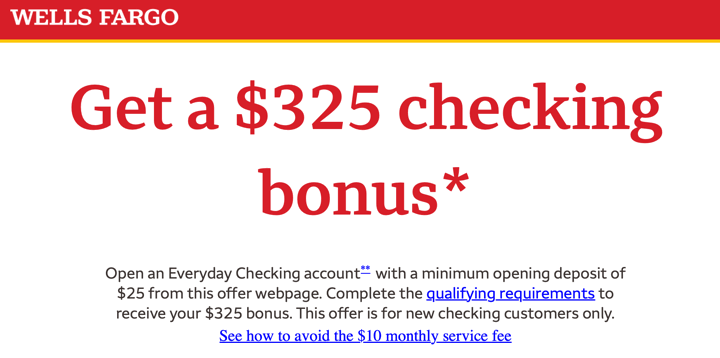
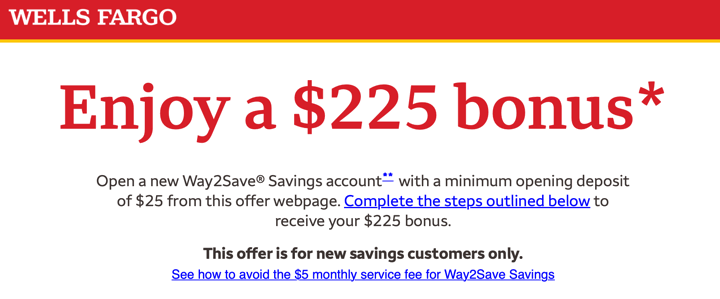
Wells Fargo $325 Checking + $225 Savings Account Bonuses

Updated with current $325 Checking + $225 Savings offers. Wells Fargo has brought back a few larger bonuses for both new checking and savings account customers. The checking bonus requires direct deposit and the savings bonus requires a $10,000 new money deposit for at least 90 days. You must live in an eligible zip code, but their footprint is pretty big. Found via DoC. Currently, the offers end on April 9th, 2024.

  • $325 bonus for a new Everyday Checking account. You are not eligible for this offer if you currently have Wells Fargo consumer checking account or if you have received a bonus for opening a Wells Fargo consumer checking account within the past 12 months.
  • $225 bonus for a new Way2Save® Savings account. You are not eligible for this offer if you currently have Wells Fargo consumer savings account or if you have received a bonus for opening a Wells Fargo consumer savings account within the past 12 months.

$325 Everyday Checking account bonus details.

  • Open a new Everyday Checking account with a minimum opening deposit of $25 by April 9, 2024 online via the link above. If you open in-branch, you must first generate a bonus offer code via the link above.
  • Within 90 calendar days of account opening (the “qualification period”), receive a total of $1,000 or more in qualifying direct deposits to your new checking account. “A qualifying direct deposit is an ACH (Automated Clearing House) automatic electronic deposit of your salary, pension, Social Security, or other regular income into your bank account.”
  • Once the 90-day qualification period has elapsed, they will deposit any earned bonus into your new checking account within 30 days.

In the past, Wells Fargo has not done a “hard credit check” upon a new account opening, while also being pretty flexible with what qualifies as a direct deposit.

The Wells Fargo Everyday Checking account monthly service fee is $10, but it is waived with one of the following each fee period:

  • $500 minimum daily balance
  • $500 or more in total qualifying “electronic” deposits

$225 Way2Save Savings account bonus details.

  • Open a new new Way2Save Savings account with a minimum opening deposit of $25 by April 9, 2024 online via the link above. If you open in-branch, you must first generate a bonus offer code via the link above.
  • Within 30 calendar days of account opening (the “qualification period”), deposit $10,000 or more in new money to your new savings account and maintain at least a $10,000 balance for 90 days after account opening. New money is money that is new to the customer or new to Wells Fargo (deposited into the customer’s new savings account from outside of Wells Fargo and Company and all affiliates, or from a Wells Fargo account not owned by the customer).
  • Bonus will be deposited into your new savings account within 30 days after you have met all offer requirements.

The Way2Save interest rate is a horrible 0.01% APY. However, receiving the $225 bonus for holding $10,000 for 90 days works out to roughly a 9% annualized rate of return over those 90 days.

The Way2Save® Savings $5 monthly service fee can be avoided with one of the following each fee period:

  • $300 minimum daily balance
  • 1 automatic transfer each fee period of $25 or more from a linked Wells Fargo checking account
  • 1 automatic transfer each business day within the fee period of $1 or more from a linked Wells Fargo checking account.
  • 1 or more Save As You Go® transfers from a linked Wells Fargo checking account.
  • Primary account owner is 24 years old or under. (When the primary account owner reaches the age of 25, age can no longer be used to avoid the monthly service fee.) Customers 12 and under must have an adult co-owner.

IKEA Family Discount: $15 off $150, $30 off $300, $50 off $500 (Ends 3/3/24)

New discount up to 10% off, ends 3/3/24. IKEA has a limited-time “Spend and Get” promotion offering $15 off $150+, $30 off $300+, and $50 off $500+ purchases (all amounts are before sales tax and other taxes). U.S. only. Valid in-store and online. IKEA Family member number or IKEA Business Network account number required. IKEA Family is their loyalty program and is free to join.

There are some exclusions, including gift cards:

IKEA Family – Spend and Get Offer – Get $15 Off Your Purchase of $150 or more (pre-tax); Get $30 Off Your Purchase of $300 or more (pre-tax); Get $50 Off Your Purchase of $500 or more (pre-tax)*

Must scan or sign-in with IKEA Family member number or IKEA Business Network account number in order to receive offer. Minimum purchase amount must be met in a single transaction before taxes. Discount applied before tax, shipping, and handling. Offer will apply automatically at check-out if purchase qualifies. Not valid on IKEA Gift Cards or payment of your IKEA credit card. Offer excludes Click & Collect, Kitchen Planning and other services. Not valid in IKEA Swedish Restaurant or Bistro. Limit: one redemption per IKEA Family member number or IKEA Business Network account number. Offer tiers cannot be stacked and offer cannot be combined with other IKEA offers or coupons. Not valid on previous purchases. Discount applied proportionally across items purchased, as shown on receipt. On returns, only the net purchase price as shown on receipt is refunded. Other restrictions may apply. See store or IKEA-USA.com for more details. ©Inter IKEA Systems B.V. 2024.

IKEA coupons are pretty rare, other than their ongoing $25 off $250 moving coupon.

Right now, some people are also being targeted with a Chase Offer that offers 10% off at IKEA. It may be worth logging into your Chase account online and look for it in the “Chase Offers” box. Unfortunately, I did not see it under any of my cards.

Best Interest Rates on Cash – February 2024

Here’s my monthly roundup of the best interest rates on cash as of February 2024, roughly sorted from shortest to longest maturities. There are often lesser-known opportunities available to individual investors, where you could earn a lot more money while keeping the same level of safety by moving to another FDIC-insured bank or NCUA-insured credit union. Check out my Ultimate Rate-Chaser Calculator to see how much extra interest you could earn from switching. Rates listed are available to everyone nationwide. Rates checked as of 2/5/2024.

TL;DR: Mostly minor movements. Still 5%+ savings accounts and short-term CDs, but no more 5-year CDs at 5% APY. Compare against Treasury bills and bonds at every maturity, taking into account state tax exemption.

Fintech accounts
Available only to individual investors, fintech companies often pay higher-than-market rates in order to achieve fast short-term growth (often using venture capital). “Fintech” is usually a software layer on top of a partner bank’s FDIC insurance.

  • 5.32% APY ($1 minimum). Raisin lets you switch between different FDIC-insured banks and NCUA-insured credit unions easily without opening a new account every time, and their liquid savings rates currently top out at 5.32% APY. See my Raisin review for details. Raisin does not charge depositors a fee for the service.
  • 5.36% APY (before fees). MaxMyInterest is another service that allows you to access and switch between different FDIC-insured banks. You can view their current banks and APYs here. As of 12/6/23, the highest rate is from Customers Bank at 5.36% APY. However, note that they charge a membership fee of 0.04% per quarter, or 0.16% per year (subject to $20 minimum per quarter, or $80 per year). That means if you have a $10,000 balance, then $80 a year = 0.80% per year. This service is meant for those with larger balances. You are allowed to cancel the service and keep the bank accounts, but then you may lose their specially-negotiated rates and cannot switch between banks anymore.

High-yield savings accounts
Since the huge megabanks STILL pay essentially no interest, everyone should have a separate, no-fee online savings account to piggy-back onto your existing checking account. The interest rates on savings accounts can drop at any time, so I list the top rates as well as competitive rates from banks with a history of competitive rates and solid user experience. Some banks will bait you with a temporary top rate and then lower the rates in the hopes that you are too lazy to leave.

  • The top rate at the moment is at Milli (app only) at 5.50% APY. BrioDirect at 5.35% APY. CIT Platinum Savings at 5.05% APY with $5,000+ balance.
  • SoFi Bank is now up to 4.60% APY + up to $325 new account bonus with direct deposit. You must maintain a direct deposit of any amount each month for the higher APY. SoFi has historically competitive rates and full banking features. See details at $25 + $300 SoFi Money new account and deposit bonus.
  • Here is a limited survey of high-yield savings accounts. They aren’t the highest current rate, but historically have kept it relatively competitive and I like to track their history.

Short-term guaranteed rates (1 year and under)
A common question is what to do with a big pile of cash that you’re waiting to deploy shortly (plan to buy a house soon, just sold your house, just sold your business, legal settlement, inheritance). My usual advice is to keep things simple and take your time. If not a savings account, then put it in a flexible short-term CD under the FDIC limits until you have a plan.

  • No Penalty CDs offer a fixed interest rate that can never go down, but you can still take out your money (once) without any fees if you want to use it elsewhere. Raisin has a 5-month No Penalty CD at 5.36% APY with $1 minimum deposit and 30-day minimum hold time. CIT Bank has a 11-month No Penalty CD at 4.90% APY with a $1,000 minimum deposit. Ally Bank has a 11-month No Penalty CD at 4.25% APY for all balance tiers. Marcus has a 13-month No Penalty CD at 4.70% APY with a $500 minimum deposit. Consider opening multiple CDs in smaller increments for more flexibility.
  • Lafayette Federal Credit Union has a 1-year certificate at 5.56% APY ($500 min). They also have jumbo certificates with $100,000 minimums at even higher rates, but a harsh 180-day penalty if you withdraw your CD funds before maturity. Anyone can join this credit union via partner organization ($10 one-time fee).
  • CIBC Agility Online has a 12-month CD at 5.51% APY. Reasonable 30-day penalty if you withdraw your CD funds before maturity.

Money market mutual funds + Ultra-short bond ETFs
Many brokerage firms that pay out very little interest on their default cash sweep funds (and keep the difference for themselves). Note: Money market mutual funds are highly-regulated, but ultimately not FDIC-insured, so I would still stick with highly reputable firms. I am including a few ultra-short bond ETFs as they may be your best cash alternative in a brokerage account, but they may experience losses.

  • Vanguard Federal Money Market Fund is the default sweep option for Vanguard brokerage accounts, which has an SEC yield of 5.28% (changes daily, but also works out to a compound yield of 5.41%, which is better for comparing against APY). Odds are this is much higher than your own broker’s default cash sweep interest rate.
  • The PIMCO Enhanced Short Maturity Active Bond ETF (MINT) has a 5.39% SEC yield and the iShares Short Maturity Bond ETF (NEAR) has a 5.15% SEC yield while holding a portfolio of investment-grade bonds with an average duration of ~6 months.

Treasury Bills and Ultra-short Treasury ETFs
Another option is to buy individual Treasury bills which come in a variety of maturities from 4-weeks to 52-weeks and are fully backed by the US government. You can also invest in ETFs that hold a rotating basket of short-term Treasury Bills for you, while charging a small management fee for doing so. T-bill interest is exempt from state and local income taxes, which can make a significant difference in your effective yield.

  • You can build your own T-Bill ladder at TreasuryDirect.gov or via a brokerage account with a bond desk like Vanguard and Fidelity. Here are the current Treasury Bill rates. As of 2/5/24, a new 4-week T-Bill had the equivalent of 5.39% annualized interest and a 52-week T-Bill had the equivalent of 4.64% annualized interest.
  • The iShares 0-3 Month Treasury Bond ETF (SGOV) has a 5.17% SEC yield and effective duration of 0.10 years. SPDR Bloomberg Barclays 1-3 Month T-Bill ETF (BIL) has a 5.24% SEC yield and effective duration of 0.08 years.

US Savings Bonds
Series I Savings Bonds offer rates that are linked to inflation and backed by the US government. You must hold them for at least a year. If you redeem them within 5 years there is a penalty of the last 3 months of interest. The annual purchase limit for electronic I bonds is $10,000 per Social Security Number, available online at TreasuryDirect.gov. You can also buy an additional $5,000 in paper I bonds using your tax refund with IRS Form 8888.

  • “I Bonds” bought between November 2023 and April 2024 will earn a 5.27% rate for the first six months. The rate of the subsequent 6-month period will be based on inflation again. More on Savings Bonds here.
  • In mid-April 2023, the CPI will be announced and you will have a short period where you will have a very close estimate of the rate for the next 12 months. I will have another post up at that time.

Rewards checking accounts
These unique checking accounts pay above-average interest rates, but with unique risks. You have to jump through certain hoops which usually involve 10+ debit card purchases each cycle, a certain number of ACH/direct deposits, and/or a certain number of logins per month. If you make a mistake (or they judge that you did) you risk earning zero interest for that month. Some folks don’t mind the extra work and attention required, while others would rather not bother. Rates can also drop suddenly, leaving a “bait-and-switch” feeling.

  • OnPath Federal Credit Union pays 7.00% APY on up to $10,000 if you make 15 debit card purchases, opt into online statements, and login to online or mobile banking once per statement cycle. Anyone can join this credit union via $5 membership fee to join partner organization. You can also get a $100 Visa Reward card when you open a new account and make qualifying transactions.
  • Credit Union of New Jersey pays 6.00% APY on up to $25,000 if you make 15 debit card purchases, opt into online statements, and make at least 1 direct deposit, online bill payment, or automatic payment (ACH) per statement cycle. Anyone can join this credit union via $5 membership fee to join partner organization.
  • Pelican State Credit Union pays 6.05% APY on up to $20,000 if you make 15 debit card purchases, opt into online statements, log into your account at least once, and make at least 1 direct deposit, online bill payment, or automatic payment (ACH) per statement cycle. Anyone can join this credit union via partner organization membership.
  • Orion Federal Credit Union pays 6.00% APY on up to $10,000 if you make electronic deposits of $500+ each month (ACH transfers count) and spend $500+ on your Orion debit or credit card each month. Anyone can join this credit union via $10 membership fee to partner organization membership.
  • All America/Redneck Bank pays 5.30% APY on up to $15,000 if you make 10 debit card purchases each monthly cycle with online statements.
  • Find a locally-restricted rewards checking account at DepositAccounts.

Certificates of deposit (greater than 1 year)
CDs offer higher rates, but come with an early withdrawal penalty. By finding a bank CD with a reasonable early withdrawal penalty, you can enjoy higher rates but maintain access in a true emergency. Alternatively, consider building a CD ladder of different maturity lengths (ex. 1/2/3/4/5-years) such that you have access to part of the ladder each year, but your blended interest rate is higher than a savings account. When one CD matures, use that money to buy another 5-year CD to keep the ladder going. Some CDs also offer “add-ons” where you can deposit more funds if rates drop.

  • Library Of Congress Federal Credit Union has a 60-month CD at 4.84% APY with $500 minimum. Shorter terms are pretty competitive as well: 4-year at 4.89% APY. 3-year at 5.25% APY. 2-year at 5.20% APY. 1-year at 5.35% APY. The early withdrawal penalty for the 5-year is 180 days of interest. Anyone can join this credit union via partner organization.
  • BMO Alto has a 5-year CD at 4.60% APY. 4-year at 4.60% APY. 3-year at 4.60% APY. 2-year at 4.75% APY. 1-year at 5.30% APY. No minimum. The early withdrawal penalty (EWP) for CD maturities of 1 year or more is 180 days of interest. For CD maturities of 11 months or less, the EWP is 90 days of interest. Note that they reserve the right to prohibit early withdrawals entirely. Online-only subsidiary of BMO Bank.
  • You can buy certificates of deposit via the bond desks of Vanguard and Fidelity. You may need an account to see the rates. These “brokered CDs” offer FDIC insurance and easy laddering, but they don’t come with predictable early withdrawal penalties. Right now, I see a 5-year non-callable CD at 4.10% APY (callable: no, call protection: yes). Be warned that now both Vanguard and Fidelity will list higher rates from callable CDs, which importantly means they can call back your CD if rates drop later.

Longer-term Instruments
I’d use these with caution due to increased interest rate risk, but I still track them to see the rest of the current yield curve.

  • Willing to lock up your money for 10 years? You can buy long-term certificates of deposit via the bond desks of Vanguard and Fidelity. These “brokered CDs” offer FDIC insurance, but they don’t come with predictable early withdrawal penalties. You might find something that pays more than your other brokerage cash and Treasury options. Right now, I see a 10-year CDs at [n/a] (callable: no, call protection: yes) vs. 4.16% for a 10-year Treasury. Watch out for higher rates from callable CDs where they can call your CD back if interest rates drop.

All rates were checked as of 2/5/2023.

Photo by micheile henderson on Unsplash

Alaska Airlines Visa Credit Card: 60,000 Miles + $122 Companion Fare ($95 Annual Fee)

The Alaska Airlines Visa credit card is issued by Bank of America and offers several unique cardholder perks, and currently has an increased limited-time offer. The business card version currently also has a limited-time offer.

Alaska Airlines Visa Signature Card

  • 60,000 Alaska miles + Companion Fare from $122 after $3,000 or more in purchases within the first 90 days after account opening. Companion fare voucher is “Buy one ticket, get one for $122” ($99 fare plus taxes and fees from just $23).
  • Free checked bag + Priority boarding. Any cardholder who purchases airfare with their card, and up to 6 additional guests traveling on the same reservation, may check their first bag free. This is worth $60 roundtrip per person.
  • 3X miles for every $1 spent on eligible Alaska Airlines purchases. 2X miles for every $1 spent on eligible gas, cable, streaming services and local transit including ride share purchases. 1X mile per $1 spent on all other purchases.
  • 10% rewards bonus w/ BofA on all miles earned from card purchases if you have an eligible Bank of America® account.
  • Ability to earn another Alaska’s Famous Companion Fare ($6k spend requirement). Get another Companion Fare from $122 ($99 fare plus taxes and fees from $23) each account anniversary after you spend $6,000 or more on purchases within the prior anniversary year. Valid on all Alaska Airlines flights booked on alaskaair.com.
  • No foreign transaction fees.
  • $95 annual fee.

I will be adding this offer to the Top 10 Best Credit Card Bonus Offers.
Alaska Airlines Visa Business Card

  • 50,000 Alaska miles + Companion Fare Voucher after $3,000 in purchase within 90 days. Companion fare voucher is “Buy one ticket, get one for $122” ($99 fare plus taxes and fees from just $23).
  • Free checked bag + Priority boarding. Any cardholder who purchases airfare with their card, and up to 6 additional guests traveling on the same reservation, may check their first bag free. This is worth $60 roundtrip per person.
  • Ability to earn another Alaska’s Famous Companion Fare ($6k spend requirement). Get another Companion Fare from $122 ($99 fare plus taxes and fees from $23) each account anniversary after you spend $6,000 or more on purchases within the prior anniversary year. Valid on all Alaska Airlines flights booked on alaskaair.com.
  • 10% rewards bonus w/ BofA on all miles earned from card purchases if you have an eligible Bank of America® small business account.
  • $70 annual fee for company, plus $25 per card.

I will be adding this offer to the Top 10 Best Small Business Credit Card Bonus Offers.

“Tune Out the Noise”: A Film about Index Funds and Dimensional Fund Advisors (DFA)

The film Tune Out the Noise is a documentary by Academy Award–winning director Errol Morris about the rise of academic finance, the computer analysis of market data, index funds, and the founding of Dimensional Fund Advisors (DFA). It appears that DFA commissioned this film, so it obviously will support their specific type of investing, but it should also explain the reasoning behind low-cost index funds and why high-expense active funds have been steadily losing market share over time.

Until 1/31, you can watch the film for free at film.dimensional.com/podcast with access code RATIONAL. They ask for name and e-mail, but don’t verify. This is offered through the Rational Reminder podcast, and you may also find interesting their interview with Errol Morris.

I learned about this through Paul Merriman’s newsletter:

Trust in the future of an investment may be the most important reason for most investors to stay the course for the long term. I formed a lasting trust in the academic work of Drs. Fama and French when I attended a 3 day workshop at Dimensional Fund Advisors in 1994.

That trust led our firm to use the DFA funds since the mid 90s. While I believe there are a lot of people who find our long term studies helpful, I’m not sure that all of those people understand that almost all of our studies, that go back to 1928, are based on the data from the academics who are associated with DFA. If you don’t already have a sense of trust about the source of our data, I think you will feel better if you watch the new documentary, “Turn Off the Noise.”

Here is a summary blurb about the film:

Tune Out the Noise is a documentary film about a group of unlikely upstarts who crossed paths at the University of Chicago in the middle of the 20th century, just as computers were first being used to analyze data. That serendipitous, monumental shift enabled them to develop, and then apply, research that turned Wall Street upside down, from its ineffectual investing methods to how those were sold to the public.

It’s a story about how finance became a science and challenged the traditional methods of investing. That, in turn, led to the invention of index funds, the founding of Dimensional Fund Advisors—an investment firm dedicated to implementing the science—and the evolution of client-focused financial advice. These advances have benefited generations of investors.

I am currently in the middle of watching the film (trying to finish before the free access ends), and it does have a very nice production quality while showing the backstory of many famous financial academics. It’s kind of nice to put a face with the names. I personally only invest a small portion of my portfolio into DFA and DFA-style funds (Avantis was started by former DFA executives), but I will watch the rest with an open mind and hope to learn some useful history.

Added after finishing the entire film: The film goes from the basic discoveries of efficient markets, the value of diversification, and the idea that a low-cost broad fund outperformed nearly all big investment trusts back then. It’s important to know that DFA takes the academic “backtesting” further than Vanguard. I enjoyed the history of CRSP and how all these data nerds got together. They did pretty much gloss over Vanguard with “Wells Fargo just handed the retail index fund concept to Bogle on a FREE silver platter”.

Vanguard is more about the big stuff. Diversification from holding the entire market and thousands of stocks, not just 100 or less. Lower expense ratio costs. Lower trading costs. Lower costs from not attempting and failing at market timing or chasing recent performance. But it’s all an algorithm of some sort, based on looking back at the historical data. The S&P 500 is an algorithm, just a simpler one that works well at a 0.05% expense ratio.

DFA is a more actively managed algorithm, but still keeps the broad diversification and lower expenses (they are still lowest quartile in expenses). They also focus on the Fama/French academically-found factors like size, value, quality. Again, historically small value stocks have outperformed on average for long periods of time. Will they keep doing so? I don’t know.

Is the DFA method better? Is the the DFA higher-return possibility worth more than the higher expenses they charge? In the past, you could only go through a financial advisor, which added yet another layer of fees, so my answer was an easier “no”. But DFA and Avantis have finally released ETFs which anyone can buy, and I have as a bet on about 10% of my portfolio (the part that bets on size and value anyway). I don’t bet the whole farm on it. I think lower costs and market-cap weighting are much more reliable. But if you want to know why, the film gives you an idea. Is it a commercial for DFA? Sure. But a documentary about index funds would also serve as a commercial for Vanguard, no?

Robinhood IRA Transfer and 401k Rollover 3% Bonus Match (No Cap)

Robinhood Gold subscribers have the standard feature of a 3% match on all eligible annual IRA contributions. However, this bonus is somewhat limited as the annual IRA contribution limits are relatively low. 3% of $6,000 is $180, but Gold costs $60 a year. The primary benefit of Robinhood Gold is 5% interest on your cash sweep (otherwise it is only 1.5%). Here is their IRA match FAQ.

For a limited-time, Robinhood Gold has improved the offer to include a 3% match on IRA transfers and 401k/403b/457 account rollovers between January 17, 2024 and April 30, 2024, with no limit on the amount of match earned. You should open or have an open Traditional or Roth IRA (even if empty) with Robinhood and then transfer into the proper IRA container (pre-tax or Roth).

For folks with big IRAs or 401ks, this can be very significant bonus. A $100,000 IRA or 401k rollover would get you $3,000. $35,000 would get you over $1,000. $350,000 would get you over $10,000. Now that $60 a year for Robinhood Gold doesn’t seem as much of a hurdle!

The catch? You must keep the funds in your Robinhood IRA for at least 5 years to keep the match, and be a Robinhood Gold subscriber for 1 year after the first deposit that earns the 3% match. Details on the 3% limited-time offer here.

I’m certainly considering this offer, as I don’t think I’ve ever seen a bonus this large offered on a 401k rollover. However, I also think of Robinhood as amongst the “leanest” in customer service. I’ve done several ACAT transfers before, and they can spend a certain amount of time in “limbo” where your stocks have been taken out of the origination account, and hasn’t quite shown up in the destination account. It can be a bit nerve-wracking and I wouldn’t want to deal with Robinhood if something was lost in transit.

How long does it take for IRA transfers and 401(k) rollovers to complete?
For IRA transfers, after we receive an account transfer request, it typically takes 5-7 business days for the transfer to be completed in your Robinhood account. Check out Transfers and rollovers for more info. For 401(k) rollovers, this process can typically take 2-4 weeks for deposits to complete.

When will I get the match?
We’ll deposit your earned match after the eligible contributions settle in your account. For transfers, you’ll get the match as soon as they settle. For rollovers, you’ll get the match upon settlement, which is typically within 5-7 business days of receipt.

Along those same lines, I’m also not sure I want to keep my IRA there for 5 years. Most other brokerage transfer offers don’t have such a long hold time requirement.

Either way, I hope the idea of paying for IRA transfers catches on with some other brokers. Brokers fighting for assets works out especially well if you are a buy-and-hold investor. Robinhood says that transfers and rollovers will still earn a 1% match after 4/30/24. That’s actually still pretty good historically.

Best 0% APR Balance Transfer Credit Cards – Updated 2024

0aprLooking to pay off any remaining credit card debt? 📈 Shopping around for the best balance transfer offer can save you thousands of dollars in interest. Below is a freshly updated list of the best 0% APR balance transfer offers. I try to include both the big banks and lesser-known credit unions with easy membership requirements.
Best No Balance Transfer Fee 0% APR Offers

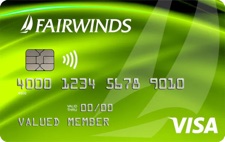
Fairwinds CU Cash Back Card0% Introductory APR for 12 months on purchases and balance transfers and no balance transfer fees. After the intro APR offer ends, a variable APR will apply. You must be an Fairwinds Credit Union member to obtain this card, but membership is open to everyone. You must also keep a nominal $5 in a share savings account. Also earns 1.5% cash back on purchases. No annual fee.

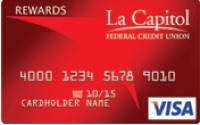
La Capital FCU Rewards Card0% Introductory APR for 12 months on balance transfers and no balance transfer fee during the first 90 days after account opening. After the intro APR offer ends, a variable APR will apply. You must be an La Capitol Federal Credit Union member to obtain this card, but membership is open to everyone who joins a partner organization for as little as $20 (Louisiana Association for Personal Financial Achievement). You must also keep a nominal amount (usually around $5) in a share savings account. No annual fee.

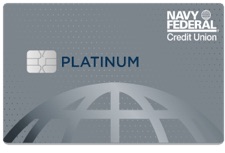
Navy Federal CU Platinum Card0.99% Introductory APR for 12 months on balance transfers during the first 60 days after account opening and no balance transfer fees. (This is not 0%, but ~1% is still quite rare in the current interest rate environment.) After the intro APR offer ends, a variable APR will apply. You must be an Navy Fedral Credit Union member to obtain this card, and membership is limited to those with a military affiliation, although it does include anyone whose immediate family member serves or has ever served in the military. You must also keep a nominal amount (usually around $5) in a share savings account. No annual fee.

Comparing a shorter no-fee balance transfer vs. a longer one with a modest fee. As of January 2024, the average credit card interest rate is roughly 24% APR (!). If you are paying 24% APR, that’s like paying 2% on your balance every month (!). Paying a 3% upfront fee for an 21 month period of 0% would be like paying your current interest rate for 1.5 months and then getting 0% interest for the remaining 19.5 months. That may be preferable to 12 months at 0% with no balance transfer fee, especially if you spread out your payments over the entire period and use that additional time to pay it all off by the end. Here is an example comparison.

  • $5,000 balance, 24% APR, 12 month payoff = $472 per month for 12 months. ($5,673 total paid)
  • $5,000 balance, 0% APR + No BT fee, 12 month payoff = $417 per month for 12 months. ($5,000 total paid)
  • $5,000 balance, 24% APR, 21 months payoff = $293 per month for 21 months. ($6,172 total paid)
  • $5,000 balance, 0% APR + 3% BT fee, 21 month payoff = $245 per month for 21 months. ($5,150 total paid)
  • $5,000 balance, 0% APR + no BT fee, 21 month payoff = $238 per month for 21 months. ($5,000 total paid) ** not an available offer **

I can see how one might prefer the $245 per month for 21 months, even thought it results in a slightly higher total amount paid than the $417 per month for 12 months. Especially if this creates an attainable plan that the end of 21 months, you are debt-free and you saved over $1,000 in interest ($6,172 vs. $5,150). Even if there was no balance transfer fee for 21 months (which unfortunately isn’t an option), the difference would only be $7 per month.

If you are sure you can pay it all off within the shorter 0% period, then you should pick the no balance transfer fee option.

Best Low Fee, Longer-Term 0% APR Balance Transfer Offers

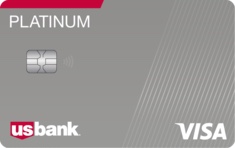
US Bank Visa Platinum Card  – 0% Intro APR on purchases and balance transfers for 21 billing cycles. After the intro APR offer ends, a variable APR will apply. There is a 3% balance transfer fee ($5 minimum). Side perk of up to $600 in cell phone protection. No annual fee.

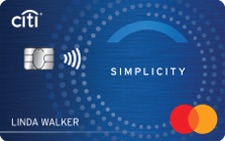
Citi Simplicity® Card – 0% Intro APR on balance transfers for 21 months from date of first transfer. All transfers must be completed in first 4 months. This unique card has no late fees and no penalty interest rate. You also get 0% Intro APR on purchases for 12 months from date of account opening. After the intro APR offer ends, a variable APR will apply. There is a 3% balance transfer fee ($5 minimum). No annual fee.

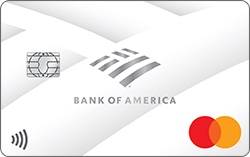
BankAmericard Credit Card – 0% Intro APR for 18 billing cycles for purchases and balance transfers made in the first 60 days of opening your account. After the intro APR offer ends, a variable APR will apply. There is a 3% balance transfer fee. No annual fee.

Wells Fargo Reflect Card – 0% Intro APR on balance transfers and purchases for 21 months from date of account account opening. Balance transfers must be made within 120 days from account opening There is 5% balance transfer fee (min $5). No annual fee.

Wells Fargo Reflect Card – 0% Intro APR for 18 months for purchases and balance transfers. After the intro APR offer ends, a variable APR will apply. There is a 3% balance transfer fee ($5 minimum) for balance transfers made in the first 60 days of opening your account. No annual fee.