Simple, Easy, Frugal Ideas For Emergency Preparedness

June 1st is the start of Hurricane season for the East Coast, it’s always Earthquake season on the West Coast, and it’s near peak season for Tornadoes in many states, so in general it’s a good time in general to check up on your disaster plans. While there are several places like FEMA and the Red Cross that will have extensive lists of what you should have, but really, do you keep 3 days worth of food in your house, your car, and at work? Okay, I’m sure some of you do, but I don’t.

Instead, I liked reading about simple and easy things you can do that will still make a big difference if you are out of power and other services for several days. Most of these things are free, or involve slight changes to your buying patterns on stuff you would have bought anyways.

Food: Stockpile and Rotate Your Pantry
I wonder if it is necessary to buy 20 cans of beans or military MREs and stick them in a box somewhere. Chances are that most of us could live off of what we have in our cabinets for a least a few days. To improve on that, just be aware and buy extra of certain staples when they happen to be on sale. Canned soups, vegetables, fruits, peanut butter. Cereal, crackers, pasta, rice. Don’t let them just sit there though, buy more when needed and then eat the items before they get stale. I just put an empty duffel bag in the pantry with a manual can opener inside so I could throw some stuff in there and run if really needed. If the power does go out and you stay at home, remember to eat the perishable food in the refrigerator first, followed by the food in the freezer, so that you can saved the canned goods for last.

Water
If you buy bottled water, keep an extra case, and rotate as needed by the expiration dates so that the water stays fresh. You can also store tap water in old 2-liter soda bottles which are sanitized first with a bit of chlorine bleach. This should cost essentially nothing. During an actual emergency, another trick is to save and use the water held in the tank of your hot water heater.

Cooking and Heating: Keep Your Propane Tank Halfway Full
If you have a propane grill, you can use it for cooking when without power or natural gas. Do not use your grill indoors, though, to avoid carbon monoxide poisoning. If you live in an area where it gets especially cold, there are indoor propane heaters with built-in sensors that will let you heat your house safely. Propane is a lot easier to store safely than gasoline!

Transportation: Keep Your Gas Tank At Least 1/4 Full
So, where is the safest place to store large quantities of gasoline in an emergency? Your car! So stop seeing how close you can get to “E” before filling up. Besides, if you really need to go somewhere in an emergency, you need to go, not stop by at the nearest gas station first. This way you’ll be a good 50-100 miles away before having to stop. Also, having lots of gas means that you can…

Power: Use Your Car Engine For Electricity
I think a great tool to have around is a cheap power inverter (available for $30 including shipping) that will let you plug in lights for your house, a radio/TV/laptop, or just charge your cell phone using your running car. Just plug into your cigarette adapter (lower watts) or connect to your car batter (higher watts). Comes in mighty useful for road trips as well.

Everything Else: Cash
No, it won’t be able to earn any interest, but having a decent amount cash handy can be very helpful. Stores may not take credit cards when there is a blackout due to fraud, which I found when trying to buy some things at my local hardware store during a blackout. Coincidentally, there were having a special on those hand-crank radio/flashlight combos so I picked one up. 🙂 I’m not sure how much is a good amount to have in the house safebox. Between $100-$500?

This list isn’t exhaustive, just what I could think up, so please share your own ideas in the comments.

Weekend Links: College, Jobs, and Junk

ISPF of GradMoneyMatters ponders whether parents should influence their children’s college applications. It’s a tough question, even if the parents refuse to pay, it’s not easy for a kid to simply “pay for it themselves” because the current financial aid system assumes the parents will cover a certain amount.

Patrick at CashMoneyLife quits his job and is about to start a new one, but is faced with a counteroffer from his current employer. Tricky situation, but it must be nice to be liked so much.

JD of GetRichSlowly reminds us that college students throw away some sweet crap when the semester ends. I’m sure I threw away some good stuff in my day. When I moved into my first apartment, we bought all the furniture inside from the old tenants for $50. That couch ended up lasting me 10 years…

NCN of No Credit Needed discussed his $100 a day rule to control impulse buying (and the resulting accumulation of junk). $100 a month is more like it for me… unless it involves tasty hole-in-the-wall international food. 🙂

Too late? Got junk? Trent of The Simple Dollar talks about the process of selling everything you don’t want anymore. I think I need to move about three more times, and that will force me to get rid of the last of my idle things.

Finally the New York Times had an article about voluntary simplicity and a family trying to minimize their stuff. Mentioned and via Unclutterer.

Ask The Readers: Wedding Gifts – How Do You Decide How Much To Give?

It’s wedding season again, and we have a variety of weddings coming up from a mix of close friends, not-so-close friends, relatives, and co-workers. This is probably not polite conversation, but hey, I’m all about discussing otherwise taboo financial topics. So, when deciding on how much to spend on a wedding gift, what factors do you consider?

How Close Are You?
This is simple – do you give more to your closer friends or family? Or are all weddings equally beautiful?

How Fancy Is The Wedding?
This the “at least cover your meal” philosophy. With all this talk about frugal weddings vs. monster weddings, it is clear (after paying for our own wedding) that some weddings have cost about $50 per person, while others will have cost $200 per person. As a guest, do you feel obligated to give a bigger gift when you know the food and setting are more extravagant?

I’m kind of mixed about this philosophy. So if you have two equally close friends, and one decides to throw a mega-bash destination wedding with filet mignon while the other friend has a small gathering in their backyard, you are supposed to give more to the former couple? This also would suggest that if you are not able to attend, then you can give a smaller gift. Hmm.

Your Financial Situation?
Now that we are labeled as a “successful professional couple”, is there more pressure to give a bigger gift? If a person is currently going back to school, are unemployed, or have chosen a career path with a lower assumed salary, do you feel that they should be able to give less?

What factors affect your wedding gift size? (Check all that apply.)

View Results

Loading ... Loading ...

No Rice For You!

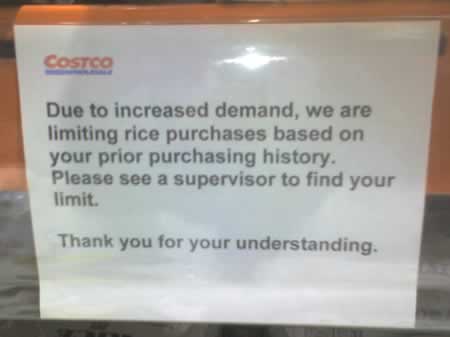
While shopping at Costco yesterday, I was greeted with a peculiar sign:

altext

We bought one bag, which apparently did not require supervisor approval. My weak understanding of all the buzz:

1. Rice prices globally are rising.
2. This is greatly affecting countries like China, Vietnam, India, who are usually great exporters.
3. They may not export as much.
4. US citizens will likely pay more as a result.
5. Big rice buyers like bakeries worried, want to buy lots of rice now.
6. Costco and Sam’s want enough rice to make all their customers happy, so they limit purchases.
7. Buzz from CNN playing this story all day long causes (I think) undue hoarding.

But, why not just raise the prices now? It’s not like a Wii where the price is set by Nintendo. Is this happening near you as well?

Links: Wisdom, Hope, Knowledge Edition

More posts from other bloggers that also hopefully made me wiser and smarter:

Millionaire Mommy Next Door reminds us that there is more than one right answer on how to get rich. Lots of wisdom here. While I’m reading all these financial books, I think many people who do get rich think their way is the best way, and the fact that they are rich somehow proves that. It doesn’t!

Mrs. Micah shares what busts her budget. I never though of my hopefulness as costly, but my forgetfulness is definitely up there.

JLP of AllFinancialMatters teams up with his wife to present the five things they want their kids to know about money. Highly sensible knowledge to impart!

SVB’s Digerati Life drops some tips on making 10 ordinary things last longer. It made me feel slightly better about trying not to waste the last of my shampoo by watering it down…

Ginger of GirlsJustWannaHaveFunds discusses mothers deciding whether or not to work after a baby. It’s funny how things change. For a while I was the one who wanted to stay at home with the kids, but now our goals seem to be switched. Hopefully our double-half-time idea pans out. Our financial life test-drive is working out pretty well so far.

Links: Minimalism, Ad Vaccines, Roth 401k, and More

More articles from other bloggers:

  • Jacob of Early Retirement Extreme explores his minimalist inspirations. I just watched the move Into the Wild this weekend, about a new college grad who abandons his possessions, gives his entire $24,000 savings account to charity, and hitchhikes to Alaska to live in the wilderness. I always like it when people break from the norm, even if I choose not to do it myself.
  • Lisa Tiffin has a guest post at Get Rich Slowly about inoculating your kids against advertising. The analogy is great, and may save me a lot of saying “No” in the years to come.
  • The Finance Buff explains why he chose a Traditional 401k over a Roth 401(k). I enjoyed his explanation of how your effective tax rate in retirement may be a blend of different tax brackets, often resulting in a lower rate than you might think.
  • Singla Ma of Fabulous Financials shares her notes about a workshop for The Professional Woman. After reading this and Suze Orman’s book Women & Money, I have definitely found similar differences in how my wife and I handle things in the workplace.
  • JB of Get Rich or Die Trying posted his new monthly budget in detail, all the way down to his Netflix subscription. For the voyeurs.
  • Finally, I’d like to congratulate my sister for shopping smart when she found a top she wanted at Gap, but a button loop was broken and it was the last one in her size. Instead of leaving it, or paying full price anyway, she remembered my Home Depot experience and asked politely for a discount… and got 50% off. Now if only I could convince her to open up that IRA on top of funding her 401k… 😉

Links: Rental Nightmares, Housing Cares, Buffett Shares, and More

Here are some posts I found useful while reading my fellow financial bloggers and more:

SingleGuyMoney shares some of his rental property issues. Apparently even buying a home warranty from American Home Shield won’t ease all repair headaches, as it doesn’t cover pre-existing problems (even if they were unknown).

PaidTwice shares why she doesn’t care what her house is worth. I agree in that my housing payment is pretty much set for the foreseeable future. If anything, I want prices to go down. Because that means that my friends might be able to afford a house, and then I can perhaps get a good deal on a second property.

Canadian Capitalist shares his notes from the 2007 Berkshire Hathaway Annual Report. It’s actually pretty fun to read, although I do admit I usually get bored after a few pages and have to read it in parts.

The Honest Dollar advises us to avoid the recency bias. Seriously. Can we finally admit that we can’t see 3 years ahead? Just a few years ago the “experts” were saying how the economy is so resilient and earnings are solid and blah blah blah. Now it’s all “recession-proof your portfolio!”. Tune out all this noise!! Nowhere in my asset allocation decision process is there a factor of “does the market look gloomy?”

Jim at Blueprint For Financial Prosperity talks about the Airborne class action lawsuit. High school teacher who “got sick a lot” doesn’t make wonder drug? Shocker!

JD of GetRichSlowly points out another reason to be wary of gift cards. If you have some Sharper Image gift cards – congratulations! They’re useless.

A co-worker sent me this Couch-to-5K Running Plan. Seems like a good guide to get off your tush and finish a 5K if you’ve never done one before. If I was clever I’d find some parallels with personal finance.

Free Credit Score Report Card and Analysis

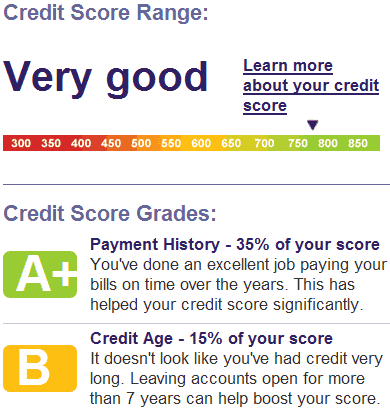
In case the last 5 free ways to get your credit score weren’t enough, there’s also the free Credit.com Report Card. It is actually a pretty comprehensive analysis, providing:

  • Credit Score Range: This provides a hint of your credit score based on the standard FICO range of 300-850. (You have to pay for the specific number… see below)
  • Credit Score Grades: School-style grades (A-, C+) of each of the main factors in FICO scores: Payment History, Debt Usage, Credit Age, Account Mix, and Recent Inquiries.
  • Actual Credit Report Details: Your address on file, employer data, total accounts, total credit limits, number of inquiries, etc.

Here’s an example screenshot:

altext

I’ve bought my credit report and score before, and this is the kind of information I would find useful anyhow. I don’t care if my score is 728 vs. 732 vs. 721 since slight changes occur all the time. Note that this analysis is based on your data from the TransUnion credit bureau only. You can upgrade to reports from all three credit bureaus plus actual credit scores for $14.95 per month.

Finding Cheap or Discounted Ski Lift Tickets

This is a bit late in the season, but if you like to ski or snowboard be sure to sign up for the e-mail newsletter by SlidingOnTheCheap.com. They send out a free weekly newsletter that summarizes all of the specials and discounts offered by each of the resorts in most of the major US ski areas: Lake Tahoe, Colorado, Pacific Northwest, New England, Utah, and Southern California. It saves a lot of time versus tracking all of the changes on each of the websites separately. They also give away several free lift tickets each week, and occasionally get their own subscriber-only deals.

It’s always good to stay subscribed year-round because often ski resorts will sell some really cheap season passes early on in the year. For the Lake Tahoe area specifically, you can also bookmark SnowBomb.

Otherwise, if you are willing to take a gamble on buying some employee freebies or lift-ticket credits, you can either keep your eye open at the resort for scalpers or try on your local Craiglist ahead of time (just search “lift tickets”). We recently saved $24 on each of 4 lift tickets this weekend this way.

Subprime Loan Crisis Explained By Cartoon Stick Figures

Here’s a funny yet educational slide show (alternate link) explaining how the subprime mortgage mess was created through some complex financial trickery and well… simple and stupid assumptions. You know, like (1) housing prices always go up and (2) you can always refinance to another loan. There are a few expletives, but I would rate it PG-13.

altext

Thanks to Kirsten who e-mailed it to me. I couldn’t find an author, but it seems to have been first posted online by The Big Picture.

Stanford Offers Free Tuition To Low and Middle-Income Families

You may have heard that Stanford University is waiving tuition for students with families making less than $100,000 annually. If your family makes less than $60,000, room and board is waived as well. This is not chump change: Annual tuition for Stanford is around $35,000 a year and housing is $11,000 a year.

What was interesting was the last line: Only about a third of students are expected to qualify. According to the 2006 census only 19% of US households made more than $100,000. For the students at Stanford, approximately 67% of families make more than $100,000. Of course, Stanford is in California where the incomes are higher overall. Still, this information makes me want to know the income breakdown of various community, state, and private schools out there. It will also be interesting to see what Stanford’s make-up becomes after this decision comes into effect.

In an ideal world, such things wouldn’t matter, but it’s quite apparent from this move that it does. Many qualified students don’t apply to certain schools due to high costs, and this will help Stanford get more of those kids. Financial aid may bridge the gap with loans, but not everyone wants to leave school with $100,000 in loans.

Reader Question: Handling a Bank Error In My Favor?

Reader Kristina from Arizona has a problem. Well, some might not see it as a problem, but here it is:

On December 7, 2007, I had $2,802.00 deposited into my business checking account at Wamu. A chunk of change I must say. I called the bank to ask them about it and said they would put in search and see if there is a match in the system for anyone with missing funds. They told me that it was a counter, CASH deposit made in Georgia. I live in Arizona and have never been to Georgia. The bank said they would call me when they found something.

So a week goes by and I hear nothing. I call the bank again and ask them about it. Still nothing. Then another week goes by. I call the bank a 3rd time and still nothing and tell me they will do another search. I called today and asked them if they could send me a copy of the deposit slip. So they will be sending it out soon.

I really don’t know what I should do. I know the money is not mine, but what if I never caught the deposit in the first place and used that money? Would I get in trouble for using that money that is in MY account?

The bank has made an error. I think the bank should have to fork out the money back to the person who made the deposit and let me keep the money. OK OK maybe that is a little to greedy. But who wouldn’t want some extra money!

It’s been over 2 months and still waiting.

So what I did with the money for now is put it into my IngDirect Savings to earn a little money on it for the time being.

I would love everyones thoughts on this. Please help!

So a bit of ethics, and a bit of legality. My non-lawyer, non-ethicist opinion is this: It was correct to contact them about it, both in terms of ethics and to avoid any future legal hassles. But I would also document that contact somehow, either through a letter, saved e-mail, or signed acknowledgment by a bank employee. Otherwise, I’d probably do what you did. If someone claims it correctly, they can have it, but in the meantime there is nobody to actually give it back to, so I’d keep it.

Any other viewpoints or suggestions for Kristina? Has a similar bank error happened you to you, or perhaps one not in your favor?