Marriott Bonvoy Boundless Card Review: 3 Free Nights (50k Points Each)

The Marriott Bonvoy Boundless credit card is one of the co-branded rewards card for Marriott hotels (including the 7,000 hotels participating in Marriott Bonvoy® resulting from the merger of Starwood Preferred Guest and Marriott). Here are the highlights:

  • Earn 3 Free Night Awards (each night valued up to 50,000 points) after spending $3,000 on purchases within the first 3 months from account opening. That’s a total potential value of 250,000 points. Certain hotels have resort fees.
  • Earn 3X points per $1 on the first $6,000 spent in combined purchases each year on grocery stores, gas stations, and dining.
  • 1 Free Night Award (valued up to 35,000 points) every year after account anniversary.
  • 1 Elite Night Credit towards Elite Status for every $5,000 you spend.
  • Earn up to 17X total points per $1 spent at over 7,000 hotels participating in Marriott Bonvoy(R) with the Marriott Bonvoy Boundless(R) Card.
  • 2X points for every $1 spent on all other purchases.
  • Automatic Silver Elite Status each account anniversary year. Gold Status when you spend $35,000 on purchases each account year.
  • 15 Elite Night Credits each calendar year.
  • No Foreign Transaction Fees.
  • $95 annual fee.

Keep in mind the following:

This credit card is not available to you if (1) you currently have any of the following cards or (2) you received a new cardmember bonus for any of the following cards within the last 24 months: Marriott Bonvoy® Premier credit card, Marriott Rewards® Premier credit card, Marriott Bonvoy Boundless® credit card, Marriott Rewards® Premier Plus credit card, Marriott Bonvoy Bold® credit card.

The Marriott Bonvoy program no longer has a fixed hotel category chart for booking points. You can still use these points at either Marriott properties (Ritz-Carlton, Renaissance Hotels, Courtyard, Residence Inn, Springhill Suites, Fairfield Inn & Suites) or former Starwood Properties (Westin, Sheraton, The Luxury Collection, Four Points by Sheraton, W Hotels, St. Regis, Le Méridien, Aloft), but now it is “dynamic” awards where the points required are more linked to the actual cash cost than before.

For reference, 50,000 Bonvoy points used to get you a peak award at Courtyard Waikiki Beach in Hawaii, a standard or off-peak award at the Sheraton Kauai Resort or Residence Inn Maui Wailea, or an off-peak award night at the Westin Moana Surfrider in Waikiki, Honolulu or the Westin Princeville Ocean Resort Villas.

What is a reasonable estimate for the value of a Marriott Bonvoy point? Based on multiple real-world searches of redeemable properties, I choose to use a conservative estimate of 0.70 cents per Bonvoy point. That means 50,000 Bonvoy points = estimated $350 redeemable value, and 100,000 Bonvoy points = estimated $700 redeemable hotel night value. However, I almost always get closer to 1 cent per point value when I actually choose to redeem. Remember to compare the full price of the hotel price with all taxes, as that is what you would have to pay instead of just points.

You can use the Marriott free night search tool to price out some sample hotels for yourself. Also, here are details on the Free Night Award Top Off option.

Bonvoy Points can also be transferred to airline miles with a bonus. 60,000 Marriott points = 25,000 airline miles. Similar to the old Starwood bonus structure, they will add 15,000 points for every 60,000 points you transfer to airline miles. More information here.

Finally, Marriott points are also convertible to gift cards, but it takes 60,000 points to redeem for a $200 gift card for Marriott or retailers like Best Buy, Home Depot, or Nordstrom. That ratio isn’t all that great so you’ll definitely get the most value via hotel night redemptions or airline miles transfer.

Free Night Award with Card Renewal. At your card anniversary (when you pay the annual fee), you will receive a Free Night Award that is good for one night (redemption level at or under 35,000 Marriott Bonvoy points) at a participating hotel. This excludes the very top properties, but for regular travelers it will be very easy to get your $95 value. Here are some sample hotels that I have tried to book in the past that came in at or under 35,000 points for selected dates:

  • Sheraton Kona Resort (Big Island, Hawaii)
  • Westin Hapuna Beach Resort (Big Island, Hawaii)
  • Courtyard Waikiki Beach (Honolulu, Oahu)
  • Sheraton Kauai Resort (Kauai, Hawaii)
  • W Atlanta
  • New York Marriott at the Brooklyn Bridge
  • Chicago Marriott Downtown Magnificent Mile
  • W Chicago
  • The Ritz-Carlton, Beijing, China
  • The S. Regis Bangkok, Thailand

Find a hotel that costs 40,000 points a night or 50,000 points? For example, I recently booked the Westin Maui at 60k points a night. You can just pay the difference in points, as long as the difference is within 15,000 points. Here are details on the Free Night Award Top Off option.

You can add up to 15,000 Marriott Bonvoy® points to any Free Night Award that you have earned. So if it’s a 50k Free Night Award, you can add up to 15k to redeem at hotel that has Standard Room at a cost of 65,000 points per night.

No annual fee alternative. The Marriott Bonvoy Bold card is also offers bonus points and some (lesser) perks, but with no annual fee.

Bottom line. The Marriott Bonvoy Boundless credit card (formerly the Marriott Rewards Premier Plus Credit Card) is currently offering a special offer for new cardholders. As with all hotel cards, the value is dependent on your unique travel preferences. If you stay at Marriott/Starwood properties regularly, the free night award every year should easily cover the annual fee.

Also see: Top 10 Best Credit Card Bonus Offers.

The information for theMarriott Bonvoy Boundless Card has been collected independently by My Money Blog. The card details on this page have not been reviewed or provided by the card issuer.


IHG One Rewards Premier Credit Card Review: 140,000 Points Offer

The IHG One Rewards Premier Credit Card is the premium IHG hotel co-branded card that includes special IHG perks like a free night award every year you keep the card, Elite status, and every 4th award night free. Here are the highlights:

  • 140,000 Bonus Points after you spend $3,000 on purchases in the first 3 months from account opening.
  • Free Award Night after each account anniversary year at eligible IHG hotels worldwide. Valid at IHG Hotels with a current point redemption cap of 40,000 points. NEW: You can now also pay the difference over 40,000 points to redeem your Anniversary Night at hotels above the 40,000 point redemption level.
  • 4th Award Night Free. Enjoy a free reward night when you redeem points for a consecutive four-night IHG(R) hotel stay. That means if you use points to pay for 3 nights in a row, the 4th night is free. You can even book 8 award nights total and get two of them free, and so on. Works on any award level.
  • Earn up to 26 total points per $1 spent when you stay at IHG Hotels & Resorts.
  • Earn 5 points per $1 spent on purchases on travel, at gas stations, and restaurants. Earn 3 points per $1 spent on all other purchases.
  • Automatic Platinum Elite status included as a Premier card member. IHG points also don’t expire when you are an Elite member.
  • Global Entry, TSA PreCheck® or NEXUS statement credit of up to $100 ($120 starting 10/1/24) every 4 years as reimbursement for the application fee charged to your card.
  • No foreign transaction fees.
  • IHG One Rewards Bonus points are redeemable at Hotels & Resorts such as InterContinental®, Crowne Plaza®, Kimpton®, EVEN® Hotels, Indigo® Hotels & Holiday Inn®.
  • $99 annual fee.

Please note the following:

This product is available to you if you do not have a current IHG One Rewards Credit Card and have not received a new Cardmember bonus within the last 24 months. This does not apply to Business Card Credit Card products.

What can you get with IHG points? The best redemption value for IHG points is for free hotel nights. The other options offer significantly less value. While the points don’t translate directly to a dollar value, but overall a conservation valuation is 0.50 cents of value per point, which would make 140,000 IHG points worth an estimated $700 value. You can perform the calculations for hotels that fit your needs. I tried a bunch of other various combinations and got between 0.5 cents and 0.8 cents per point equivalent value.

(IHG points are worth less than other points like Hyatt or Chase Ultimate Rewards points, but you get a lot more of them with this bonus!)

IHG stands for Intercontinental Hotel Group which has over 5,000 hotels including the following brands:

  • Intercontinental Hotels & Resorts
  • Crowne Plaza
  • Kimpton
  • Holiday Inn, Holiday Inn Express
  • Staybridge Suites
  • Candlewood Suites
  • Hotel Indigo
  • EVEN Hotels

Fourth Reward Night Free

The 4th Reward night free perk can be very valuable and nice to see on a card with no annual fee. You get the fourth reward night free when you redeem points for a consecutive four-night IHG hotel stay (only pay for 3 nights with points). It showed up automatically for me when booking with points online.

For each standard room Reward Night stay of 4 or more nights, every 4th night is free. Applies only to 4 or more consecutive nights within the same Reward Night point redemption room stay at the same property. With this benefit, eligible members will be charged the Reward Night point redemption rate for the first 3 nights, and 0 points for the 4th night of the stay, as applicable. Members can utilize the 4th Reward Night Free benefit on an unlimited number of stays annually.

IHG points expire after 24 months of inactivity, so if you keep up your activity then you can save up these free nights for later. Chase Ultimate Rewards points also convert to IHG points.

Total of 26X points per $1 spent when you stay at IHG. Here’s how this breaks down: Earn 10X points from IHG® for being an IHG One Rewards Member + 10X points with this card + 6X points from IHG® with Platinum Elite Status with Platinum Elite Status (a benefit of this card) = total of 26X points total at 5,400+ IHG® hotels & resorts.

The rewards on other purchases has improved to the following:

  • 5X IHG points per $1 spent at gas stations, dining, and travel (including hotels).
  • 3X IHG point per $1 spent on all other card purchases

I would keep this card if you can use the anniversary night certificate with the 40,000 point maximum value. You should be able to get $99 value out of it as long as you need a hotel night. Stay must be completed within 12 months from date of issue.

Don’t want a card with an annual fee? The no-annual fee Traveler version has a very competitive bonus right now.

Bottom line. The IHG One Rewards Premier Credit Card includes a sign-up bonus and special IHG perks like a free night award every year you keep the card, Elite status, and every 4th award night free. As with most of these co-branded cards, the best value is obtained if you can redeem for IHG hotel nights.

I will be adding this to the Top 10 Best Credit Card Bonus Offers.

The information for the IHG One Rewards Premier Credit Card has been collected independently by My Money Blog. The card details on this page have not been reviewed or provided by the card issuer.

Best Interest Rates Survey: Savings Accounts, Treasuries, CDs, Money Markets, ETFs – June 2025

Here’s my monthly survey of the best interest rates on cash as of June 2025, roughly sorted from shortest to longest maturities. Banks and brokerages love taking advantage of our idle cash, and you can often earning more money while keeping the same level of safety by moving to another FDIC-insured bank or NCUA-insured credit union. Check out my Ultimate Rate-Chaser Calculator to see how much extra interest you could earn from switching. Rates listed are available to everyone nationwide. Rates checked as of 6/4/2025.

TL;DR: Savings account interest rates are mostly stable overall, topping out around 4.60% APY. Short-term T-Bill rates at around 4.3%. Top 5-year CD rates are ~4.25% APY, while 5-year Treasury rate is ~4%.

High-yield savings accounts*
Since the huge megabanks still pay essentially no interest, everyone should at least have a separate, no-fee online savings account to piggy-back onto your existing checking account. The interest rates on savings accounts can drop at any time, so I list the top rates as well as competitive rates from banks with a history of competitive rates and solid user experience. Some banks will bait you with a temporary top rate and then lower the rates in the hopes that you are too lazy to leave.

  • The top saving rate at the moment: Elevault at 4.60% APY (no min), which appears to be an app-only subsidiary of Southern Bancorp, member FDIC (and thus not a fintech). The “good/excellent” savings rate zone appears to be roughly 4% and above. CIT Platinum Savings is now at 4.10% APY with $5,000+ balance. There are many banks in between.
  • There are also now a lot of savings accounts with higher rates but also added hoops. Examples: Roger.bank at 4.65% APY (no min), but does require an additional companion checking account. Axos One Savings at 4.66% APY (no min), but requires an Axos One Checking with direct deposit of $1,500+ and minimum balance of $1,500.
  • SoFi Bank is at 3.80% APY + up to $325 new account bonus with direct deposit. You must maintain a direct deposit of any amount (even $1) each month for the higher APY. SoFi has historically competitive rates and full banking features. See details at $25 + $300 SoFi Money new account and deposit bonus.
  • Here is a limited survey of high-yield savings accounts. They aren’t the top rates, but a group that have historically kept it relatively competitive such that I like to track their history. I’d call this the “okay/good” zone of 3.50%+.

Short-term guaranteed rates (1 year and under)
A common question is what to do with a big pile of cash that you’re waiting to deploy shortly (plan to buy a house soon, just sold your house, just sold your business, legal settlement, inheritance). My usual advice is to keep things simple and take your time. If not a savings account, then put it in a flexible short-term CD under the FDIC limits until you have a plan.

  • No Penalty CDs offer a fixed interest rate that can never go down, but you can still take out your money (once) without any fees if you want to use it elsewhere. Marcus has a 7-month No Penalty CD at 4.00% APY ($500 minimum deposit) and 13-month at 3.90% APY. Farmer’s Insurance FCU has 9-month No Penalty CD at 4.25% APY ($1,000 minimum deposit). Kinecta FCU has 9-month Liquid CD at 4.25% APY ($10,000 minimum) that allows for daily penalty-free withdrawals of up to 50% of the start of day balance. Consider opening multiple CDs in smaller increments for more flexibility.
  • Eagle Bank has a 12-month certificate special at 4.55% APY ($1,000 min). Early withdrawal penalty is 90 days of interest.

Money market mutual funds
Many brokerage firms that pay out very little interest on their default cash sweep funds (and keep the difference for themselves). Note: Money market mutual funds are highly-regulated, but ultimately not FDIC-insured, so I would still stick with highly reputable firms.

  • Vanguard Federal Money Market Fund (VMFXX) is the default sweep option for Vanguard brokerage accounts, which has an SEC yield of 4.23% (changes daily, but also works out to a compound yield of 4.31%, which is better for comparing against APY). Odds are this is much higher than your own broker’s default cash sweep interest rate.
  • Vanguard Treasury Money Market Fund (VUSXX) is an alternative money market fund which you must manually purchase, but the interest will be mostly (100% for 2024 tax year) exempt from state and local income taxes because it comes from qualifying US government obligations. Current SEC yield of 4.23% (compound yield of 4.31%).

Treasury Bills and Ultra-short Treasury ETFs
Another option is to buy individual Treasury bills which come in a variety of maturities from 4-weeks to 52-weeks and are fully backed by the US government. You can also invest in ETFs that hold a rotating basket of short-term Treasury Bills for you, while charging a small management fee for doing so. T-bill interest is exempt from state and local income taxes, which can make a significant difference in your effective yield.

  • You can build your own T-Bill ladder at TreasuryDirect.gov or via a brokerage account with a bond desk like Vanguard and Fidelity. Here are the current Treasury Bill rates. As of 6/4/25, a new 4-week T-Bill had the equivalent of 4.28% annualized interest and a 52-week T-Bill had the equivalent of 4.08% annualized interest.
  • The iShares 0-3 Month Treasury Bond ETF (SGOV) has a 4.17% SEC yield (0.09% expense ratio) and effective duration of 0.10 years. SPDR Bloomberg Barclays 1-3 Month T-Bill ETF (BIL) has a 4.13% SEC yield (0.136% expense ratio) and effective duration of 0.15 years. The new Vanguard 0-3 Month Treasury Bill ETF (VBIL) has a 4.19% SEC yield (0.07% expense ratio) and effective duration of 0.10 years.

US Savings Bonds
Series I Savings Bonds offer rates that are linked to inflation and backed by the US government. You must hold them for at least a year. If you redeem them within 5 years there is a penalty of the last 3 months of interest. The annual purchase limit for electronic I bonds is $10,000 per Social Security Number, available online at TreasuryDirect.gov.

  • “I Bonds” bought between May 2025 and October 2025 will earn a 3.98% rate for the first six months. The rate of the subsequent 6-month period will be based on inflation again. More on Savings Bonds here.
  • In mid-October 2025, the CPI will be announced and you will have a short period where you will have a very close estimate of the rate for the next 12 months. I will post another update at that time.

Rewards checking accounts
These unique checking accounts pay above-average interest rates, but with unique risks. You have to jump through certain hoops which usually involve 10+ debit card purchases each cycle, a certain number of ACH/direct deposits, and/or a certain number of logins per month. If you make a mistake (or they judge that you did) you risk earning zero interest for that month. Some folks don’t mind the extra work and attention required, while others would rather not bother. Rates can also drop suddenly, leaving a “bait-and-switch” feeling.

  • OnPath Federal Credit Union (my review) pays 7.00% APY on up to $10,000 if you make 15 debit card purchases, opt into online statements, and login to online or mobile banking once per statement cycle. Anyone can join this credit union via $5 membership fee to join partner organization. You can also get a $100 Visa Reward card when you open a new account and make qualifying transactions.
  • Genisys Credit Union pays 6.75% APY on up to $7,500 if you make 10 debit card purchases of $5+ each per statement cycle, and opt into online statements. Anyone can join this credit union via $5 membership fee to join partner organization.
  • La Capitol Federal Credit Union pays 5.75% APY on up to $10,000 if you make 15 debit card purchases of at least $5 each per statement cycle. Anyone can join this credit union via partner organization, Louisiana Association for Personal Financial Achievement ($20).
  • First Southern Bank pays 5.50% APY on up to $25,000 if you make at least 15 debit card purchases, 1 ACH credit or payment transaction, and enroll in online statements.
  • Credit Union of New Jersey pays 6.00% APY on up to $25,000 if you make 12 debit card purchases, opt into online statements, and make at least 1 direct deposit, online bill payment, or automatic payment (ACH) per statement cycle. Anyone can join this credit union via $5 membership fee to join partner organization.
  • Andrews Federal Credit Union pays 5.50% APY (down from 6%) on up to $25,000 if you make 15 debit card purchases, opt into online statements, and make at least 1 direct deposit or ACH transaction per statement cycle. Anyone can join this credit union via partner organization.
  • Find a locally-restricted rewards checking account at DepositAccounts.

Certificates of deposit (greater than 1 year)
CDs offer higher rates, but come with an early withdrawal penalty. By finding a bank CD with a reasonable early withdrawal penalty, you can enjoy higher rates but maintain access in a true emergency. Alternatively, consider building a CD ladder of different maturity lengths (ex. 1/2/3/4/5-years) such that you have access to part of the ladder each year, but your blended interest rate is higher than a savings account. When one CD matures, use that money to buy another 5-year CD to keep the ladder going. Some CDs also offer “add-ons” where you can deposit more funds if rates drop.

  • Mountain America Credit Union (MACU) has a 5-year certificate at 4.25% APY ($500 minimum), 4-year at 4.20% APY, 3-year at 4.15% APY, 2-year at 4.00% APY, and 1-year at 4.20% APY. Early withdrawal penalty for the 4-year and 5-year is 365 days of interest. Anyone can join this credit union via partner organization American Consumer Council for a one-time $5 fee (or try promo code “consumer”).
  • Lafayette Federal Credit Union (LFCU) has a 5/4/3/2/1-year certificates at 4.28% APY ($500 min). Slightly higher rates with jumbo $100,000+ balances. Note that the early withdrawal penalty for the 5-year is a relatively large 600 days of interest. Anyone nationwide can join LFCU by joining the Home Ownership Financial Literacy Council (HOFLC) for a one-time $10 fee.
  • You can buy certificates of deposit via the bond desks of Vanguard and Fidelity. You may need an account to see the rates. These “brokered CDs” offer FDIC insurance and easy laddering, but they don’t come with predictable early withdrawal penalties. Right now, I see a 5-year non-callable brokered CD at 4.30% APY (callable: no, call protection: yes). Be warned that both Vanguard and Fidelity will list higher rates from callable CDs, which importantly means they can (and will!) call back your CD if rates drop significantly later.

Longer-term Instruments
I’d use these with caution due to increased interest rate risk (tbh, I don’t use them at all), but I still track them to see the rest of the current yield curve.

  • Willing to lock up your money for 10 years? You can buy long-term certificates of deposit via the bond desks of Vanguard and Fidelity. These “brokered CDs” offer FDIC insurance, but they don’t come with predictable early withdrawal penalties. You might find something that pays more than your other brokerage cash and Treasury options. Right now, I see a 10-year CDs at [none listed] (non-callable) vs. 4.35% for a 10-year Treasury. Watch out for higher rates from callable CDs where they can call your CD back if interest rates drop.

All rates were checked as of 6/4/25.

* I no longer recommend fintech companies due to the possibility of loss due to poor recordkeeping and lack of government regulation. (Ex. Evergreen Wealth at 5% APY is a fintech.)

Photo by insung yoon on Unsplash

Summer Reading Programs for Kids 2025: Book It, Barnes & Noble, and More

Help encourage your kids to read this summer with the following free programs that offer some small incentives if they complete a reading goal and/or challenge:

  • Book It! Summer (Free Personal Pizza) – “Use the BOOK IT!® Mobile App to set goals, track progress, and redeem rewards. During the summer months of June, July, and August, any child that meets their parent-set reading goals can earn a free Pizza Hut® single topping Personal Pan Pizza®* from participating locations.”
  • Barnes & Noble Summer Reading Program (Free Book) – “Participation is a fun and easy way for kids to earn free books. They simply read a designated number of books – library books, books borrowed from friends or books bought at Barnes & Noble – write about their favorite part in our Reading Journal, and bring a completed Reading Journal to a Barnes & Noble bookstore. Children then choose their free book from the books listed on the Reading Journal and collect their free book from a store near them during July and August.”
  • Half Price Books Summer Reading Camp ($5 off) – “During the months of July and August campers can visit their local HPB with their completed reading logs to receive $5 Bookworm Bucks which are good for $5 off anything in store.” Need to live near a physical Half Price Books location.
  • Books A Million Summer Reading Adventure (Free Dog Man Backpack) – “Choose any four books from the summer reading adventure feature in-store or online. Write about the books you’ve read in your summer reading adventure logbook. Show your completed logbook to a store associate to receive your free backpack.”
  • Chuck E Cheese Reading Rewards (Free Play Points) – “Valid at participating locations. Limit 1 certificate per child, per day. Certificate must be presented at time of checkout. Redeem this certificate and get 10 FREE Play Points with any food purchase.”

Of course, check out your local library as well. We just completed our first summer library haul this week, me included! Last summer, the kids scored a couple of free pizzas and a free book each from Barnes & Noble, and I felt it was a fun and worthwhile activity.

YMCA Free Summer Memberships For Teens (Nationwide but Targeted)

Parent of a teen? It can be tricky to find a place for your young teens in the summer time. Check your local YMCA chapter as many are offering free summer YMCA membership for teens. Some are for specific grades, like entering 7th or 8th graders. Here are some example locations:

(Hat tip to FreeBFinder)

The YMCA can be a safe space for your teen to socialize as well as have access to gyms, pickleball/basketball courts, heated pools, fitness centers, and in-person and virtual live-stream and on-demand exercise classes.

If this really interests but nothing is shown online, I would still call your local YMCA, as some locations may not list their participation in on their websites. They may also offering discounted teen memberships, along with affordable leadership programs and/or lifeguard training. The YMCA can be a great source of first-time jobs for older teens.

Planet Fitness High School Summer Pass 2025: Free Gym Membership For Teens

Planet Fitness is running the High School Summer Pass again in 2025, which is a free gym membership for teens ages 14-19 to work out at any of its more than 2,500+ locations throughout the US and Canada. Valid from Saturday, June 1 through Saturday, August 31. Participants must work out at the location they sign up at and are not permitted to use other locations. Here is a gym locator.

Participants can work out for FREE at Planet Fitness locations (U.S. and Canada, excluding Puerto Rico) starting Sunday, June 1 through Sunday, August 31. Participants must work out at the location they sign up at and are not permitted to use other locations.

Merrill Edge + BofA Preferred Rewards = Up to $1,000 ACAT Transfer Bonus, Improved Credit Card Rewards

Updated May 2025. Merrill Edge is the self-directed brokerage arm formed after Bank of America and Merrill Lynch merged together. They are currently offering an increased cash bonus of up to $1,000 for moving “new money” or assets over to them from another brokerage firm. The offer code is 1000PR. Offer valid for both new and existing IRAs and taxable brokerage accounts (they call them Cash Management Accounts).

Here’s an overview along with my personal experience as I’ve had an account with them for a few years now.

Cash bonus. If you are holding shares of stock, ETFs, or mutual funds elsewhere, you can simply perform an “in-kind” ACAT transfer over to Merrill Edge. Your 100 shares of AAPL will remain 100 shares of AAPL, so you don’t have to worry about price changes, lost dividends, or tax consequences. Any cost basis should transfer over as well. Make a qualifying transfer and/or deposit to your new account within 45 days and maintain your balance for at least 90 days. The fine print version:

  1. You must enroll by entering the offer code in the online application during account opening or by providing it when speaking with a Merrill Financial Solutions Advisor at 877.657.3847.
  2. Fund your account with at least $20,000 in qualifying net new assets within 45 days of account opening. Assets transferred from other accounts at MLPF&S, Bank of America Private Bank, or 401(k) accounts administered by MLPF&S do not count towards qualifying net new assets.
  3. You must be enrolled in Preferred Rewards as of 90 days from meeting the funding criteria described in Step 2.
  4. After 90 days from meeting the funding criteria described in Step 2, your cash reward will be determined by the qualifying net new assets in your account (irrespective of any losses or gains due to trading or market volatility) as follows:
  • $100 bonus with $20,000+ in new assets
  • $200 bonus with $50,000+ in new assets
  • $400 bonus with $100,000+ in new assets
  • $1,000 bonus with $250,000 or more in new assets

Customers not enrolled in Preferred Rewards as of 90 days after funding will receive the following cash reward: qualifying net new assets of $20,000 to $49,999 receive $100; for $50,000-$99,999, receive $150; for $100,000-$249,999, receive $250; for $250,000 or more, receive $600.

Note that Preferred Rewards tiers usually requires a while to reach, unless you satisfy their “fast track” requirements:

You can enroll, and maintain your membership, in the Bank of America Preferred Rewards® program if you have an active, eligible personal checking account with Bank of America® and maintain the balance required for one of the balance tiers. The balance tiers are $20,000 for the Gold tier, $50,000 for the Platinum tier, $100,000 for the Platinum Honors tier, and $1,000,000 for the Diamond Honors tier. Balances include your combined, qualifying Bank of America deposit accounts (such as checking, savings, certificate of deposit) and/or your Merrill investment accounts (such as Cash Management Accounts, 529 Plans). You can satisfy the combined balance requirement for enrollment with either:

– a three-month combined average daily balance in your qualifying deposit and investment accounts, or
– a current combined balance, provided that you enroll at the time you open your first eligible personal checking account and satisfy the balance requirement at the end of at least one day within 30 days of opening that account.

After I did a similar bonus a couple years ago with a partial transfer (just enough to satisfy one of the tiers), a Merrill Edge rep contacted me and offered me a custom bonus to move even more assets over. (The bonus ratios were about the same, but higher limits.) Therefore, if you are considering this and happen to have more than $250,000 to transfer over, you may want to give them a call and see if they can offer even more money.

(Additional Outgoing ACAT Fee Reimbursement: Merrill Edge will also reimburse you any outgoing ACAT transfer fee or final closure fees that your old broker may charge you. You will need to contact Merrill directly and then send them a copy of your final statement with the fee shown.)

You can even transfer in Admiral Shares of Vanguard mutual funds – they won’t let you buy any additional shares, but you can only hold or sell them. You can, however, buy more shares of the corresponding Vanguard ETF if you wish. (Alternatively, you should consider having Vanguard convert your Admiral share into ETFs on a one-time basis that will preserve your original cost basis. After you have ETFs, you can move those over to Merrill Edge and trade them as you wish.)

The features for the account itself seem like most other online brokerages. Unlimited commission-free online stock, ETF and options trades (+ $0.65 per-contract fee). You can trade ETFs, fixed income, mutual funds, and options.

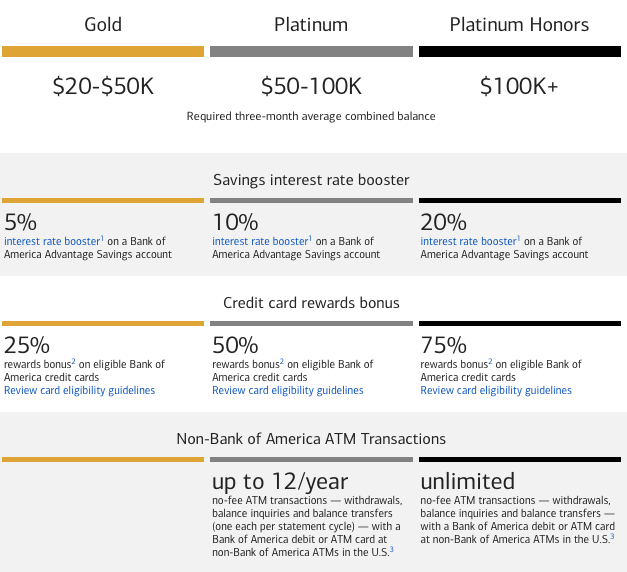
Preferred Rewards bonus. The Preferred Rewards program is designed to rewards clients with multiple account and higher assets located at Bank of America banking, Merrill Edge online brokerage, and Merrill Lynch investment accounts. Here is a partial table taken from their comparison chart (click to enlarge):

BofA checking accounts. With Gold status ($20k in assets) and above, you’ll get the monthly maintenance fee on up to 4 checking or savings accounts waived. That means you no longer have to worry about a minimum balance or maintaining direct deposit, depending on your account type. You’ll also get waived ATM fees at non-BofA ATMs at Platinum and above (12/year at $50k assets, unlimited at $100k). Free cashier’s checks.

Credit card rewards. With the Preferred Rewards boost, you can get up to 2.6% cash back on all your purchases with the Bank of America Unlimited Cash Rewards card, or 2.6% towards travel and no foreign transaction fees with the Bank of America Travel Rewards Card. You can also get 5.2% cash back on the first $2,500 in combined grocery/wholesale club/gas purchases each quarter with the Bank of America Customized Cash Rewards Card.

My personal experience. In terms of Merrill Edge, I’ve had an account with them for several years now and my lightning review is that they have a “okay/good” user interface and solidly “good” customer service (i.e. real, informed humans available 24/7 on the phone, not email-only customer service that takes hours to days like Robinhood). I am not an active trader and only make about 10-15 trades a year, but have been quite satisfied with the account. I can also move money instantly between my Merrill Edge and Bank of America checking accounts, making it relatively easy to sweep out idle cash into an external savings account, as their default cash sweep pays nearly zero interest. Don’t leave too much cash there!

The biggest financial benefit to this BofA/Merrill Edge combo with Preferred Rewards has probably been the 75% boost to their credit card rewards, allowing me to get a flat 2.625% cash back on virtually all my daily purchases. The second biggest benefit has probably been this cash bonus, and the third is the waived checking and ATM fees.

The ongoing credit card rewards would be the main reason to do this deposit offer, as the bonus percentages alone aren’t that high. For example, a $400 bonus on a $100,000 transfer amount is only 0.4%. Other brokerage transfer bonuses can be 1%, even 2%, and up.

Bottom line. Merrill Edge is currently offering up to $1,000 if you move over new assets to their self-directed brokerage. This can simply be mutual fund or ETFs shares currently being held elsewhere. When you keep enough assets across Bank of America and Merrill Edge, their Preferred Rewards program can offer ongoing perks like waived bank account fees and boosted credit card rewards.

Bank of America Unlimited Cash Rewards Card Review: 2% Cash Back for First Year (Up to 3.12% With Preferred Rewards)

New limited-time offer. The Bank of America Unlimited Cash Rewards Card is the most simple, straightforward, no-annual-fee credit card in the Bank of America line-up. If you are a Preferred Rewards client, you can increase the cash back earned by 25% to 75%. Right, they are also offering a special offer during the first year. Here are the highlights:

  • New customers: $200 cash rewards bonus after $1,000 in purchases in the first 90 days.
  • 2% cash back on purchases for the first year from account opening. After that, the standard structure is unlimited 1.5% cash back on all purchases. Redeem as a statement credit, deposit to BofA bank account, or deposit to Merrill brokerage account (including 529).
  • Bank of America Preferred Rewards® members earn 25%-75% more cash back on every purchase. However, Preferred Rewards bonuses are not applied to the 0.5% first-year bonus. Details below.
  • 0% Introductory APR offer. See link for details.
  • 3% foreign transaction fee.
  • No annual fee.

During the current limited-time offer, the cash back rewards are boosted to 2% for the first year. The 75% Preferred Rewards bonus for Platinum members does not apply to the extra 0.5%, so the net cash back during the first year for Platinum members would be 1.5% * 1.75 + 0.5% = 3.125% cash back on everything during the first year. I wonder if this is in response the recent US Bank Smartly card changes… now that new applicants can’t get a similar deal at 4% cash back, this might be the best deal in town again.

Preferred Rewards bonus basics. The Preferred Rewards program is designed to rewards clients with multiple account and higher assets located at Bank of America banking, Merrill Edge online brokerage, and Merrill Lynch investment accounts. Here is a partial table taken from their comparison chart (click to enlarge):

bofa_pref1

Let’s consider the options. Bank of America’s interest rates on cash accounts tend to be lower than highest-available outside banks (read: nearly zero), so moving cash over to qualify may result in earning less interest on your cash deposits. Merrill Lynch advisory accounts also usually come with management fees. The sweet spot is therefore the Merrill Edge self-directed brokerage, where you can move over your existing brokerage assets like stocks, mutual funds, and ETFs held elsewhere (Vanguard, Fidelity, Schwab, etc).

In the past, moving over to Merrill Edge at the Platinum and Platinum Plus levels also led to 30 to 100 free online stock trades every month. Fast forward to now, and nearly all major online brokers offer commission-free trades anyway.

Personally, I moved over $100k of brokerage assets from Vanguard to Merrill Edge to qualify for Platinum Honors. You should ask Merrill Edge if they will cover any ACAT transfer fees involved. I realize not everyone will have this level of assets to move around, but if you do then it is worth considering. Keep in mind that it will take a while for your “3-month average combined balance” to reach the $100k level and officially qualify for Platinum Honors. (In certain cases, when you open a new Merrill Edge account and new BofA Checking with a asset transfer bonus offer, you may be eligible to “fast track” to a higher tier.) You might become Gold first, then Platinum, and so on. After that, the 25%-75% rewards bonus on credit card rewards kick in. Once you reach a certain tier, BofA guarantees that you will stay there for a year no matter what, even if your balance fluctuates.

Boosted cash back percentages with Preferred Rewards. The standard structure is a flat 1.5% cash back on all purchases. Here’s how the numbers work out after you reach each tier:

  • Platinum Honors: 2.625% cash back on all purchases (75% bonus).
  • Platinum: 2.25% cash back on all purchases (50% bonus).
  • Gold: 1.875% cash back on all purchases (25% bonus).

I consider the bar set at 2% cash back to be considered a “great” rewards card. The Platinum and Platinum Honors levels allow you to surpass that bar. Again, not everyone will have this level of assets to move around, and so this offer is not available to everyone. BofA is willing to pay such high cash back on the credit card because they hope to make it back through their other products (banking, brokerage, loans).

Their plan worked on me because Bank of America has managed to convince me to go from only having a checking account with them to now also having a Merrill Edge brokerage account and a Bank of America credit card.

Comparison against other BofA credit cards. Not all Bank of America consumer credit cards qualify for Preferred Rewards. Other cards of interest that do qualify are:

Honestly, these are all solid cards if you qualify for Preferred Rewards. I can see any one of them being a good choice for those that want relatively simple rewards after setting up a “relationship” with BofA.

My slight personal favorite is the Travel Rewards credit card. The rewards structure on the Travel Rewards is similar to the Unlimited Cash Rewards card including the 1.5% back (up to 2.62% with Preferred Rewards) earning rate and no annual fee, except that the rewards can only be used to offset past travel and dining purchases made on the card in the past 12 months. I have redeemed thousands of dollars in statement credits and never run out of travel/dining purchases to offset. Their redemption process is quick and easy. One difference is that the Travel Rewards has no foreign transaction fee, while this Unlimited Cash Rewards card has a 3% foreign transaction fee. Together, this makes the Travel Rewards card a great “catch-all” card that I always have in my wallet. You may prefer the Unlimited Cash Rewards card if you have very little travel/dining charges.

The Premium Rewards card may be better if you can reliably utilize the $100 annual Airline Incidentals credit (seat upgrades, baggage fees, lounge fees) to offset the $95 annual fee, as then the increased cash back on travel/dining is all net profit. The Customized Cash Rewards cards with its 3/2/1 structure is also tempting as a companion to the Travel/Unlimited Cash, but you may prefer other rewards card for specific categories.

Bottom line. The Bank of America Unlimited Cash Rewards Credit Card is an “okay” cash back rewards card with a 1.5% cash back on everything structure, but turns into an “excellent” 2.62% cash back rewards card if you can take full advantage of their Preferred Rewards program. If you transfer $100,000 of existing brokerage assets (could be ETFs or mutual funds) over to Merrill Edge, you can qualify for the highest Platinum Honors tier. This won’t be a good option for everyone, but something to be aware of if you can swing it.

During the current limited-time offer, the cash back rewards are boosted to 2% for the first year. The 75% Preferred Rewards bonus for Platinum members does not apply to the extra 0.5%, so the net cash back during the first year for Platinum members would be 1.5% * 1.75 + 0.5% = 3.12% cash back on everything during the first year.

Bank of America Customized Cash Rewards Card Review: 6% Cash Back in One Category for First Year (Up to 8.25% with Preferred Rewards)

New limited-time offer. The Bank of America Customized Cash Rewards Credit Card is the “3-2-1” cash back rewards credit card in the Bank of America line-up. If you are a Preferred Rewards client, you can increase the cash back earned by 25% to 75%. Right, they are also offering a special offer during the first year. Here are the highlights:

  • New customers: $200 cash rewards bonus after $1,000 in purchases in the first 90 days.
  • Earn 1% cash back on every purchase, 2% at grocery stores and wholesale clubs, and 3% on your choice category up to the first $2,500 in combined grocery/wholesale club/choice category purchases each quarter. During the first year, you’ll get an extra 3% cash back on the choice category.
  • Cardholders will be able to choose their 3% cash back category from one of these 6 options: gas and EV charging stations; online shopping, including cable, internet, phone plans and streaming; dining; travel; drug stores and pharmacies; or home improvement and furnishings.. You can change your category once each calendar month in-app or online. Do nothing and it will stay the same.
  • Bank of America Preferred Rewards® members earn 25%-75% more cash back on every purchase. However, Preferred Rewards bonuses are not applied to the 3% first-year bonus. Details below.
  • 0% Introductory APR offer. See link for details.
  • No annual fee.

During the current limited-time offer, the cash back rewards on your special choice category are boosted by an additional 3% for the first year. The 75% Preferred Rewards bonus for Platinum members does not apply to the extra 3%, so the net cash back during the first year for Platinum members would be 3% * 1.75 + 3% = 8.25% cash back on your Choice Category during the first year, subject to the $2,500 cap per quarter which includes grocery/wholesale club purchases. You would also get 3.5% cash back on your grocery/wholesale club purchases during the first year, again subject to the $2,500 cap per quarter which includes any purchases in your Choice Category.

Theoretically, if you only used your card for the Choice Category and spent exactly $2,500 in that Choice Category per quarter, in one year you would rack up $825 in rewards from $10,000 in purchases. This would be separate from the one-time $200 new customer cash bonus.

Personally, I think the “Online Shopping” category is the most flexible. Per this page: “Online Shopping category includes purchases made online via a website or a digital application (an app). Here are the provided examples of eligible merchants: Amazon, Walmart, Comcast, Etsy, Netflix, Nordstrom, Ticketmaster.

Preferred Rewards bonus basics. The Preferred Rewards program is designed to rewards clients with multiple account and higher assets located at Bank of America banking, Merrill Edge online brokerage, and Merrill Lynch investment accounts. Here is a partial table taken from their comparison chart (click to enlarge):

bofa_pref1

Let’s consider the options. Bank of America’s interest rates on cash accounts tend to be lower than highest-available outside banks (read: nearly zero), so moving cash over to qualify may result in earning less interest on your cash deposits. Merrill Lynch advisory accounts also usually come with management fees. The sweet spot is therefore the Merrill Edge self-directed brokerage, where you can move over your existing brokerage assets like stocks, mutual funds, and ETFs held elsewhere (Vanguard, Fidelity, Schwab, etc).

In the past, moving over to Merrill Edge at the Platinum and Platinum Plus levels also led to 30 to 100 free online stock trades every month. Fast forward to now, and nearly all major online brokers offer commission-free trades anyway.

Personally, I moved over $100k of brokerage assets from Vanguard to Merrill Edge to qualify for Platinum Honors. You should ask Merrill Edge if they will cover any ACAT transfer fees involved. I realize not everyone will have this level of assets to move around, but if you do then it is worth considering. Keep in mind that it will take a while for your “3-month average combined balance” to reach the $100k level and officially qualify for Platinum Honors. You might become Gold first, then Platinum, and so on. After that, the 25%-75% rewards bonus on credit card rewards kick in. Once you reach a certain tier, BofA guarantees that you will stay there for a year no matter what, even if your balance fluctuates. (In certain cases, when you open a new Merrill Edge account and new BofA Checking with a asset transfer bonus offer, you may be eligible to “fast track” to a higher tier.)

Cash Back Rewards after Preferred Rewards bonus (standard):

Recall that the basic structure is “1/2/3”; you get 1% cash back on every purchase, 2% at grocery stores and wholesale clubs and 3% on choice category for the first $2,500 in combined grocery/wholesale club/gas purchases each quarter (1/2/3). Here’s how the bonuses work out:

  • Platinum Honors: 1.75% cash back on every purchase, 3.5% at grocery stores and wholesale clubs, and 5.25% on choice category for the first $2,500 in combined grocery/wholesale club/gas purchases each quarter.
  • Platinum: 1.5% cash back on every purchase, 3% at grocery stores and wholesale clubs, and 4.5% on choice category for the first $2,500 in combined grocery/wholesale club/gas purchases each quarter.
  • Gold: 1.25% cash back on every purchase, 2.5% at grocery stores and wholesale clubs, and 3.75% on choice category for the first $2,500 in combined grocery/wholesale club/gas purchases each quarter.

Not all Bank of America consumer credit cards qualify for Preferred Rewards. Other cards of interest that do qualify are:

Bottom line. The Bank of America Cash Rewards Credit Card is an “okay” cash back rewards card with a 1/2/3 structure, but turns into an “excellent” rewards card if you are willing to do deal with the added complexity of tracking purchase categories and can take full advantage of their Preferred Rewards program. If you transfer $100,000 of existing brokerage assets over to Merrill Edge, you can qualify for the highest Platinum Honors tier. This won’t be a good option for everyone, but something to be aware of if you can swing it.

During the current limited-time offer, the Choice Category purchases are boosted by an additional 3% for the first year. The 75% Preferred Rewards bonus for Platinum members does not apply to the extra 3%, so the net cash back during the first year for Platinum members would be 3% * 1.75 + 3% = 8.25% cash back on your Choice Category during the first year, subject to the $2,500 purchase cap per quarter which includes any grocery/wholesale club purchases.

Big List of 529 College Savings Plan Promotions: 529 Day 5/29 2025

College savings plans that are looking to grow assets tend to have promotions on May 29th, aka “529 Day”. I started gathering up these bonuses from various plans even before having kids, and eventually consolidated them into one single plan. The bonus amounts tend to be pretty modest, and transfers do involve extra legwork, so getting more than one is mostly for the highly-motivated.

Here’s a list of bonuses that include guaranteed amounts; I’m less interested in drawings. I’m listing the state, but you do not have to be a resident of that state to open a 529 account there. You can have multiple 529s from different states, and often you can usually get the bonus once for each child/beneficiary. However, you may need to be a resident to qualify for a specific bonus, or there may be an age restriction on the beneficiary, etc.

  • CaliforniaCA Scholarshare. Open a ScholarShare 529 account between May 20 and May 31, 2025, and receive a $50 bonus. Use promo code 529Day25.
  • FloridaFlorida Prepaid 529. Open a Florida 529 Savings Plan by June 30, 2025, and get $50 added to your account.
  • GeorgiaPath2College 529. Open a Georgia Path2College 529 account between May 20 and May 31, 2025, and receive a $50 bonus! Use promo code 529Day25.
  • KansasLearning Quest 529. Nothing on their site yet, but might be one coming closer to 5/29.
  • MichiganMichigan Education Trust. Purchase a new MET from 5/29/25 to 6/1/25 and get a $50 bonus. A minimum $250 contribution during online enrollment is required, use coupon code 529DAY during enrollment to qualify.
  • MinnesotaMN Saves 529. Open a Minnesota 529 College Savings Plan account between May 20 and May 31, 2025, and receive a $50 bonus! Use promo code 529Day25.
  • NebraskaNEST 529. Nothing on their site yet, but might be one coming closer to 5/29.
  • PennsylvaniaPA 529. There is only a drawing, but wanted to note that all PA children born after January 1, 2019, have a $100 investment available for them in a Keystone Scholars account. You must activate to claim.
  • UtahUtah My529. To be eligible to receive a $25 matching contribution from my529, open an account for a beneficiary who is new to my529 and contribute $25 or more to the new account between May 1 and May 31, 2025. Use the code 529DAY25 during the account setup process. my529 will match the $25 contribution on or around June 16, 2025. Account owners must be Utah residents. The beneficiary does not need to be a Utah resident.
  • VirginiaNEST 529. For one day only, open a new Invest529 account on May 29th and use the gift code 529DAY2025 to receive a bonus initial contribution of $25.

529 plans can now pay for K-12 tuition, apprenticeships, and other educational expenses beyond college tuition and room/board. You can even pay to up to $10,000 of student loans (including your own). Check your own state rules to ensure they enable this option, though. Finally, opening a plan and making any contribution also starts the 15-year clock on potential future 529-to-Roth IRA rollovers.

Most 529 plans also now have convenient contribution links to share with friends and family. Please let me know if you find others.

Sources: NY Times, CollegeSaving.org, specific state websites.

Photo credit: Modified from Pawel Czerwinski on Unsplash

Webull Brokerage: Deposit Promos, Free WSJ Subscription, 3.5% IRA Match w/ Premium

Brokerage app Webull is running a “7 Years of Webull” anniversary promo (full terms) that includes some decent bonuses that are stackable. This offer is targeted at selected existing customers who have a funded account as of 5/20/25. Check your app or desktop account if you didn’t get a notification.

Offer #1: 30 Days of Webull Premium. If you deposit $100+, you get 30 days of Webull Premium, their new upgrade tier that is similar to Robinhood Gold.

Offer #2: Deposit Bonus. Pays out automatically in 12 equal monthly installments. First payment will be within 45 days of 6/30/25, so your hold time will be up to 15 months or so. The ratios are pretty good at the lower end; for example $200 for $2,000 is a 10% ratio.

Offer #3: 12-month subscription to The Wall Street Journal. Must deposit $10,000+. You need Webull Premium to keep this going, which costs $40 for a year. This is still a steep discount to the usual pricing (intro ~$100 a year for the first year, ~$500 a year ongoing).

Stacking example: If you deposit $10,001 in new funds (and invest it there for 13-15 months) and pay $40 for a year of Webull Premium, you can get both a $400 deposit bonus and 12 months of WSJ. With Webull Premium, you also make available 4.1% APY on cash sweep, 3.5% bonus on IRA contributions, and 3% bonus on IRA transfers (5-year minimum hold period for both). I’m more here for the short-term promos though, as I’m not a big fan of Webull customer service in general.

Best Interest Rates Survey: Savings Accounts, Treasuries, CDs, Money Markets, ETFs – May 2025

Here’s my monthly survey of the best interest rates on cash as of May 2025, roughly sorted from shortest to longest maturities. Banks love taking advantage of our idle cash, and you can often earning more money while keeping the same level of safety by moving to another FDIC-insured bank or NCUA-insured credit union. Check out my Ultimate Rate-Chaser Calculator to see how much extra interest you could earn from switching. Rates listed are available to everyone nationwide. Rates checked as of 5/14/2025.

TL;DR: Savings account interest rates are stable overall. Short-term T-Bill rates at around 4.3%. Top 5-year CD rates are ~4.25% APY, while 5-year Treasury rate is ~4.15%.

High-yield savings accounts*
Since the huge megabanks still pay essentially no interest, everyone should at least have a separate, no-fee online savings account to piggy-back onto your existing checking account. The interest rates on savings accounts can drop at any time, so I list the top rates as well as competitive rates from banks with a history of competitive rates and solid user experience. Some banks will bait you with a temporary top rate and then lower the rates in the hopes that you are too lazy to leave.

  • The top saving rate at the moment: Axos One Savings at 4.66% APY (no min). Roger.bank is right behind at 4.65% APY (no min), but does require an additional companion checking account. OnPath FCU has a new account paying 5.00% APY but requires $25,000 min and has some ACH withdrawal hoops. CIT Platinum Savings is now at 4.10% APY with $5,000+ balance, but also has a $225/$300 deposit bonus you can stack on top. There are many banks in between.
  • SoFi Bank is at 3.80% APY + up to $325 new account bonus with direct deposit. You must maintain a direct deposit of any amount (even $1) each month for the higher APY. SoFi has historically competitive rates and full banking features. See details at $25 + $300 SoFi Money new account and deposit bonus.
  • Here is a limited survey of high-yield savings accounts. They aren’t the top rates, but a group that have historically kept it relatively competitive such that I like to track their history.

Short-term guaranteed rates (1 year and under)
A common question is what to do with a big pile of cash that you’re waiting to deploy shortly (plan to buy a house soon, just sold your house, just sold your business, legal settlement, inheritance). My usual advice is to keep things simple and take your time. If not a savings account, then put it in a flexible short-term CD under the FDIC limits until you have a plan.

  • No Penalty CDs offer a fixed interest rate that can never go down, but you can still take out your money (once) without any fees if you want to use it elsewhere. Marcus has a 7-month No Penalty CD at 4.00% APY ($500 minimum deposit) and 13-month at 3.90% APY. Farmer’s Insurance FCU has 9-month No Penalty CD at 4.25% APY ($1,000 minimum deposit). Kinecta FCU has 9-month Liquid CD at 4.25% APY ($10,000 minimum) that allows for daily penalty-free withdrawals of up to 50% of the start of day balance. Consider opening multiple CDs in smaller increments for more flexibility.
  • Security State Bank has a 12-month certificate special at 4.65% APY ($25,000 min). Early withdrawal penalty is 180 days of interest.

Money market mutual funds
Many brokerage firms that pay out very little interest on their default cash sweep funds (and keep the difference for themselves). Note: Money market mutual funds are highly-regulated, but ultimately not FDIC-insured, so I would still stick with highly reputable firms.

  • Vanguard Federal Money Market Fund (VMFXX) is the default sweep option for Vanguard brokerage accounts, which has an SEC yield of 4.20% (changes daily, but also works out to a compound yield of 4.28%, which is better for comparing against APY). Odds are this is much higher than your own broker’s default cash sweep interest rate.
  • Vanguard Treasury Money Market Fund (VUSXX) is an alternative money market fund which you must manually purchase, but the interest will be mostly (100% for 2024 tax year) exempt from state and local income taxes because it comes from qualifying US government obligations. Current SEC yield of 4.23% (compound yield of 4.31%).

Treasury Bills and Ultra-short Treasury ETFs
Another option is to buy individual Treasury bills which come in a variety of maturities from 4-weeks to 52-weeks and are fully backed by the US government. You can also invest in ETFs that hold a rotating basket of short-term Treasury Bills for you, while charging a small management fee for doing so. T-bill interest is exempt from state and local income taxes, which can make a significant difference in your effective yield.

  • You can build your own T-Bill ladder at TreasuryDirect.gov or via a brokerage account with a bond desk like Vanguard and Fidelity. Here are the current Treasury Bill rates. As of 5/14/25, a new 4-week T-Bill had the equivalent of 4.32% annualized interest and a 52-week T-Bill had the equivalent of 4.14% annualized interest.
  • The iShares 0-3 Month Treasury Bond ETF (SGOV) has a 4.17% SEC yield (0.09% expense ratio) and effective duration of 0.10 years. SPDR Bloomberg Barclays 1-3 Month T-Bill ETF (BIL) has a 4.13% SEC yield (0.136% expense ratio) and effective duration of 0.15 years. The new Vanguard 0-3 Month Treasury Bill ETF (VBIL) has a 4.20% SEC yield (0.07% expense ratio) and effective duration of 0.10 years.

US Savings Bonds
Series I Savings Bonds offer rates that are linked to inflation and backed by the US government. You must hold them for at least a year. If you redeem them within 5 years there is a penalty of the last 3 months of interest. The annual purchase limit for electronic I bonds is $10,000 per Social Security Number, available online at TreasuryDirect.gov.

  • “I Bonds” bought between May 2025 and October 2025 will earn a 3.98% rate for the first six months. The rate of the subsequent 6-month period will be based on inflation again. More on Savings Bonds here.
  • In mid-October 2025, the CPI will be announced and you will have a short period where you will have a very close estimate of the rate for the next 12 months. I will post another update at that time.

Rewards checking accounts
These unique checking accounts pay above-average interest rates, but with unique risks. You have to jump through certain hoops which usually involve 10+ debit card purchases each cycle, a certain number of ACH/direct deposits, and/or a certain number of logins per month. If you make a mistake (or they judge that you did) you risk earning zero interest for that month. Some folks don’t mind the extra work and attention required, while others would rather not bother. Rates can also drop suddenly, leaving a “bait-and-switch” feeling.

  • OnPath Federal Credit Union (my review) pays 7.00% APY on up to $10,000 if you make 15 debit card purchases, opt into online statements, and login to online or mobile banking once per statement cycle. Anyone can join this credit union via $5 membership fee to join partner organization. You can also get a $100 Visa Reward card when you open a new account and make qualifying transactions.
  • Genisys Credit Union pays 6.75% APY on up to $7,500 if you make 10 debit card purchases of $5+ each per statement cycle, and opt into online statements. Anyone can join this credit union via $5 membership fee to join partner organization.
  • La Capitol Federal Credit Union pays 5.75% APY on up to $10,000 if you make 15 debit card purchases of at least $5 each per statement cycle. Anyone can join this credit union via partner organization, Louisiana Association for Personal Financial Achievement ($20).
  • First Southern Bank pays 5.50% APY on up to $25,000 if you make at least 15 debit card purchases, 1 ACH credit or payment transaction, and enroll in online statements.
  • Credit Union of New Jersey pays 6.00% APY on up to $25,000 if you make 12 debit card purchases, opt into online statements, and make at least 1 direct deposit, online bill payment, or automatic payment (ACH) per statement cycle. Anyone can join this credit union via $5 membership fee to join partner organization.
  • Andrews Federal Credit Union pays 5.50% APY (down from 6%) on up to $25,000 if you make 15 debit card purchases, opt into online statements, and make at least 1 direct deposit or ACH transaction per statement cycle. Anyone can join this credit union via partner organization.
  • Find a locally-restricted rewards checking account at DepositAccounts.

Certificates of deposit (greater than 1 year)
CDs offer higher rates, but come with an early withdrawal penalty. By finding a bank CD with a reasonable early withdrawal penalty, you can enjoy higher rates but maintain access in a true emergency. Alternatively, consider building a CD ladder of different maturity lengths (ex. 1/2/3/4/5-years) such that you have access to part of the ladder each year, but your blended interest rate is higher than a savings account. When one CD matures, use that money to buy another 5-year CD to keep the ladder going. Some CDs also offer “add-ons” where you can deposit more funds if rates drop.

  • Mountain America Credit Union (MACU) has a 5-year certificate at 4.25% APY ($500 minimum), 4-year at 4.20% APY, 3-year at 4.15% APY, 2-year at 4.00% APY, and 1-year at 4.20% APY. Early withdrawal penalty for the 4-year and 5-year is 365 days of interest. Anyone can join this credit union via partner organization American Consumer Council for a one-time $5 fee (or try promo code “consumer”).
  • Lafayette Federal Credit Union (LFCU) has a 5/4/3/2/1-year certificates at 4.28% APY ($500 min). Slightly higher rates with jumbo $100,000+ balances. Note that the early withdrawal penalty for the 5-year is a relatively large 600 days of interest. Anyone nationwide can join LFCU by joining the Home Ownership Financial Literacy Council (HOFLC) for a one-time $10 fee.
  • You can buy certificates of deposit via the bond desks of Vanguard and Fidelity. You may need an account to see the rates. These “brokered CDs” offer FDIC insurance and easy laddering, but they don’t come with predictable early withdrawal penalties. Right now, I see a 5-year non-callable brokered CD at 4.20% APY (callable: no, call protection: yes). Be warned that both Vanguard and Fidelity will list higher rates from callable CDs, which importantly means they can (and will!) call back your CD if rates drop significantly later.

Longer-term Instruments
I’d use these with caution due to increased interest rate risk (tbh, I don’t use them at all), but I still track them to see the rest of the current yield curve.

  • Willing to lock up your money for 10 years? You can buy long-term certificates of deposit via the bond desks of Vanguard and Fidelity. These “brokered CDs” offer FDIC insurance, but they don’t come with predictable early withdrawal penalties. You might find something that pays more than your other brokerage cash and Treasury options. Right now, I see a 10-year CDs at 4.05% (non-callable) vs. 4.53% for a 10-year Treasury. Watch out for higher rates from callable CDs where they can call your CD back if interest rates drop.

All rates were checked as of 5/14/25.

* I no longer recommend fintech companies due to the possibility of loss due to poor recordkeeping and lack of government regulation. (Ex. Evergreen Wealth at 5% APY is a fintech.)

Photo by insung yoon on Unsplash