American Express “Member Week” March 17-21 (Limited-Time Offers)

American Express is celebrating their 175th birthday (!) with a “Member Week” from March 17-21. They are touting various special offers. I honestly don’t know if they will be awesome or disappointing, but I figure that it’s worth logging into your AmEx account/app and checking your AmEx Offer. Here is the press release and the official Member Week page.

Besides a chance at tickets to see Gracie Abrams and a free martini at “participating restaurants in New York, Washington D.C., Miami, Atlanta and Chicago”, here’s their teaser on the retail offers:

In honor of its 175th year, American Express will introduce new, limited-time Amex Offers for eligible U.S. Consumer and Business Card Members. Eligible Consumer Card Members can access more than $290 in statement credits when they make qualifying purchases from brands like Kiehl’s, Levi’s, barnesandnoble.com, Brooks Brothers and Shiseido; eligible Business Card Members can access more than $500 in statement credits on qualifying purchases from HP, Lowe’s and more. More information about Amex Offers and redemption deadlines can be found here (terms apply).
Helium Mobile Promo Code: Free Cellular Plan

Helium Mobile is offering a “free” cellular plan that includes 100 minutes talk, 300 texts, and 3 GB of data per month (no hotspot). You have to upload a government-issued ID (name, address, date of birth, ID number), but you don’t need to provide a credit card. You also have to always allow Location Sharing so they can always track your exact location. Helium Mobile is a T-Mobile MVNO, so you will need a compatible unlocked GSM phone.

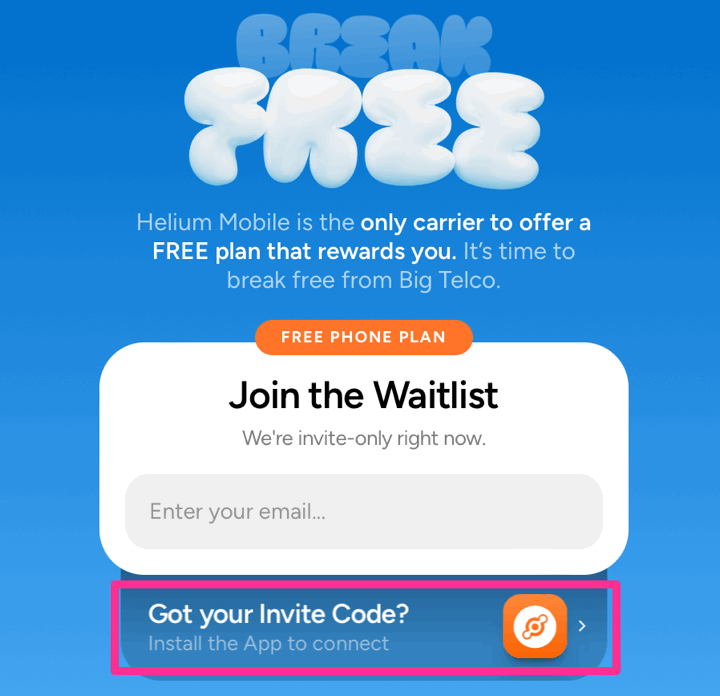
The free plan is currently waitlist-only unless you have an invite code, but one of the following invite codes should work to provide you immediate access. Click on the “Got an invite code?” link on the front page. Both iOS and Android apps are available. Try these:

  • JGKOS6O (my referral code)
  • HELIUMCEO
  • HELIUMFREE
  • BREAKFREE

They offer both eSIM and physical SIMs, but as of now the physical SIMs are out of stock and the expected wait time is at least a few weeks.

This is not the first cellular carrier to promote a “free” plan, nor the first to try and build a network of people sharing their WiFi for theoretically low-cost data (“Helium Hotspots”), and you shouldn’t be surprised that the reason beyond this new one is “something something crypto”. They never seem to last very long, and in the past have had hidden fees (FreedomPop) and sometimes required too much effort (RingPlus).

I probably wouldn’t bother using this as your primary number due to the hassle of porting in and out again possibly soon, but having an extra phone number can be useful for a variety of reasons. Some special offers are effectively limited to one per phone number, and sometimes you may not want to give out your primary phone number. You might have an old phone you want to use, or you could just add an eSIM number to your existing phone.

I’m concerned that the always-on location sharing would be a drain on battery life (in addition to your privacy). They say they use Fitness data which is less draining, but I’m still dubious. I would probably learn towards using an old phone.

Pepper Gift Card App: $20 Bonus w/ $200 Purchase (New Users)

Update 4/23: Looks like the party is winding down. Pepper no longer sells Amazon or Sam’s Club gift cards when purchasing with credit cards. You can still redeem using points. 10X on Chipotle and DoorDash is all that remains. I would recommending spending your points.

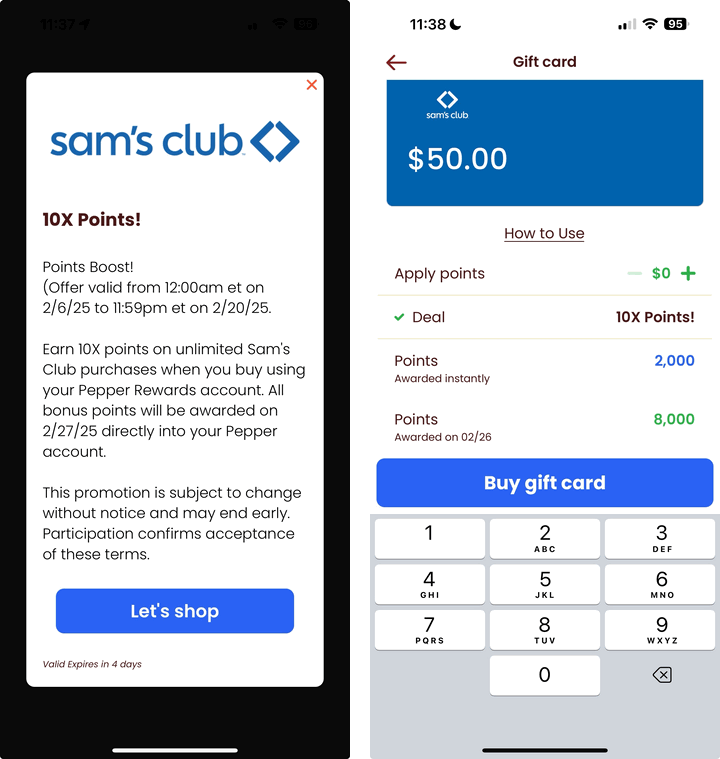
Update 3/14: New extended sales from now until 11:59p ET on March 16th. Be sure you see the offer on your screen before tapping “Buy gift card”. For example, if you buy a $50 Sam’s Club gift card during an 10X offer you’ll get a total of 10,000 points – 2,000 instantly and 8,000 extra later (10,000 points = $5, example screenshot below). I check the Pepper app first thing every morning to see the limited-time Flash Sales and to redeem all my available points that arrived from past purchases. Also, check your AmEx Offers to see if you have a targeted $30 off $75 at Pepper.

  • Sam’s Club 10X/10% back. Sam’s Club codes work at Walmart, and vice versa. They are interchangeable, even after using it at one place you can still use the rest at the other. I’m topped up again.
  • Home Depot 10X/10% back.
  • DoorDash 10X/10% back.
  • Lowe’s 12X/12% back.
  • Chipotle 10X/10% back.
  • Giant Eagle/GetGo/Market District 10X/10% back.

I know these screenshots have older dates, but it shows what you’re looking for during a flash sale:

– Pepper points will now expire if 60 days pass without a purchase. If you made a purchase prior to 11/15/24, you’ll enjoy a grace period; this policy change will not take effect until February 1, 2025. Keep in mind you can buy a $1 gift card.

– Pepper has changed their referral offer to a fixed $20 bonus after spending $200 in your first 15 days. Stack with AmEx offers and a flash sale, if possible.)

Look to stack it with this $30 off $75 AmEx Offer. Search for “Pepper” in your AmEx app. You are less likely to find it again if you used it already.

Original post, updated:

Pepper continues to offer up “flash sales” that offer big discounts on gift cards from Sam’s Club, REI, Sam’s Club, and so on. Plus you still get whatever credit card rewards from the Pepper purchase. Examples are Sam’s Club (= Walmart) at 10% back, IKEA 18% back, Airbnb 14% back in the form of points. Stock up quickly when you see the sale in the app. Redeem instantly into your respective store accounts, if you wish. (Tip: The math will work out. Every 2,000 points is worth $1 in future gift cards. 10,000 points = $5, and so on. Must redeem in increments of $5.)

Here’s the current offer for new Pepper users:

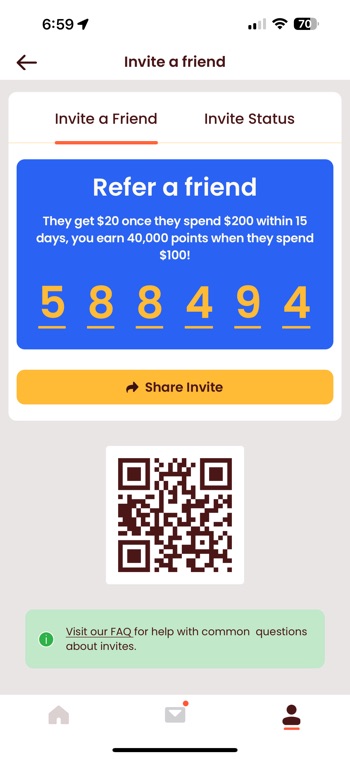
  • Download the Pepper Rewards app and be sure to enter a referral code 588494 on the first screen when joining. Thanks if you use it!
  • Get $20 after spending $200 in your first 15 days. This bonus has changed from the previous offer, but still not bad astheir old double offer only applied on their standard 4X rates, while their daily flash rates are 10X to 15X.
  • You’ll also earn rewards from using your credit card for purchase. Use a 2% or better cash back rewards card, or use it to satisfy a credit card bonus spending requirement that is even better than 2%.

Pepper is an iOS and Android app that sells discounted, new gift cards in exact amounts that are delivered instantly on your phone. This lets you to wait until the moment before purchase when you already have the final purchase price (in-person or online), and then go buy a discounted gift card via the app down to the penny. The main problem with gift cards is when you don’t use up the entire balance. This helps to avoid the waste.

Southwest Becomes Just Another Commodity Airline (Basic Economy, No Checked Bags, Less Legroom, Paid Seating)

The big news in travel is that Southwest Airlines has basically given up their unique “We are different!” corporate identity and become just another commodity airline that tries to look as cheap as possible upfront (only $200!) while adding multiple fees on the backend for all the things that used to be included (want to sit next to each other? checked bags? decent legroom? ok sure it’s really $500). As educated consumers, our job is to understand the changes to their value proposition and adjust accordingly. Here’s a list of the new Southwest realities:

  • Basic Economy has arrived to Southwest. The cheapest fare tier is now called “Basic”, not “Wanna Get Away”. You can no longer make free changes; you only get a non-transferrable credit that expires after only 6 months. Earns only 2X points, down from 6X points (elite status-holders get a little more). They are stripping everything possible because Southwest believes that people just pick the lowest fare regardless of features when listed on a comparison site like Google Flights or Expedia.
  • No more free bags. Starting 5/29, on most fares you’ll no longer get two free bags included and they’ll start charging you like everyone else. Business Select fares and A-List Preferred elites will get 2 free checked bags. A-List elites and co-branded credit cardholders will get 1 free checked bag.
  • No more open seating. Must pay for seat choice. Southwest is moving to assigned seats as well, which means Basic fares will have to pay up to pick their seats or be stuck in the worst middle seats or in the back.
  • No more reasonable legroom for everyone. Southwest used to be known for decent seat width and legroom in all its seats. Southwest is now adding “premium” extra-legroom seats if you pay extra $$$. This usually means the rest of Economy loses a few inches in return (right now it looks like seat pitch will go down to 31″ from 32″, similar to Basic Economy for other major airlines).
  • Changes to Rapid Rewards points redemptions. When redeeming Rapid Rewards points for flights, it will not longer be directly linked to the current cash fare. Basically, they want to be able to charge whatever amount they want, and limit the number of award tickets available on certain flights.

I wouldn’t actually read this Southwest press release because it has so much PR-spin that it is quite trifficult to understand what they are actually doing, but this attached graphic is useful:

It’s almost funny because you can still look up their old talking points and interviews on why open seating is better, why keeping free checked bags is better, why the fact that Southwest treats everyone well is important, but now it’s just the exact opposite. Your unique brand was around for 50 years, but now you’ve traded it all for a temporary bump in share price.

Well, Southwest, if you want us to just judge you on price, that’s fine with me. Selling a commodity product is usually a tough business, though. Prediction: The next step is to be merged away with another major airline soon.

In the meantime, I’m not sure if this makes their co-branded credit card more desirable or not. The card has basically added a free checked bag benefit that can be valuable, and some of them offer seating choice perks, but if you were a loyal Southwest flier, these new changes may cause you to not fly them as much anymore and now try out other airlines.

Wyndham Rewards Earner Cards: Up to 90,000 Bonus Points (Valid at Vacasa Home Rentals)

Updated with limited-time offers. The Wyndham Rewards Earner credit cards currently all have increased bonuses of up to 90,000 points. While these are not the highest amounts offered ever, they are above the normal bonuses. This hotel-chain co-branded card earns rewards that redeemable towards the Wyndham chain of hotels and Vacasa-managed vacation home rentals.

Wyndham Rewards Earner Card highlights:

  • 60,000 bonus points after $2,000 in purchases in the first 90 days.
  • 5X points per $1 spent on Hotels by Wyndham and qualifying gas purchases.
  • 2X points per $1 spent on dining and grocery store purchases (excluding Target® and Walmart®).
  • 1 point per $1 spent on all other purchases (excluding Wyndham Timeshare resort down payments).
  • Automatic upgrade to Wyndham Rewards Gold status.
  • 10% fewer Wyndham Rewards points required for go free® awards.
  • 7,500 bonus points each anniversary year if you spend $15,000 on eligible purchases.
  • No annual fee.

Wyndham Rewards Earner Plus Card highlights:

  • 90,000 bonus points after $2,000 in purchases in the first 90 days.
  • 6X points per $1 spent on Hotels by Wyndham and gas purchasess.
  • 4X points per $1 spent on dining and grocery store purchases (excluding Target and Walmart).
  • 1 point per $1 spent on all other purchases (excluding Wyndham Timeshare resort down payments).
  • Automatic upgrade to Wyndham Rewards Platinum status.
  • 10% fewer Wyndham Rewards points required for go free® awards.
  • 7,500 bonus points each anniversary year after annual fee renewal.
  • $75 annual fee.

Wyndham Rewards Earner Business Card highlights:

  • 75,000 bonus points total. 50,000 bonus points after spending $4,000 on purchases and paying the annual fee in full, both within the first 90 days. Also, earn 25,000 bonus points after spending $12,000 on purchases within the first 365 days.
  • 8X points per $1 spent on Hotels by Wyndham and gas purchasess.
  • 5X points per $1 spent on eligible marketing, advertising, and utilities purchases.
  • 1 point per $1 spent on all other purchases (excluding Wyndham Timeshare resort down payments).
  • Automatic upgrade to Wyndham Rewards Diamond status.
  • 10% fewer Wyndham Rewards points required for go free® awards.
  • 15,000 bonus points each anniversary year after annual fee renewal.
  • $95 annual fee.

Wyndham hotels have a relatively simple system that charges 7,500, 15,000, or 30,000 points for a “Go Free” award hotel night with no blackout dates (as long as a standard room is available for cash, you can book it with points). You can also redeem toward a discounted “Go Fast” cash and points rate. Resort fees may apply and cannot be paid with points. Note that when you have one of these credit cards, you get a 10% discount, so for example the 15,000 points tier would be actually be reduced down to 13,500 points.

You can also use the points for Vacasa vacation home rentals (like Airbnb or VRBO). Starting 3/26/24, it will cost 15,000 points *per bedroom* per night if the cash cost (including all taxes and fees!) is up to $250 *per bedroom* per night, or 30,000 points per bedroom per night if the cash cost is up to $500 per bedroom per night. More details at here and here.

That means your family likes to stay at Airbnbs, then 90,000 points can get you 3 nights at a 1-bedroom Vacasa-managed property that would otherwise cost up to $500 per night when including all taxes and fees, or at a 2-bedroom Vacasa property that would otherwise cost up to $250 *per bedroom* per night when including all taxes and fees. You can browse Vacasa properties here and book by calling 800-441-1034.

Wyndham points expiration – Important!

  • Wyndham Rewards points will expire if you have no activity on your account for a period of 18 months.
  • In addition, all Wyndham Rewards points expire 4 years after being earned — regardless of account activity.

From the official Terms & Conditions:

Except as may otherwise be required under applicable law, Wyndham Rewards points expire four (4) years after the checkout date of the stay for which the applicable points are posted to the Member’s account (the “Four Year Rule”), unless the points are forfeited or cancelled earlier due to membership inactivity (as more particularly described below), or otherwise in accordance with these Terms and Conditions. All accrued points in a Member’s Wyndham Rewards account may be cancelled or forfeited if the Member has no Account Activity (as defined below) for a period of approximately, but never less than, eighteen (18) consecutive months. For purposes of these Terms and Conditions, “Account Activity” means any (i) point earning, (ii) stay posted to a Member’s Wyndham Rewards account, regardless of whether or not such stay earns Wyndham Rewards points, and (iii) redemption or transfer activity involving a change in the Member’s Wyndham Rewards point balance, in each case, conducted in accordance with these Terms and Conditions.

For example, earning points via this credit card will only reset the 18-month inactivity clock. Look for the exact date in your online account page.

Wyndham Rewards includes over 9,000 hotels worldwide – from Days Inn motels to Wyndham Grand hotels. You can use this link to filter locations easily by country, state, and/or point level. Participating hotel chains include:

  • AmericInn by Wyndham®
  • Dolce Hotels and Resorts® by Wyndham
  • Hawthorn Suites by Wyndham®
  • Howard Johnson by Wyndham®
  • La Quinta by Wyndham®
  • Ramada by Wyndham®
  • Days Inn by Wyndham®
  • Super 8 by Wyndham®
  • Travelodge by Wyndham®
  • Wingate by Wyndham®
  • Wyndham Grand®
  • Wyndham Hotels and Resorts®
  • Wyndham Garden®

Depending on the hotel, you might get over 1 cent per point value (i.e. $300 cash hotel night for 30,000 points), but you might also get closer to 0.5 cent per point value (i.e. a $75 hotel night might require 15,000 points).

Bottom line. The Wyndham Rewards Earner credit cards earns rewards that can get you free nights at Wyndham hotels and Vacasa vacation home rentals. However, know that you must redeem the points within 4 years at the longest, even with regular account activity. This is somewhat of a niche card, but if you’ve got all the popular ones, there is still good potential value here if you put in some legwork.

Also see: Top 10 Best Credit Card Bonus Offers and Top 10 Best Business Card Offers.

Best Interest Rates Survey: Savings Accounts, Treasuries, CDs, ETFs – March 2025

Here’s my monthly survey of the best interest rates on cash as of March, roughly sorted from shortest to longest maturities. Banks love taking advantage of our idle cash, and you can often earning more money while keeping the same level of safety by moving to another FDIC-insured bank or NCUA-insured credit union. Check out my Ultimate Rate-Chaser Calculator to see how much extra interest you could earn from switching. Rates listed are available to everyone nationwide. Rates checked as of 3/9/2024.

TL;DR: Short-term savings accounts dropped very slightly overall, with top rates varying widely from 3.7% to 5% APY. Short-term T-Bill rates at around 4.3%. Top 5-year CD rates are ~4.30% APY, while 5-year Treasury rate is ~4.1%.

High-yield savings accounts*
Since the huge megabanks still pay essentially no interest, everyone should at least have a separate, no-fee online savings account to piggy-back onto your existing checking account. The interest rates on savings accounts can drop at any time, so I list the top rates as well as competitive rates from banks with a history of competitive rates and solid user experience. Some banks will bait you with a temporary top rate and then lower the rates in the hopes that you are too lazy to leave.

  • The top saving rate at the moment: Roger.bank is at 5.00% APY (no min), but does require an additional companion checking account. CIT Platinum Savings is now at 4.30% APY with $5,000+ balance, but also has a $225/$300 deposit bonus you can stack on top.
  • SoFi Bank is at 3.80% APY + up to $325 new account bonus with direct deposit. You must maintain a direct deposit of any amount (even $1) each month for the higher APY. SoFi has historically competitive rates and full banking features. See details at $25 + $300 SoFi Money new account and deposit bonus.
  • Here is a limited survey of high-yield savings accounts. They aren’t the top rates, but a group that have historically kept it relatively competitive such that I like to track their history.

Short-term guaranteed rates (1 year and under)
A common question is what to do with a big pile of cash that you’re waiting to deploy shortly (plan to buy a house soon, just sold your house, just sold your business, legal settlement, inheritance). My usual advice is to keep things simple and take your time. If not a savings account, then put it in a flexible short-term CD under the FDIC limits until you have a plan.

  • No Penalty CDs offer a fixed interest rate that can never go down, but you can still take out your money (once) without any fees if you want to use it elsewhere. Marcus has a 13mo No Penalty CD at 4.15% APY ($500 minimum deposit). Farmer’s Insurance FCU has 9-month No Penalty CD at 4.25% APY ($1,000 minimum deposit). Credit Human has 12-month Liquid CD at 4.26% APY ($5,000 minimum) that allows unlimited deposits and two allowed withdrawals. Consider opening multiple CDs in smaller increments for more flexibility.
  • Security State Bank has a 12-month certificate special at 4.65% APY ($25,000 min). Early withdrawal penalty is 180 days of interest.

Money market mutual funds
Many brokerage firms that pay out very little interest on their default cash sweep funds (and keep the difference for themselves). Note: Money market mutual funds are highly-regulated, but ultimately not FDIC-insured, so I would still stick with highly reputable firms.

  • Vanguard Federal Money Market Fund (VMFXX) is the default sweep option for Vanguard brokerage accounts, which has an SEC yield of 4.24% (changes daily, but also works out to a compound yield of 4.32%, which is better for comparing against APY). Odds are this is much higher than your own broker’s default cash sweep interest rate.
  • Vanguard Treasury Money Market Fund (VUSXX) is an alternative money market fund which you must manually purchase, but the interest will be mostly (100% for 2024 tax year) exempt from state and local income taxes because it comes from qualifying US government obligations. Current SEC yield of 4.25% (compound yield of 4.33%).

Treasury Bills and Ultra-short Treasury ETFs
Another option is to buy individual Treasury bills which come in a variety of maturities from 4-weeks to 52-weeks and are fully backed by the US government. You can also invest in ETFs that hold a rotating basket of short-term Treasury Bills for you, while charging a small management fee for doing so. T-bill interest is exempt from state and local income taxes, which can make a significant difference in your effective yield.

  • You can build your own T-Bill ladder at TreasuryDirect.gov or via a brokerage account with a bond desk like Vanguard and Fidelity. Here are the current Treasury Bill rates. As of 3/7/25, a new 4-week T-Bill had the equivalent of 4.31% annualized interest and a 52-week T-Bill had the equivalent of 4.06% annualized interest.
  • The iShares 0-3 Month Treasury Bond ETF (SGOV) has a 4.20% SEC yield (0.09% expense ratio) and effective duration of 0.09 years. SPDR Bloomberg Barclays 1-3 Month T-Bill ETF (BIL) has a 4.13% SEC yield (0.136% expense ratio) and effective duration of 0.15 years. The Vanguard 0-3 Month Treasury Bill ETF (VBIL) hasn’t been around long enough to generate an SEC yield (0.07% expense ratio).

US Savings Bonds
Series I Savings Bonds offer rates that are linked to inflation and backed by the US government. You must hold them for at least a year. If you redeem them within 5 years there is a penalty of the last 3 months of interest. The annual purchase limit for electronic I bonds is $10,000 per Social Security Number, available online at TreasuryDirect.gov.

  • “I Bonds” bought between November 2024 and April 2025 will earn a 3.11% rate for the first six months. The rate of the subsequent 6-month period will be based on inflation again. More on Savings Bonds here.
  • In mid-April 2025, the CPI will be announced and you will have a short period where you will have a very close estimate of the rate for the next 12 months. I will have another post up at that time.

Rewards checking accounts
These unique checking accounts pay above-average interest rates, but with unique risks. You have to jump through certain hoops which usually involve 10+ debit card purchases each cycle, a certain number of ACH/direct deposits, and/or a certain number of logins per month. If you make a mistake (or they judge that you did) you risk earning zero interest for that month. Some folks don’t mind the extra work and attention required, while others would rather not bother. Rates can also drop suddenly, leaving a “bait-and-switch” feeling.

  • OnPath Federal Credit Union (my review) pays 7.00% APY on up to $10,000 if you make 15 debit card purchases, opt into online statements, and login to online or mobile banking once per statement cycle. Anyone can join this credit union via $5 membership fee to join partner organization. You can also get a $100 Visa Reward card when you open a new account and make qualifying transactions.
  • Genisys Credit Union pays 6.75% APY on up to $7,500 if you make 10 debit card purchases of $5+ each per statement cycle, and opt into online statements. Anyone can join this credit union via $5 membership fee to join partner organization.
  • La Capitol Federal Credit Union pays 5.75% APY (down from 6.25%) on up to $10,000 if you make 15 debit card purchases of at least $5 each per statement cycle. Anyone can join this credit union via partner organization, Louisiana Association for Personal Financial Achievement ($20).
  • (new) First Southern Bank pays 5.50% APY on up to $25,000 if you make at least 15 debit card purchases, 1 ACH credit or payment transaction, and enroll in online statements.
  • Credit Union of New Jersey pays 6.00% APY on up to $25,000 if you make 12 debit card purchases, opt into online statements, and make at least 1 direct deposit, online bill payment, or automatic payment (ACH) per statement cycle. Anyone can join this credit union via $5 membership fee to join partner organization.
  • Andrews Federal Credit Union pays 6.00% APY on up to $25,000 if you make 15 debit card purchases, opt into online statements, and make at least 1 direct deposit or ACH transaction per statement cycle. Anyone can join this credit union via partner organization.
  • Find a locally-restricted rewards checking account at DepositAccounts.

Certificates of deposit (greater than 1 year)
CDs offer higher rates, but come with an early withdrawal penalty. By finding a bank CD with a reasonable early withdrawal penalty, you can enjoy higher rates but maintain access in a true emergency. Alternatively, consider building a CD ladder of different maturity lengths (ex. 1/2/3/4/5-years) such that you have access to part of the ladder each year, but your blended interest rate is higher than a savings account. When one CD matures, use that money to buy another 5-year CD to keep the ladder going. Some CDs also offer “add-ons” where you can deposit more funds if rates drop.

  • KS State Bank has a 5-year certificate at 4.30% APY ($500 minimum), 4-year at 4.30% APY, 3-year at 4.30% APY, 2-year at 4.25% APY, and 1-year at 4.30% APY. $500 minimum. The early withdrawal penalty (EWP) for the 5-year is a huge 540 days of interest.
  • Mountain America Credit Union (MACU) has a 5-year certificate at 4.25% APY ($500 minimum), 4-year at 4.25% APY, 3-year at 4.25% APY, 2-year at 3.95% APY, and 1-year at 4.25% APY. Early withdrawal penalty for the 4-year and 5-year is 365 days of interest. Anyone can join this credit union via partner organization American Consumer Council for a one-time $5 fee (or try promo code “consumer”).
  • Lafayette Federal Credit Union (LFCU) has a 5/4/3/2/1-year certificates at 4.28% APY ($500 min). Slightly higher rates with jumbo $100,000+ balances. Note that the early withdrawal penalty for the 5-year is a relatively large 600 days of interest. Anyone nationwide can join LFCU by joining the Home Ownership Financial Literacy Council (HOFLC) for a one-time $10 fee.
  • You can buy certificates of deposit via the bond desks of Vanguard and Fidelity. You may need an account to see the rates. These “brokered CDs” offer FDIC insurance and easy laddering, but they don’t come with predictable early withdrawal penalties. Right now, I see a 5-year non-callable CD at 4.10% APY (callable: no, call protection: yes). Be warned that both Vanguard and Fidelity will list higher rates from callable CDs, which importantly means they can call back your CD if rates drop later. (Issuers have indeed started calling some of their old 5%+ CDs during 2024.)

Longer-term Instruments
I’d use these with caution due to increased interest rate risk (tbh, I don’t use them at all), but I still track them to see the rest of the current yield curve.

  • Willing to lock up your money for 10 years? You can buy long-term certificates of deposit via the bond desks of Vanguard and Fidelity. These “brokered CDs” offer FDIC insurance, but they don’t come with predictable early withdrawal penalties. You might find something that pays more than your other brokerage cash and Treasury options. Right now, I see a 10-year CDs at [n/a] (non-callable) vs. 4.32% for a 10-year Treasury. Watch out for higher rates from callable CDs where they can call your CD back if interest rates drop.

All rates were checked as of 3/9/25.

* I no longer recommend fintech companies due to the possibility of loss due to poor recordkeeping and lack of government regulation. (Ex. Evergreen Wealth at 5% APY is a fintech.)

Photo by insung yoon on Unsplash

Raisin Marketplace: Up to $400 Deposit Bonus (and Why I’m Skipping It)

Raisin is a financial marketplace that allows you to access high-interest certificates of deposit and savings accounts from multiple different banks and credit unions without having to open up a new account at each one. Right now, they have some new deposit bonuses that are pretty solid based on the bonus-to-deposit ratios and minimum holding periods. However, I will personally not be taking advantage of them due to their use of custodial FBO accounts. I think it’s most useful to both point out the existence of these bonuses and explain my take on them. Details below.

Here are the new bonuses:

  • New customer $250 bonus. Open a new account with promo code GET250, deposit $25,000 within 14 days, and maintain for 90 days for the $250 bonus.
  • Existing customer deposit bonus, up to $400. Must deposit $50,000 in new money. $200 on a 3–6 month CD. $300 on a 7–11 month CD. $400 for a 12+ month CD. Must maintain for full CD maturity period.

How Raisin works. The benefit of Raisin is that you can easily access aggressively high rates at a new bank or credit union without having to open yet another new account (and endure credit checks, identify verification hurdles, join partner organizations, leave funds in share savings accounts, etc). The price is added complexity, higher risk for miscommunication and errors, and a place in a regulatory shadow zone.

Instead of opening a direct account at a new partner bank, there are at least three different parties.

  • Raisin, which is the overall business (“financial technology company”) and not a bank and not a credit union. (Source #1)
  • There are the middlemen, Custodial Bank(s) and Service Bank. The Custodial Bank opens up FBO (For Benefit Of) accounts at each of the Partner Banks/Credit Unions in THEIR names. These FBO accounts are basically big pooled accounts, and the Custodial Bank is supposed to keep track of all the money going in and out for all the individual Raisin customers in their own virtual ledger. The Service Bank is in charge of moving your funds amongst the various banks. Central Bank of Kansas City (CBKC), Member FDIC, is the Service Bank. CBKC, Lewis & Clark Bank and Starion Bank, each Member FDIC, are the Custodial Banks. (Source #2)
  • There are the partner banks. These banks and credit unions are looking to grow deposits, but they have no idea who you are as an individual. They come and go on the Raisin platform. They only see that they opened a single, huge FBO account for the Custodial Bank. (Source #3)

While this setup appears to be perfectly legal (as far I can tell, I am not a lawyer), that doesn’t mean that there is someone to clean up the mess if something goes wrong. It’s like if someone steals your wallet and the cops are too busy with violent crime to track them down, it doesn’t matter if it’s illegal, you’re still not getting your money back.

The real-world example is what happened with Juno, Yotta, Synapse, and Evolve Bank & Trust. They had major disagreements about the ledger tracking all the deposits and withdrawals. They all blamed each other for the missing funds (~$50 million). Since no bank actually failed, the FDIC did not step in. No other regulatory agency stepped in. I was surprised. It was all left to a severely-underfunded bankruptcy court, and the mess still isn’t figured out. Someone ran off with tens of millions of dollars, and innocent individuals were left holding the bag.

Source #1:

Raisin is not a bank and your money is always handled by a federally regulated financial institution — whether in transit, stored in the Cash Account, or in an account at a partner bank. The Custodial Bank keeps records of all funds deposited through the Raisin platform for added security.

Source #2

Custodial accounts are accounts held on for the benefit of Raisin customers by a custodial bank at the banks and credit unions where customers deposit their money through Raisin. When a customer makes a deposit through the Raisin platform into a savings product offered by a given financial institution, the funds move from the customer’s external bank account (also referred to as their reference account) to a custodial account held by one of Raisin’s partner custodial banks at the financial institution offering the savings product. Central Bank of Kansas City (CBKC), Lewis & Clark Bank and Starion Bank, each Member FDIC, are the Custodial Banks.

Source #3:

An FDIC-supervised custodial bank opens the “For Benefit Of” account for each customer and agrees directly with Raisin’s customers to act as the custodian of their funds. This custodial bank is authorized by Raisin customers, as their agent, to hold their deposits at federally regulated banks and credit unions on their behalf in a custodial capacity. Customer funds are never co-mingled with Raisin funds.

Again, if everyone does what they say they will, then it’s all good. The problem is what happens when they don’t. If it happens with Raisin (or any of the parties involved, all relatively small institutions), it has the potential to be a complete mess that could take years to untangle. In today’s regulatory environment, I have zero interest in putting my cash into any sort of regulatory grey area.

In contrast, the CIT Bank $225/$300 deposit offer involves a simple, direct relationship with CIT Bank, an FDIC-insured bank, where you have an individual/joint account directly held in your name. There is a single system. There is no potential pointing of figures between multiple parties. There is a long, established history of the FDIC stepping in resolve a bank failure within days. It’s about as safe as it gets.

Bottom line. I’m doing the CIT bank offer, but not the Raisin offer.

SGOV, STIP, TIP iShares ETFs: Claim Your State Income Tax Exemption (2024/2025)

As a follow-up to my posts for Vanguard and Fidelity money market funds, iShares ETFs (Blackrock) has also recently released their US GOI percentages for 2024 tax year. US Government Obligation Interest (US GOI) like Treasury bills and bonds are generally exempt from state and local income taxes. However, in order to claim this exemption, you’ll likely have to manually enter it on your tax return after digging up a few extra details.

The tax document has a pretty good summary of the situation for all brokers:

The Form 1099-DIV (or substitute form) you received from your financial advisor or brokerage firm may include income derived from U.S. Government and agency obligations. This income may be excluded from state income tax (although in many states, only the income from Treasury obligations is exempt from personal state income tax). The information below is provided to assist with the completion of shareholder state income tax returns. The amount in Box 1a of 2024 IRS Form 1099-DIV should be multiplied by the applicable percentages below to obtain the dollar amount of income derived from the sources categorized below. Because the qualifications for exclusion vary by state (some states have investment threshold requirements), please consult your tax advisor for details.

It’s notable that even things like the iShares iBonds 20XX Term TIPS ETFs are not 100% US government obligations, so it’s important to reference this document and not assume. For iShares TIPS Bond ETF (TIP) and iShares 0-5 Year TIPS Bond ETF (STIP) the USGOI percentage for 2024 was indeed at 100.00%.

For iShares 0-3 Month Treasury Bond ETF (SGOV), the USGOI percentage for 2024 was 97.53%. This is pretty good and why SGOV is my default cash position at most brokers. The tax document also confirms that at least 50% of the assets of the fund were invested in Federal Obligations at the end of each quarter of the fiscal year. That means that SGOV met the minimum criteria for the dividend income to be exempt in the states of California, Connecticut, and New York.

TastyTrade Referral (Important Correction!)

Update: I’m very sorry, I was in a rush and read the offer wrong. There is no $500 for the referred person. Please don’t open and fund. If I end up getting a $500 reward for referring you, I will send you the $500. However, I don’t have a way of tracking this, so please contact me now if you opened an account with my referral code and have already funded. My recommendation is to not fund – especially due to the long 6-month holding period.

TastyTrade brokerage is offering a $500 double referral offer. However, it is only for the referring person, not the referred.

Fidelity Money Market Funds: Claim Your State Income Tax Exemption (Updated 2025)

Updated. As the brokerage 1099 forms for the 2024 Tax Year are coming out, here is a quick reminder for those subject to state and/or local income taxes. If you earned interest from a money market fund, a significant portion of this interest may have come from “US Government Obligations” like Treasury bills and bonds, which are generally exempt from state and local income taxes. However, in order to claim this exemption, you’ll likely have to manually enter it on your tax return after digging up a few extra details.

(Note: California, Connecticut, and New York exempt dividend income only when the mutual fund has met certain minimum investments in U.S. government securities. They require that 50% of a mutual fund’s assets at each quarter-end within the tax year consist of U.S. government obligations.)

Fidelity has released US GOI percentages for 2024 on their institutional website, but it’s a little hard to read since it includes a lot of funds and share classes that are used by Fidelity-affiliated financial advisors and institutional portfolios. Their tax document page still says “Expected mid February” – Update 2/22: 2024 Percentage of Income from
U.S. Government Securities now available
. The numbers from both sources are the same, although rounded off differently for some reason.

Here are the results for the most popular core Fidelity money market funds:

  • Fidelity® Treasury Only Money Market Fund (FDLXX, CUSIP 31617H300) – 97.0032%.
  • Fidelity® Government Money Market Fund (SPAXX, CUSIP 31617H102) – 55.0877%.
  • Fidelity® Government Cash Reserves (FDRXX, CUSIP 316067107) – 57.1917%.
  • Fidelity® Treasury Money Market Fund* (FZFXX, CUSIP 316341304) – 50.5640%. *FZFXX did not meet the minimum investment in U.S. Government securities required to exempt the distribution from tax in California, Connecticut, and New York.
  • Fidelity® Government Money Market Fund Premium Class (FZCXX, CUSIP 31617H706) – 55.0877%. This fund has a $100,000 minimum, but also a lower expense ratio than SPAXX, which means it earns about 0.10% more yield annually as of this writing 2/20/25.

To find the portion of Fidelity dividends that may be exempt from your state income tax, multiply the amount of “ordinary dividends” reported in Box 1a of your Form 1099-DIV by the percentage listed in the PDF. For example, if you earned $1,000 in total interest from Fidelity Treasury Only Money Market Fund (FDLXX) in 2024, then $970.03 could possibly be exempt from state and local income taxes. If your marginal state income tax rate was 10% that would be a ~$97 tax savings for every $1,000 in total interest earned.

On a net after-tax basis, folks with a ~10% state income tax rate will likely find that FDLXX earns more interest than the default core holdings of SPAXX/FZFXX, even though the gross yield of SPAXX/FZFXX is higher than that of FDLXX.

To obtain these tax savings, you’ll have to manually adjust your state/local income tax return. I don’t believe that TurboTax, H&R Block, and other tax software will do this automatically for you, as they won’t have the required information on their own. (I’m also not sure if they ask about it in their interview process.) If you use an accountant, you should also double-check to make sure they use this information. Here is some information on how to enter this into TurboTax:

  • When you are entering the 1099-DIV Box 1a, 1b, and 2a – click the “My form has info in other boxes (this is uncommon)” checkbox.
  • Next, click on the option “A portion of these dividends is U.S. Government interest.”
  • On the next screen enter the Government interest amount. This will be subtracted from your state return.

Standard disclosure: Check with your state or local tax office or with your tax advisor to determine whether your state allows you to exclude some or all of the income you earn from mutual funds that invest in U.S. government obligations.

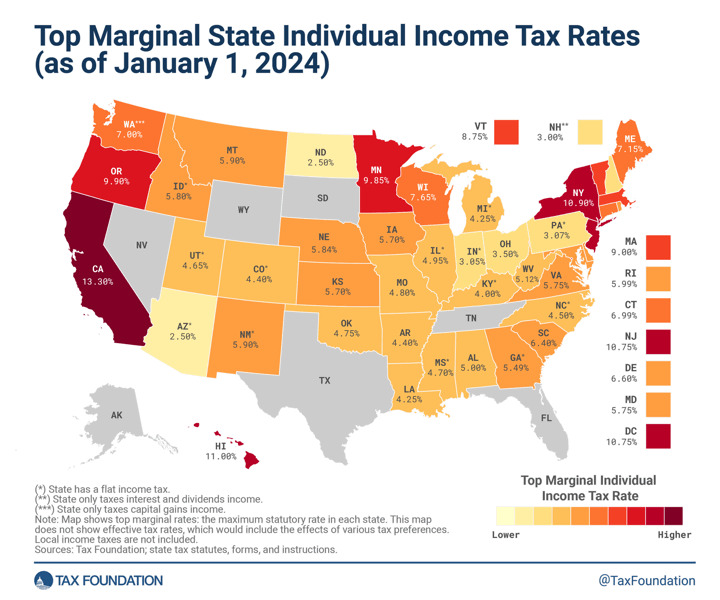
[Image credit – Tax Foundation]

TurboTax Promo: Switch to TurboTax, File on App by 2/28, Get Deluxe/Premium For $0 Federal, $0 State

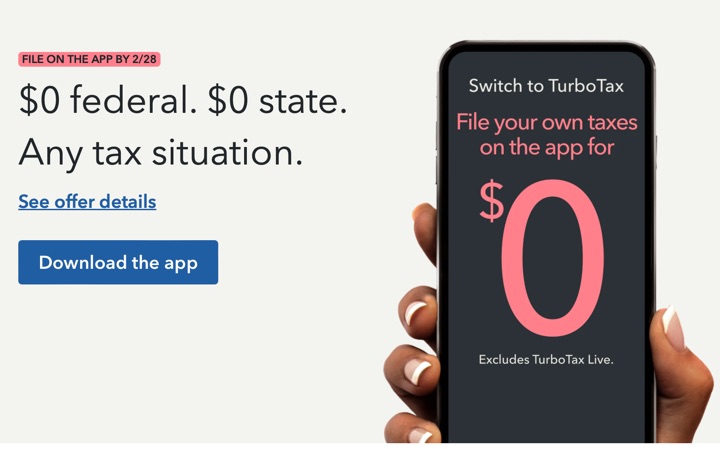
Here is a new TurboTax App promo link that offers free tax filing ($0 Federal, $0 State) for ALL tax situations (not just 1040EZ form users). This includes their TurboTax Standard, Deluxe, and Premium products. Here are the specific set of requirements:

  • Switch to TurboTax. You must not have used TurboTax last year to file your taxes. (If you used TurboTax the year before last, but not last year, you’re still eligible for this offer.)
  • Use the TurboTax app to start and file. You must start and file your taxes using the TurboTax mobile app. The offer link above should provide a QR code to scan.
  • DIY only – TurboTax Live not included. This offer is only available for the “Do your own taxes” product. TurboTax Live products are excluded.
  • File by February 28, 2025. Taxes must be filed by February 28, 2025.

Even if they ask you to “upgrade” in the app, as long as you follow the rules above, the fee should be waived at the checkout. “We might ask you to upgrade, but we’ll waive the fee as long as you file on the app by February 28.”

TurboTax has gotten into trouble in the past for advertising their Free Edition, but often little things like having a single 1099-MISC form would make you ineligible and thus you’d have to upgrade to a paid product. Now, they must disclose that roughly 37% of filers qualify for Free Edition.

Meanwhile, the retail price of TurboTax Premium is now up to $89 Federal + $39 per State. There are discounts everywhere, but it’s still close to $100 total after 30% off. You can get this deal even if you have a 1099-MISC form or two, some investment income from a stock sale on a 1099-B, want to itemize deductions, and have rental income, or something like that.

I’ve never done taxes on an app, but they claim that it’s actually easier since you can take pictures of all your forms to upload them, instead of typing it all in. However, their FAQ seems to offer another workaround if you still want to avoid the app. As long as you *start* on the app, and *file* on the app, you can work on your stuff on a web browser in the middle.

You’re eligible for this offer when you start and file your taxes in the TurboTax mobile app.
If you switch to doing your taxes using a web browser instead of the app, we’ll show you a reminder that you must file in the app to redeem the offer.
If you choose not to file in the app, the cost of TurboTax will go back to regular pricing, which is based on the complexity of your tax return.

Federal and State e-File is included at no additional cost. I know that TurboTax Desktop charges you an additional $25 for a State e-File (you can print and mail for free), but according to their online chat (and some unofficial online sources), this TurboTax State Online/App version includes Federal and State e-File at no additional cost. I don’t like how TurboTax makes this information hard to find, and that there are different policies for Desktop vs. Online.

With a $0 all-in cost including Fed+State eFile if you qualify, this is definitely a strong offer, but the deadline is coming up and I’m still getting late brokerage 1099s trickling in mid-February. 😡 Let’s hope for no amended 1099s! 🤞 I’m looking at you, Apex Clearing…

Disclosure: I am an affiliate of TurboTax. I usually don’t write about TurboTax unless there is an especially good deal on them, and I think this deal is worth sharing since the retail price of TurboTax Premium is $89 Federal + $39 per State.

Southwest Airlines Credit Cards: Unique Companion Pass

Update March 2025. Southwest has made some big changes to how they run, and it’s not entire clear how it will affect their credit cards. The “Wanna Get Away” fare is going away later this year, to be replaced by “Basic”. I will try to update things as well as I can.

For now, Southwest still offers their unique Companion Pass, which lets you fly with a companion for free when you book both paid AND award flights on Southwest. Once you qualify by earning 135,000 points in a calendar year, you earn the Companion Pass for both the rest of the year in which you earn it AND all of the next year (ex. rest of 2025 + all of 2026). Importantly, all points earned from credit cards count toward the requirement, and each card also offers a 10,000 point boost toward the Companion Pass requirement.

New limited-time offer: Right now if you apply by 3/31/25, you have an opportunity to earn a “Promo” Companion Pass much more easily with a reasonable spending hurdle. See details below. This promotional Companion Pass doesn’t last through the end of 2026, but it does last until 2/28/26.

Southwest Rapid Rewards® Plus Credit Card

  • 50,000 points after you spend $1,000 on purchases in the first 3 months from account opening.
  • Receive 3,000 anniversary points each year.
  • 10,000 Companion Pass® qualifying points boost each year.
  • 2X points on Southwest(R) purchases.
  • 2X points on local transit and commuting, including rideshare.
  • 2X points on internet, cable, and phone services, and select streaming.
  • 1 point per $1 spent on all other purchases.
  • 2 EarlyBird Check-In(R) each year
  • 25% back on inflight purchases
  • All points earned count towards Companion Pass(R).
  • $69 annual fee.

Southwest Rapid Rewards® Priority Credit Card

  • 50,000 points after you spend $1,000 on purchases in the first 3 months from account opening.
  • Receive 7,500 anniversary points and a $75 Southwest® travel credit each year.
  • 10,000 Companion Pass® qualifying points boost each year.
  • 3X points on Southwest purchases.
  • 2X points on local transit and commuting, including rideshare.
  • 2X points on internet, cable, and phone services, and select streaming.
  • 1 point per $1 spent on all other purchases.
  • 2 EarlyBird Check-In(R) each year
  • 25% back on inflight purchases
  • 1,500 TQPs toward A-List status for every $5,000 spent in purchases annually (no limit on TQP earned).
  • 4 Upgraded Boardings per year when available.
  • $149 annual fee.

The following are business credit cards:

Southwest Rapid Rewards® Performance Business Credit Card

  • 80,000 bonus points after spending $5,000 on purchases in the first 3 months from account opening.
  • 9,000 bonus points after each Cardmember anniversary.
  • NEW: 4X points on Southwest(R) purchases.
  • 3X points on Rapid Rewards® hotel and car rental partners.
  • NEW: 2X points on rideshare.
  • 2X points on social media and search engine advertising, Internet, cable and phone services and 1 point per $1 spent on all other purchases.
  • 4 Upgraded Boardings per year when available.
  • Inflight WiFi Credits (up to 365 x $8 credits per year).
  • Up to $120 Global Entry, TSA PreCheck® or NEXUS fee credit. Receive a statement credit of up to $120 every 4 years as reimbursement for the application fee for Global Entry, TSA PreCheck® or NEXUS.
  • $199 annual fee.

Southwest Rapid Rewards® Premier Business Credit Card

  • 60,000 bonus points after spending $3,000 on purchases in the first 3 months from account opening.
  • 6,000 bonus points after each Cardmember anniversary.
  • 3X points on Southwest(R) purchases.
  • 2X points and Rapid Rewards® hotel and car rental partners.
  • 2X points on local transit and commuting, including rideshare.
  • 1 point per $1 spent on all other purchases.
  • 2 EarlyBird Check-In(R) each year
  • $99 annual fee.

Value of Rapid Rewards points. Redeeming Southwest points for flights varies in a narrow range, but a very reasonable approximation from my experience is 1.3 cents in Wanna Get Away airfare in per point. That works out to $650+ in Wanna Get Away airfare for every 50,000 points or $1,300+ in Wanna Get Away airfare from 100,000 points (you are still liable for taxes and fees from $5.60 one-way). This valuation may change when they switch to “Basic”.

Now, if you manage to qualify for the the Companion Pass on every trip that you book with those points, that doubles the potential value of each award redemption. In other words, 125,000 Rapid Rewards, would usually get you $1,850 in Wanna Get Away airfare, but with the Companion Pass you’d get an extra companion ticket for every flight booked.

There may be other options like gift cards, but the redemption value is less than half the value you could get from redeeming for flights.

Southwest points expiration policy, per Southwest.com:

Do the points I earn expire?

No, your Rapid Rewards points do not expire. However, if you choose to close your account, the points in your account will be terminated.

Card restrictions. All of these Southwest credit cards are subject to “5/24” restrictions, which means that your application will be automatically denied if you have opened 5 or more credit cards in the last 24 months (check your credit reports). Our household strategy is to have one person only apply for Chase 5/24 cards, and the other person applies for everything else. There is also this language on the consumer card:

This product is available to you if you do not have a current Southwest Rapid Rewards® Credit Card and have not received a new Cardmember bonus within the last 24 months. This does not apply to Business Card and Employee Credit Card products.

Basically, you can get one sign-up bonus from a Southwest consumer card once every 24 months. You can also get one sign-up bonus from a Southwest business card once every 24 months.

Stack your Companion Pass with Chase Ultimate Rewards points. If you have the Chase Sapphire Preferred or Chase Sapphire Reserve, you can transfer Ultimate Rewards points to Southwest points on a 1:1 basis. If you book an award flight with those Southwest points while you have the Companion Pass, you can double the value of your Ultimate Rewards points as well.

Bottom line. Southwest credit cards offer new cardholders the opportunity to earn hundreds of dollars worth of Wanna Get Away airfare, but if you time things right and maybe combine the welcome offers from a personal and business card, you can also grab the Southwest Companion pass, which provides a free companion ticket on every flight bought with cash OR points booked both during the rest of the year in which you earned it, AND the full next calendar year.

Also see: Top 10 Best Credit Card Bonus Offers and the Top 10 Best Business Card Offers.

The information for the Southwest Rapid Rewards Cards has been collected independently by My Money Blog. The card details on this page have not been reviewed or provided by the card issuer.