Scouting For 0% Balance Transfer Offers

[This is Part 2 of an ongoing series about how to make money from 0% APR balance transfers.]

Now that you’ve read my introduction and warnings about 0% balance transfer offers, let’s try to find some suitable deals. First, some definitions:

A balance transfer is traditionally the transfer of a debt balance from one credit card to another. However, there are various direct and indirect methods to convert this into cash inside a bank account. It is usually for larger amounts, up to almost all of the credit limit on the card.

A cash advance is often similar, but not identical. Usually, this is for smaller amounts (your card may list a special “cash advance limit”) and comes to you directly as cash. If you use a PIN with your credit card at an ATM or bank branch to receive cash, this is considered a cash advance. Cash advances usually have the highest interest rate, and are almost always to be avoided.

A purchase is pretty familiar to everyone and just that, when you are getting services and/or goods with your credit card. Some credit card companies reserve the right to reclassify purchases of cash-equivalents (such as traveller’s checks) as cash advances.

The reason why it is important to note the difference between these three terms is that in the fine print of your credit card agreement, these three things can be treated totally differently. That brings us to the fine print. This is the guts of any balance transfer offer, and can usually be found in small print on the back of physical applications, and via a links that says Terms and Conditions on online applications. It’s meant to be hard to find, but it is critical to find it.

As a working example, let’s take the first card on my Best of 0% APR Offers list – the Citi Professional Cash Card. I do a quick scan of the application, and note that they are also offering a permanent 3% cash bank on restaurants, gas stations, certain office supply merchants, and for auto rentals. I’ll discuss this later.

Then, click on the Apply Now button. You should see this: On the initial application page, you see this:
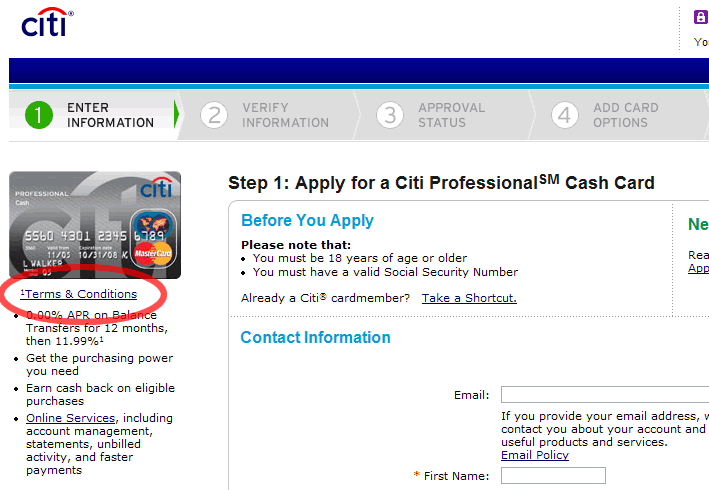
Application Screenshot 1

Now click on Terms and Conditions (circled above). Every online application should have a similar link. If you have a physical Terms and Conditions sheet, save it. If you have an online version, print it out or print to a PDF. Here is an example PDF. It takes just seconds but gives you peace of mind. Then either tuck it away or e-mail it to yourself.

Ok, now we have the T&Cs. I usually do the following online – hit Ctrl-F and search for the term “balance transfer”. The Firefox web browser has a nice feature where you can highlight every occurrence. I also do this for the term “fee”. For paper versions I just do this by skimming. You get good at it after a while 🙂

Doing this alerts me to the following pertinent sentences:

Annual fees – None.

Balance transfer APR: As long as balance transfers are completed within 12 months from date of account opening, 0.00% for 12 months from date of first balance transfer . After that, 11.99% variable.
Cash advance APR: 20.99% variable.
Default APR: 29.99% variable. See explanation below.*

Balance transfer fee: 3% of each balance transfer; $5 minimum. There is no fee with the 0.00% APR balance transfer offer described above.

Here is a screenshot that I took:
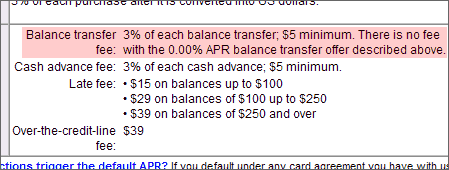
No Balance Transfer Fee Screenshot

So there is no balance transfer fee with the 0% APR offer. Sweet.

But, the purchase APR is at nearly 12% APR. Remember, since your payments always go towards the balance at the lowest interest rate, if you request a 0% balance transfer all your payments would go towards that. So you can’t take advantage of both the 0% on balance transfers and the cashback program. Here I’d do the 0% for 12 months, and then after that is over I’d keep the cards for the 3% back on restaurants.

Annual fees. This should be zero or at least waived for the first year during the 0% period. I only tolerate annual fees for excellent rewards cards like the Starwood American Express Card. In this case, it is zero.

Balance Transfer APR and Length – Obviously, lower is better and 0% APR is best. 0% is usually for a limited time, anywhere from 3 months to 15 months. Anything over 9 months catches my eyes. Here it is 0% for 12 months, which is very good.

As interest rates rise, 0.99% or 1.99% might start to look good as well when you can make 5-6% at the bank. But remember, you pay taxes on the bank interest, and you cannot deduct credit card interest. So if you make 6% but are in the 25% tax bracket, you end up with 4.5%. If your credit charges 1%, your profit margin is 3%. Still not bad depending, but perhaps you could do better elsewhere.

Update: Interest charged for money used for investment purposes can be tax deductible if you document it properly. So in my previous example if you the bank is paying 6% and your credit card is charging 1%, if done right you can deduct the 1% on your taxes and get taxed only on the 5% margin (3.75% net if taxes are 25%). I’m no tax expert, so consult your accountant for details.

Balance Transfer Transaction Fees – Again, lower is better and best is zero. 3% is common, but the caps are what I focus upon. For example, there may be a cap of $75 on balance transfers not part of the promotional offer.

If you transfer $5,000, you pay $75 or 1.5% of balance.
If you transfer $10,000, you still pay $75 or 0.75% of balance.
If you transfer $20,000, you only pay 0.375%.

If there are no caps, that indicates a bad deal. 3% upfront is usually too much to overcome and you can do better. Caps $75 and under get a closer look from me. But again, in this case, there is no balance transfer fee. Nice!

The rest – Okay, those three things are my primary screens. If those aren’t satisfied, into the shredder it goes. Some credit cards make you have a purchase each month to keep the low rate, often for the “0% for life” deals. Keep in mind purchases get their own APR, and all payments go towards the balance with the lowest interest rate. Now, there are tons of other stuff on there, but I personally don’t pay too much attention to them. Here are some examples:

APR on Purchases – 0% on purchases are great and add flexibility to the account, but I usually only make purchases on separate cards to get 2-5% cashback. They can be useful if you make a lot of purchases.

Default APR, APR on Cash Advances, Late Payment Fee, etc. – I don’t plan on ever paying any of these, and they are all very similar across all credit card companies, so I gloss over them. For a good run down of these other fine print details, check out this post at StopBuyingCrap. One thing to note is the Universal Default Clause, which basically says that you get the crazy-high default rate if they find out you pay any creditor late. Utilities usually don’t report to credit bureaus until you are over 30 days late, but credit card companies report it pretty much as soon as you are late.

Balance Transfer / Cash Advance Checks
For an existing account, you may get checks in the mail offering 0% APR or similar as well. You should be very careful as to whether these are classified as cash advances or balance transfers by your credit card companies. After that, repeat the steps above to see if it’s a good deal. It can be tricky, you may get four checks, and the first two have different terms than the last two! In addition, some checks say that if you write it to yourself, it is a cash advance, but if you write it to someone else, it’s a balance transfer.

Too much! I’m Lazy, Can You Do This For Me?
Sure, as mentioned above I have composed a list of good pre-screened no annual fee, no balance transfer fee, 0% APR offers. I will keep this list updated regularly.

Yes, talking about fine print is as fun as watching paint dry, but it’s a necessary step to ensure maximum profit. My next post is about the application process and actually getting the borrowed money into your bank account.


Skip To Another Part
I. Introduction and Warnings About 0% Balance Transfer Offers
II. Scouting For 0% Balance Transfer Offers
III. Application Tips and Getting Cash From 0% Balance Transfers
IV. Setup And Management of 0% APR Balance Transfers
V. Best Pre-Screened No Fee 0% APR Balance Transfer Offers


Introduction and Warnings About 0% Balance Transfer Offers

[This is Part 1 of an ongoing series. I am going to break it up into several smaller segments due to time constraints, and keep track of them in this index of posts.]

Most likely you have seen these offers shower your mailboxes, credit card companies enticing you to use their cards with incredibly low interest rates, many even as low as 0% APR. Borrow money for free? Too good to be true. Must be a catch. Well, yes and no. It’s like cooking outdoors over an open flame. If you understand the hazards take the proper precautions, you won’t get burnt and you can get some tasty results.

What tasty result? Simply put – Free Money. You can make major bucks off of other people’s money. So that’s what this series of posts is going to be about. Sure, you can get $100 for a quickie signup bonus, and I do that too. But with this strategy, you can make hundreds if not over a thousand dollars with just one card. I am personally going to make over a thousand dollars this year.

What? Huh? Give me the Big Picture.
There are plenty of reasons for borrowing money for free. The most obvious is to pay down debts with high interest rates – car loans, home-equity loans, even other credit cards. In each case, you would be saving the interest you would be otherwise paying on those loans. That saved interest is money in your pocket.

But what if you don’t have any debt? Well, these days even big banks like Washington Mutual are paying you 5% a year or more on your idle cash. If you were to get your hands on a $10,000 free loan for a year, that’d be roughly $500 at the end. You borrow $10k, keep the $500 interest, and then repay the $10,000 back. Nothing to buy, nothing to sell, just shuffling money around between the credit card company and a bank. You don’t even need to use any of your own money.

I currently have almost $30,000 of borrowed money sitting in the bank right now. I don’t know about you, but making more than an extra grand a year for paying some bills sounds good to me!

What’s the Catch?
Borrowing money from credit card companies is not for everyone. As I’ve been told many many times, credit card companies aren’t stupid. They aren’t highly profitable corporations because of their love of philanthropy. They are enticing you with easy credit for the sole reason that if you don’t pay off your balance in time, they will start charging interest. And lots of it.

Therefore, there are mainly three types of people I’d recommend staying away from credit card companies:

#1 – You Have Poor Credit and/or Carry Balances Regularly – First of all, if you have poor credit, you probably can’t get a really low interest rate anyways. Second, you probably have shown that you can’t handle credit responsibly and very likely may just pile on additional debt by doing these activities.

Then there are people with great credit, but carry balances. Here’s a straightforward rule: If you don’t pay off all your statement in full every month and regularly pay credit card interest, this may not be for you. Check out my Frugal Living section and pay off that debt first. Now, you may consider a 0% balance transfer to lower your interest rate on that debt – that’s probably okay. But I wouldn’t recommend getting any more than that; You might just accumulating more debt.

#2 – You Need A Top Credit Score Soon – These there are some things that require a decent credit score, and some things you want a tip-top credit score for. The best example of this is if you are shopping for a mortgage. Having some balance transfers will not necessarily hurt your credit significantly, but in order to get the best loan rate you’ll want to keep your credit score as high as possible. I am going to probably shop for a mortgage in about a year, so I plan on paying off all my balances a couple months before then. That will give my credit score time to bounce back and peak.

#3 – You Forget To Pay Bills. Here’s another easy rule: If you’ve paid more than one bill late within the last year, this may not be right for you. Credit card companies love when you pay late. They get to charge you late fees and jack up that nice 0% rate to 20%+ instead. You can probably get one late payment forgiven once in a while, but I wouldn’t push it. Now, there are lots of tools to remind you about payments and such which I will cover later, but some people just don’t keep up with their bills all that well. And some people are pretty militant about it, like me.

Going back to my fire analogy, if you’re a pyromaniac or really clumsy, maybe cooking over an open flame isn’t the best idea. Stick with Outback Steakhouse 🙂

Now, I do not claim to be the inventor of this activity, in fact my own mother used low-interest credit cards to help finance my education before I even knew what a credit card was. I will try my best to present helpful and accurate information possible based on my own experiences and research, but I am not perfect.

For those ready to break out the charcoal, the next step is Scouting For 0% Balance Transfer Offers, including how to read the fine print to find a truly good offer. Read on!


Skip To Another Part
I. Introduction and Warnings About 0% Balance Transfer Offers
II. Scouting For 0% Balance Transfer Offers
III. Application Tips and Getting Cash From 0% Balance Transfers
IV. Setup And Management of 0% APR Balance Transfers
V. Best Pre-Screened No Fee 0% APR Balance Transfer Offers

0% APR Balance Transfers Index Page

I apologize for not following up with a nice big page on the 0% balance transfer game after asking for requests. I’ve gotten almost 100 questions and just haven’t had time to organize my thoughts while trying to upgrade this site. It is definitely next in my queue.

For now I’ve composed an central page that lists most of my current posts on the topic. As you can see it’s very patchwork, but there is lots of information in there. Please look around, and questions are still welcome.

Request For Questions About 0% Balance Transfers

I have been doing 0% balance transfers for a while now, but my original three-part series (Part 1, Part 2, Part 3) about how to do them is getting a bit dated. I have also made several follow-up posts to it (like how to get a check directly and tips to manage payments), but they are hard to find for newer readers. Finally, many answers to common questions are buried in the comments.

In addition, right now is a great time do this activity as the difference between what you’re borrowing at (0%) and what you are earning in interest (over 5%) is the biggest that I can remember. For every $20k you borrow, you can earn $1,000 of interest in a year.
[Read more…]

Why I Open My Junk Mail… 12,000 More Miles From Discover

I always read my junk mail. You never know when you’ll get a juicy targeted offer not available to the general public. It may be extra cashback on a specific category, or just 0% APR with no balance transfer fees from a bank that usually charges fees. Besides, I have to open it to shred it anyways, and after a while you become a pro at sifting through the fine print instantly.

In this case, I got my Discover Miles Card back when it was offering a 5,000 mile signup bonus. Now, it’s offering a 12,000 miles bonus over 12 months. I cashed in my bonus miles and have been happily earning 5+% interest on my borrowed free money. But for some reason, I just got a letter saying I’m getting a replacement card and I get the 12,000 miles bones offer as well. Same rules, I have to make a purchase once a month (still 0% for purchases for me, so no problem). So if you have this card, keep an eye out. 12,000 miles is worth over $75 in gift cards.

Of course, you may not agree with me and want to save some trees (though I do recycle). In that case, you can opt out of pre-screened credit offers by either calling 1-888-5OPTOUT or going here. For more information visit (and proof that these sites aren’t scams), visit FTC.gov.

American Express Version of Citi Dividend Card

Citi plus Amex logos

(This entry used to be about the Citi Dividend Card, but it has been discontinued. I’m going to wait for the dust to settle and put up some good alternatives.)

Another option is the one I took, which is to get the Citi Driver’s Edge Card.

Getting A Credit Card to Give Me A Free Set of Tires

free tiresI just applied for the Citi Driver’s Edge Platinum MasterCard that I wrote more about previously. I’m driving a lot more this summer and therefore also spending a lot more on gas, so the 6% cash back on gas and groceries will come in handy. I’m also getting close to the $300 annual cap on my Dividend card this year, so I need another card anyways to fill that gap.

Also, I’ll also be able to rack up those Drive Rebates that give me cash for driving miles. If you drive enough, it effectively doubles your cash back percentage as the drive rebates match the cashback rebates. So in this case, you could get up to 12% back in the first year, and 6% back in subsequent years. I figured out that I can pay for my complete next set of 4 tires with this card:
[Read more…]

Fidelity 529 CashBack Deposit

The end of the 2nd quarter of 2006 brings me a nice $135 deposit from my MBNA Fidelity 529 Card into my 529 account. Paying for everything humanly possible with credit cards has its rewards!*

529 money deposit

[Read more…]

And You Thought You Had A Hard Time Cancelling!

If you’ve already hard about the guy who had the worst time ever cancelling his AOL account… and recorded the entire conversation, then skip the rest of this post. Otherwise, turn down the volume in your office cubicle and watch this:
[Read more…]

Best ATM or Credit Card For Foreign Travel?

Just because you’re overseas on vacation, doesn’t mean you shouldn’t still pay attention to fees. Visa and Mastercard charge a standard 1% “conversion” fee on all foreign transactions (even if they are in US dollars!.) Many major credit card issuers charge you up to another 3% on top of that. Why? Because they can.

But by selected the best credit card in your arsenal, you can minimize the damage. Flyertalk has a great resource listing all the card issuers and the rates they charge. Don’t forget to also take into account the cashback program of your specific card, as you’ll still earn it on foreign purchases.
[Read more…]

What’s a Hard Credit Check, And Why They’re Valuable

I talk a lot about “hard” and “soft” credit pulls. I don’t think I’ve ever actually seen these terms used by FICO officials, so it may be kind of confusing. Money geek slang, who knew? A credit check, also known as credit pull or credit inquiry, is (logically) when a third party wants to examine at your credit history.

A “soft” pull is one that does not affect your credit score. You can get 1,000 of these and it won’t matter as they are not visible to other people checking your credit. These are often done without your knowledge as long as they have a “permissible purpose by law”, and may include:
[Read more…]

Credit Score Myths – Don’t Cancel Old Accounts

Credit scores remain all the rage, but there are a lot of misconceptions out there. Four common ones are outlined in this MSN Money article titled ‘4 Credit-Scoring Myths‘. What’s the first myth? That closing credit cards will help your score.

No, no, no. For the umpteenth time: Closing accounts can never help your credit score, and may hurt it… It?s true that having too many open accounts can hurt your score. But once you?ve opened the accounts, you?ve done the damage. You can?t repair it by shutting the account, and you may actually make things worse… The credit score looks at the difference between your available credit and what you?re using. Shut down accounts, and your total available credit shrinks, making your balances loom larger, which typically hurts your score.

[Read more…]