My Business Credit Card of Choice (For Now)

Update: The below promotion is now expired. The New Business Gold Rewards Card® from American Express OPEN now offers 3X points on airfare, 2X points on advertising, gas, and shipping and 1X point on everything else. The annual fee for this card is $175 but it is waived for all new cardholders. You can also get unlimited additional gold cards for an extra annual fee of $50 but this fee is waived for the first year as well.

Even though any individual can apply for business credit cards, I’ve been looking for one for my actual active business, as I have some upcoming big purchases to make. I don’t buy gas or groceries for my business, mostly software, online services, and computer equipment. Most biz cards only get 1% back on those things, so applied for the New Business Gold Rewards Card® from American Express OPEN which I wrote about previously, mainly for the $100 and 5,000 miles upfront bonus. I doubt I can get to the 90,000 bonus point level, but I’m going to try to reach the 10,000 point bonus. Terms and restrictions apply.

This should give me a nice bonus and greater than 1% overall back since I’ll also get 1 Membership Rewads point per dollar spent. I also get 5% off FedEx too. I saw “for now” because the annual fee is only waived for the first year, but sometimes they waive it for the 2nd year too.

AmEx Business Gold Even Better, $100 plus up to 100,000 points

Update: The below promotion is now expired. The New Business Gold Rewards Card® from American Express OPEN now offers 3X points on airfare, 2X points on advertising, gas, and shipping and 1X point on everything else. The annual fee for this card is $175 but it is waived for all new cardholders. You can also get unlimited additional gold cards for an extra annual fee of $50 but this fee is waived for the first year as well.

Thanks to Aruna for pointing out in my Two $100 Business Credit Card Bonuses post that on top the $100 statement credit for the New Business Gold Rewards Card® from American Express OPEN, you can also get a boatload of Membership Rewards points during the first year. It starts at 5,000 free points for doing nothing, and goes all the way up to 100,000 points with enough spending. That’s 100,000 not just 10,000!

It’s a bit hidden – if you click on the ‘Learn More’ link on the application page, you’ll see the bonus points offer, which works out to:

5,000 free points for doing nothing.
10,000 free points total for spending $20,000 in the first year
30,000 free points total for spending $50,000
90,000 free points total for spending $60,000 ($5,000 avg x 12 mo)

(The last 10,000 points for the one-year card renewal, which you’ll be charged $125 for, so you’ll have to decide if it’s worth it. The first year’s annual fee is already waived.)

Membership Rewards points are similar to Citi ThankYou points, but you can also transfer them into frequent flyer miles with many programs like Delta and Southwest Airlines. You get 1 point per dollar spent on your AmEx card, although there are occasional ‘Double Mile’ promotions. Overall, I would value them at about 1 cent per point, as you can either go for airline miles or things like gift cards (10,000 points = $100 gift card at stores like Banana Republic or Home Depot). In the past, I used to transfer my points into Southwest Airlines credits, and then sell the flight vouchers on eBay to get more like 1.5 cents/mile.

At 1 cent/point x 5,000 points, you are getting $50 for doing nothing. So in essence with one purchase you get the $100 statement credit and $50 in points for $150 total.

If you can spend $60,000 in one year, things get interesting. You get 60,000 points directly for the spending, and then you get 90,000 bonus points, for a total of 150,000 points on $60,000 of spending. That works out to a healthy 2.5% cashback, again at 1 cent per point. On top of that you also still get the $100 statement credit.

Remember, anyone can apply for a business credit card!

Earning More Free Money Using Business Credit Cards

Many people aren’t aware of the fact that anyone can apply for business credit cards, even if they are not part of a corporation or LLC. Just use your own name as the business name, and your Social Security Number as the Tax ID.

Why? Because any individual can be a business as well. The business type is called a sole proprietorship. Maybe you sell garage sale items or crafts on eBay. Boom! You’re a sole proprietorship. Done any freelance work for a friend? You’re a sole proprietorship. This is the most simple business entity, but it is fully legit and recognized by the IRS. Unless you apply for another one, the name of your business is your legal name, eg. John Doe.

When you apply for a business credit card, you will have to put down both your Social Security number and the Tax ID number for the business. If you are a Sole Proprietorship, you Tax ID is your Social Security Number. (Unless you filed for a EIN). For the vast majority of business credit cards, if even you are a corporation or LLC, you will still be personally liable for business debts. That’s why they’ll usually ask you for your SSN anyways.

Remember, if you are a sole proprietorship there is no legal distinction between you and your business anyhow. Business debts are personal debts. Personal debts are business debts.

(Also, unless you want to deduct your purchases as qualified business expenses on your tax return, you really don’t need to worry about any tax issues or filing anything special with the IRS. You can simply buy things with the card and pay off the balance as you would your other credit cards. If you do want to take deductions, please consult your tax advisor.)

Because of this liability, you will get a hard credit inquiry to your personal credit report just like apply for a consumer card so that the issuer can make a decision whether to offer you credit. (Now, businesses can also have their own credit scores, but that’s another post for another time.) However, for most business credit cards the card itself won’t show up on your personal credit report. This means that you can open and close accounts, have a bunch of new accounts, and max out the credit lines without affecting your personal credit card score. This also means you can make thousands from playing the 0% Balance Transfer game without worrying about your credit score!

In addition, I use this fact to get more credit card bonuses. I was reminded of this recently by my mom, actually. My parents live in a smaller city which is basically only served by Delta Airlines, so they love SkyMiles. When you are in a small city, tickets are expensive since you can’t get a nonstop flight. So they always get over 2 cents to the mile when redeeming for free tickets.

Anyways, my mom applied for the Gold Delta SkyMiles American Express Card for the 17,500 free bonus miles (Even though now new card owners can earn 30,000 miles), and then my dad applied for the SkyMiles card for the free miles. My mom asked me if she could cancel the card and apply again to get more free miles. Not so quickly, I don’t think, but while don’t you apply for the Delta Business SkyMiles AmEx card for another 20,000 free miles? First year is even free too. She applied and got accepted, now next Thanksgiving is at my place 😉

Citibank May Start Charging Balance Transfer Fees

I just received some bad news – it looks like Citibank may very soon start to charge balance transfer fees on several of their credit card products. So if you have been on the fence about taking advantage of one of their offers, now may be a good time. I don’t see any changes yet, many still say “no balance transfer fees with this offer”, but I will be updating my prescreened best offers list as I find them.

Capital One: Great For International Travel

In my post about the Best ATM or Credit Card For Foreign Travel?, Capital One was a promising option as it had no issuer-based foreign currency surcharges, unlike the 3% charged by Citibank or Chase.

However, it was not entirely clear if they waived the 1% fee charged by Visa/Mastercard. After my trip to China, I am happy to report that the 1% Visa/MC fee was indeed waived, at least for me. I came to this conclusion after using historical exchange rates courtesy of Oanda.com.

Here are some examples for Chinese Yuan on June 6, 2006:

Capital One USD to CNY exchange rate: 7.997 to 1
Interbank Rate USD to CNY rate: 8.01 to 1

And another example for Hong Kong Dollar on June 12, 2006:

Capital One USD to HKD exchange rate: 7.762 to 1
Interbank Rate USD to HKD rate: 7.76 to 1

They were essentially the same, varying less than 0.2% (and sometimes even in my favor!). As you might have guessed, the interbank rate is the rate that banks charge each other and is usually the best rate available. Retail exchange rates are usually more expensive either way by a certain margin. If there was a 1% fee, the exchange rate for CNY would have been about 7.93 to 1 or so, giving me less yuan for a dollar.

This may have been for my specific Capital One card, but I don’t think so. I have a GoGash card that gives me 1% flat cashback, so in addition to avoiding conversion surcharges I even got 1% net back on my purchases. Thus, even though Capital One is weird in reporting their credit limits, I’m still keeping this one around for international travel.

Top 3 Alternatives to the Citi Dividend Card

Bah. I still haven’t gotten my cancellation letter from Citibank regarding the discontinued Dividend card. I don’t want to assume, but I think it’s likely just a matter of time. According to the people who have the letters, you still get 5% until October 13th, so another month and a half. Here are what I see as the top 4 3 current alternatives, in no particular order as each has it’s own pros and cons:

1) HSBC Direct Rewards Card

Pros: 5% back at groceries, gas, and drugstores with $500 annual cap. 1% back on purchases over $3,000.

Cons: Rewards only paid out annually. Only 0.5% on first $3,000 of purchases. Relatively unknown card issuer. People report having FICOs of above 700 and still being denied.

2) Citi Driver’s Edge Platinum MasterCard

Pros: 6% back at groceries, gas, and drugstores with $1,000 annual cap. 1% back on all other purchases. You also get Drive Rebates of $100 for every 10,000 miles driven, increasing potential cashback to over 7%.

Cons: Rewards redeemable in cash only towards car expenses (tires, repairs, parts, etc.) or student loans. Otherwise redeemable as gift cards or gas cards. 6% only for first 12 months, 3% after that.

3) Chase Cash Plus Rewards MasterCard

Pros: 5% back at groceries, gas, and drugstores with $300 annual cap. 1% back on all other purchases. $50 bonus after first purchase.

Cons: I thought they killed this card. Like the Citibank card, there is no mention of it on the website. This specific application link appears to work, although it is unknown if the rewards on this card will also become extinct in the near future.

I already got the Citi Driver’s Edge card before all this Dividend doom and gloom, so I’m already switched. It’s working out well since I’ve already sent in my first mileage documentation and I’m going to be driving a good deal this summer. According to my calculations, I’m getting over 7% cash back due to the mileage rebates. Instead of trying to time it to get free tires, I’ll probably just take the easy route and get gas gift cards.

A possible strategy to get to $50 cashout mark for Dividend owners is to buy some gift cards at the grocery store you usually shop at anyways. For example, I could just buy a $100 Safeway card, get the $5 back, and wait until after October 13th to use it.

0% Balance Transfers Questions & Answers: 3rd Half

Here is the 3rd half of questions submitted to me. Yes, 3rd half. I thought I could finish last time, but some of the comments had 6 questions within one comment 😉 Not a problem, just took another post. This should just about finish my series on How To Make Money From 0% APR Balance Transfers (index of all posts).

[Read more…]

0% Balance Transfers Questions & Answers: 2nd Half

Here is the 2nd half of questions submitted to me. 1st half is here. All are part of my series on How To Make Money From 0% APR Balance Transfers (index of all posts). And off we go:

[Read more…]

Citibank Kills their 5% Dividend Card?

cardhold.jpgAlas, could it be true? I was alerted two days ago that you can no longer apply for the Citibank Dividend card which is one of my favorite rewards cards. If you try to apply, you get this:

Changes are underway to the Citi Dividend Card, so we are unable to process your application at this time. Please check back soon for more details…

At first, I thought “no big deal, probably just temporary”. But according to commenters, Citi says that the card is discontinued and there are currently no more straight cash-back credit card options. No more 5% back!! I would be more distressed, but I just switched over to the Citi Driver’s Edge Card which gives 6% back on gas, groceries, and drugstores for a year, but it’s via car expenses or their ThankYou points. Instead of going for the tires though, I may just cash them out for gas cards for the convenience. After that, looks like I’ll have to start looking for another card…

0% Balance Transfers Questions & Answers: 1st Half

Ok, I’ve been thinking of ways to handle all the questions on this topic I still haven’t answered in my 4-Part series on How To Make Money From 0% APR Balance Transfers. I decided simply to answer them all, Cramer-Lightning-Round-style. Questions may have been edited for length, spelling, and clarity. Remember, the answers are from me – one imperfect man with an opinion.

Here’s the first half:
[Read more…]

Setup And Management of 0% APR Balance Transfers

[This is Part 4 of an ongoing series about how to make money from 0% APR balance transfers.]

So now you have the money and are ready to earn some interest. How do I set this up so I don’t spent all day on it?

Overall, It’s Easy
Seriously, when people say it’s too much trouble to keep track of, I just don’t understand. It’s a credit card bill. I’m sure most people already get 5 bills a month. You get a bill, you pay the bill. What’s so hard about that? The only thing slightly taxing is to remember to pay it off completely by the end of the 0% period.

Put another way, the risk here is in your control, unlike stock market risk or even real estate. If you make your payments, your profit is virtually guaranteed.

Now, there are three main objectives here – pay the minimum payment on time, keep earning max interest, and then pay off the entire balance before the 0% period expires.

Minimum Payment Setup
There are two basic ways to pay your credit card bills, either “push” them the money via check or online BillPay, or have the credit card compnay “pull” the money out of your bank account:

Manual Push
This is what I do. It’s a bit old-fashioned, but it just makes sense to me. The 0% balance transfer is just another bill I have. I get the paper (or online) bill, put it my ToDo box, and then within a few days I pay it online with my bank’s online billpay. I can schedule the payment ahead of time, and the bank tells me when the payment will arrive. This way, I keep earning interest on my money as long as possible. You may want to test out your online billpay system if you don’t trust it just yet. You could do this with checks too, but why waste the stamp these days?

Automatic Push
Since your first minimum payment will be the largest minimum payment (unless they change it on you), you can just try to send the same amount every month at the same time. Bill due dates are usually about the same time of each month. For example, let’s say my MBNA card is due from the 25-27th of each month and the first payment was $245. Due to weekends and stuff, I could schedule a repeating monthly payment of $250 every month on the 20th.

This way, it’s all done for you. Every month your job is to just to glance at the bill and make sure the minimum payment is not bigger than your previous payment, which would indicate they changed the minimum payment rules (uncommon, but possible).

Note that both of these is assuming you use a checking account with billpay. If you can absorb the minimum payments using your usual checking account, great. Nowadays Citibank and Washington Mutual also have savings accounts earning 5% APY right now. I just move money into my checking account twice a month from savings to cover bills.

Manual Pull
This method has the benefit of being able to use high-yield savings accounts. You must make sure that they accept such external requests (Emigrant Direct no longer does.) If this is the first time doing this, I try to pay very early the first month and ensure that it posts correctly.

I’ve done this with HSBC Direct, WaMu, and others. You just have to give your credit card company your bank’s routing number and account number. Then each month, after getting the bill, you log in, and have them take out the minimum payment. You can also specify the posting date – again, waiting until the due date gives you more time earning bank interest.

This method allows you to just move all the money into a high-yield account and have it sit there the whole time. You just pay the credit card company back a bit of their own money each month, and watch interest accumulate.

Automatic Pull
I thought more credit card companies did this, but I just did a quick look and didn’t find any. The idea is for you to authorize the credit card company to pull out a set amount (the minimum payment for example), every month from your savings account. No fuss, no muss. I dislike the lack of control here, but others may not mind.

Payment Reminders

There are several ways to remember to pay your bill:

1) Most credit card companies also offer free email alerts to remind you to pay your bill. For example, I think I have one set to remind me 5 days before the due date.

2) If you use Outlook or a PDA, just stick in recurring monthly reminder on there. Use Snooze as needed, but not too often 🙂

3) I used to use Yahoo Calendar, but now my favorite is Google Calendar. Both allow you to set up both e-mail and SMS text message reminders to your cell phone, which I like.

Pin down the period end and set multiple reminders
You want to make sure of the end date of your 0% APR. Check the fine print. Call your card issuer and confirm. It should coincide with your statement cycle end date. If the CSR doesn’t sound confident, call and speak to another one.

Examples: The Discover Miles Card says “0% until the last day of the billing period ending during April 2008”. So if your billing period ends on every 23-25th, then be sure to pay it off by April 23rd, 2008. Give yourself a buffer, maybe have it paid off by the 17th.

The Citi Home Rebate Platinum Select MasterCard says “0.00% for 12 months from date of first balance transfer.” Check your statement to find out the actual date for the balance transfer.

Set multiple reminders! I usually make a little list of deadlines, which I check against each month whenever I get a bill.

Ok, I think that’s the bulk of the walkthrough. If you’re ready, use one of the cards I mentioned or see this list of the best cards with no-fee 0% balance transfers.

If you still have some concerns, I made a list from your questions and gave my answers. See Part 1, Part 2, and Part 3. Please read through it, I think 95% of questions should be answered by the end. If not, leave a comment. Thanks!


Skip To Another Part
I. Introduction and Warnings About 0% Balance Transfer Offers
II. Scouting For 0% Balance Transfer Offers
III. Application Tips and Getting Cash From 0% Balance Transfers
IV. Setup And Management of 0% APR Balance Transfers
V. Best Pre-Screened No Fee 0% APR Balance Transfer Offers

Application Tips and Getting Cash From 0% Balance Transfers

[This is Part 3 of an ongoing series about how to make money from 0% APR balance transfers.]

Before I start, someone said that it’s too easy with Citibank, and can I do an example with another issuer. Sure. Let’s run through it with the Discover More Card this time.

First, you do all the scouting and find the following:

Annual Fee: NONE

Balance Transfers APR: 0% until the last day of the billing period ending during May 2009*, then the standard APR for purchases

Annual Percentage Rate (“APR”) for Purchases: 0.0% until the last day of the billing period ending during November 2008;* then the standard APR, a rate between 10.99% and 18.99%**

BALANCE TRANSFER FEE: 3.0% for each balance transfer made under this offer, with a minimum of $10 and a maximum of $75.

Ok, no annual fee, 0% APR until May 2009 (as of this most recent update, perhaps even longer than 12 months) on balance transfers (note the specific wording though, also the exact date may be different depending on how long ago I updated this post). The balance transfer fee is 3% capped at $75.

This means if you transfer $7,500, then $75 is only 1% of that balance. Transfer $15,000, and that’s only a 0.50% fee, and so on. You can still make this up and create profit.

Application Process
Credit card applications are pretty much the same all around, but there are some things to note.

Housing Information
They always seem to ask if you rent or own, your housing payment, and how long you’ve stay at your address. Part of this is probably identity verification, and part of it is screening on their end. So I wouldn’t lie here because you think owning is better. Any mortgage should show on your credit report anyways. I both rent and move a lot, and I haven’t had any problems getting cards.

Employment Information
Same deal, tell the truth. I’m not sure about all companies, but often if you are a full-time student, credit card companies will be more lax with you and still give you a card even with low income.

Household Financial Information
This is important. And vague: Household Annual Income. This number is important. For one, most low-interest cards like this that target people with good credit have a minimum income requirement. It may not be that high but it’s there.

Second of all, it helps determine your credit limit. For the purposes of this activity, you want the highest credit limit you can get. In a way, I think it’s intentionally vague so they can offer you more credit (and earn more potential interest). So you want to say your household annual income is as big as possible. Include everything – your parents income, your roommate’s income, interest income, dividend income, money from grandma. If you can get into that next bracket, all the better.

In this case, Discover is upfront about it:

Except for full-time students, you must have a minimum annual household income of $15,000 to be considered for any Discover Card account. For highest credit line, please include all sources of annual household income.

There are two screens and 7 steps where you enter your information. Click on ‘Submit Application’ (don’t worry, it’s not the last page), and the next screen will ask you for balance transfer information.

Getting Your Money

As part of the application, they will ask you if you want to make a balance transfer, how much you want, and where you want it to go. They want your balances!

How much you want?
When requesting a balance transfer amount, I recommend for reaching for the sky. Ask for double or triple what your current limits are, or even higher. They won’t reject you for asking for too much, in the end they get to decide what kind of credit limit you can get. For example, if you just ask for $5,000, maybe they’ll just give you $5,000 or $7,000. But if you ask for $10,000, they may just give it to you as that means more guaranteed business for them.

When I applied for the Discover Miles Card, I asked for a $15,000 in balance transfers and got an $11,000 limit. I only had one Discover card a few years before this one, so I was pretty happy.

While you may want to ask for the balance transfer with the application to haggle a higher credit limit, other times you may want to put it off. This is so you can transfer some of the credit limits on your other cards within the same issuer in order to get a much higher limit. For example, if you got a $10,000 limit on your new AT&T/Citibank card and already had $10,000 on another Citi card, you could make it so that you had $19,000 on the new card and leave $1,000 on the old card.

Getting the Money Directly
Some card issuers may allow you to issue yourself a check for the balance transfer amount, or even deposit it electronically into your bank account with bank account and routing number. The latter is preferred since you’ll be losing potential interest while the check is in the mail and waits to clear. Two banks I have gotten direct checks are AT&T/Citibank and Chase, but this may vary. This is by far the easiest way to get your money.

Citibank is the easiest to get a check from. Click here for a step-by-step guide on how to request a balance transfer check online after you get the card.

Indirectly
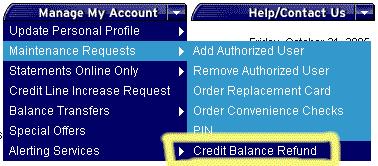
If they don’t, then you’ll have to do it indirectly. This will require another credit card, and it doesn’t even have to have a balance. Let’s say you request a $10,000 transfer from Card A to Card B. Once approved, it will show up on Card B as a $10,000 payment, and you will now have a negative (credit) balance on card B. If you make a lot of purchases you could just use it up that way, but most people will have to ask for a credit balance refund in the form of a check.

It matters what card issuer you use for Card B. AT&T/Citibank is the easiest to transfer TO as well, in the fact that you can request it online directly and without even human interaction. Here is a screenshot of the menu option you should look for:

AT&T Citibank Screenshot

I’ve gotten negative balances even greater than my credit limit with Citi (ex. credit limit $5,000 and then goes to -$10,000 with a received transfer), with zero problems.

I have also done this with American Express by calling in. Sometimes they will make you wait for a few days to make sure the payment clears before issuing the check. Now, if you send a big fat payment to a card that you never use, they might become suspicious. I have sent it to my American Express Starwood card which I already use regularly as a rewards card, and they’ve never given me a hard time.

Do not send it to MBNA, they may reject the transfer. I have also reported some success with Discover in the past, but I am not so sure about Chase, Advanta, and others. If you do try one of these, it’s better to use a card that already has a balance on it to fly “under the radar”. Honestly, I almost always just use AT&T/Citibank, switching to a different Citi card sometimes if I do more than one a month. Last time I used American Express was mainly an experiment to make sure they still did it.

With my Discover Miles card, I sent $7,000 to Citibank and $7,000 American Express. American Express sent me a check for the overpayment after verifying the balance transfer with Discover, which ended up making their check arrive about 4 days later than Citibank’s.

Either directly or indirectly, you should have money now in the form of a check or online transfer.

Where do you put the money?
If you already have higher-interest loans, like a home equity line of credit or other credit card debt, you could just move it there.

Otherwise, I recommend putting the money into an FDIC-insured or similarly safe checking or savings account that is relatively liquid. Here are some online savings account options, and this is my current setup to maximize interest. One reason why is that you must still make the minimum payments on the card, with are usually about 2% of the principal. So on $10,000 that would about $200 a month, decreasing each subsequent month as you pay it down. The second reason is more practical – if somehow you make a late payment, you can minimize the damage by simply paying the entire balance off immediately. Even at 20% APR, if you can pay it off in a few days the damage won’t be devastating.

Of course, some people may place it into bonds, dividend-yielding stocks, or other investments. To each their own, but I would not take that kind of risk for short-term loaned money.

Next up: Setup and management of the balance transfer. How do you manage the payments and due dates?


Skip To Another Part
I. Introduction and Warnings About 0% Balance Transfer Offers
II. Scouting For 0% Balance Transfer Offers
III. Application Tips and Getting Cash From 0% Balance Transfers
IV. Setup And Management of 0% APR Balance Transfers
V. Best Pre-Screened No Fee 0% APR Balance Transfer Offers