American Express Premier Rewards Gold Card: 25,000 Point / $250 Sign-Up Bonus

American Express Premier Rewards Gold CardAmerican Express has temporarily brought back their 25,000 Membership Rewards point offer for their Premier Rewards Gold Card from American Express®, which is one of their upscale-oriented charge cards where you must pay off the balance each month. Offer expires October 12th.

  • Earn More: earn 25K Membership Rewards points after you spend $2K during your first three months of Card membership. MR points are very versatile, and can be converted to 25,000 frequent flier miles in a number of programs in various increments, or you can simply get $250 in gift cards at several stores like Home Depot, Crate & Barrel, or Macy’s. (The usual offers are for 10,000 or 15,000 bonus points.)
  • No annual fee for your first year. Another important feature, you can get the sign-up bonus and also try out this card for free for a year. If you keep the card after that, there is a $195 annual fee.
  • Offers 3X points on airfare, 2X points on gasoline at U.S. stand-alone gas stations and at U.S. stand-alone supermarkets, and 1X points on other purchases. The traditional versions only offer 1 point per $ spent, so these are an extra perk for those that spend a lot on airfare.
  • Earn an additional 15,000 Membership Rewards bonus points when you spend $30,000 within one calendar year. This means that if you spend $30,000 in a year ($2,500 per month) that you’ll get at least 25,000 for sign-up + 30,000 on spending + 15,000 bonus = 70,000 points total, plus any extra for gas/groceries/airfare.

For those that charge a lot, especially with reimbursed airfare, that’s enough for 70,000 frequent flier miles (possibly two flights to Hawaii) or $700 in gift cards. If you don’t, there’s still that $250 upfront bonus with only $1,000 minimum spending. Terms and Restrictions Apply.

LendingClub Investment Criteria – What Loans To Avoid?

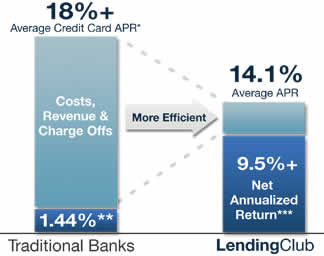
LendingClub.com (LC) is a website that securitizes person-to-person loans so that you can lend money to other people in as little as $25 increments, and you earn the interest. The idea is to replace banks and credit cards as the major middlemen used for lending. Here’s an illustration from their site:

Now, if you read my previous posts on LendingClub, you know I’m skeptical about getting 9.5% returns in the long run. My LendingClub Net Annualized Return is currently 6.8% after fees. If I can stay in the 4-6% range, I’d be happy as I view this activity as a hobby. My favorite loan so far is helping a young couple purchase a tiny 200 sf house-on-wheels.

The investment process is set up such that LC examines the loan application and assigns it a credit grade with an interest rate from 6.39% – 21.64%. All you have to decide is whether to fund the loan or not in increments of $25. You can’t change the rate. Therefore, the key is to quickly fund the relatively attractive loans and avoid the unattractive ones.

You can view historical performance data at the LC website, but it is very raw. I recently came across a new site called LendStats.com that has been sorting through the data and presenting it in some very insightful ways. The owner KenL uses a nice, simple formula for return on investment (ROI) and one can see from the data several ways to improve your returns.

Loan Factors To Avoid

Business loans. If you look at all the loan categories, only the ones under the Educational and Small Business categories have negative ROIs. (Educational loans have a much smaller sample size.) In general, perhaps it is a form of adverse selection when someone with a business idea must resort to making a personally-backed loan from strangers to fund their idea. Also, it may be that the economy is so tough that only select new businesses survive.

Borrowers with mortgages. Until recently, a mortgage holder was deemed more credit-worthy than a renter. That person had to have the means to make a 20% down payment and pass underwriting from a bank. Now, with so many people underwater in their homes, the ROI from renters is higher than mortgage-holders. Renters have greater flexibility with their cashflow. I suspect many people find themselves so bogged down by their mortgages that they decide to simply declare bankruptcy and forget about all their other debts as well.

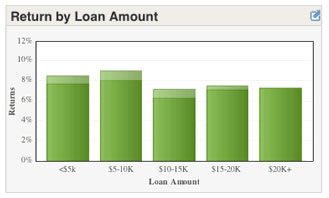
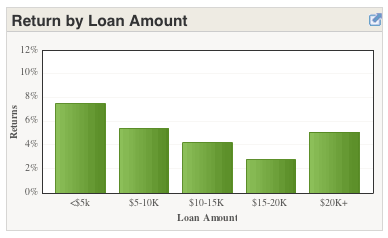
Loan amounts greater than $20,000. Loans over $25k have a negative ROI overall, with $20k loans not doing much better. Bigger loans means bigger risk, which apparently isn’t adequately compensated for by higher interest rates. Also, I am wary of people doing the “borrow-and-bankrupt” route where they try to amass as much debt as they can and then declare bankruptcy after either a huge party, leaving the country, or hiding assets.

Borrowers with more than 2 credit inquiries within last 6 months. Average ROI consistently goes down as the number of inquiries on your credit report goes up. This indicates that you are also trying to get credit from others, and thus your debt-to-income may be higher than reported. In general, this also increases the likelihood of either desperation, fraud, and/or impending crisis.

Any F and G rated loans. The general trend is still supporting my original plan of only buying the highest-rated A loans, however there are some improvements in the B through E grades. Loans with the lowest grades of F and G continue to have negative ROIs. These are also the loans with the smallest sample size, but since there are so few of them anyway I find it easier to simply avoid them.

Continental OnePass Plus Card: Free 25,000 Miles, Free Checked Bag, Primary Rental Car Insurance

Continental Airlines OnePass Plus CardNow that I’m flying a lot more again, I’m back in the hunt for some frequent flier perks. I just came across the new Continental Airlines OnePass Plus Card from Chase, which has a pretty nice mix of perks for travelers.
Sign-Up Bonus: Free Flight

  • 25,000 Bonus Miles after first purchase (no minimum amount) for first-time Continental Airlines personal Cardmembers. That’s enough already for one free round-trip airfare within the continental US.
  • No annual fee the first year. The regular annual fee is $85, but is waived the first year.
  • 5,000 Bonus Miles for adding an authorized user to your account. This is another easy one to get. Remember, just because you add someone doesn’t mean you have to give them the card. 😉
  • If you spend $25,000 on the card annually, you’ll get another 10,000 bonus miles. Since you earn 1 miles per $1 spent as well, this works out to 1.4 miles/dollar when you reach that mark.

Travel Perks

  • Free checked bag. If you fly on Continental, you and up to 9 travel companions will all each get your first checked bag for free. That’s a savings of $50 round-trip, per person.
  • Primary rental car insurance. Almost all personal credit cards only offer secondary rental car insurance, which means you have to file a claim with your own auto insurance first, which means you have to pay the deductible and possibly face higher future premiums. With primary collision damage waiver (CDW) even for personal use, you get coverage for damage or theft without having to make a claim.
  • More travel insurance that isn’t on all cards, like trip cancellation insurance up to $1500 for a illness with doctor’s note , delayed baggage coverage up to $300 if you have baggage delayed more than 18 hours and need to buy items to get by.
  • If you decide to keep this card past the first year, you’ll get two free passes to their First-Class airport lounge.

As you may have heard, Continental and United are merging, and the resulting airline is supposed to have the name United. Here’s a chance to rack up some miles that will eventually merge together – this card and bonus may not be available in the future. Until when they actually do merge, I should also note that Continental’s OnePass is known as one of the better programs when it comes to redeeming miles for trips.

Besides the Continental Airlines OnePass Plus Card, you can get a more flexible $625 travel bonus from the Chase Sapphire Preferred® Card, as well as other cards worth $500 in airfare.

“Disclaimer: This content is not provided or commissioned by the issuer. Opinions expressed here are author’s alone, not those of the issuer, and have not been reviewed, approved or otherwise endorsed by the issuer. This site may be compensated through the issuer’s Affiliate Program.  “The responses below are not provided or commissioned by the bank advertiser. Responses have not been reviewed, approved or otherwise endorsed by the bank advertiser. It is not the bank advertiser’s responsibility to ensure all posts and/or questions are answered.”

Updated myFICO Coupon Codes & Twitter Tip

Update February 2011: Use coupon code FICO25 for 25% off!

The last time I actually paid for my credit score was before I bought my house, and that was basically a fit of paranoia to make sure it was crazy-awesome before the lender pulled it. There are plenty of “FAKE-O” credit scores out there, but the only place to get your real FICO score is myFICO.com.

I’ve actually checked my FICO score several times since then for free, as promos usually pop up every couple month or so. I always try to post them here, but am often a bit late. This happened again this week, with myFICO offering free scores to the first 3,000 people. It was announced on their Twitter feed @myfico, so you may want to follow them for future opportunities. (While you’re at it, follow me @mymoneyblog too. I sometimes post smaller or short-lasting deals only on my Twitter page.)

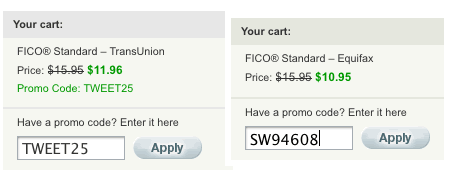
Here are the best promotional codes out there currently: TWEET25 to get 25% off your TransUnion FICO and SW94608 to get 30% off your Equifax FICO. You enter the promo code relatively late in the buying process, right before entering your credit card information.

Whenever you do buy a score, I would recommend trying to correlate your score and the current information on your report. Then you can start to learn what changes really affect your personal score. I’ve applied for 12 credit cards and canceled 5 with almost no appreciable affect to my scores (see credit score myths) – despite all the “rules” – only to have a huge balance on my mom’s credit card (with me as authorized user) show up and drop it by 30 points.

LendingClub P2P Loan Investment Returns Update 2010 Q3

LendingClub.com is a website that securitizes person-to-person loans so that you can lend money to other people in as little as $25 increments, and you collect the interest after some fees. The idea is to replace banks and credit cards as the major middlemen used for lending. “Investors earn better returns, borrowers pay lower rates.” I’ve been investing some money with them since they started in 2007.

Last time I wrote about LendingClub in May, I expressed concerns about their historical performance data living up to their marketed 9.65% returns and then LendingClub responded on why they thought things weren’t that bad. It’s been 3 months, so I figure it’s a good time for another update.

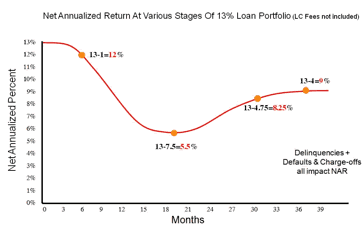
The first part of their argument is that they think that loan performance over time will go like this, with a drop and then significant recovery near the end of the term:

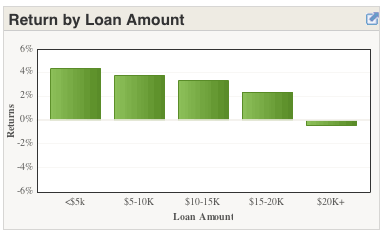
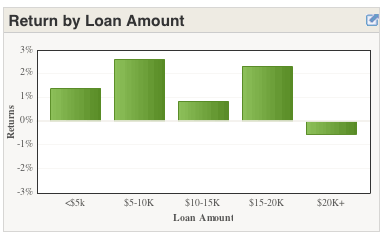
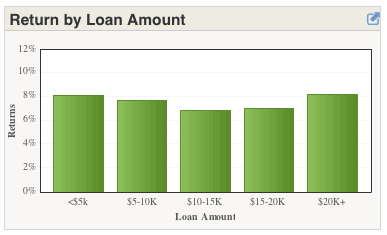
However, I don’t see that behavior happening. As you can see below, the older the loans, the lower the overall performance. Returns just keep dropping for loans going from 1.5 to 3 years old. There is no rise or recovery at the end of the three-year term. Data was taken from actual LC loans with observation date of August 17th, 2010.

Loans Originating Second Half of 2008 (about 1.5-2 years old)

Loans Originating First Half of 2008 (about 2-2.5 years old)

Loans Originating 6/1/2007 to 12/31/2007 (about 2.5-3 years old)


Note the change in the y-axis scale

Now, the next part of their argument was that all the loans that originated before they changed their credit requirements and interest rates at the end of 2008 weren’t a valid data set to be analyzing. (That doesn’t make me feel much better because as an early adopter, I hold a lot of those loans.) While improved underwriting may make the average returns higher, I don’t see why it should affect the overall performance behavior over time.

2009+ Loans Only

Okay, so the newer vintage loans that originated after January 1st, 2009 take into account their current lending criteria. In the end, we’ll just have to see if people really get higher returns. From now on, I’m going to try and track the performance every quarter. Here is the performance of loans originating in the first half of 2009, as of August 17th, 2010. Since it a loan has to be late for 4 months to be actually considered in default, this means the loans only have effective ages of 1 to 1.5 years.

So far, not too bad at about 8% return. Here is the performance of loans originating in the first quarter of 2009 with two observation dates (May 2010 and August 2010) overlaid on top of each other. You can see that the loan performance has decreased slightly over the last 3 months. I hope that I am wrong, and that the performance does start to improve.

You may call me a LendingClub basher, but I still consider myself an active investor and supporter. I want them to have awesome returns, but the data simply doesn’t support the likelihood of earning 9.5% annually. Investors should go into it with realistic expectations, and ideally an interest in P2P social lending. Despite this, if LendingClub can average, say 6% returns going forward, that would still be quite an accomplishment for this new business model. I know I’d be happy with that.

To Prospective Borrowers
Honestly, LendingClub is more attractive as an option for borrowing money and/or credit card debt consolidation. You can borrow up to $25,000 and you can know your rate before actually applying for the loan. If the rate quote they give you can be beaten elsewhere, then just walk away with no obligation. When writing your loan application, try to include as much applicable information as possible (reason for loan, how will you repay, monthly budget breakdown) and answer all lender questions promptly for the best results.

Equifax.com Promotional Code: Free 3-in-1 Credit Report & FICO Score

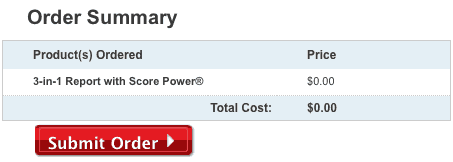
Visit the 3-in-1 Credit Report with Score page at Equifax and click on “Buy Now”. You’ll have to register on the website or log in with a previously created account. There is no need to enter credit card information. When you are able to, enter the promotion code NOC431 and the price will show as $0.00. Via littlepenguin of SD. Users have reported mixed success with many people getting some sort of error, but it worked fine for me:

You will end up with your credit reports from all three credit bureaus (Experian, Equifax, and TransUnion) as well as your official FICO score based on your Experian credit report. (You know you have 3 different FICO scores – one from each bureau – right?) A pretty good deal, although I wouldn’t say it’s worth the $39.95 retail price. I wouldn’t wait too long on this, the code could expire at any time. (Update: Appears to be expired, some people are calling in manually and applying the code with success.)

Citibank Back-to-School Student Credit Cards

Going back to school? Citibank has some good card options for college students:

  • Citi mtvU Platinum Select Visa Card
  • Citi Forward Card for College Students – $75 Statement Credit

Both the mtvU and Forward cards offer 5x rewards on bookstores, movies, music, and restaurants – boy do they know students. 5x ThankYou points amounts to 3.45% cash back or 5% back in the form of gift cards from certain retailers. Great deal if you can handle credit responsibly. I’m pretty sure I applied for my first credit card in college in exchange for a cheap t-shirt with a Cal logo on it and no rewards whatsoever. Good thing I’ve always hated owing other people money…

As noted previously, 5x points on bookstores also includes anything bought at Amazon.com (a bookstore!). Would go perfectly with your free year of Amazon Prime.

Free Year of Amazon Prime For Students (.edu email)

Amazon Student LogoAmazon.com has a new program called Amazon Student where you can get “exclusive deals”, the best of which is a free one-year subscription to Amazon Prime. This allows you to get the convenience of free 2-day shipping on most products (including textbooks and even some used books) with no minimum order amount. Usually costs $79 a year.

You can even keep your existing Amazon.com account, just click here, enter your .edu e-mail address, and click on the confirmation e-mail to activate. If you have an .edu e-mail, try it!

This is a really nice perk, and would go great with the Citi Forward® Card gives you 5 ThankYou® Points for every $1 you spend at restaurants and on entertainment, like bookstores, of which Amazon.com counts regardless of what you are actually buying at the bookstore. Up to 2% APR reduction when using credit wisely. This equates to 5% back in the form of gift cards at select retailers, or a 3.45% pure cashback return. Really, I’ve done it.  2,500 bonus ThankYou Points after spending $500 within the first 3 months of cardmembership and up to 1,200 bonus ThankYou Points for paying on time and staying under your credit limit. Watch your interest rate go down and your ThankYou Points go up.

See my Citi Forward review and rewards follow-up for more details.

New Credit Card Trend: Rotating Rewards, Swiss Army Style

When you charge something on your credit card, the merchant usually pays about 2-3% in transaction fees for the convenience and benefit of accepting these cards (it makes it easier for people to spend money with them). In order to get their specific card “in your wallet”, issuers often rebate part of these fees in the form of % cashback rewards or frequent flier miles. This makes sense, because many people with good credit and/or higher spending don’t carry balances so that the primary source of profits is from these transaction fees.

Swiss Army Knife

The trick for issuing banks, of course, is to offer as little rewards as possible yet still convince enough people as a group to use the card. The newest trend is to offer a high 3% to 5% back (more than they take in!) but only on a specific group of rotating purchases. Usually the rest earn 1% cashback. If you pay attention to the rules, this can make for some significant savings. I think of it as a Swiss army knife of credit cards; you just need to pick the right one for the job. 🙂 It might even be time to dust off an old card you don’t use anymore.

Here are some popular cards and their current rotating categories. Also, new cardholders can combine with current sign-up bonuses of up to $100 upfront.

Citi® Dividend Platinum Select® Visa® Card
Reward categories change quarterly. From April 1st to June 30th, you can earn 5% cash back on

  • Home Depot
  • Home Furnishing purchases
  • Home & Garden Purchases

After you get your card, you must enroll by logging into your account or calling 1-800-231-0891. There is no cap on the 5% back, except for the $300 overall cap on all dividend rewards annually. All other purchases do earn a standard 1% with no tiers, and rewards do not expire as long as you have activity once every 12 months.

Chase Freedom Visa – $100 Bonus Cash Back
Reward categories change quarterly. From January 1 to March 31, 2012 you can earn 5% cash back on up to $1,500 spent in the following categories:

  • Gas Stations
  • Amazon.com

You must enroll at ChaseBonus.com. All other purchases do earn a standard 1%, with no tiers or expiration of rewards. Currently, the Chase Freedom Visa – $100 Bonus Cash Back has a promotion offering a $100 check if you sign up and make $500 in purchases in your first three months.

Discover More CardDiscover More Card
Reward categories change quarterly. From January 1st to March 31st, you can earn 5% cash back on up to $300 spent in the following categories:

  • Gas
  • Entertainment

In September, you can also earn 5% cash back on up to $200 spent in grocery stores and drugstores. You must enroll online to activate the rewards each quarter. Discover card has a tiered cashback rate (1% unlimited Cashback Bonus on purchases after your total annual purchases exceed $3000; purchases that are part of your first $3000 earn .25%.).

PenFed Platinum Cashback Rewards CardPenFed Platinum Cashback Rewards Card
Bonus categories appear and change regularly for this card, but not on a set schedule.

You can view all the eligible merchants. You don’t need to enroll. This is in addition to the year-round rewards structure of 5% cash back on gas purchases (must pay at pump) and 1% cash back on everything else. Rewards are credited monthly on your next statement.

Note: To get this card, you must also have membership to the Pentagon Federal Credit Union (you can apply for both at the same time). In general, membership is open to the military, US government employees, or the family or household of existing members. However, anyone can become eligible by joining the National Military Family Association (NMFA) for a $20 one-time fee. PenFed also offers other competitive financial products, including low-rate mortgages and long-term CD rates.

In order to keep track of all these, I usually just cut off the top part of a Post-It note with the sticky backing, and use it to label each card in my wallet. Here’s a pic of one of my cards:

Citi Dividend World Mastercard Image
 

myFICO Coupon Code: 20% to 30% Off

Update February 2011: Use coupon code FICO25 for 25% off!

I am not a big fan having to purchase credit scores. I can understand why a lender would pay to get a calculation of your likelihood of defaulting on your loan, but if it’s based on our data, why do we have to pay just to see it? Even if I am declined for a loan, I can only see my report, not the numerical score that supposedly defines my financial life.

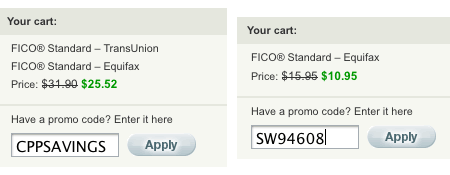
There are plenty of “FAKE-O” credit scores out there, but the only place to get your real FICO score is myFICO.com. If you must order your score, use the promotional code CPPSAVINGS to get 20% off.

For the Equifax credit score only, you can get it for $10.95 using the code SW94608, which is over 30% off. You enter the promo code relatively late in the buying process, right before entering your credit card information.

Whenever you do buy a score, I would recommend trying to correlate your score and the current information on your report. Then you can start to learn what changes really affect your score. I’ve applied for 12 credit cards and canceled 5 with almost no appreciable affect to my scores (see credit score myths) – despite all the “rules” – only to have a huge balance on my mom’s credit card (with me as authorized user) show up and drop it by 30 points.

Penfed Visa Platinum Cashback Rewards Card – 5% Cash Back on Gas

There used to be a bunch of great cashback cards for gas, but now the only one that still offers 5% back to consumers is the PenFed Visa® Platinum Cash Rewards Card. It offers:

  • 5% cash back on gas purchases (must pay at pump)
  • 0.25% cash back on everything else.

No annual fee. The rewards are credited on each monthly statement, so that you don’t have to wait to meet any $50 thresholds or remember to call in. If your family spends $200 on gas per month, that alone will have this card paying you $120 per year in rewards.

The catch? You must also be a member of the Pentagon Federal Credit Union, and you can apply for membership as part of the credit card application. In general, membership is open to members of the military and affiliated organizations, US government employees, or the family or household of existing members. However, anyone can become eligible by joining the National Military Family Association (NMFA) for a $20 one-time fee (and it goes to a good cause). PenFed also offers other competitive financial products, including low-rate mortgages and long-term CD rates.

Lower Your Credit Card APR: Phone Script from DebtGoal

DebtGoal is a new site that helps you track and manage your debt-reduction goals (as opposed to a debt settlement company). After the free trial, it runs $11.95 per month. One of the things they do is try and guide you to lower the interest rates on your credit cards. Here’s a sample script that you can try out yourself for free, which is quite simple but probably also effective:

Hello, my name is _______________. I have been a cardholder since ____. In the past few months, several credit card companies have offered me lower rates than my current rate with you. I value my relationship with you, but I would like you to match the other offers that I have received and reduce my interest rate by ___%. Are you authorized to adjust my interest rate?

It can be handy to actually have offers or other cards in front of you that really have lower rates. Depending on their response, you could also throw in one of these:

  • “Are there other people who have the authority to lower my rate? May I speak with them?”
  • “Do you have a promotional rate that I can take advantage of?”
  • “What would I have to do to get a lower rate? Can I call back later when I meet those criteria?”
  • “Can I qualify for a hardship program?”

Any other success stories or tips?