Barclays Bank Tiered Savings: $200 Bonus on $30,000 Deposit (+3.90% APY)

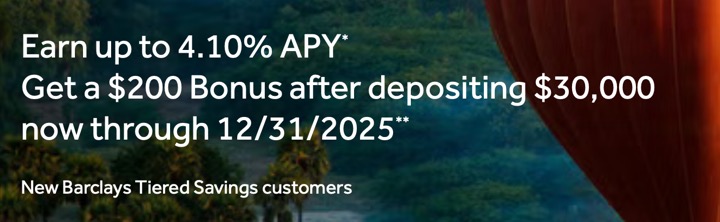
Barclays Bank Delaware is an FDIC-insured US bank with a limited-time offer of a $200 bonus if you deposit $30,000+ in new funds into their Tiered Savings Account. You must fund within 30 days of opening, and maintain the balance of at least $30,000 for another 120 consecutive days after funding. Bonus arrives after another 60 days. You must be a new Barclays Tiered Savings customer (current and previous Barclays customers with a Savings or CD are not eligible). Note that they have other flavors of savings accounts, so be sure to apply for the right one. Direct deposit is not required. Offer expires 12/31/2025.

There is a slightly better version of this bonus for AARP members (you will need an active membership number).

Here are the current interest rate tiers, as of 10/19/25. Note that it’s basically a 3.90% APY account unless you have a $250,000 balance. As with all savings accounts, the rates are also subject to change at any time.
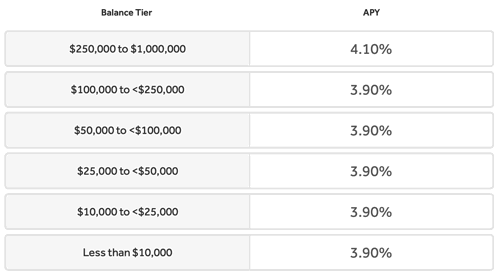
Bonus math. This is a 0.66% bonus on $25,000 if you keep it there for 120 days, which makes it the equivalent of 2% APY annualized. Bonus will be paid around Day 180 and the account must be open at that time, but you only need to maintain full balance through Day 120 after funding. The bonus is on top of the standard interest rate, currently a relatively competitive 3.90% APY for a $25,000 balance as of 10/19/25.

The equivalent of roughly 5.90% total APY over 120 days makes it a decent offer for those with compatible balances looking for short-term place to hold their cash for a few months. However, it’s not as good as the currently live CIT Bank deposit offer that offers $225 for $25k and $300 for $50k with no minimum holding period.
How to Close Your US Bank Account or US Bank Credit Card Online

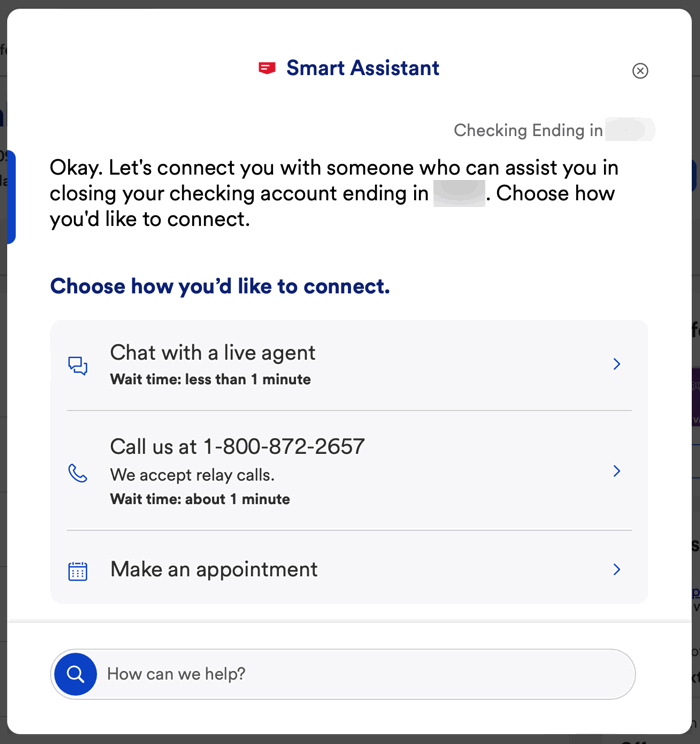
After US Bank completely changed the terms of their Smartly Rewards credit card less than 6 months after application, I have nearly completed closing nearly all of my US Bank accounts, including bank accounts, credit cards, and brokerage accounts. The process was relatively simple, and you don’t need to visit a branch or call them on the phone if you don’t want to. You can close your account online using the Live Chat feature on their website. Simply type in “close account” into their Smart Assistant search bar, and then they will ask which account you want to close. After you select it, you will be presented with the following popup options. These may be different based on their daytime/weekday business hours, but I was able to reach someone in less than a minute. The Live Chat agent closed things efficiently while I did other stuff on my computer.

If you have a US Bank credit card with an annual fee that was charged to your account within the last 30 days, the annual fee will be automatically refunded after you close the credit card account. In other words, you can wait until you actually see the new annual fee charged to the account before you close the account (if you want). That may give you more time to redeem all your rewards (which will be lost upon closure) and use up all the perks like a travel statement credit or TSA PreCheck/Global Entry application fee. In the past, US Bank has also offered “retention” offers in order to keep your business, but I was not offered anything this time when canceling. Perhaps if you call into a human, they might be more likely to offer something, I don’t know.

For the US Bank brokerage account, I had moved in over $100k in assets to qualify for their highest loyalty tier. Well, that loyalty was not rewarded, so I was off again looking for the best place for my assets. I thought about the Kraken up to 2% offer for 1-year hold, but the reward-to-risk ratio just wasn’t there for me. The current regulatory environment is not pro-consumer, and I didn’t feel comfortable with possible having to beg and plead for my $100k back if Kraken blew themselves up in a crypto meltdown. I also didn’t like how the “up to” 2% bonus was contingent on outside factors. I’ll still take the easy crypto money, though!

In the end, I chose this Merrill Edge transfer offer, which is a $400 bonus on $100k transferred (0.4%) with a much shorter 90-day hold. I already have an account with Merrill and Preferred Rewards status, and I find them reliable and professional. Merrill Edge will also reimburse me for the $95 outgoing transfer fee charged by US Bank. Thankfully, this offer is also valid for existing customers. If one bank isn’t meeting your needs, there is most likely a better offer out there.

Best Interest Rates Survey: Bank Accounts, Treasury Bills, Money Markets, ETFs – October 2025

Here’s my monthly survey of the best interest rates on cash as of October 2025, roughly sorted from shortest to longest maturities. Banks and brokerages love taking advantage of our idle cash, and you can often earning more money while keeping the same level of safety by moving to another FDIC-insured bank or NCUA-insured credit union. Check out my Ultimate Rate-Chaser Calculator to see how much extra interest you could earn from switching. Rates listed are available to everyone nationwide. Rates checked as of 10/13/2025.

TL;DR: Savings account interest rates have dropped slightly overall. You can get 4.6% and 4.5% APY if you accept some hoops/restrictions. Short-term T-Bill rates have fallen slightly, now ~4.1%. Top 5-year CD rates are ~4.3% APY, while 5-year Treasury rate is ~3.6%.

High-yield savings accounts*
Since the huge megabanks still pay essentially no interest, everyone should at least have a separate, no-fee online savings account to piggy-back onto your existing checking account. The interest rates on savings accounts can drop at any time, so I list the top rates as well as competitive rates from banks with a history of competitive rates and solid user experience. Some banks will bait you with a temporary top rate and then lower the rates in the hopes that you are too lazy to leave.

  • The top saving rate at the moment: Pibank at 4.60% APY (no min), but they have some weird restrictions; like you can only use wire/Plaid to deposit and wire transfers to withdraw funds?! Presidential Bank has a 4.50% APY savings account that requires an Advantage Checking account. You’ll have to decide if the hoops are worth it. CIT Platinum Savings is now at 3.85% APY with $5,000+ balance and is offering an up to $300 deposit bonus which increases your effective APY for a while. There are many banks in between.
  • SoFi Bank is at 3.80% APY + up to 4.50% APY for 6 months + $325 new account bonus with qualifying direct deposit. You must maintain a direct deposit of any amount (even $1) each month for the higher APY. SoFi has historically competitive rates and full banking features.
  • Here is a limited survey of high-yield savings accounts. They aren’t the top rates, but a group that have historically kept it relatively competitive such that I like to track their history. I call this the “okay/good” zone of 3.40%+.

Short-term guaranteed rates (1 year and under)
A common question is what to do with a big pile of cash that you’re waiting to deploy shortly (plan to buy a house soon, just sold your house, just sold your business, legal settlement, inheritance). My usual advice is to keep things simple and take your time. If not a savings account, then put it in a flexible short-term CD under the FDIC limits until you have a plan.

  • No Penalty CDs offer a fixed interest rate that can never go down, but you can still take out your money (once) without any fees if you want to use it elsewhere. Marcus has a 13-month No Penalty CD at 3.95% APY ($500 minimum deposit). Farmer’s Insurance FCU has a 9-month No Penalty CD at 4.00% APY ($1,000 minimum deposit). USA USALLIANCE Financial CU has a 11-month No Penalty CD at 3.90% APY ($500 minimum deposit).
  • Abound Credit Union has a 10-month certificate at 4.30% APY ($500 min). Early withdrawal penalty is 90 days of interest. Anyone can join this credit union via $10 membership fee to join partner organization.

Money market mutual funds
Many brokerage firms that pay out very little interest on their default cash sweep funds (and keep the difference for themselves). Note: Money market mutual funds are highly-regulated, but ultimately not FDIC-insured, so I would still stick with highly reputable firms.

  • Vanguard Federal Money Market Fund (VMFXX) is the default sweep option for Vanguard brokerage accounts, which has a 7-day SEC yield of 4.04% (changes daily, but also works out to a compound yield of 4.12%, which is better for comparing against APY). Odds are this is much higher than your own broker’s default cash sweep interest rate.
  • Vanguard Treasury Money Market Fund (VUSXX) is an alternative money market fund which you must manually purchase, but the interest will be mostly (100% for 2024 tax year) exempt from state and local income taxes because it comes from qualifying US government obligations. Current 7-day SEC yield of 4.04% (compound yield of 4.12%).

Treasury Bills and Ultra-short Treasury ETFs
Another option is to buy individual Treasury bills which come in a variety of maturities from 4-weeks to 52-weeks and are fully backed by the US government. You can also invest in ETFs that hold a rotating basket of short-term Treasury Bills for you, while charging a small management fee for doing so. T-bill interest is exempt from state and local income taxes, which can make a significant difference in your effective yield.

  • You can build your own T-Bill ladder at TreasuryDirect.gov or via a brokerage account with a bond desk like Vanguard and Fidelity. Here are the current Treasury Bill rates. As of 10/10/25, a new 4-week T-Bill had the equivalent of 4.09% annualized interest and a 52-week T-Bill had the equivalent of 3.61% annualized interest.
  • The iShares 0-3 Month Treasury Bond ETF (SGOV) has a 4.12% 30-day SEC yield (0.09% expense ratio) and effective duration of 0.10 years. SPDR Bloomberg Barclays 1-3 Month T-Bill ETF (BIL) has a 4.02% 30-day SEC yield (0.136% expense ratio) and effective duration of 0.15 years. The new Vanguard 0-3 Month Treasury Bill ETF (VBIL) has a 4.12% 30-day SEC yield (0.07% expense ratio) and effective duration of 0.10 years.

US Savings Bonds
Series I Savings Bonds offer rates that are linked to inflation and backed by the US government. You must hold them for at least a year. If you redeem them within 5 years there is a penalty of the last 3 months of interest. The annual purchase limit for electronic I bonds is $10,000 per Social Security Number, available online at TreasuryDirect.gov.

  • “I Bonds” bought between May 2025 and October 2025 will earn a 3.98% rate for the first six months. The rate of the subsequent 6-month period will be based on inflation again. More on Savings Bonds here.
  • In mid-October 2025, the CPI will be announced and you will have a short period where you will have a very close estimate of the rate for the next 12 months. I will post another update at that time.

Rewards checking accounts
These unique checking accounts pay above-average interest rates, but with unique risks. You have to jump through certain hoops which usually involve 10+ debit card purchases each cycle, a certain number of ACH/direct deposits, and/or a certain number of logins per month. If you make a mistake (or they judge that you did) you risk earning zero interest for that month. Some folks don’t mind the extra work and attention required, while others would rather not bother. Rates can also drop suddenly, leaving a “bait-and-switch” feeling.

  • OnPath Federal Credit Union (my review) pays 7.00% APY on up to $10,000 if you make 15 debit card purchases, opt into online statements, and login to online or mobile banking once per statement cycle. Anyone can join this credit union via $5 membership fee to join partner organization. You can also get a $150 Visa Reward card when you open a new account and make qualifying transactions.
  • Genisys Credit Union pays 6.75% APY on up to $7,500 if you make 10 debit card purchases of $5+ each per statement cycle, and opt into online statements. Anyone can join this credit union via $5 membership fee to join partner organization.
  • Oklahoma Central Credit Union pays 6.00% APY on up to $10,000 if you make 15 debit card purchases (non-ATM) per statement cycle. Anyone can join this credit union if they are “affiliated with another credit union”.
  • La Capitol Federal Credit Union pays 5.75% APY on up to $10,000 if you make 15 debit card purchases of at least $5 each per statement cycle. Anyone can join this credit union via partner organization, Louisiana Association for Personal Financial Achievement ($20).
  • First Southern Bank pays 5.50% APY on up to $25,000 if you make at least 15 debit card purchases, 1 ACH credit or payment transaction, and enroll in online statements.
  • Credit Union of New Jersey pays 6.00% APY on up to $25,000 if you make 12 debit card purchases, opt into online statements, and make at least 1 direct deposit, online bill payment, or automatic payment (ACH) per statement cycle. Anyone can join this credit union via $5 membership fee to join partner organization.
  • Andrews Federal Credit Union pays 5.50% APY (down from 6%) on up to $25,000 if you make 15 debit card purchases, opt into online statements, and make at least 1 direct deposit or ACH transaction per statement cycle. Anyone can join this credit union via partner organization.
  • Find a locally-restricted rewards checking account at DepositAccounts.

Certificates of deposit (greater than 1 year)
CDs offer higher rates, but come with an early withdrawal penalty. By finding a bank CD with a reasonable early withdrawal penalty, you can enjoy higher rates but maintain access in a true emergency. Alternatively, consider building a CD ladder of different maturity lengths (ex. 1/2/3/4/5-years) such that you have access to part of the ladder each year, but your blended interest rate is higher than a savings account. When one CD matures, use that money to buy another 5-year CD to keep the ladder going. Some CDs also offer “add-ons” where you can deposit more funds if rates drop.

  • United Fidelity Bank has a 5-year certificate at 4.30% APY ($1,000 minimum), 4-year at 4.25% APY, 3-year at 4.20% APY, 2-year at 4.20% APY, and 1.5-year at 4.25% APY. Early withdrawal penalties are not disclosed clearly online.
  • Mountain America Credit Union (MACU) has a 5-year certificate at 4.00% APY ($500 minimum), 4-year at 4.00% APY, 3-year at 4.00% APY, 2-year at 4.25% APY, and 1-year at 4.00% APY. Early withdrawal penalty for the 4-year and 5-year is 365 days of interest. Anyone can join this credit union via partner organization American Consumer Council for a one-time $5 fee (or try promo code “consumer”).
  • Lafayette Federal Credit Union (LFCU) has a 5-year certificate at 3.97% APY ($500 minimum), 4-year at 3.97% APY, 3-year at 3.97% APY, 2-year at 4.02% APY, and 1-year at 4.02% APY. Slightly higher rates with jumbo $100,000+ balances. Note that the early withdrawal penalty for the 5-year is a relatively large 600 days of interest. Anyone nationwide can join LFCU by joining the Home Ownership Financial Literacy Council (HOFLC) for a one-time $10 fee.
  • You can buy certificates of deposit via the bond desks of Vanguard and Fidelity. You may need an account to see the rates. These “brokered CDs” offer FDIC insurance and easy laddering, but they don’t come with predictable early withdrawal penalties. Right now, I see a 5-year non-callable brokered CD at 3.75% APY (callable: no, call protection: yes). Be warned that both Vanguard and Fidelity will list higher rates from callable CDs, which importantly means they can (and will!) call back your CD if rates drop significantly later.

Longer-term Instruments
I’d use these with caution due to increased interest rate risk (tbh, I don’t use them at all), but I still track them to see the rest of the current yield curve.

  • Willing to lock up your money for 10 years? You can buy long-term certificates of deposit via the bond desks of Vanguard and Fidelity. These “brokered CDs” offer FDIC insurance, but they don’t come with predictable early withdrawal penalties. You might find something that pays more than your other brokerage cash and Treasury options. Right now, I see a 10-year CDs at [n/a] (non-callable) vs. 4.05% for a 10-year Treasury. Watch out for higher rates from callable CDs where they can call your CD back if interest rates drop.

All rates were checked as of 10/13/25.

* I no longer recommend fintech companies due to the possibility of significant loss due to poor recordkeeping and the lack of government protection in such scenarios. The point of cash is absolute safety of principal.

Photo by Giorgio Trovato on Unsplash

Bank of America Credit Cards – 2% More Rewards Day on Thursday 11/6/2025

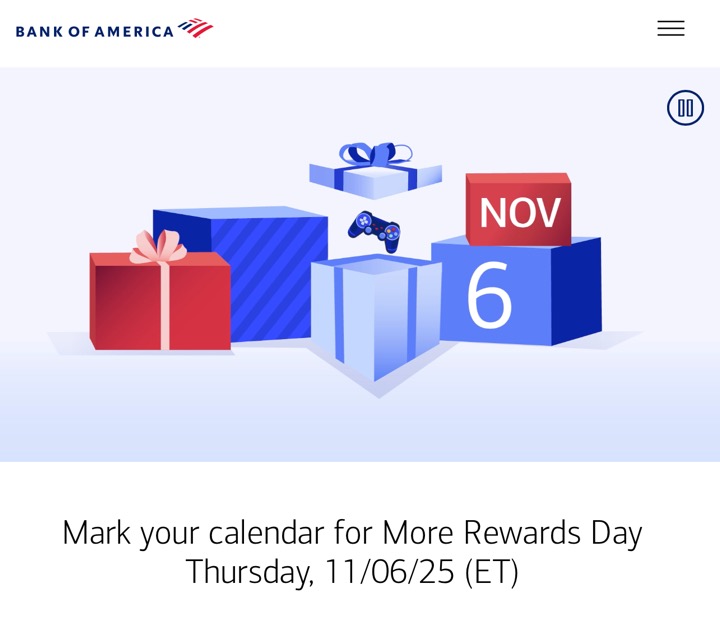
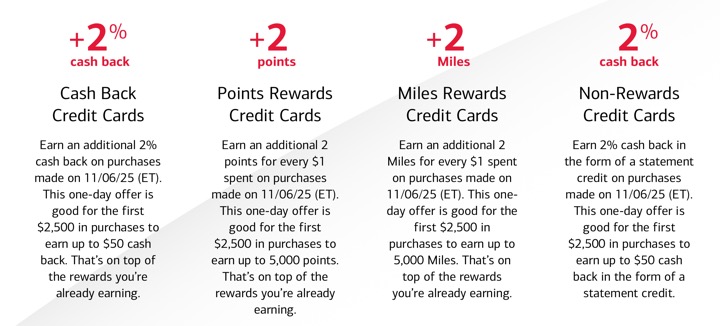
Back for 2025. Bank of America has a one-day credit card promotion called “More Rewards Day” on Thursday, 11/6/25. Depending on your BofA credit card type (both consumer and business cards are all eligible), you can earn an additional 2% cash back or 2 points or miles/$1 spent on up to $2,500 in purchases made on 11/6/25 only (Eastern time zone!), up to a $50/5,000 point cap per unique credit card account. That’s on on top of the rewards you’re already earning. No enrollment required.

Eligible cards include:

Customized Cash Rewards
Unlimited Cash Rewards
Travel Rewards
Premium Rewards®
Premium Rewards® Elite
BankAmericard® Power Rewards®
BankAmericard Rewards®
MERRILL+®
MERRILL+® Elite
Atmos™ Rewards Ascent
Atmos™ Rewards Summit
Royal Caribbean®
Celebrity Cruises®
Norwegian Cruise Line
Beaches
Sandals
Free Spirit®
Allegiant
Air France KLM
BankAmericard®

You can get up to a $50 bonus on each of your unique BofA credit cards. Note that it expires 11:59pm in the Eastern time zone. It appears that somehow they can track the “transaction date” separately from when it posts to your statement. Note that some retail websites don’t actually charge you until a physical item ships.

Only Purchases that post to your account and appear on your statement with a transaction date of 11/06/2025 will qualify. Merchants may impact when a transaction will appear on your statement, particularly if they delay processing of the purchase. Transactions with delayed processing of 90 days or more will not be eligible to be included in the promotional offer.

Some possibilities beyond timing the normal bonus categories on your unique cards:

  • Pay estimated income taxes at PayUSATax.com for currently a 1.75% fee.
  • Pay your insurance premiums upfront. My State Farm grouped monthly bill can also be timed using manual payment.
  • Pay your utilities, property taxes, phone bills, and other monthly bills upfront. Sometimes it just costs a one-time flat fee to pay by credit card, which can be worth if you are charging $1,000+.
  • Make your annual charitable contributions for this year on this date.

Closing US Bank Accounts to Avoid Annual Fee After Smartly Credit Card Negative Changes

As of 9/15/25, my US Bank Smartly credit card was downgraded from 4% cash back for my situation to the more restrictive version of the negative changes to the US Bank Smartly credit card, which matches what is available to new applicants. In other words, a 2% cash back card. Going for any higher cash back rewards tier would actually lose you money due to the interest you must give up on your bank balances.

US Bank changed the terms of their product less than 6 months after many people applied and opened multiple new accounts, including myself. Rather disappointing, although I would have accepted the less restrictive version. But now, since I can get better cash back elsewhere, it was time to tear down the US Bank relationship that I had previously been incentivized to build.

Before 9/15/25, I had:

  • Smartly Checking account with active deposits and withdrawals.
  • Smartly Savings account.
  • Smartly Credit Card with thousands of dollars in monthly transactions.
  • US Bancorp Investments Self-Direct Brokerage account with $100,000+ in assets.

After the negative changes, I will have:

  • Smartly Checking with $5 balance.
  • Smartly Savings (closed).
  • Smartly Credit Card with no regular activity.
  • US Bancorp Investments Self-Direct Brokerage account (closed).

This minimal setup keeps a few accounts open for possible future use, but in the meantime there will be no regular activity and no fees. The US Bank Smartly Checking has a $12 monthly fee that can be waived with a U.S. Bank Smartly credit card. The US Bank Smartly credit card itself has no annual fee. I’ll make a transaction on the checking and the credit card once a year to maintain activity and prevent closure. Hibernation mode.

CIT Bank Platinum Savings Account: Up to $300 Deposit Bonus (New & Existing Customers)

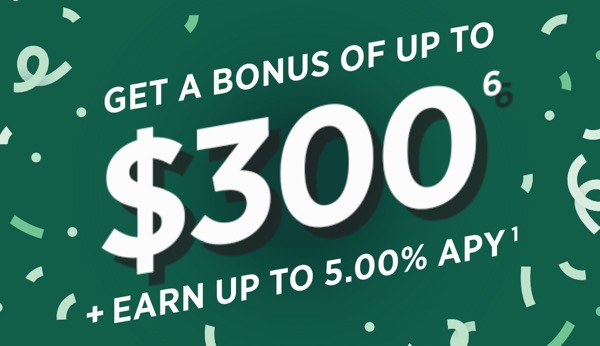
CIT Bank has a new limited-time $225/$300 Platinum Savings deposit bonus.1 The bonus depends on deposit amount, and it is open to both new and existing customers*. Importantly, the bonus is in addition to the interest rate, currently a competitive 3.75% APY2 (as of 11/20/25) with a balance of $5,000 or more. There is a minimum $100 deposit to open a new account.

* Important note: The fine print states: “Customers who previously participated in the PS2025 promotion and received the associated bonus are not eligible to participate in the PS2025 promotion again.” This was an earlier promotion from around March 2025.

New deposit bonus details. For new customers, you must first open a new account with at least $100 and promo code PS2025 at this special offer link. You’ll get multiple confirmations that you are enrolled in the promo during the application process.

If you already have an CIT Bank existing account, you still need to first officially enroll in this offer via the “Start savings now” button and then logging into your CIT Bank account. If you have other types of CIT Bank accounts already, but need to open a new Platinum Savings account, you can do that easily as well.

There are only two tiers for the bonus, either $25,000 or $50,000. Qualifying funds must come from an account outside of CIT Bank. (Transfers from existing CIT Bank accounts will not qualify for this promotion.)

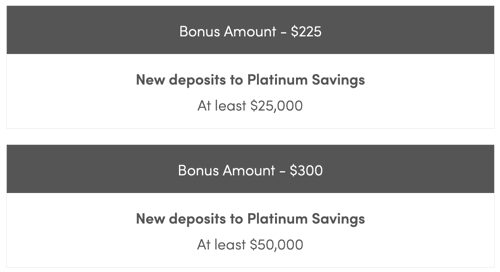
  • A new deposit of $25,000 to $49,999 within 30 calendar days of your open/enrollment date will get you a $225 cash bonus.
  • A new deposit of $50,000+ within 30 calendar days of your open/enrollment date will get you a $300 cash bonus.

There is a limit of one Platinum Savings promotional offer per account and per Primary customer. If multiple Platinum Savings accounts are opened, only one account per primary account owner is eligible.

All customers who qualify for the $225 or $300 bonus offer will receive the bonus in the enrolled Platinum Savings account within 60 days after the 30-day funding period. The enrolled Platinum Savings account must be open at the time of the bonus payment to qualify. You can fund all at once or in multiple transfers, it just has to be done within the 30-day window.

Note that there is no minimum holding period. You just need to fund within the 30-day period after your opening/enrollment date. After that initial 30-day period, your account just needs to be open at the time of the bonus payment, which is another 60 days after the 30-day mark. You do not have to maintain the balance during those additional 60 days, although you could choose to keep it there until the bonus arrives.

Effective APY rough numbers. The lack of minimum holding period makes the potential effective APY theoretically sky-high. For the sake of rough numbers, if you assume you keep the money there for 30 days, here are the effective interest rates you could get as either a new or existing customer:

  • For a new/existing customer earning the $225 bonus on $25,000 in new deposits with a 30-day hold period, which also qualifies you for the current 3.75% APY tier, that works out to a total 14.55% APY for 30 days (10.8 + 3.75).
  • For a new/existing customer earning the $300 bonus on $50,000 in new deposits with a 30-day hold period, which also qualifies you for the current 3.75% APY tier, that works out to a total 10.95% APY for 30 days (7.2 + 3.75).

You can see that the $25k tier works out to be a higher percentage, but you get more absolute money if you have enough fund for the $50k tier.

The Platinum Savings account has no minimum balance fees, no monthly service fees, no inactivity fee. However, make sure you keep $5,000 in there to qualify for the highest interest rate tier.

Bottom line. CIT Bank has really good limited-time deposit bonuses from time to time, and thankfully they are also usually available to existing customers. Right now is one of those times, with a new up to $300 Platinum Savings deposit bonus and it is indeed open to both new and existing customers. The bonus is on top of the interest rate, currently 3.75% APY (as of 11/20/25) with a balance of $5,000 or more.

This offer is for a limited-time only, and they may end it at any time.

1Official promotion disclosure:

This limited time offer to qualify for a $225 cash bonus with a minimum deposit of $25,000 or a $300 bonus with a minimum deposit of $50,000 is available to New and Existing Customers who meet the Platinum Savings promotion criteria. The Promotion begins on November 20, 2025 and can end at any time without notice.

Click here to see promotion details and
terms.

2APY disclosure for Platinum Savings:

Platinum Savings is a tiered interest rate account. Interest is paid on the entire account balance based on the interest rate and APY in effect that day for the balance tier associated with the end-of day account balance. *APYs — Annual Percentage Yields are accurate as of November 20, 2025: 0.25% APY on balances of $0.01 to $4,999.99; 3.75% APY on balances of $5,000.00 or more. Interest Rates for the Platinum Savings account are variable and may change at any time without notice. The minimum to open a Platinum Savings account is $100.

For complete list of account details and fees, see the CIT Bank Personal Account disclosures.

Connexus Credit Union: Rewards Checking $300 Bonus + 5% APY

Connexus Credit Union has a $300 bonus for their Xtraordinary Checking Account, which is a “Rewards” checking account that requires a number of debit card transactions and other activities to earn a special rate (currently 5% APY). Anyone can join this credit union via partner organization Connexus Association for a one-time $5 fee. Here are the promo highlights:

  • Must open a new Xtraordinary Checking Account between 9/08/2025 and 11/09/2025 with promo code XTRABONUS. Individuals who previously had a Connexus Checking Account are eligible, so long as the account closure occurred before 7/01/2025.
  • Meet the following account requirements for two month-end periods within 120 days of account opening:
    • Make 15 debit card purchases or accumulate $500 in debit card spending.
    • Be subscribed to eStatements.
    • Make one monthly deposit of at least $500 from either a direct deposit or an ACH deposit.
  • Bonus will be based on your average daily balance during the two qualifying months:
    • $0 bonus: $999.99 or less
    • $100 bonus: $1,000.00 – $4,999.99
    • $200 bonus: $5,000.00 – $9,999.99
    • $300 bonus: $10,000.00 or more

Notably, the “monthly deposit” does not have to be a Direct Deposit of payroll. ACH transfers count. From their fine print:

What qualifies as a monthly direct deposit or an ACH deposit (from a non-Connexus account) into my Xtraordinary Checking Account?
Some example deposits for this account requirement include direct deposit from payroll, retirement benefits, or government benefits.

Additionally, you can use Connexus Digital Banking to link to an external account at a different financial institution and transfer funds into your Xtraordinary Checking Account each month to meet the ACH deposit requirement.

I currently have my direct deposit going to another institution. Can I set up a monthly $500 ACH transfer from my other financial institution to meet this account requirement?
Yes, this would meet the monthly direct deposit account requirement. Please contact us to ensure you have the correct information to set up your ACH transfer.

Besides the bonus, these same monthly requirements will also qualify you for the top 5.00% APY rate on balances up to $25,000. This means you can get both. The checking account has no monthly fees and no minimum balance requirement. They offer a handy tool to make sure you are qualifying.

Technically, you can earn the $300 bonus with a $10,000 balance held for only 2 months (say 60 days) or even less if you finish the qualifying activities within a partial month (like the rest of September and then October). $300 on $10,000 held for 60 days is 18% APY annualized. You’d also be getting the 5% APY rate as well with qualifying activities.

Connexus CU has historically offered some competitive CD rates in the past. Readers at DoC report that they are tight on identity verification and thus may ask for a utility bill, Social Security card, etc. I like that you don’t have to switch over your direct deposit for this bonus, although you do have to make a bunch of debit card purchases. Amazon $1 purchases and Self-checkout are your friend!

Best Interest Rates Survey: Bank Accounts, Treasury Bills, Money Markets, ETFs – September 2025

Here’s my monthly survey of the best interest rates on cash as of September 2025, roughly sorted from shortest to longest maturities. Banks and brokerages love taking advantage of our idle cash, and you can often earning more money while keeping the same level of safety by moving to another FDIC-insured bank or NCUA-insured credit union. Check out my Ultimate Rate-Chaser Calculator to see how much extra interest you could earn from switching. Rates listed are available to everyone nationwide. Rates checked as of 9/9/2025.

TL;DR: Savings account interest rates are mostly stable (maybe a tiny bit lower on average) with one at 4.8% APY but most struggling to stay above 4.00% APY. Short-term T-Bill rates have fallen slightly, now ~4.2%. Top 5-year CD rates are ~4.25% APY, while 5-year Treasury rate is ~3.6%.

High-yield savings accounts*
Since the huge megabanks still pay essentially no interest, everyone should at least have a separate, no-fee online savings account to piggy-back onto your existing checking account. The interest rates on savings accounts can drop at any time, so I list the top rates as well as competitive rates from banks with a history of competitive rates and solid user experience. Some banks will bait you with a temporary top rate and then lower the rates in the hopes that you are too lazy to leave.

  • The top saving rate at the moment: HUSTL Financial at 4.80% APY (no min), a division of Vantage West Credit Union, member NCUA (and thus not a fintech). No direct experience with this one; was recently lowered from 5%. The “good/excellent” savings rate zone appears to be roughly 4% and above. CIT Platinum Savings is now at 4.00% APY with $5,000+ balance. There are many banks in between.
  • SoFi Bank is at 3.80% APY + up to 4.50% APY for 6 months + $325 new account bonus with qualifying direct deposit. You must maintain a direct deposit of any amount (even $1) each month for the higher APY. SoFi has historically competitive rates and full banking features.
  • Here is a limited survey of high-yield savings accounts. They aren’t the top rates, but a group that have historically kept it relatively competitive such that I like to track their history. I call this the “okay/good” zone of 3.50%+.

Short-term guaranteed rates (1 year and under)
A common question is what to do with a big pile of cash that you’re waiting to deploy shortly (plan to buy a house soon, just sold your house, just sold your business, legal settlement, inheritance). My usual advice is to keep things simple and take your time. If not a savings account, then put it in a flexible short-term CD under the FDIC limits until you have a plan.

  • No Penalty CDs offer a fixed interest rate that can never go down, but you can still take out your money (once) without any fees if you want to use it elsewhere. Marcus has a 13-month No Penalty CD at 4.15% APY ($500 minimum deposit). Farmer’s Insurance FCU has a 9-month No Penalty CD at 4.25% APY ($1,000 minimum deposit). USA USALLIANCE Financial CU has a 11-month No Penalty CD at 4.20% APY ($500 minimum deposit).
  • Eagle Bank has a 12-month certificate at 4.40% APY ($1,000 min). Early withdrawal penalty is 90 days of interest.

Money market mutual funds
Many brokerage firms that pay out very little interest on their default cash sweep funds (and keep the difference for themselves). Note: Money market mutual funds are highly-regulated, but ultimately not FDIC-insured, so I would still stick with highly reputable firms.

  • Vanguard Federal Money Market Fund (VMFXX) is the default sweep option for Vanguard brokerage accounts, which has an SEC yield of 4.20% (changes daily, but also works out to a compound yield of 4.28%, which is better for comparing against APY). Odds are this is much higher than your own broker’s default cash sweep interest rate.
  • Vanguard Treasury Money Market Fund (VUSXX) is an alternative money market fund which you must manually purchase, but the interest will be mostly (100% for 2024 tax year) exempt from state and local income taxes because it comes from qualifying US government obligations. Current SEC yield of 4.20% (compound yield of 4.28%).

Treasury Bills and Ultra-short Treasury ETFs
Another option is to buy individual Treasury bills which come in a variety of maturities from 4-weeks to 52-weeks and are fully backed by the US government. You can also invest in ETFs that hold a rotating basket of short-term Treasury Bills for you, while charging a small management fee for doing so. T-bill interest is exempt from state and local income taxes, which can make a significant difference in your effective yield.

  • You can build your own T-Bill ladder at TreasuryDirect.gov or via a brokerage account with a bond desk like Vanguard and Fidelity. Here are the current Treasury Bill rates. As of 9/9/25, a new 4-week T-Bill had the equivalent of 4.16% annualized interest and a 52-week T-Bill had the equivalent of 3.68% annualized interest.
  • The iShares 0-3 Month Treasury Bond ETF (SGOV) has a 4.21% SEC yield (0.09% expense ratio) and effective duration of 0.10 years. SPDR Bloomberg Barclays 1-3 Month T-Bill ETF (BIL) has a 4.14% SEC yield (0.136% expense ratio) and effective duration of 0.15 years. The new Vanguard 0-3 Month Treasury Bill ETF (VBIL) has a 4.21% SEC yield (0.07% expense ratio) and effective duration of 0.10 years.

US Savings Bonds
Series I Savings Bonds offer rates that are linked to inflation and backed by the US government. You must hold them for at least a year. If you redeem them within 5 years there is a penalty of the last 3 months of interest. The annual purchase limit for electronic I bonds is $10,000 per Social Security Number, available online at TreasuryDirect.gov.

  • “I Bonds” bought between May 2025 and October 2025 will earn a 3.98% rate for the first six months. The rate of the subsequent 6-month period will be based on inflation again. More on Savings Bonds here.
  • In mid-October 2025, the CPI will be announced and you will have a short period where you will have a very close estimate of the rate for the next 12 months. I will post another update at that time.

Rewards checking accounts
These unique checking accounts pay above-average interest rates, but with unique risks. You have to jump through certain hoops which usually involve 10+ debit card purchases each cycle, a certain number of ACH/direct deposits, and/or a certain number of logins per month. If you make a mistake (or they judge that you did) you risk earning zero interest for that month. Some folks don’t mind the extra work and attention required, while others would rather not bother. Rates can also drop suddenly, leaving a “bait-and-switch” feeling.

  • OnPath Federal Credit Union (my review) pays 7.00% APY on up to $10,000 if you make 15 debit card purchases, opt into online statements, and login to online or mobile banking once per statement cycle. Anyone can join this credit union via $5 membership fee to join partner organization. You can also get a $150 Visa Reward card when you open a new account and make qualifying transactions.
  • Genisys Credit Union pays 6.75% APY on up to $7,500 if you make 10 debit card purchases of $5+ each per statement cycle, and opt into online statements. Anyone can join this credit union via $5 membership fee to join partner organization.
  • NEW: Oklahoma Central Credit Union pays 6.00% APY on up to $10,000 if you make 15 debit card purchases (non-ATM) per statement cycle. Anyone can join this credit union if they are “affiliated with another credit union”.
  • La Capitol Federal Credit Union pays 5.75% APY on up to $10,000 if you make 15 debit card purchases of at least $5 each per statement cycle. Anyone can join this credit union via partner organization, Louisiana Association for Personal Financial Achievement ($20).
  • First Southern Bank pays 5.50% APY on up to $25,000 if you make at least 15 debit card purchases, 1 ACH credit or payment transaction, and enroll in online statements.
  • Credit Union of New Jersey pays 6.00% APY on up to $25,000 if you make 12 debit card purchases, opt into online statements, and make at least 1 direct deposit, online bill payment, or automatic payment (ACH) per statement cycle. Anyone can join this credit union via $5 membership fee to join partner organization.
  • Andrews Federal Credit Union pays 5.50% APY (down from 6%) on up to $25,000 if you make 15 debit card purchases, opt into online statements, and make at least 1 direct deposit or ACH transaction per statement cycle. Anyone can join this credit union via partner organization.
  • Find a locally-restricted rewards checking account at DepositAccounts.

Certificates of deposit (greater than 1 year)
CDs offer higher rates, but come with an early withdrawal penalty. By finding a bank CD with a reasonable early withdrawal penalty, you can enjoy higher rates but maintain access in a true emergency. Alternatively, consider building a CD ladder of different maturity lengths (ex. 1/2/3/4/5-years) such that you have access to part of the ladder each year, but your blended interest rate is higher than a savings account. When one CD matures, use that money to buy another 5-year CD to keep the ladder going. Some CDs also offer “add-ons” where you can deposit more funds if rates drop.

  • Mountain America Credit Union (MACU) has a 5-year certificate at 4.25% APY ($500 minimum), 4-year at 4.20% APY, 3-year at 4.15% APY, 2-year at 4.00% APY, and 1-year at 4.15% APY. Early withdrawal penalty for the 4-year and 5-year is 365 days of interest. Anyone can join this credit union via partner organization American Consumer Council for a one-time $5 fee (or try promo code “consumer”).
  • Lafayette Federal Credit Union (LFCU) has a 5/4/3/2/1-year certificates at 4.28% APY ($500 min). Slightly higher rates with jumbo $100,000+ balances. Note that the early withdrawal penalty for the 5-year is a relatively large 600 days of interest. Anyone nationwide can join LFCU by joining the Home Ownership Financial Literacy Council (HOFLC) for a one-time $10 fee.
  • You can buy certificates of deposit via the bond desks of Vanguard and Fidelity. You may need an account to see the rates. These “brokered CDs” offer FDIC insurance and easy laddering, but they don’t come with predictable early withdrawal penalties. Right now, I see a 5-year non-callable brokered CD at 3.70% APY (callable: no, call protection: yes). Be warned that both Vanguard and Fidelity will list higher rates from callable CDs, which importantly means they can (and will!) call back your CD if rates drop significantly later.

Longer-term Instruments
I’d use these with caution due to increased interest rate risk (tbh, I don’t use them at all), but I still track them to see the rest of the current yield curve.

  • Willing to lock up your money for 10 years? You can buy long-term certificates of deposit via the bond desks of Vanguard and Fidelity. These “brokered CDs” offer FDIC insurance, but they don’t come with predictable early withdrawal penalties. You might find something that pays more than your other brokerage cash and Treasury options. Right now, I see a 10-year CDs at [n/a] (non-callable) vs. 4.08% for a 10-year Treasury. Watch out for higher rates from callable CDs where they can call your CD back if interest rates drop.

All rates were checked as of 9/9/25.

* I no longer recommend fintech companies due to the possibility of significant loss due to poor recordkeeping and the lack of government protection in such scenarios. (Ex. Evergreen Wealth at 5% APY is a fintech.)

Photo by insung yoon on Unsplash

Live Oak Bank: $200 Bonus on $20,000 Deposit (New and Existing Customers)

Offer is back. Again available to existing customers depositing new funds!

Live Oak Bank is an FDIC-insured internet bank that is focused on lending to small businesses. Their personal savings account has a limited-time offer of a $200 bonus if you deposit $20,000+ in new funds into their online savings account by 9/30/25 via this special offer page and keep it there for 60 days. The current interest rate is 4.00% APY. Direct deposit is not required. Valid for both new and existing customers, as long as you are adding new money (lookback date is 9/1).

Selected fine print:

New and Existing Customers:

The promotion begins on September 2nd, 2025.

Only one bonus is available per Tax Identification Number per promotional period.

Only personal savings accounts are eligible for the bonus offer. Checking accounts, certificates of deposit (CD) accounts and fiduciary accounts (e.g., trusts) are not eligible for this offer.

Opening of a new account will be subject to approval by Live Oak Banking Company in its sole discretion.

A new account must be opened between September 2, 2025 and September 30, 2025 to be eligible.

A new Live Oak Bank personal savings account must be fully funded with at least $20,000 by 11:59 p.m. Eastern Time on 09/30/2025 to be eligible for the bonus. If the account is not fully funded by September 30th, then the account is not eligible for the bonus offer.

All funding of the new personal savings account must consist of funds originating from an external financial institution to qualify; deposits or transfers originating from an existing Live Oak Bank account (whether personal or business) via internal transfer, CD redemption, check, ACH transfer, wire, or loan proceeds do not qualify for bonus offer.

Beginning on the date in September 2025 that the new account attains a balance of at least $20,000, if the balance remains equal to or exceeding $20,000 for 60 consecutive days, then the account will be eligible for the bonus if all other conditions are met. If all eligibility criteria are met, the $200 cash bonus will be deposited to your open, eligible account within 45 days following the expiration of the 60-day period.

Your new account must not be closed or restricted at the time of payout in order to receive the bonus. Live Oak Bank reserves the right to withdraw or withhold the bonus offer from any customer, with or without notice, if fraud or other suspicious activity is suspected.

Any promotional amounts received may be subject to taxation.

Existing Customers:

In addition to the other requirements for the bonus offer, existing Live Oak Bank customers must maintain their existing account balances (not including interest accrued but not credited to the account) at or above the end of day balance as of September 1st 2025 11:59:59pm (ET) across their existing personal savings in order to be eligible for the bonus offer.

Bonus math. This is a 1% bonus on $20,000 if you keep it there for 60 days, which makes it the equivalent of 6% APY annualized. Bonus will be paid around Day 105 and the account must be open at that time, but you only need to maintain full balance through Day 60. The bonus is on top of the standard interest rate, currently a competitive 4.00% APY as of 9/3/25.

This equivalent of roughly 10% total APY over 60 days makes it a solid offer for those with compatible balances looking for short-term place to hold their cash for a few months. Live Oak Bank seems to come and go with the competitiveness of their rates, but it’s nice that this is available to existing customers.

Capital One 360 Savings Class Action Settlement Thoughts

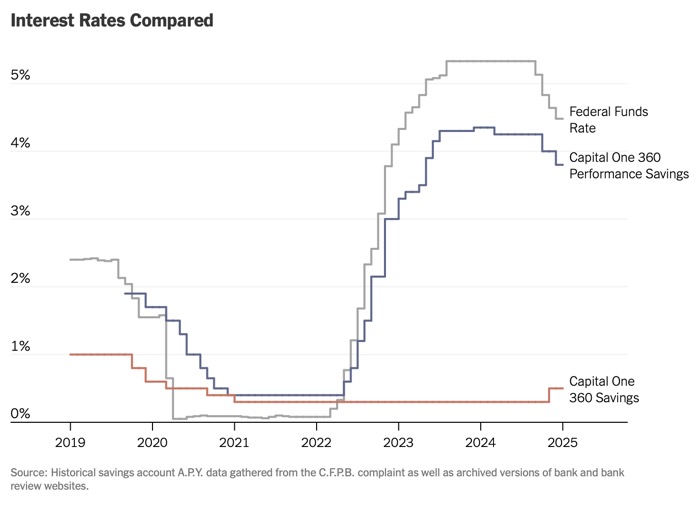
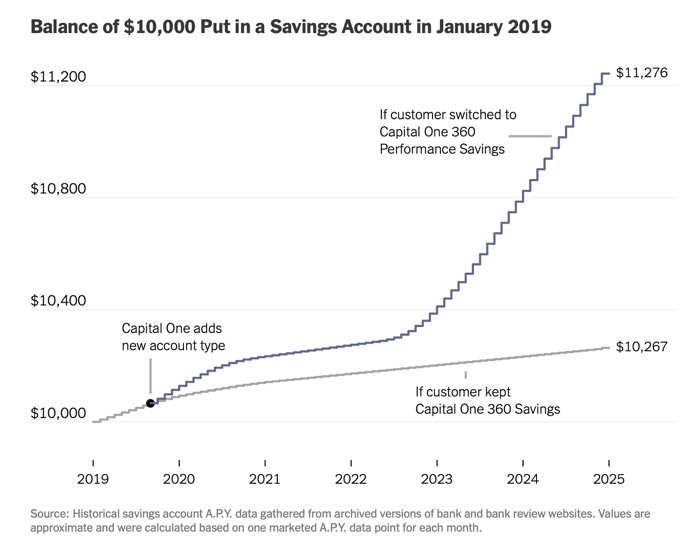
Capital One settled a class action settlement involving alleged deceptive marketing because it kept the interest rate on customers with deposits in their older “360 Savings Account” lower without closing them, while simultaneously marketing a new “360 Performance Savings Account” at a higher interest. Many people in the older accounts either thought they were the same or thought they were getting the higher, marketed interest rate. Anyone who had an original “360 Savings” account between 9/18/19 and 6/16/25 is included in the settlement.

The Consumer Financial Protection Bureau estimated that Capital One avoided paying $2 billion in interest by not automatically converting each 360 Savings account to a 360 Performance Savings account. Meanwhile, the settlement amount is really $300 million, with another $125 million earmarked for higher interest rates in the future for the older accounts.

Via this NYT article, you can see charts of both the different interest rates (above) and what would have happened to a single account with $10,000 balance (below).

I just received my postcard regarding the settlement, and the main takeaways are:

  • The cash payments will be related to the historical account balances in the older, low-interest accounts. There is no evidence to submit. For me, that is probably very little if any. However, they do have a provision to perhaps distribute any leftover funds pro-rata, so who knows.
  • I should still choose an electronic payment, because if the amount is less than $5, they will not be sending paper checks and will only send the funds to you via electronic payment. I usually prefer Venmo.

Random side-story! During a jury duty stint years ago, a personal injury lawyer once spent time to explain to us the details of the infamous “I spilled McDonald’s hot coffee on myself” lawsuit. To make it very brief, it was a specific McDonald’s location that decided to speed up its morning rush by making extra, extra hot coffee (180-190°F) and portioning it into cups ahead of time so that in theory it would stay hot for longer. Coffee made under normal, industry-standard operating procedures would not be that hot (135-140°F). 190°F is hot enough for instant 3rd-degree burns requiring skin grafts. To summarize, the details matter.

In this case, one of the problems was that “360 Savings” and “360 Performance Savings” were basically identical. There was no other “plausible deniability” reason for them to have the new account, other than to disadvantage their existing customers. With other banks, they will often tweak something so that the two accounts are a little bit different. Maybe the minimum balance changes, so they are targeted “higher balance” accounts which are thus cheaper to manage (and justify a higher interest rate). Maybe one will require a direct deposit or recurring transfers, again justifying a different interest rate.

Nearly every consumer financial company takes advantage of behavioral tendencies like forgetfulness or inertia. Checking account overdraft fees. Credit card late payment fees. Auto-renewing subscriptions for Netflix on down. Charles Schwab made over $9 billion in “net interest income” in 2024, which was basically half of their total revenue. Guess what uninvested cash in your Schwab brokerage account earns? 0.05% APY.

Best Interest Rates Survey: Bank Accounts, Treasury Bills, Money Markets, ETFs – August 2025

Here’s my monthly survey of the best interest rates on cash as of August 2025, roughly sorted from shortest to longest maturities. Banks and brokerages love taking advantage of our idle cash, and you can often earning more money while keeping the same level of safety by moving to another FDIC-insured bank or NCUA-insured credit union. Check out my Ultimate Rate-Chaser Calculator to see how much extra interest you could earn from switching. Rates listed are available to everyone nationwide. Rates checked as of 8/10/2025.

TL;DR: Savings account interest rates are mostly stable (maybe a tiny bit lower on average) with one at 5% APY but most struggling to stay above 4.00% APY. Short-term T-Bill rates at around 4.3%. Top 5-year CD rates are ~4.25% APY, while 5-year Treasury rate is ~3.8%.

High-yield savings accounts*
Since the huge megabanks still pay essentially no interest, everyone should at least have a separate, no-fee online savings account to piggy-back onto your existing checking account. The interest rates on savings accounts can drop at any time, so I list the top rates as well as competitive rates from banks with a history of competitive rates and solid user experience. Some banks will bait you with a temporary top rate and then lower the rates in the hopes that you are too lazy to leave.

  • The top saving rate at the moment: HUSTL Financial at 5.00% APY (no min), a division of Vantage West Credit Union, member NCUA (and thus not a fintech). No direct experience with this one; wonder how long it will last? The “good/excellent” savings rate zone appears to be roughly 4% and above. CIT Platinum Savings is now at 4.00% APY with $5,000+ balance. There are many banks in between.
  • SoFi Bank is at 3.80% APY + up to $325 new account bonus with direct deposit. You must maintain a direct deposit of any amount (even $1) each month for the higher APY. SoFi has historically competitive rates and full banking features. See details at $25 + $300 SoFi Money new account and deposit bonus.
  • Here is a limited survey of high-yield savings accounts. They aren’t the top rates, but a group that have historically kept it relatively competitive such that I like to track their history. I’d call this the “okay/good” zone of 3.50%+.

Short-term guaranteed rates (1 year and under)
A common question is what to do with a big pile of cash that you’re waiting to deploy shortly (plan to buy a house soon, just sold your house, just sold your business, legal settlement, inheritance). My usual advice is to keep things simple and take your time. If not a savings account, then put it in a flexible short-term CD under the FDIC limits until you have a plan.

  • No Penalty CDs offer a fixed interest rate that can never go down, but you can still take out your money (once) without any fees if you want to use it elsewhere. Marcus has a 13-month No Penalty CD at 4.15% APY ($500 minimum deposit). Farmer’s Insurance FCU has a 9-month No Penalty CD at 4.25% APY ($1,000 minimum deposit). USA USALLIANCE Financial CU has a 11-month No Penalty CD at 4.20% APY ($500 minimum deposit).
  • Eagle Bank has a 12-month certificate at 4.40% APY ($1,000 min). Early withdrawal penalty is 90 days of interest.

Money market mutual funds
Many brokerage firms that pay out very little interest on their default cash sweep funds (and keep the difference for themselves). Note: Money market mutual funds are highly-regulated, but ultimately not FDIC-insured, so I would still stick with highly reputable firms.

  • Vanguard Federal Money Market Fund (VMFXX) is the default sweep option for Vanguard brokerage accounts, which has an SEC yield of 4.22% (changes daily, but also works out to a compound yield of 4.30%, which is better for comparing against APY). Odds are this is much higher than your own broker’s default cash sweep interest rate.
  • Vanguard Treasury Money Market Fund (VUSXX) is an alternative money market fund which you must manually purchase, but the interest will be mostly (100% for 2024 tax year) exempt from state and local income taxes because it comes from qualifying US government obligations. Current SEC yield of 4.24% (compound yield of 4.32%).

Treasury Bills and Ultra-short Treasury ETFs
Another option is to buy individual Treasury bills which come in a variety of maturities from 4-weeks to 52-weeks and are fully backed by the US government. You can also invest in ETFs that hold a rotating basket of short-term Treasury Bills for you, while charging a small management fee for doing so. T-bill interest is exempt from state and local income taxes, which can make a significant difference in your effective yield.

  • You can build your own T-Bill ladder at TreasuryDirect.gov or via a brokerage account with a bond desk like Vanguard and Fidelity. Here are the current Treasury Bill rates. As of 8/8/25, a new 4-week T-Bill had the equivalent of 4.36% annualized interest and a 52-week T-Bill had the equivalent of 3.92% annualized interest.
  • The iShares 0-3 Month Treasury Bond ETF (SGOV) has a 4.24% SEC yield (0.09% expense ratio) and effective duration of 0.10 years. SPDR Bloomberg Barclays 1-3 Month T-Bill ETF (BIL) has a 4.16% SEC yield (0.136% expense ratio) and effective duration of 0.15 years. The new Vanguard 0-3 Month Treasury Bill ETF (VBIL) has a 4.21% SEC yield (0.07% expense ratio) and effective duration of 0.10 years.

US Savings Bonds
Series I Savings Bonds offer rates that are linked to inflation and backed by the US government. You must hold them for at least a year. If you redeem them within 5 years there is a penalty of the last 3 months of interest. The annual purchase limit for electronic I bonds is $10,000 per Social Security Number, available online at TreasuryDirect.gov.

  • “I Bonds” bought between May 2025 and October 2025 will earn a 3.98% rate for the first six months. The rate of the subsequent 6-month period will be based on inflation again. More on Savings Bonds here.
  • In mid-October 2025, the CPI will be announced and you will have a short period where you will have a very close estimate of the rate for the next 12 months. I will post another update at that time.

Rewards checking accounts
These unique checking accounts pay above-average interest rates, but with unique risks. You have to jump through certain hoops which usually involve 10+ debit card purchases each cycle, a certain number of ACH/direct deposits, and/or a certain number of logins per month. If you make a mistake (or they judge that you did) you risk earning zero interest for that month. Some folks don’t mind the extra work and attention required, while others would rather not bother. Rates can also drop suddenly, leaving a “bait-and-switch” feeling.

  • OnPath Federal Credit Union (my review) pays 7.00% APY on up to $10,000 if you make 15 debit card purchases, opt into online statements, and login to online or mobile banking once per statement cycle. Anyone can join this credit union via $5 membership fee to join partner organization. You can also get a $100 Visa Reward card when you open a new account and make qualifying transactions.
  • Genisys Credit Union pays 6.75% APY on up to $7,500 if you make 10 debit card purchases of $5+ each per statement cycle, and opt into online statements. Anyone can join this credit union via $5 membership fee to join partner organization.
  • La Capitol Federal Credit Union pays 5.75% APY on up to $10,000 if you make 15 debit card purchases of at least $5 each per statement cycle. Anyone can join this credit union via partner organization, Louisiana Association for Personal Financial Achievement ($20).
  • First Southern Bank pays 5.50% APY on up to $25,000 if you make at least 15 debit card purchases, 1 ACH credit or payment transaction, and enroll in online statements.
  • Credit Union of New Jersey pays 6.00% APY on up to $25,000 if you make 12 debit card purchases, opt into online statements, and make at least 1 direct deposit, online bill payment, or automatic payment (ACH) per statement cycle. Anyone can join this credit union via $5 membership fee to join partner organization.
  • Andrews Federal Credit Union pays 5.50% APY (down from 6%) on up to $25,000 if you make 15 debit card purchases, opt into online statements, and make at least 1 direct deposit or ACH transaction per statement cycle. Anyone can join this credit union via partner organization.
  • Find a locally-restricted rewards checking account at DepositAccounts.

Certificates of deposit (greater than 1 year)
CDs offer higher rates, but come with an early withdrawal penalty. By finding a bank CD with a reasonable early withdrawal penalty, you can enjoy higher rates but maintain access in a true emergency. Alternatively, consider building a CD ladder of different maturity lengths (ex. 1/2/3/4/5-years) such that you have access to part of the ladder each year, but your blended interest rate is higher than a savings account. When one CD matures, use that money to buy another 5-year CD to keep the ladder going. Some CDs also offer “add-ons” where you can deposit more funds if rates drop.

  • Mountain America Credit Union (MACU) has a 5-year certificate at 4.25% APY ($500 minimum), 4-year at 4.20% APY, 3-year at 4.15% APY, 2-year at 4.00% APY, and 1-year at 4.15% APY. Early withdrawal penalty for the 4-year and 5-year is 365 days of interest. Anyone can join this credit union via partner organization American Consumer Council for a one-time $5 fee (or try promo code “consumer”).
  • Lafayette Federal Credit Union (LFCU) has a 5/4/3/2/1-year certificates at 4.28% APY ($500 min). Slightly higher rates with jumbo $100,000+ balances. Note that the early withdrawal penalty for the 5-year is a relatively large 600 days of interest. Anyone nationwide can join LFCU by joining the Home Ownership Financial Literacy Council (HOFLC) for a one-time $10 fee.
  • You can buy certificates of deposit via the bond desks of Vanguard and Fidelity. You may need an account to see the rates. These “brokered CDs” offer FDIC insurance and easy laddering, but they don’t come with predictable early withdrawal penalties. Right now, I see a 5-year non-callable brokered CD at 3.95% APY (callable: no, call protection: yes). Be warned that both Vanguard and Fidelity will list higher rates from callable CDs, which importantly means they can (and will!) call back your CD if rates drop significantly later.

Longer-term Instruments
I’d use these with caution due to increased interest rate risk (tbh, I don’t use them at all), but I still track them to see the rest of the current yield curve.

  • Willing to lock up your money for 10 years? You can buy long-term certificates of deposit via the bond desks of Vanguard and Fidelity. These “brokered CDs” offer FDIC insurance, but they don’t come with predictable early withdrawal penalties. You might find something that pays more than your other brokerage cash and Treasury options. Right now, I see a 10-year CDs at 3.85% (non-callable) vs. 4.27% for a 10-year Treasury. Watch out for higher rates from callable CDs where they can call your CD back if interest rates drop.

All rates were checked as of 8/10/25.

* I no longer recommend fintech companies due to the possibility of loss due to poor recordkeeping and lack of government regulation. (Ex. Evergreen Wealth at 5% APY is a fintech.)

Photo by insung yoon on Unsplash

Capital One 360 Checking $250 Bonus w/ Direct Deposit

Capital One has a $250 bonus for “new” 360 Checking accountholders. What is “new”? If you have or had an open 360 Checking, Simply Checking, or Total Control Checking account as a primary or secondary account holder with Capital One on or after January 1, 2022, you will be ineligible for the bonus. Here are the details:

  • Open a 360 Checking account on or after August 22, 2024, using promotional code CHECKING250.
  • Complete at least 2 Qualifying Direct Deposits each of $500 or more to your 360 Checking account within 75 days of account opening.
  • You have 75 days to complete the requirements above. After the first 75 days from account opening, your status to receive the bonus will be assessed and processed, which can take up to 60 days. This means, if all requirements are met, you can expect your bonus to be deposited into your account within 135 days from account opening. To receive your bonus, your account must also be open and in good standing at the time the bonus will be deposited.

(This can be a good idea to close any idle Capital One 360 accounts.)

The 360 Checking account is similar to many other online checking options. There is a rather disappointing 0.10% APY interest rate, and nothing special other than the ability to link easily with 360 Savings. Highlights:

  • No monthly fees, no minimum balance required.
  • 0.10% APY on all balance tiers.
  • Remote check deposit via app.
  • Paper checks will cost you $20 for 50 checks, or $25 for 100 checks.
  • In addition to their own ATMs, Capital One uses the Allpoint ATM network for fee-free ATM access.
  • You can use your 360 Savings as the overdraft backup source of funds.

A pretty generous checking bonus if you are eligible, but not that attractive long-term unless you already prefer using CapOne 360 Savings.