 Employer-based retirement plans like the 401(k), 403(b), and Thrift Savings Plan are not perfect, but they are often the best available option to save money in a tax-advantaged manner. For 2019, the employee elective deferral (contribution) limit for these plans increased to $19,000 (it is indexed to inflation). The additional catch-up contribution allowed for those age 50+ stays at $6,000 (for a total of $25,000).
Here’s a historical chart of contribution limits for the last 11 years (2009-2019).
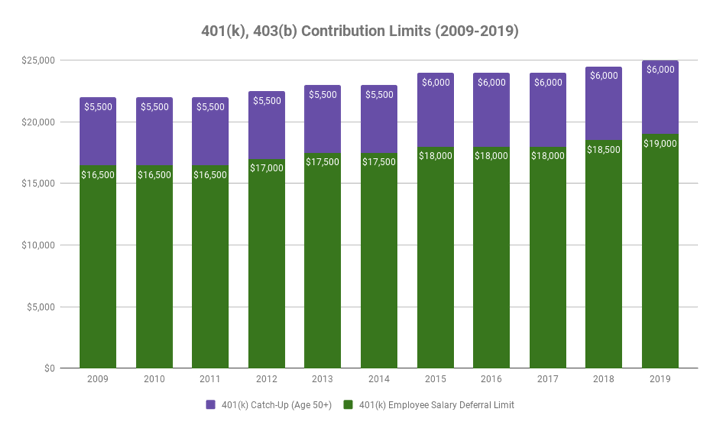
| Year | 401k/403b Elective Deferral Limit | Additional Catch-Up Allowed (Age 50+) |
| 2009 | $16,500 | $5,500 |
| 2010 | $16,500 | $5,500 |
| 2011 | $16,500 | $5,500 |
| 2012 | $17,000 | $5,500 |
| 2013 | $17,500 | $5,500 |
| 2014 | $17,500 | $5,500 |
| 2015 | $18,000 | $6,000 |
| 2016 | $18,000 | $6,000 |
| 2017 | $18,000 | $6,000 |
| 2018 | $18,500 | $6,000 |
| 2019 | $19,000 | $6,000 |
The limits are the same for both Roth and “Traditional” pre-tax 401k plans, although the effective after-tax amounts can be quite different. Employer match contributions do not count towards the elective deferral limit. Curiously, some employer plans set their own limit on contributions. A former employer of mine had a 20% deferral limit, so if your income was $50,000 the most you could put away was $10,000 a year.
For 2019, the maximum contribution limit when you include both employer and employee contributions is $56,000, an increase of $1,000. The employer portion includes company match and profit-sharing contributions.
The employee salary deferral max limit applies even if you participate in multiple 401k plans.
Sources: IRS.gov, IRS.gov COLA Table [PDF], IRS on multiple plans.
 The Best Credit Card Bonus Offers – 2025
 Big List of Free Stocks from Brokerage Apps
 Best Interest Rates on Cash - 2025
 Free Credit Scores x 3 + Free Credit Monitoring
 Best No Fee 0% APR Balance Transfer Offers
 Little-Known Cellular Data Plans That Can Save Big Money
 How To Haggle Your Cable or Direct TV Bill
 Big List of Free Consumer Data Reports (Credit, Rent, Work)
The max limit of 56k does not apply across plans, it is a per-employer limit
Thanks, fixed that to apply to the employee salary deferral limit.
I just wish that I was smart enough to start maxing this out when I was younger as I do now.
What is your take on putting more money in beyond this year’s $19,000? For us, we are putting that money in traditional brokerage accounts, but I am curious what you think. I do not see the value in it, but I wonder if I am missing something. Perhaps you have another post I missed on the subject?
Above maxing out the things that are available (IRA, Backdoor Roth IRA, 401k and similar, Solo 401k/SEP IRA and similar), yes I just invest in a taxable brokerage account (and some in a 529 plan). If you have a high income and and a high savings rate, it’s a good thing that you are maxing everything tax-advantaged and still buying productive assets like stocks, bonds, or real estate.