Search Results for: fundrise

Fundrise vs. Vanguard Real Estate ETF REIT Review 2023 (Final Update and Cashout!)

Final update July 2023, with full cashout. It has now been nearly 6 years for my experiment comparing a Fundrise Real Estate portfolio and the Vanguard Real Estate ETF. In Fundrise, we have a start-up with “crowdfunding” beginnings that offers users a share of a concentrated basket of properties actively chosen from the private market. In Vanguard, we have a one of the largest real estate ETFs in the world – users own a tiny passive slice of ~165 public-traded REITs. I invested $1,000 into both in October 2017 and cashed out in July 2023, for a holding period of 5 years and 9 months.

fundrise_logo

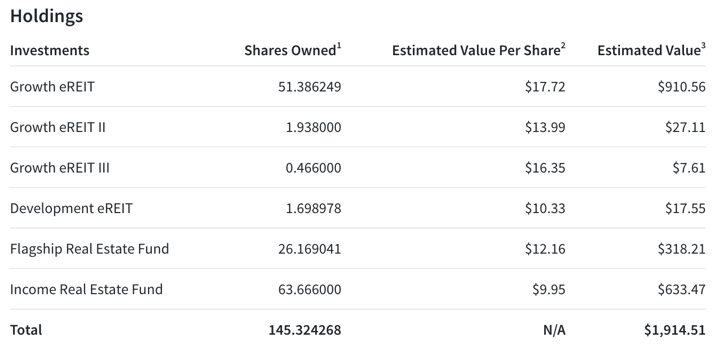
Fundrise Starter Portfolio background. When I bought in, the Fundrise Starter Portfolio was a simple 50/50 mix of two eREITs: the Fundrise Income eREIT and the Fundrise Growth eREIT*. Since these are finite baskets of entire properties, over time they will close one fund and start another similar basket. What new investors are buying today will be different apartment complexes and office buildings than what I bought in 2017. Here were my holding as of the end of June 2023:
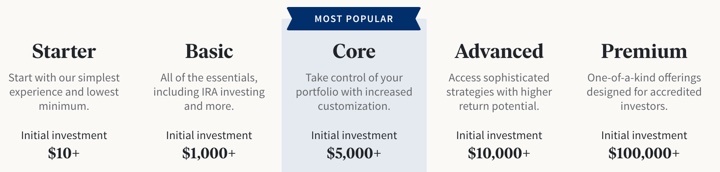
Each private eREIT works within recent crowdfunding legislation that allows all investors to own a basket of individual real estate properties (not just accredited investors with high net worth). The minimum deposit is now just $10. You must buy shares directly from Fundrise, and there are only limited quarterly liquidity windows as this is meant to be a long-term investment. There are also additional options available with higher investments:
Vanguard REIT ETF background. The Vanguard REIT ETF (VNQ) is the ETF share class of a $60+ billion index fund that invests in publicly-traded real estate investment trusts (REITs). You can purchase it via any brokerage account. You have the liquidity of being to sell on any day the stock market is open. A single share currently costs about $100, but many brokers offer fractional dollar-based trades if you want. All shareholders are holding the same ratio of (tens of?) thousands of office buildings, hotels, storage centers, nursing homes, shopping centers, apartment complexes, timber REITs, mortgage REITs, and so on. Here is a recent breakdown:
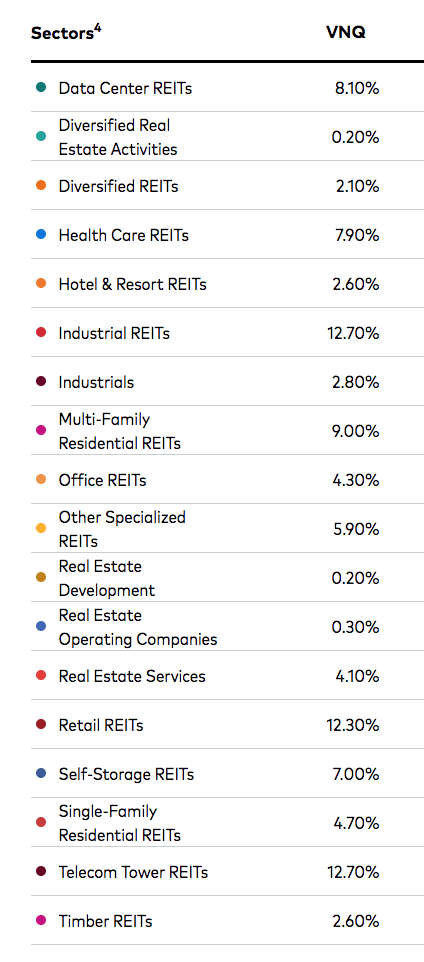
Expenses. The Fundrise Starter Portfolio has an 0.85% annual asset management fee and a 0.15% annual investment advisory fee (1% “all-in” total). The Vanguard REIT ETF has an expense ratio of 0.12% on top, but each public REIT also has their own internal costs like employee salaries to manage their properties. In each case, investors are paying for real estate management, office space and salaries for those employees, etc. REITs may also use debt to increase their real estate exposure (leverage). Is the technology offered by Fundrise a more efficient way to invest in real estate?

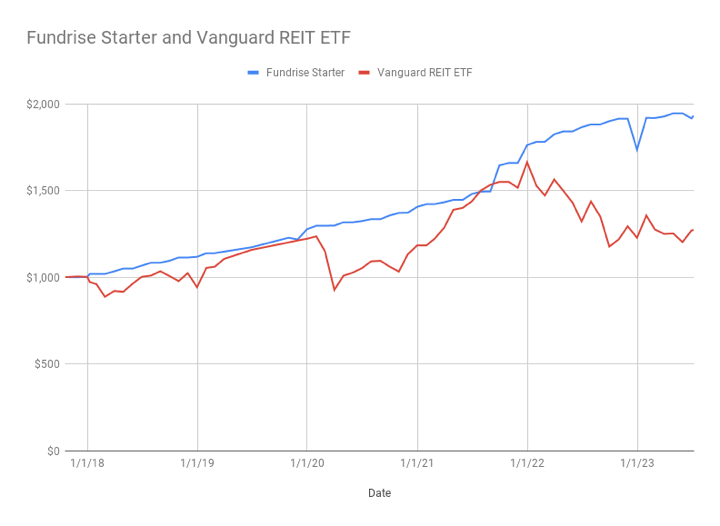
Final performance numbers. Based on an initial $1,000 investment in October 2017 and immediately reinvestment of all dividends, here are the monthly balances of my Fundrise portfolio vs. the Vanguard REIT ETF.

Again, there are quarterly redemption windows, and I initiated my request for a full withdrawal May 26, 2023 in preparation for the end of the second quarter on June 30th. On July 4th, I was notified that my request was approved, and I received the funds into my bank account on July 7th.

While the balances have much closer at times, the final balance was $1,931 (12.2% annualized return) for Fundrise, compared to only $1,272 (4.3% annualized return) for the Vanguard REIT ETF. The final endpoint is probably the widest margin during the entire experiment.

Commentary. One issue with this comparison is that this chart uses two different types of NAVs (net asset values). Vanguard updates the NAV daily based on the combined agreement of millions of investors. Every trading day, there is a price where you can liquidate your VNQ shares. Meanwhile, Fundrise NAVs are only estimates as there is no daily market value available since they hold entire apartment complexes, office buildings, and so on (similar to your house, but with even fewer comps). Your liquidity from Fundrise is limited to quarterly windows that are not guaranteed. That is why I wanted to finish this experiment will a full cash-out, so we can at least somewhat test if the NAVs are realistic. I was honestly a bit skeptical that the Fundrise NAVs could keep going up while the VNQ NAVs were struggling, but they did cash me out at the NAVs they posted. I have to give them credit for that. In the end, perhaps Fundrise is closer to owning a basket of pieces of real apartment complexes and buildings, in that the rising interest rates really didn’t hurt residential housing prices so far either.

The potential drawbacks still remain. In a more stressful bear market, the liquidity is not guaranteed and neither is the NAV if you were forced to liquidate the entire thing as opposed to trading existing shares to new investors. I made my withdrawal request before the sudden PeerStreet bankruptcy filing, but Fundrise is also a young company without a long history of profitability. (Fundrise does benefit from earning ongoing management fees on the assets under management, while PeerStreet earned a cut of the loan proceeds. Without a steady stream of new loans, PeerStreet quickly stopped making as much money.)

Bottom line. I have finally concluded a nearly 6-year experiment (5 years was the initial goal) where I compared investing $1,000 each into real estate via Fundrise direct active investment and the passive REIT index ETF from Vanguard. Based on actual cash-out numbers, Fundrise final balance was $1,931 (12.2% annualized return), while the Vanguard REIT ETF final balance was $1,272 (4.3% annualized return).

You can learn more about all Fundrise Real Estate options here. Anyone can invest with Fundrise; you don’t need to be an accredited investor.

Fundrise eREIT Quarterly Liquidity Details and Redemption Process

fundrise_logo

I’ve been putting some side money into crowdfunded real-estate investments – see here and here – and I have decided to test out the quarterly liquidity window of my Fundrise eREIT investment (review). An important difference between most of these private real estate investments and publicly-listed REIT is liquidity. On most any given weekday, I can sell my public REIT (i.e. VNQ) for a price that an open market deems fair and within few days I will have cash in hand.

The Fundrise Income eREITs are private REITs that take advantage of new crowdfunding regulations open to all investors (not just accredited investors). The intended time horizon of this investment at least 5 years, but they also advertise “quarterly liquidity” as a feature (see below). I was interested to see how this feature worked, as many of the other asset-backed loans in which I am invested could take a year or longer to get my money back. I decided to test out this “emergency hatch”.

fundrise_ereit1

The rules. You are allowed to make a redemption request once per quarter. For the full details on Fundrise quarterly redemption plans, please see the section of each eREIT Offering Circular titled, “Description of Our Common Shares—Quarterly Redemption Plan” at this link. It’s pretty dense, and I will only highlight this table which includes the “early withdrawal penalty” imposed if you redeem your shares within 5 years.

fundrise_redeem

In other words, if I redeem now after one year, I will pay a 3% penalty on the current net asset value (NAV). The NAV itself is a complex calculation of the underlying assets that I believe is only updated to investors once a quarter.

Note that you are not guaranteed to have liquidity of all your shares. If too many shareholders request liquidity at the same time, that might force them to sell assets at large discounts and harm other shareholders. Here is an excerpt from the Offering Circular:

Q: Will there be any limits on my ability to redeem my shares?

A: Yes. While we designed our redemption plan to allow shareholders to request redemptions on a quarterly basis, we need to impose limitations on the total amount of net redemptions per calendar quarter in order to maintain sufficient sources of liquidity to satisfy redemption requests without impacting our ability to invest in commercial real estate assets and maximize investor returns.
In the event our Manager determines, in its sole discretion, that we do not have sufficient funds available to redeem all of the common shares for which redemption requests have been submitted in any given month or calendar quarter, as applicable, such pending requests will be honored on a pro rata basis. […]

Redemption Process. The process of requesting a quarterly redemption was straightforward. Here’s a step-by-step rundown:

  • Contact Fundrise support and request a redemption (3/6 in my case). You need to make this request at least 15 days prior to the end of the applicable quarter.
  • They asked the reason for my redemption, and I told them. You don’t need to supply a reason, they just wanted feedback.
  • They sent over the official redemption form, which I was able to read and complete online. I received an e-mail confirmation of my redemption request.
  • At the end of the quarter (3/31 in my case), I received another e-mail confirmation that my redemption request was processed.
  • 12 days after the end of the quarter (4/12 in my case), I received another e-mail confirmation that the funds were being transferred to my bank account.

Complete Investment Timeline. Here’s a summary of cashflows from beginning to end.

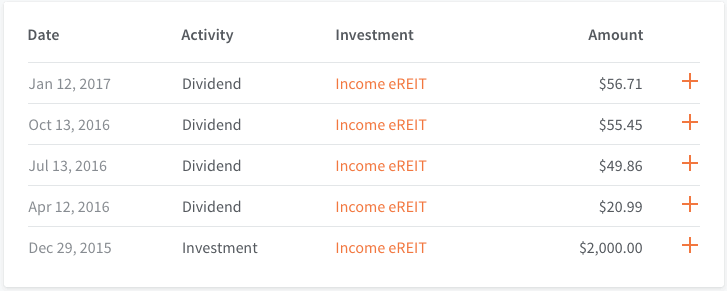
  • December 29, 2015. Invested $2,000 into Fundrise Income eREIT (200 shares x $10 a share).
  • Held for 15 months. Received 5 quarterly income distributions on a timely basis in April, July, October 2016 and January, April 2017. Total of $234.79.
  • Early March 2017. Requested redemption of all 200 shares as of the end of quarter 3/31/17.
  • April 12, 2017. Received $1,908 in principal back. 100% of NAV would have been $1967.

Screenshot:

fundrise_final

So I invested $2,000 and after 471 days I collected a total of $2,142.79 for a total gain of 7.14%. The annualized return works out to 5.49%. That’s not amazing but not bad considering that I am bailing out of a 5+ year investment after only a year. I’m confident that my returns would have been better if I waited out the full 5 years as real estate ownership investments take time to work out. (Traditional non-traded REITs are infamous for having huge penalties for early withdrawals where you get back less than 90 cents on the dollar.)

Hopefully this post answers some questions about the liquidity of Fundrise eREITs. I received my money, as requested, in about a month. If instant/daily liquidity is important to you, I would still stick with publicly-traded REITs.

Bottom line. The Fundrise Income eREITs are meant as long-term investments with time horizons of at least 5 years. However, they advertise the availability of limited quarterly liquidity. I tested out this liquidity feature and was able to cash out subject to a 3% discount from net asset value. It worked as promised, howewer I would not recommend using this option unless necessary as it will impair your overall return. Fundrise does warn you that in an extreme event with depressed prices, this liquidity window may be closed for the benefit of long-term investors. You can sign-up and learn about currently-available Fundrise eREITs here.

Fundrise Income eREIT Review 2017: One Year Update

fundrise_logo

Here’s an update on my $2,000 investment into the Fundrise Income eREIT. Fundrise is taking advantage of recent legislation allowing certain crowdfunding investments to be offered to the general public (they were previously limited only to accredited investors). REIT = Real Estate Investment Trust. This specific eREIT initially sold out of its $50 million offering, but Fundrise has since opened regional eREITs called the West Coast, Heartland, and East Coast eREITs. The highlights:

  • $1,000 investment minimum.
  • Quarterly cash distributions.
  • Quarterly liquidity window. You can request to sell shares quarterly, but liquidity is not always guaranteed.
  • Fees are claimed to be roughly 1/10th the fees of similar non-traded REITs. Until Dec 31, 2017, you pay $0 in asset management fees unless you earn a 15% annualized return.
  • Transparency. They give you the details on the properties held, along with updates whenever a new property is added or sold.

Why not just invest in a low-cost REIT index fund? I happen to think most everyone should invest in a low-cost REIT index fund like the Vanguard REIT ETF (VNQ) if they want commercial real estate exposure. I have many times more money in VNQ than I have in Fundrise. VNQ invests in publicly-traded REITs, huge companies worth up to tens of billions of dollars. VNQ also has wide diversification and daily liquidity. But as publicly-traded REITs have grown in popularity (and price), their income yields have gone down.

Fundrise makes direct investments into smaller properties with the goal of obtaining higher risk-adjusted returns. They do a mix of equity, preferred equity, and debt. Examples of real-life holdings are a luxury rental townhome complex and a $2 million boutique hotel. From their FAQ:

Specifically, we believe the market for smaller real estate transactions (“small balance commercial market or SBC”) is underserved by conventional capital sources and that lending in the market is fragmented, reducing the availability and overall efficiency for real estate owners raising funds. This inefficiency and fragmentation of the SBC market has resulted in a relatively favorable pricing dynamic which the eREIT intends to capitalize on using efficiencies created through our technology platform.

Here’s a comparison chart taken from the Fundrise site:

fundrise_ereit1

Quarterly liquidity. As noted, the investment offers the ability to request liquidity on a quarterly basis, but it is not guaranteed that you can withdraw all that you request. In addition, you may not receive back your full initial investment based on the current calculation of the net asset value (NAV).

Update: I tested out the quarterly liquidity window and was able to withdraw my funds in a simple process and without issue.

Dividend reinvestment. I chose to have my dividends paid directly into my checking account. However, you can now choose to have your dividend automatically reinvested across currently available offerings.

Tax time paperwork? All you get at tax time is a single 1099-DIV form with your ordinary dividends listed in Box 1a. That’s it. Every other box is empty. This is much easier than dealing with the 10-page list of tax lots from LendingClub or Prosper.

Dividend income updates.

  • Q1 2016. 4.5% annualized dividend was announced. This was the first complete quarter of activity, so the dividend was not as large as when funds became fully invested. The portfolio had 13 commercial real estate assets from 8 different metropolitan areas, with approximately $31.5 million committed.
  • Q2 2016. 10% annualized dividend announced, paid mid-July. Portfolio now includes 15 assets totaling roughly $47.25M in committed capital.
  • Q3 2016. 11% annualized dividend announced, paid mid-October.
  • Q4 2016. 11.25% annualized dividend announced, paid mid-January. Portfolio now includes 17 assets and all of the $50 million has been invested.

Screenshot from my account:

fundrise1701

Recap and next steps? It has now been over a year since my initial investment in the Fundrise Income eREIT, designated my Real Estate Crowdfunding Experiment #2. I’ve earned $183.01 in dividends on my initial $2,000 investment. The quarterly dividends have arrived on time, I get regular e-mail updates, and it has been nearly zero-maintenance. I still accept the possibility of wide price fluctuations, as with any real estate investment.

Update: I tested out the quarterly liquidity window and was able to withdraw my funds in a simple process and without issue. Fundrise is still accepting direct investments into some of their eREITs, but I am now looking to re-invest into their new Fundrise 2.0 system, which has a new $500 minimum and allocates across multiple eREITs. You can sign-up and browse investments at Fundrise for free before depositing any funds or making any investments.

Fundrise Income eREIT Review

fundrise_logo

Updated with Q2 2016 performance results. My second real estate crowdfunding investment is $2,000 into the Fundrise Income eREIT. (REIT = Real Estate Investment Trust.) Their investment claim is being the “first ever low-fee, diversified commercial real estate investment available directly online to anyone in the United States, no matter their net worth.”

Fundrise is one of the first real estate companies taking advantage of the recent JOBS Act that allow certain crowdfunding investments to be offered to everyone, as previously it was limited only to accredited investors. You must be a US resident and your investment cannot exceed the greater of 10% of your gross annual income or net worth.

Here’s a quick overview of the features:

  • Low investment minimum ($1,000)
  • Quarterly cash distributions
  • Quarterly liquidity (you can request to sell shares quarterly, but liquidity is not always guaranteed)
  • Low Fees (claimed to be roughly 1/10th the fees of similar non-traded REITs). Until Dec 31, 2017, you pay $0 in asset management fees unless you earn a 15% annualized return.
  • Transparency (you get to see exactly what properties are held)

Essentially, instead of investing in a single condo building, I am now putting my money into a pot of money that will invest in a basket of different commercial real estate properties.

Why not just invest in the Vanguard REIT index fund? Well, I happen to think most everyone should invest in VNQ if they want commercial real estate exposure. I own a lot more of VNQ than this Fundrise investment. VNQ invests in publicly-traded REITs, huge companies worth up to tens of billions of dollars. VNQ offers wide diversification and you have daily liquidity. But as publicly-traded REITs have grown in popularity (and price), their income yields have gone down.

As with other crowdfunding sites, Fundrise deals with specific, smaller deals with (hopefully) higher risk-adjusted returns. This eREIT diversifies your money across multiple properties, but we’re still talking examples like a $2 million townhouse complex, or a $2 million boutique hotel. An analogy might be made with “micro-cap” investing. From their FAQ:

Specifically, we believe the market for smaller real estate transactions (“small balance commercial market or SBC”) is underserved by conventional capital sources and that lending in the market is fragmented, reducing the availability and overall efficiency for real estate owners raising funds. This inefficiency and fragmentation of the SBC market has resulted in a relatively favorable pricing dynamic which the eREIT intends to capitalize on using efficiencies created through our technology platform.

A positive feature is the ability to request liquidity on a quarterly basis, but it is not guaranteed that you can withdraw all that you request (similar to some hedge funds). Here’s a comparison chart taken from the Fundrise site:

fundrise_ereit1

Why Fundrise? It can be hard to differentiate between the various crowdfunding websites. One way that I feel that Fundrise differs is they are more picky about the deals they choose to fund. Talk about higher standards is one thing, but I’ve been tracking them for a while and Fundrise really does offer far fewer deals than the other competitor sites I have signed up with. For about a year now, every deal that I’d been interested in filled up within 24 hours. Even this eREIT had a waitlist. Will this selectivity last? I don’t know, I hope so. Will their selectivity produce higher, safer returns? I don’t know, I hope so.

Dividend income updates.

  • 1st Quarter 2016. 4.5% annualized dividend was announced. This is the first complete quarter of activity, so the dividend size is expected to increase once funds are fully invested. The portfolio included 13 commercial real estate assets from 8 different metropolitan areas, with approximately $31.5 million committed as of March 31, 2016.
  • 2nd Quarter 2016. 10% annualized dividend announced, to be paid mid-July. Portfolio now includes 15 assets totaling roughly $47.25M in committed capital.

Screenshot from my account:

fundrise2016q1

I think the Fundrise Income eREIT is an interesting concept. There may be a waitlist to join, but they do work through it. I am simply sharing my own results, not making an investment recommendation as I don’t know your situation. This is a higher-risk, speculative investment.

Crowdfunded Real Estate Investing: Is Due Diligence by Individual Investors Even Possible?

A surprising takeaway from peer-to-peer lending through Prosper and LendingClub was that the borrowers who most strongly promised to pay you back (e.g. “I promise I will pay you back, so help me God, thank you so much”) turned out to also be the most likely to default. If you extend that to crowdsourced real estate investing, this is probably the analogous statement:

“We exclusively work with leading sponsors on commercial real estate offerings that meet our strict marketplace requirements.”

Reading this WSJ article Missing Millions and a Rabbinical Arbitrator: Real-Estate Deal Gone Bad Hits Popular Crowd Funder (gift article, should bypass paywall) about CrowdStreet, you get more of a peek behind the curtain. The strange title? Apparently one of their sour deals has resulted in $63 million of “missing” investor funds while also stipulating that any disputes be settled by a rabbinical court rather than the US legal system. Now that’s a new thing to look for in the fine print.

There is much more information in the full article, but here are a few quotes on Crowdstreet returns:

The Journal analyzed data on expected and realized returns of 104 completed deals from the sale of property or investor redemptions, which the company posted from 2013 to August 2022.

The Journal analysis found that more than half of those investments promoted on CrowdStreet’s platform failed to meet their target returns. Hundreds of CrowdStreet users lost some $34 million on 19 deals that underperformed as of this July, according to the Journal’s analysis. A dozen of those deals lost nearly 100% of investor funds.

CrowdStreet also hosted successful deals. More than 20 deals outperformed projected return rates by at least 10 percentage points. Hundreds of others are still outstanding. It often takes at least three years before investors can realize a return on their investments.

Some of the deals did well, some did awful. You can see their completed deals here. Many of their complete losses were hotel-related (“The 100% loss shown simply represents absolute total loss of capital incurred by investors”, ouch). Houston Red Lion Hotel. Cloverleaf Suites Overland Park. Intellistay Courtyard Tulsa. Four Points Sheraton Little Rock, Arkansas. That sounds like some poor deal structuring if your downside is so extreme.

The stated aim of all these real estate start-ups is to make commercial real estate investing more accessible to individual investors. Unfortunately, in my opinion it has been shown that individual investors simply aren’t given enough information to judge whether the deals are good or not. I would look up property addresses, learn about neighborhoods, try to look up the history of the borrowing groups, read through the comparables, appraisals, and contracts, but in the end, you are trusting the platform to perform most of the due diligence. There are no audited financial reports for me to read. There are no ratings agencies. How can one tell the difference between skill and luck? I have managed positive overall returns with my specific investments with PeerStreet, RealtyShares, Fundrise, Patch of Land, and others, but I had the most faith in PeerStreet’s model and they are likely to end up my worst performer.

The problem is the platform is strongly incentivized to do what is necessarily to maintain a high rate of deal flow and transactions, so they can make fees. When you are “exclusive” and “strict”, you don’t get deal flow now that the boom times have ended. Once the deal flow stops, they are dead in the water. This adds pressure to allow marginal borrowers and questionable deal terms.

I’ve only put relatively small amounts of “play account” funds into these sites, but as I don’t feel I can properly judge the individual deals nor properly judge the deal brokers, it’s probably time for me to avoid this asset class altogether.

Tellus App: “High-Yield Savings” That Isn’t FDIC-Insured, Backed by Vague Promises

A few readers asked about the Tellus app, which compares itself to savings accounts and pays 3.00% APY with no caps. (4.50% APY is only up to $2,500.) Here’s a quick explanation of why it’s an easy pass. Tellus investments are not FDIC-insured and they only provide a very vague description how your money is actually invested. From their FAQ:

How does Tellus afford to pay me such a high interest rate?

Tellus generates its revenues as a non-bank lender. We provide mortgages – loans secured by residential real estate. We use technology and proprietary data to choose opportunities so that we can minimize loss and fraud; this lets us pass the profits onto you in the form of highly competitive yields.

That’s a lot of fancy words, but my translation is “Tellus lends your money out at a lot more than 3.00% APY on unknown residential real estate of unknown quality, in unknown geographic areas, at unknown loan-to-value ratios”.

Mystery underlying investments. Think of all the properties in the world that could fall under “US-based real estate”. With a more transparent structure like that of Peerstreet, I can choose the exact address of the house or building that I am investing in. I can see the original appraisal. I see the borrower terms and interest rate. I can find the purchase history, the tax records, and look up comparable properties nearby. I know I’m earning 7-9% interest rates and Peerstreet is taking about 1%. With Fundrise, I get updates with the address and pictures of the exact apartment building they just bought, and they are SEC-registered private REITs. With Tellus, I have none of this. They are asking for a lot of trust for a new startup company. Are the loans wrapped in a bankruptcy-remote vehicle? Are they registered with the SEC?

Questionable promises of safety. When lending out on residential real estate, I also accept that I can lose money on the deal, because that’s how the world works. That’s honest. From their FAQ:

Is my money safe? Can I always get my money back?
Yes, your money is safe. All transactions and personal identifying data is protected by bank-level, 256-bit AES encryption. You can trust that your money and data are secure with Tellus. You will always get your money back and you can withdraw at any time.

In my opinion, this is not honest. If you’ve paid attention at all during the crypto crisis, you know that “You will always get your money back and you can withdraw at any time” really means “Your money is really the assets of a young start-up company, and if something bad happens then we may instantly freeze all withdrawals”. Real estate loans can go bad. Startup companies can go bankrupt.

This reminds me of the biggest red flag from peer-to-peer lending: The more profusely someone promises to pay you back, the less likely they are to pay you back.

Low returns for level of risk. Even if I knew Tellus lent money using conservative underwriting and everything goes perfectly, you will never get more than the promised APY. 3% APY is far too low. A 90-day Treasury bill pays more than 3%. I would expect at least double their interest rate for the risk involved in real estate lending, which means Tellus might be taking a big cut for themselves (they don’t disclose their cut either). I regularly post FDIC-insured deals at effective rates of 4%+ APY with 100% certainty that I will get 100% of my money back.

Tellus could be run by well-meaning, honest geniuses, but there is no way I’m taking this much risk for limited upside with my hard-earned money. Look beyond the slick marketing and stock photos of happy families. There are many alternatives earning a higher return with more easy assessable level of risk.

Bottom line. Tellus advertises “high yield” and “safety”, when in my opinion it offers the opposite: relatively low returns for the level of risk you are taking on (which is completely unknowable since you have no idea what they are investing in). You are risking complete loss of your investment in a young startup that is not FDIC-insured, and thus it is an easy pass for me. Be careful.

Public REITs vs. Private Equity Real Estate Funds: A Performance Comparison

There are many ways to access real estate as an asset class – publicly-traded REITs like Realty Income, diversified REIT ETFs, private funds that hold baskets of individual properties, and many new fintech varieties. This Institutional Investor article discusses a new research article comparing public REITs and closed-end private equity real estate (PERE) funds:

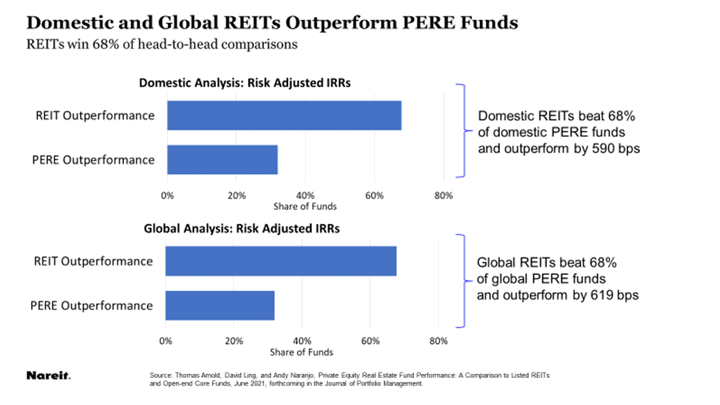
In a new study published in the Journal of Portfolio Management’s real estate issue, authors Thomas Arnold, David Ling, and Andy Naranjo found that, when compared side-by-side, real estate investment trusts outperformed U.S. closed-end private equity real estate, or PERE, funds by 165 basis points annually.

Here is another Nareit article about the study, where I noticed that the research was actually sponsored by Nareit. Here is a direct link to the study itself.

This other Institutional Investor article points out one of the “benefits” of private real estate funds – namely the fact that they don’t offer accurate daily pricing. You should also consider this a “benefit” of personal homeownership – when things are scary, houses simply don’t sell (instead of giving you a shockingly low price at that moment).

REITs, like any public security, are priced in real time. At the depth of the economic shutdown in March and early April, REIT investors imagined doomsday scenarios as commercial property and hotels sat empty and analysts forecasted that individuals would be unable to make rent payments for the foreseeable future. The price of REITs fell in line with that outlook.

In contrast, private real estate funds use other valuation methods, including appraisals — which depend on property transactions. Back in March and April, no real estate was changing hands to inform these valuations. As a result, the net asset values of private portfolios didn’t reflect the carnage.

Real estate continues to intrigue me, but I’ve always stopped short of directly investing in a rental property because I want to avoid any management responsibility (or even the responsibility hiring a good property manager). To me, rentals are best considered a potentially-lucrative part-time self-employed business opportunity, with the greater upside and downside involved. I also love that I can completely ignore my portfolio for months at a time, and the dividends and interest payments still keep coming in.

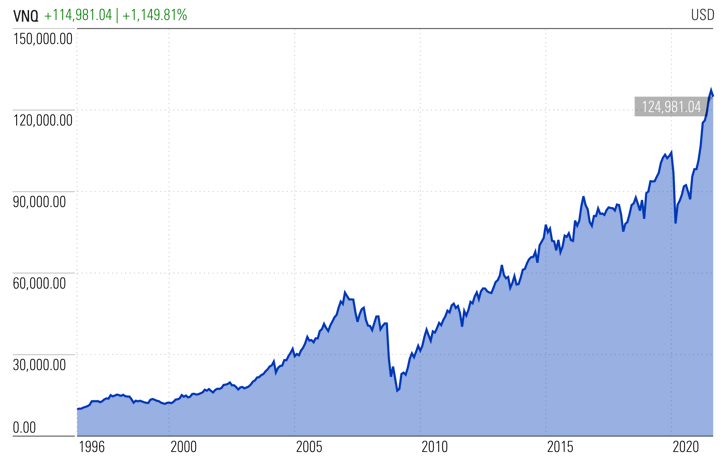
I’ve experimented with other options like PeerStreet, Fundrise and others, but the vast majority of my real estate investments are still in the low-cost index ETF VNQ (Vanguard Real Estate ETF). As long as you are good at ignoring the price drops during the scary times, it has been a solid long-term holding. Per Morningstar, here is the growth of $10,000 invested in VNQ since inception 25 years ago (with dividends reinvested!):

PeerStreet Review: Fractional Real-Estate Loan Returns (IRR) After 4.5 Years

Updated February 2021. I started investing in PeerStreet real-estate backed loans in July 2016. I’ve long liked the idea of hard money loans, but I wanted more diversification as opposed to tying all my money up with one single property. Peerstreet requires you to be an accredited investor. (There are other real-estate sites like Fundrise that don’t require that status.) Here are my overall numbers after over four years, with details below:
  • Total deposits (loaned principal): $35,000 ($60,000)
  • Total interest and fees earned: $3,979
  • 52 loans made and paid off, 8 current loans, and 3 late/default.
  • Internal rate of return (IRR) of 6.92% as of 2/16/2021.

Basic idea: Short-term loans backed by real estate. Real estate equity investors want to take out short-term loans (6 to 24 months) and don’t fit the profile of a traditional mortgage borrower. They are professional investors with multiple properties, need bridge financing, or they are on a tight timeline. As a real-estate-backed loan investor, you lend them money at 6% to 12% and usually backed by a first lien on the property. The borrower stands to lose the equity in their property, so they are incentivized to avoid default. In the worst case, you would foreclose and liquidate the property in order to get your money back. However, this is better than Prosper or LendingClub where it is an unsecured loan and your only recourse is to lower their credit score.

What are PeerStreet strengths? Here are the reasons that I decided to put more a higher amount of money into PeerStreet as compared to other worthwhile real estate marketplace sites:

  • Debt-only focus. Other real estate (RE) sites will offer both equity and debt (and things in between). PeerStreet only focuses on debt, and I also prefer the simplicity of debt. There is limited upside but also less downside. Traditionally, this might be called “hard money lending”.
  • Lower $1,000 investment minimum. Many RE investment sites have minimums of $10,000 or $25,000. At PeerStreet, $25,000 will get me slices of loans from 25 different real estate properties. You can even reinvest your earnings with as little as $100.
  • Greater availability of investments. Amongst all the RE websites that I have joined, PeerStreet has the highest and most steady volume of loans that I’ve seen. I dislike having idle cash just sit there, waiting and not earning interest. They apparently have a unique process where they have a network of lenders that bring in loans for them. They don’t originate loans themselves, they basically buy loans from these partners if they fit their criteria. This steady volume allows the lower $1,000 minimums and more diversification, as well as easy reinvestment of matured loans.
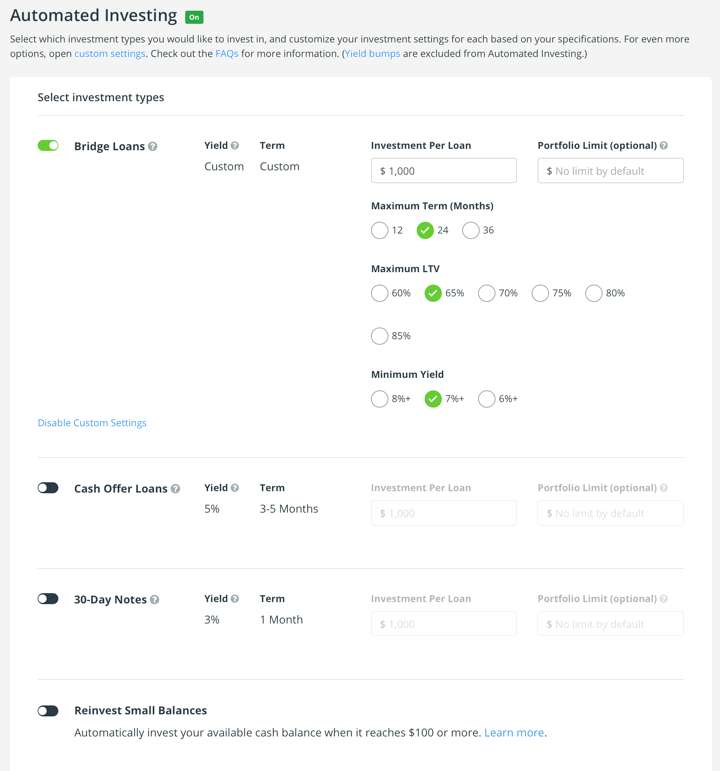
  • Automated investing. The above two characteristics allow PeerStreet to run an automated investment program. You give them say $5,000 and they will invest it automatically amongst five $1,000 loans. You can set certain criteria (LTV ratio, term length, interest rate). When a loan matures, the software can automatically reinvest your available cash. I don’t even have to log in.
  • Consistent underwriting. You should perform your own due diligence in this area, as you can only feel comfortable with automated investing if you think every loan is underwritten fairly. The riskier loans get higher interest rates. The less-risky loans get lower interest rates. The shady borrowers are turned away. I hope they earn their cut by doing this difficult task.
  • Strong venture capital backing. They have a history of increased funding. Series A was $15 million in November 2016. Series B was $30 million in April 2018. Series C was $60 million in October 2019.

Here’s a screenshot of the automated investing customizer tool:

What are PeerStreet drawbacks? A general drawback to real-estate backed loans is that your upside is limited to the full interest being paid back on time, while your downside is much larger if there is a prolonged housing crash. As long as housing prices are flat to strong, everything will probably work out fine because your collateral will cover everything. This is why it is important to have a cushion via the loan-to-value ratio.

In my opinion, one major drawback specific to Peerstreet is lower yields. This is just my limited understanding and I may be wrong, but PeerStreet has a network of lenders bringing in these deals and thus need to be paid some sort of “finders fee”, so the net yield to the investor feels lower than other sites. You could argue that this is also their secret sauce that brings in the high loan volume (and ideally the ability to be more selective), but at some point the rate is too low to justify the risks being taken.

In the current low-interest rate environment, it is also my opinion that too many real estate crowdfunding sites are chasing too few loans, which has been driving down the interest rates offered. I started out being able to find a lot of loans in the 8% to 9% range, but now the more conservative notes are in the 7%-7.5% range. In the current yield environment, my target is an 8% return while also maintaining a loan-to-value ratio of 70% or less.

How does PeerStreet make money? As with other real estate marketplace lenders, they charge a servicing fee. PeerStreet charges between 0.25% and 1%, taken out from the interest payments. This way, PeerStreet only gets paid when you get paid. When you invest, you see the fee and net interest rate that you’ll earn. In exchange, they help source the investments, set up all the required legal structures, service the loans, and coordinate the foreclosure process in case of default. In some cases, the originating lenders retains a partial interest in the loan (“skin in the game”). Here’s a partial screenshot:

peerstreet_fee

What if PeerStreet goes bankrupt? This is the same question posed to LendingClub and Prosper, and their solution is also the same. The loans are held in a bankruptcy-remote entity and will continue to be serviced by a third-party even in a bankruptcy event. From their FAQ:

PeerStreet also holds loans in a bankruptcy-remote entity that is separate from our primary corporate entity. In the event PeerStreet no longer remains in business, a third-party “special member” will step in to manage loan investments and ensure that investors continue to receive interest and principal payments. Additionally, investor funds are held in an Investors Trust Account with City National Bank and FDIC insured up to $250,000.

Tax forms? In previous years, I received both a 1099-INT and a 1099-OID. Basically, both include your gains that will be taxed at ordinary income rates (like bank account interest). Here’s what PeerStreet says:

PeerStreet investors will be issued a consolidated Form 1099 for the income distributed from their investment positions. Investors may receive one or more of the following types of 1099 form:

1099-OID for notes with terms longer than one year (at the time of issue)
1099-INT for notes with terms less than one year (at the time of issue)
1099-MISC for incentives, late fees or other income, if more than $600.

My personal performance. I started with a $10,000 investment in 2016, added another $15,000 in 2017, and added another $10,000 in 2019. Altogether, I also made about $25,000 of withdrawals whenever a loan was paid back and the loan inventory was not attractive. (They pay no interest in idle cash, and I don’t like their short-term options.) Each of my loans was less than 5% of the total portfolio. In order to get first dibs on the good loans, I set up automatic reinvestment when possible.

Here is a screenshot from my account:

As of February 2021, my internal rate of return (IRR) is 6.92% annualized net of all fees and taking into account the periods where my cash was idle. I verified this using my own spreadsheet and it matches the reporting by Peerstreet. Right now, 3 loans are in some phase of the foreclosure process. These loans are all less than 70% LTV, but I don’t know what the final recovery amount will be. In the past, I have had several late loans and all were resolved with no loss of principal (but that is no guarantee of the future). I expect my final IRR to be in the 6% to 7% range.

If you are thinking about this investment, the things I would want you to know are:

  • Real-estate backed loans are highly illiquid and the “maturity date” is just a hopeful number. You can’t just make a few clicks and sell, while the foreclosure process can take years to complete.
  • If you want some degree of reliable cashflow and/or liquidity for your funds, it is important to diversify across multiple, smaller loans.
  • The collateral makes a huge difference. With P2P unsecured loans, being 60 days late usually meant I was going to recover pennies on the dollar. With Peerstreet, I could wait around for an extra year yet still end up with all my principal plus most of the owed interest (if not more due to late charges). I have had many missed maturity dates over the years, but none of my loans have actually resulted in a loss. Usually the borrower realizes that they are better off figuring out how to pay back the loan rather than lose the property. Case Study #1. Case Study #2.
  • My expected net return of 6% to 7% has a good chance to be higher than even many “junk” bonds (and certainly high-grade corporate bonds) in this ultra-low interest rate environment. Being able to earn even 5-6% when corporate bonds are earning only 2-3% is going to attract some attention. Peerstreet is already working on packaging their loans into a fund, which may result in institutional money taking over soon.
  • It shouldn’t be overlooked that my ownership period did not include any prolonged, severe housing price drops.

Case studies. Here are detailed examples from my own investing experience that help illustrate my points:

Other sites that are offering new asset classes are Fundrise (direct ownership of real estate equity), FarmTogether (farmland), Masterworks (art), and Yieldstreet (various). I’ve also invested in LendingClub and Prosper (consumer loans).

Bottom line. PeerStreet offers higher-yield, short-term loans backed by physical real estate. As compared to traditional “hard money lending” on single local properties, Peerstreet allows investors to diversify easily with a $1,000 minimum investment per property, automated reinvestment, and nationwide exposure. In exchange, PeerStreet charges a servicing fee between 0.25% and 1%, taken out of the interest charged to the borrower. The returns you see in the listing are net of their fees. This is a unique asset class and it is important to understand the patience required due to limited liquidity.

If you are interested, you can sign up and browse investments at PeerStreet for free before depositing any funds or making any investments. You must qualify as an accredited investor (either via income or net worth) to invest. If you already invest with them, they now sync with Mint.com.

The Case Against REITs as a Separate Asset Class Holding

Morningstar has another educational article about investing in REITs as a separate asset class (free registration may be required). The entire article is worth a read, as it does a good job of summarizing the basic arguments for either carving out a special place in your portfolio for REITs, or simply leaving it at the ~4% market weighting that exists in most broad US index funds. For those already familiar with that, the historical charts add additional depth.

Historical correlations. This M* chart tracks the rolling 36-month correlation between the Vanguard Real Estate Index Fund (VGSIX) and Vanguard Total stock Market Index Fund (VTSMX), Vanguard Total International Stock Index Fund (VGTSX), and Vanguard Total Bond Market Index Fund (VBMFX). Note that the popular Vanguard Real Estate ETF (VNQ) has the same underlying holdings as VGSIX.

Sometimes the correlation between REITs and the overall stock market is very high, close to 1, but at other times it is closer to 0.5.

Historical return vs. volatility. Here’s a good stat: From 1972 to 2018, REITs have had a slightly higher average total annual return than the US Total Stock Market (11.4% vs. 10.3%), but also a higher average standard deviation (16.9% vs. 15.5%).

My take. I agree that REITs are not an “alternative” asset class on the level of fine art, music royalties, or Bitcoin. I think common sense would predict that publicly-traded corporations that own commercial property would be at least moderately correlated with the overall stock market. Historically, REITs provided a slightly higher return than stocks but also slightly higher price volatility. Using a broad REIT fund instead of a stock fund (or vice versa) is only going move the needle a relatively small amount.

However, I do see real estate as “different”. It has the limited availability of a commodity like gold or silver, yet it is productive like a factory. Land can produce rent, timber, or food (farmland). I could own single family rentals or farmland, but personal experiences have taught me that the higher potential returns also come with higher potential headaches. I’m willing to give up some of the return and simply hold REITs which don’t have be dealing with chasing late rent, fixing damages, civil lawsuits, and governmental bureaucracy.

Thus, I do hold a dedicated REIT portfolio allocation via the Vanguard REIT ETF and mutual funds. If I’m lucky they will add a bit of diversification and/or extra return, but even if they just offer more of the same, that’s good enough. (I noticed that the M* article author also discloses that he holds VNQ.) If you are interested in something closer to direct real estate ownership, see my Fundrise vs. Vanguard ETF experiment where I track my small side investment.

Real Estate Crowdfunding: Realtyshares Foreclosure Process Example 2018

Final update. I’ve invested in multiple real estate crowdfunding websites, including $2,000 into a single debt investment at RealtyShares. Unfortunately, this loan backed by a multifamily unit went into foreclosure and I outline what happened. There are risks in every investment, and my loss is your learning opportunity!

rs_okeefe1

Initial investment details.

  • Property: 6-unit, 6,490 sf multifamily in Milwaukee, Wisconsin.
  • Interest rate: 9% APR.
  • Amount invested: $2,000.
  • Term: 12 months with 6-month extension option.
  • Total loan amount $168,000. Purchase price $220,000 (LTC 76%). Estimated after-repair value $260,000. Broker Opinion of Value $238,000.
  • Loan secured by the property in first position. Personal guarantee from borrower.
  • Stated goal to rehab, stabilize, and then either sell or refinance.

Brief recap.

  • January 2016. Funds committed. Loan closed.
  • July 2016 to May 2017. Sporadic payment history for over a year. They would be on-time for a while, then there’d be a late payment, then things would brought back current, etc.
  • May 2017. Borrower stated that the property was under contract for $225,000 with final walk-through completed and expected close within 30 days.
  • June 2017. Borrower stopped paying. I guess the sale fell through (or they lied). Foreclosure process initiated by RealtyShares.
  • September 2017. Judgment granted in Wisconsin court. By law, there will be a 3-month redemption period where the borrower can still keep the house if they pay foreclosure judgment plus interest, taxes, and costs.
  • January 2018. The foreclosure sale was held and property ownership was reverted to RealtyShares. A judge still needs to confirm the sale.
  • February 2018. The judge confirmed the foreclosure sale, and RealtyShares is officially the owner of the property. Property can now be assessed and fixed up before sale.
  • April 2018. Property listed for $134,500 as per new BPO (Broker Opinion of Value).
  • June 2018. Property is under contract for sale. Exact price unknown.
  • July 2018. Property sold. Final disbursement of $1,133.73 received.

Final numbers. I invested $2,000 and got paid $210.84 of interest and $1,133.73 of principal for a total of $1,344.57. This means I only got back 67% of my money after more than 2 years. On the other hand, I have made over 50 different real estate-backed loans now, and it was only a matter of time before I got a full default. This was my first investment that finished foreclosure, but it won’t be my last.

The question is how often that happens and the size of those losses. When it came to Prosper or LendingClub, the interest rates might be higher but when a loan was 60 days late you were pretty much done. As an unsecured loan, you had nothing to fall back on if the borrower broke their promise (besides hurting their credit score). Sending it to collections typically only got you pennies on the dollar. In this case, I got back 57 cents on the dollar when you exclude interest.

Beforehand, RealtyShares told me that the foreclosure process in Wisconsin typically took about 12 months. That turned out to be a good estimate, as it was 12 months between foreclosure initiation and the property being under contract for sale.

Lessons. First, don’t put too much weight on a BPO (broker opinions of value). A broker thought this property was worth $238,000 in January 2016. Another broker thought the same property was worth only $134,500 in April 2018. The final sale price was probably closer to $100,000. That is a big gap.

Second, you should consider the local economic situation. This area is hurting, and if you do some digging you’ll see foreclosures all over the place. I didn’t know this at the time, but the low-income rental market in Milwaukee, Wisconsin was profiled in the NYT Bestselling book Evicted: Poverty and Profit in the American City (my review). Many of the properties mentioned in this book were literally down the street from this unit.

Third, you need to diversify. If this was my only investment, I might have an overly negative opinion of the asset class. If my successful Patch of Land loan was my only investment, I might have a overly positive opinion. Instead, this is one of 50+ investments for me (mostly at PeerStreet) and while I maintain a positive return higher than cash across my investments, there is the occasional foreclosure like this. Basically, when you read about my experience or someone else’s, you must take into account sample size.

Finally, I believe that some marketplace/crowdfunding sites may be better at sourcing and underwriting loans than others. As of November 2018, Realtyshares has stopped accepting new investments (they will continue to service existing investments). Even before that, they abruptly stopped doing residential loans to “focus” on commercial properties. I knew their specialty was more commercial real estate, but I didn’t want to commit $25k to a single commercial investment, so I went with this smaller residential loan. Since then, I have shifted my residential debt investing to PeerStreet as they allow me to split my investments into $1,000 minimums and they also have a slightly different model.

Communications quality. I would grade the online updates from RealtyShares as acceptable/good. They are relatively detailed and consistent, providing me a look inside the foreclosure process. Here are some sample updates:

October 9, 2017 We have identified a real estate broker to sell the property. The broker spoke with the previous property manager who was at the property a couple of weeks ago and who may be available for property preservation. The broker is going to take a contractor to the property to try and get an accurate cost estimate to complete the renovation.

September 21, 2017 Judgment was granted at the hearing. We expect the filed judgment from the court in approximately one week and will process it upon receipt. We should be able to schedule the sale in late October and it will be held after the redemption period expires—sometime in December. As soon as we receive the filed judgment order from the court we will have the exact 3 month redemption date. Sale cannot be held until the redemption period has expired.

September 8, 2017 The partner has declined to go forward with the purchase of the property. On the foreclosure front, the judgement hearing is scheduled for September 18th. If the judgement is successful, there is a 6-month right of redemption period during which the property can not be sold. During this period we will identify a property preservation firm and a commercial broker to sell the property.

August 25, 2017 A minority partner has stepped forward and has asked for a week to visit the property with the idea of making a paydown in exchange for an extension. We have agreed to speak next week after his inspection.

August 22, 2017 Service has been completed on the foreclosure. The defendants were personally served with the summons and complaint on August 2, 2017. The statutory answering time will expire on August 22, 2017. The judgment hearing will be scheduled at that time.

June 29, 2017 Due to the borrower’s inability to stay current, we have decided to start the foreclosure process for payment default. The foreclosure will run parallel with the sales process, meaning if the sponsor can sell the property and pay us off before the foreclosure is complete we will stop the process, if not we will take over the property. Typically, foreclosures in Wisconsin take up to 12 months.

Bottom line. Investing in real-estate backed loans means that if the borrower doesn’t pay up, you can foreclose and take over the property. But what is that really like? The purpose of this post is to provide real-world dates and numbers for a completed foreclosure on a marketplace real-estate investment site. I haven’t seen any other similar resources.

My current active investments are at PeerStreet ($1,000 minimums, accredited-only, debt-only) and Fundrise eREIT ($500 minimum, open to everyone, equity and debt).

The Real Estate Crowdfunding Capital Stack: Equity vs. Debt

Before I share more about my real-estate crowdfunding experiments, I wanted to take a quick step back in order to provide better context. Just as ETFs and mutual funds are separated into stocks and bonds, real estate can be separated into two general types of investments:

  • Equity = an ownership interest in the asset.
  • Debt = a loan, typically collateralized by the asset itself or other assets of the equity owner.

In the business world, I could buy a piece of Amazon or Apple and participate in the ups and down of the business value, or I could invest in bonds issued by Amazon or Apple and get a fixed return as long as Amazon and Google keep making their interest payments within the stated period of time.

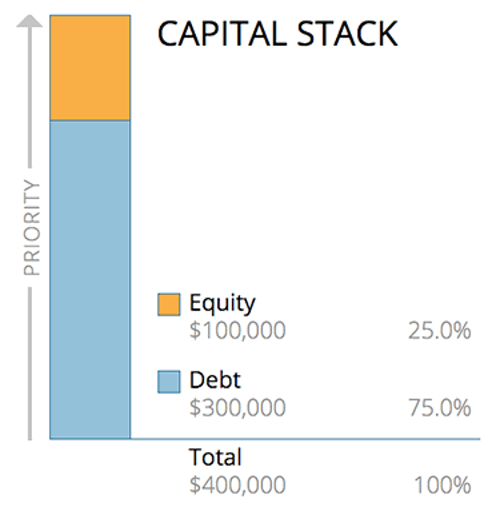
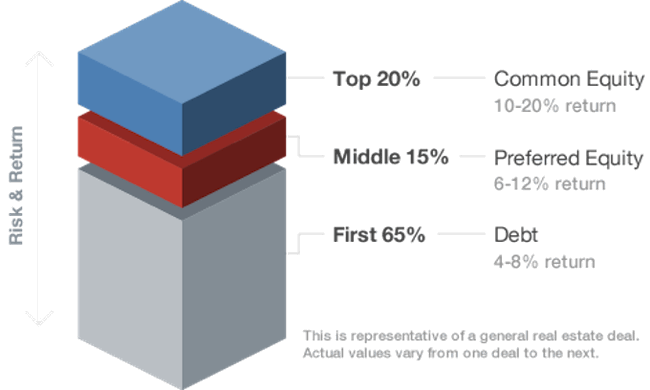
This is called the “capital stack”. In residential real estate, the stack can be quite simple. There is one homeowner and one mortgage-holder (debt). If they ever sell the house, any proceeds must first go towards the mortgage-holder. Anything left over goes to the homeowners. If the house gets sold for $400,000 and had a $300,000 mortgage, the homeowner would get $100,000. When you see the image below (source), imagine water filling up a container. The bottom layer gets paid first. If there isn’t enough “water”, the next layer doesn’t get paid. If there is excess “water”, that goes to the equity owner. (image source)

recapitalstack1

In commercial real estate, here are the four most common layers of the capital stack: common equity, preferred equity, mezzanine debt, and senior debt. Preferred equity, as its location suggests, is in between common equity and debt in terms of cashflow priority and return upside potential. It has a more senior position to cashflow than common equity, but it still junior to mezzanine and senior debt. Mezzanine debt can be explained as similar to when a homeowner might also take out a “home equity loan” that junior to the first mortgage (and thus usually at a higher interest rate). Both of these intermediate stacks are more complex in terms of how much extra return are you getting for how much extra risk, and thus I tend to avoid them. (image source)

recapitalstack3

The expected return of each layer is then adjusted based on its position in the stack. Keep in mind that as your expected return increases, so does the possibility that your actual return is zero or negative. (image source)

recapitalstack4

My equity investments. My initial feeling was that publicly-traded REITs do a pretty good job on the equity side. The big REITs hold big apartment complexes, hundreds of public storage facilities, etc. Is there an opportunity for higher returns from smaller properties? Perhaps, but the problem is that it takes years for equity investments to pan out. My plan is to invest another $1,000 into Fundrise eREITs and hold on to them for 5 years as a long-term experiment. As the dividends are paid and the net asset value is updated, I can compare side-by-side with the dividends and net asset value of the low-cost Vanguard REIT ETF (VNQ).

My debt investments. I prefer the idea of providing short-term, 7%-9% loans backed by a hard asset like real estate. This is an area traditional referred to as “hard money loans”. I can’t replicate this type of deal with an ETF or mutual fund. I plan to increase my investment in PeerStreet to roughly $25,000 total as they focus 100% on the debt side and I like their platform so far. I invest only in notes with a term under 12 months, and in the first position (most senior). This remains under my “5% Speculative Portfolio” and will track my returns regularly.

RealtyShares Review 2017: Wisconsin Apartment Loan One-Year Update

realtyshareslogo

Here’s a one-year update on my $2,000 investment through RealtyShares, a partial interest in a loan backed by a 6-unit apartment complex in Milwaukee, Wisconsin. RealtyShares is restricted to accredited investors only. Here are the highlights:

  • Property: 6-unit, 6,490 sf multifamily in Milwaukee, WI.
  • Interest rate: 9% APR, paid monthly.
  • Amount invested: $2,000.
  • Term: 12 months, with 6-month extension option.
  • Total loan amount is $168,000. Purchase price is $220,000 (LTC 76%). Estimated after-repair value is $260,000. Broker Opinion of Value is $238,000.
  • Loan is secured by the property, in the first position. Also have personal guarantee from borrower.
  • Stated goal is to rehab, stabilize, and then either sell or refinance.

rs_okeefe1

Property details. I chose this property because it is different from my other past “experiments”. I have never lived in or visited Milwaukee, Wisconsin. I have never invested in an apartment complex. Where I live, parking spaces have sold for more than $200,000. All units are 2 bed/1 bath, currently fully rented for ~$600 a month each. I don’t know all the numbers, but this place earns roughly $43,000 in gross annual rents with a purchase price of $220,000. Annual property taxes are $3,000 a year. Even if half of the rent is spent on expenses, that is still a cap rate of 10%. To be honest, I have had some second thoughts about this borrower (after a few late payments) that s/he is juggling too many investment properties using crowdfunding websites.

Initial experience. This specific investment was not “pre-funded” by RealtyShares. That meant that I had to wait until they secured enough committed money before the deal can go forward. I committed to this loan on 12/21/15 and $2,000 was debited from my Ally bank account on 12/29/15. However, the funding goal was not reached until 1/13/16 (before which I earned no interest) and I didn’t receive my first interest payment until 3/4/16 (for interest accrued 1/13-2/10). There was essentially a 3 month period between the time where they first took my money and I received my first interest check. I did receive my second month of interest shortly thereafter on 3/17/16.

Since my initial investment, RealtyShares has started offering investments on a pre-funded basis. You should also know that you don’t have to deposit any money into your account first before investing in any deal. You should link an account, but you can sign the papers and they will debit the funds when the investment closes.

What if RealtyShares goes bankrupt? RealtyShares investments have a bankruptcy-remote design. RealtyShares, Inc. is the platform. Your investment is held within a separate special-purpose LLC with a designated trustee which would continue to operate even if RealtyShares, Inc. goes bankrupt.

Payment history. I’ve been earning my 9% APR interest on my $2,000 initial investment, which works out to $15 a month. Below is a screenshot of my interest payments, which I have elected to by deposited directly into my bank account. You can see that I have received 12 payments over the last 12 months (March 2016 to March 2017). The borrower has had a few late payments, but always seems to catch up eventually. There was a mention of late charges potentially being charged, but none appear to have been paid out to my account. I need to follow-up on that (I assume it was within the allowed grace period).

Screen Shot 2017-03-16 at 3.53.47 PM

realtyshares1703b

Recap and next steps? My real-estate-backed loan through RealtyShares is now a year old, designated my Real Estate Crowdfunding Experiment #3. I have received my 9% interest as promised, and the loan is current although some past payments have been late before becoming current again. The borrower has exercised the 6-month extension option and the loan now has an expected maturity of 5/20/17, so it remains a continuing experiment to see how/if/when the borrower pays off the loan in full. I definitely like that my loans are backed by hard assets, and a small part of me is still curious as to what would happen if the borrower just walked away.

Please don’t take any of my experiments as recommendations as the entire point is that I don’t know all the angles. I am sharing and learning. Also, I don’t know your situation. If you are interested and are an accredited investor, you can sign-up for free and browse investments at RealtyShares before depositing any funds or making any investments.

Experiment #1 was with Patch of Land and single-family residential property in California, which was paid back in full with a 12.5% annualized return. Experiment #2 is ongoing with the Fundrise Income eREIT, which holds a basket of commercial property investments and has been paying quarterly distributions on a timely basis.