Search Results for: High Interest Savings

Best Interest Rates on Cash Savings – August 2017

percentage2

Interest rates are slowly waking up from their multi-year slumber, so I’m paying closer attention to the various changes each month. Don’t let a megabank pay you 0.01% APY or less for your idle cash. Here is my monthly roundup of the best safe rates available, roughly sorted from shortest to longest maturities. Rates checked as of 8/1/17.

High-yield savings accounts
While the huge brick-and-mortar banks rarely offer good yields, the online banks with a history of competitive rates offer online savings accounts clustered 1.0%-1.2% APY. Remember that with savings accounts, the interest rates can change at any time.

  • The Mega Money Market accounts of both Redneck Bank and All America Bank (they are affiliated) are paying 1.50% APY on balances up to $35,000. Note that amounts over $35,000 earn only 0.50% APY.
  • Other sample top rates without a balance cap: DollarSavingsDirect at 1.40% APY, BankDirect at 1.35% APY, Synchrony Bank and Goldman Sachs Bank are at 1.20% APY.
  • As I’ve been “bait-and-switched” a few times, I’m still sticking with my Ally Bank Savings + Checking combo due to their history of competitive rates (including CDs), 1-day interbank transfers, and a overall user experience. I also like the free overdraft transfers from savings so I can keep my checking balance at a minimum. Ally Savings is at 1.15% APY.

Money market mutual funds + Ultra-short bond ETFs
If you like to keep cash in a brokerage account, you should know that money market and short-term Treasury rates have been inching upwards. It may be worth the effort to move your money into a higher-yielding money market fund or ultrashort-term bond ETF.

  • The Vanguard Prime Money Market Fund has increased their SEC yield now to 1.10%. The default sweep option is the Vanguard Federal Money Market Fund, which only has an SEC yield of 0.92%. You can manually move the money over to Prime if you meet the $3,000 minimum investment.
  • The following bond ETFs are not FDIC-insured, but if you want to keep “standby money” in your brokerage account and have cheap/free trades, it may be worth a look. The PIMCO Enhanced Short Maturity Active Bond ETF (MINT) has a 1.52% SEC yield and the iShares Short Maturity Bond ETF (NEAR) has a 1.52% SEC yield while holding a portfolio of investment-grade bonds with an average duration of ~6 months. More info here.

Short-term guaranteed rates (under 1 year)
I am often asked what to do with a big wad of cash that you’re waiting to deploy shortly (just sold your house, just sold your business, legal settlement, inheritance). Honestly, I wouldn’t get fancy or take unnecessary risk. Just keep it safe in a short-term CD or online savings account that in insured under the FDIC limits until you have a plan.

  • The Ally Bank No-Penalty 11-Month CD is now paying 1.50% APY for $25,000+ balances and 1.25% APY for $5,000+ balances. The lack of early withdrawal penalty means that your interest rate can never go down for 11 months, but you can still jump ship if rates rise.
  • Salem Five Direct is advertising 1.25% APY on balances up to $500,000. The good news is that this rate is guaranteed until 7/1/18 – more than a year away – and since it is a savings account you can still move your money in and out without penalty. The bad news is that this rate is for new customers only.

US Savings Bonds
Series I Savings Bonds offer rates that are linked to inflation and backed by the US government. You must hold them for at least a year. There are annual purchase limits. If you redeem them within 5 years there is a penalty of the last 3 months of interest.

  • “I Bonds” bought between May and October 2017 will earn a 1.96% rate for the first six months, and then a variable rate based on ongoing inflation after that. While that next 6-month rate is currently unknown, at the very minimum the total yield after 12 months will around 1% with additional upside potential. More info here.
  • In mid-October, the CPI will be announced and you will have a short period where you will have a very close estimate of the rate for the next 12 months. I will have another post up at that time.

Prepaid Cards with Attached Savings Accounts
A small subset of prepaid debit cards have an “attached” FDIC-insured savings account with high interest rates. The risks are that balances are capped, and there are many fees that you must be careful to avoid (lest they eat up your interest). The other catch is that these good features may be killed off without much notice. My NetSpend card now only has an eligible balance up to $1,000.

  • Insight Card is one of the best remaining cards with 5% APY on up to $5,000 as of this writing. Fees to avoid include the $1 per purchase fee, $2.50 for each ATM withdrawal, and the $3.95 inactivity fee if there is no activity within 90 days. If you can navigate it carefully (basically only use ACH transfers and keep up your activity regularly) you can still end up with more interest than other options. Earning 4% extra interest on $5,000 is $200 a year.

Rewards checking accounts
These unique checking accounts pay above-average interest rates, but with some risk. You have to jump through certain hoops, and if you make a mistake you won’t earn any interest for that month. Rates can also drop quickly, leaving a “bait-and-switch” feeling. But the rates can be high while they last.

  • Northpointe Bank has Rewards Checking at 5% APY on up to $10k. The requirements are (1) 15 debit card purchases per month (in-person or online), (2) enrolling in e-statements, and (3) a monthly direct deposit or automatic withdrawal of $100 or more. ATM fees are rebated up to $10 per month.

Certificates of deposit
If you have a large cushion, it’s quite likely to just sit there for years. One option is to keep your money in longer-term investments where you can still take it out in a true emergency and pay a reasonable early withdrawal penalty. Alternatively, you could create a CD ladder of different maturity lengths such that you have access to part of the ladder each year, but your blended interest rate is higher than a savings account.

  • AmboyDirect has a 12-month CD at 1.65% APY if you deposit $10,000. Additional deposits can be made within 6 months of account opening. Note that early withdrawal penalty is a hefty 6-months of interest, however. If asked, provide offer code 601611.
  • Ally Bank also has a 5-year CD at 2.25% APY with a relatively short 150-day early withdrawal penalty and no credit union membership hoops. For example, if you closed this CD after 18-months you’d still get an 1.64% effective APY even after accounting for the penalty.
  • Hanscom Federal Credit Union is offering a 4-year Share Certificate at 2.50% APY (180-day early withdrawal penalty) if you also have Premier Checking (no monthly fee if you keep $6,000 in total balances or $2,000 in checking). HFCU also offers a 3% APY CU Thrive “starter” savings account. HFCU membership is open to active/retired military or anyone who makes a one-time $35 donation to the Nashua River Watershed Association.
  • Mountain America Credit Union is offering a 5-year Share Certificate at 2.60% APY (365-day early withdrawal penalty). $500 minimum deposit. Anyone can join this credit union via partner organization American Consumer Council for a one-time $5 fee.

Longer-term Instruments
I’d use these with caution, but I still track them to see the rest of the current yield curve.

  • Willing to lock up your money for 10+ years? You can buy certificates of deposit via the bond desks of Vanguard and Fidelity. These “brokered CDs” offer the same FDIC-insurance. As of this writing, Vanguard is showing a 10-year non-callable CD at 2.65% APY (Watch out for higher rates from callable CDs.) Unfortunately, current long-term CD rates do not rise much higher even as you extend beyond a 5-year maturity.
  • How about two decades!? Series EE Savings Bonds are not indexed to inflation, but they have a guarantee that the value will double in value in 20 years, which equals a guaranteed return of 3.5% a year. However, if you don’t hold for that long, you’ll be stuck with the normal rate which is quite low (currently a sad 0.10% rate). You could view as a huge early withdrawal penalty. You could also view it as long-term bond and thus a hedge against deflation, but only if you can hold on for 20 years. Too long for me.

All rates were checked as of 8/1/17.

Best Interest Rates on Cash Savings – July 2017

percentage2

Interest rates are slowly waking up from their multi-year slumber, so I am paying a bit more attention to the various changes each month. Don’t let a megabank pay you 0.01% APY or less for your idle cash. Here is my monthly roundup of the best safe rates available, roughly sorted from shortest to longest maturities. Rates checked as of 7/4/17.

High-yield savings accounts
While the huge brick-and-mortar banks rarely offer good yields, the online banks with a history of competitive rates offer online savings accounts clustered around 1% APY. Remember that with savings accounts, the interest rates can change at any time.

  • As I’ve been “bait-and-switched” a few times, I try to stick with savings accounts that have a consistent history of competitive rates and a good user experience. My favorite is currently Ally Bank Online Savings, which recently bumped their rate to 1.15% APY.
  • The Mega Money Market accounts of both Redneck Bank and All America Bank (they are affiliated) are paying 1.50% APY on balances up to $35,000. Note that amounts over $35,000 earn only 0.50% APY.

Money market mutual funds + Ultra-short bond ETFs
If you like to keep cash in a brokerage account, you should know that money market and short-term Treasury rates have been inching upwards. It may be worth the effort to move your money into a higher-yielding money market fund or ultrashort-term bond ETF.

  • The Vanguard Prime Money Market Fund has increased their SEC yield now to 1.07%. The default sweep option is the Vanguard Federal Money Market Fund, which only has an SEC yield of 0.87%. You can manually move the money over to Prime if you meet the $3,000 minimum investment.
  • The following bond ETFs are not FDIC-insured, but if you want to keep “standby money” in your brokerage account and have cheap/free trades, it may be worth a look. The PIMCO Enhanced Short Maturity Active Bond ETF (MINT) has a 1.49% SEC yield and the iShares Short Maturity Bond ETF (NEAR) has a 1.53% SEC yield while holding a portfolio of investment-grade bonds with an average duration of ~6 months. More info here.

Short-term guaranteed rates (under 1 year)
I am often asked what to do with a big wad of cash that you’re waiting to deploy shortly (just sold your house, just sold your business, inheritance). Honestly, I wouldn’t get fancy or take unnecessary risk. Just keep it safe in a short-term CD or online savings account that in insured under the FDIC limits until you have a plan.

  • The Ally Bank No-Penalty 11-Month CD is now paying 1.50% APY for $25,000+ balances and 1.25% APY for $5,000+ balances. The lack of early withdrawal means that you can your interest rate can never go down for 11 months, but you can still jump ship if rates rise.
  • Salem Five Direct is advertising 1.25% APY on balances up to $500,000. The good news is that this rate is guaranteed until 7/1/18 – more than a year away – and since it is a savings account you can still move your money in and out without penalty. The bad news is that this rate is for new customers only.

US Savings Bonds
Series I Savings Bonds offer rates that are linked to inflation and backed by the US government. You must hold them for at least a year. There are annual purchase limits. If you redeem them within 5 years there is a penalty of the last 3 months of interest.

  • “I Bonds” bought between May and October 2017 will earn a 1.96% rate for the first six months, and then a variable rate based on ongoing inflation after that. While that next 6-month rate is currently unknown, at the very minimum the total yield after 12 months will around 1% with additional upside potential. More info here.
  • In mid-October, the CPI will be announced and you will have a short period where you will have a very close estimate of the rate for the next 12 months. I will have another post up at that time.

Prepaid Cards with Attached Savings Accounts
A small subset of prepaid debit cards have an “attached” FDIC-insured savings account with high interest rates. The risks are that balances are capped, and there are many fees that you must be careful to avoid (lest they eat up your interest). The other catch is that these good features may be killed off without much notice. My NetSpend card now only has an eligible balance up to $1,000.

  • Insight Card is one of the best remaining cards with 5% APY on up to $5,000 as of this writing. Fees to avoid include the $1 per purchase fee, $2.50 for each ATM withdrawal, and the $3.95 inactivity fee if there is no activity within 90 days. If you can navigate it carefully (basically only use ACH transfers and keep up your activity regularly) you can still end up with more interest than other options. Earning 4% extra interest on $5,000 is $200 a year.

Rewards checking accounts
These unique checking accounts pay above-average interest rates, but with some risk. You have to jump through certain hoops, and if you make a mistake you won’t earn any interest for that month. Rates can also drop quickly, leaving a “bait-and-switch” feeling. But the rates can be high while they last.

  • Consumers Credit Union offers up to 4.59% APY on up to a $20k balance, although 3.09% APY on a $10k balance is more realistic unless you satisfy a long list of requirements. Note that the 4.59% APY requires you to apply and get approved for an additional credit card through them (other credit cards offer $500+ in sign-up bonuses) and also spend $1,000 on it every month. Keep your 12 debit purchases small as well, as for every $500 in monthly purchases you may be losing out on 2% cashback (or $10 a month on after-tax benefit). Find a local rewards checking account at DepositAccounts.

Certificates of deposit
If you have a large cushion, it’s quite likely to just sit there for years. One option is to keep your money in longer-term investments where you can still take it out in a true emergency and pay a reasonable early withdrawal penalty. Alternatively, you could create a CD ladder of different maturity lengths such that you have access to part of the ladder each year, but your blended interest rate is higher than a savings account.

  • Connexus Credit Union is offering a 1-year Share Certificate at 1.50% APY (90-day early withdrawal penalty) and a 3-year Share Certificate (180-day early withdrawal penalty) at 2.00% APY. Both have a $5,000 minimum deposit. Anyone can join this credit union via partner organization Connexus Association for a one-time $5 fee.
  • Hanscom Federal Credit Union is offering a 4-year Share Certificate at 2.50% APY (180-day early withdrawal penalty) if you also have Premier Checking (no monthly fee if you keep $6,000 in total balances or $2,000 in checking). HFCU also offer a 3% APY CU Thrive “starter” savings account. HFCU membership is open to active/retired military or anyone who makes a one-time $35 donation to the Nashua River Watershed Association.
  • Ally Bank also has a 5-year CD at 2.25% APY with a relatively short 150-day early withdrawal penalty and no credit union membership hoops. For example, if you closed this CD after 18-months, you can get a 1.64% effective APY even after accounting for the penalty.

Longer-term Instruments
I’d use these with caution, but I still track them to see the rest of the current yield curve.

  • Willing to lock up your money for 10+ years? You can buy certificates of deposit via the bond desks of Vanguard and Fidelity. These “brokered CDs” offer the same FDIC-insurance. As of this writing, Vanguard is showing a 10-year non-callable CD at 2.60% APY (2.70% if you log into Fidelity). (Unfortunately, current long-term CD rates do not rise much higher even as you extend beyond a 5-year maturity.) Prices will vary daily.
  • How about two decades!? Series EE Savings Bonds are not indexed to inflation, but they have a guarantee that the value will double in value in 20 years, which equals a guaranteed return of 3.5% a year. However, if you don’t hold for that long, you’ll be stuck with the normal rate which is quite low (currently a sad 0.10% rate). You could view as a huge early withdrawal penalty. You could also view it as long-term bond and thus a hedge against deflation, but only if you can hold on for 20 years. Too long for me.

All rates were checked as of 7/4/17.

Best Interest Rates on Cash Savings – June 2017

percentage2

Over the past month, short-term interest rates have inching upwards while the overall yield curve flattened slightly. The value in chasing interest rates continues to rebound ever so slowly, especially if you have idle cash in a megabank paying 0.01% APY or less. Here is my monthly roundup of the best safe rates available, roughly sorted from shortest to longest maturities. Rates checked as of 6/5/17.

High-yield savings accounts
While the huge brick-and-mortar banks rarely offer good yields, the online banks with a history of competitive rates offer online savings accounts clustered around 1% APY. An important feature to note with savings account is that their interest rates can change at any time.

  • As I’ve been “bait-and-switched” a few times and there are no lucrative rates that make it worth taking another risk, I am currently sticking with Ally Bank Online Savings for their reliably competitive rates and overall good user experience. Their online savings is currently at 1.05% APY.

Money market mutual funds + Ultra-short bond ETFs
If you like to keep cash in a brokerage account, you should know that money market and short-term Treasury rates have been inching upwards. It may be worth the effort to move your money into a higher-yielding money market fund or ultrashort-term bond ETF.

  • The Vanguard Prime Money Market Fund has increased their SEC yield now to 0.97%. The default sweep option is the Vanguard Federal Money Market Fund, which only has an SEC yield of 0.75%. You can manually move the money over to Prime if you meet the $3,000 minimum investment.
  • The following bond ETFs are not FDIC-insured, but if you want to keep “standby money” in your brokerage account and have cheap/free trades, it may be worth a look. Both the PIMCO Enhanced Short Maturity Active Bond ETF (MINT) and the iShares Short Maturity Bond ETF (NEAR) have a 1.43% SEC yield while holding a portfolio of investment-grade bonds with an average duration of ~6 months. More info here.

Short-term guaranteed rates (under 1 year)
I am often asked what to do with a big wad of cash that you’re waiting to deploy shortly (just sold your house, just sold your business, inheritance). Honestly, I wouldn’t get fancy or take unnecessary risk. Just keep it safe in a short-term CD or online savings account that in insured under the FDIC limits until you have a plan.

  • Palladian Private Bank has a 6-month promotional rate of 1.30% APY guaranteed (maximum initial deposit of $100k) for new accounts. After the first 6 months, the rate reverts back to their normal rate (currently 0.90% APY). Since the initial promo rate is fixed, this makes it the highest guaranteed 6-month CD rate available.
  • Salem Five Direct is advertising 1.25% APY on balances up to $500,000. The good news is that this rate is guaranteed until 7/1/18 – more than a year away – and since it is a savings account you can still move your money in and out without penalty. The bad news is that this rate is for new customers only.

US Savings Bonds
Series I Savings Bonds offer rates that are linked to inflation and backed by the US government. You must hold them for at least a year. There are annual purchase limits. If you redeem them within 5 years there is a penalty of the last 3 months of interest.

  • “I Bonds” bought between May and October 2017 will earn a 1.96% rate for the first six months, and then a variable rate based on ongoing inflation after that. While that next 6-month rate is currently unknown, at the very minimum the total yield after 12 months will around 1% with additional upside potential. More info here.
  • In mid-October, the CPI will be announced and you will have a short period where you will have a very close estimate of the rate for the next 12 months. I will have another post up at that time.

Prepaid Cards with Attached Savings Accounts
A small subset of prepaid debit cards have an “attached” FDIC-insured savings account with high interest rates. The risks are that balances are capped, and there are many fees that you must be careful to avoid (lest they eat up your interest). The other catch is that these good features may be killed off without much notice. My NetSpend card now only has an eligible balance up to $1,000.

  • Insight Card is one of the best remaining cards with 5% APY on up to $5,000 as of this writing. Fees to avoid include the $1 per purchase fee, $2.50 for each ATM withdrawal, and the $3.95 inactivity fee if there is no activity within 90 days. If you can navigate it carefully (basically only use ACH transfers and keep up your activity regularly) you can still end up with more interest than other options. Earning 4% extra interest on $5,000 is $200 over a year.

Rewards checking accounts
These unique checking accounts pay above-average interest rates, but with some risk. You have to jump through certain hoops, and if you make a mistake you won’t earn any interest for that month. Rates can also drop quickly, leaving a “bait-and-switch” feeling. But the rates can be high while they last.

  • Consumers Credit Union offers up to 4.59% APY on up to a $20k balance, although 3.09% APY on a $10k balance is more realistic unless you satisfy a long list of requirements. Note that the 4.59% APY requires you to apply and get approved for an additional credit card through them (other credit cards offer $500+ in sign-up bonuses) and also spend $1,000 on it every month. Keep your 12 debit purchases small as well, as for every $500 in monthly purchases you may be losing out on 2% cashback (or $10 a month on after-tax benefit). Find a local rewards checking account at DepositAccounts.

Certificates of deposit
If you have a large cushion, it’s quite likely to just sit there for years. One option is to keep your money in longer-term investments where you can still take it out in a true emergency and pay a reasonable early withdrawal penalty. Alternatively, you could create a CD ladder of different maturity lengths such that you have access to part of the ladder each year, but your blended interest rate is higher than a savings account.

  • Connexus Credit Union is offering a 1-year Share Certificate at 1.50% APY (90-day early withdrawal penalty) and a 3-year Share Certificate (180-day early withdrawal penalty) at 2.00% APY. Both have a $5,000 minimum deposit. Anyone can join this credit union via partner organization Connexus Association for a one-time $5 fee.
  • Hanscom Federal Credit Union is offering a 4-year Share Certificate at 2.50% APY (180-day early withdrawal penalty) if you also have Premier Checking (no monthly fee if you keep $6,000 in total balances or $2,000 in checking). HFCU also offer a 3% APY CU Thrive “starter” savings account. HFCU membership is open to active/retired military or anyone who makes a one-time $35 donation to the Nashua River Watershed Association.
  • Ally Bank Savings also has a 5-year CD at 2.25% APY with a relatively short 150-day early withdrawal penalty and no credit union membership hoops. For example, if you closed this CD after 18-months, you can get a 1.64% effective APY even after accounting for the penalty.

Longer-term Instruments
I’d use these with caution, but I still track them to see the rest of the current yield curve.

  • Willing to lock up your money for 10+ years? Did you know that you can buy certificates of deposit via Vanguard’s bond desk? These “brokered CDs” still offer the same FDIC-insurance. As of this writing, you can get a 10-year non-callable CD that pays 2.75% APY. Fidelity has a new Model CD Ladder tool that will construct a ladder for you, but you need an account to see it in full action. (Unfortunately, current long-term CD rates do not rise much higher even as you extend beyond a 5-year maturity.) Prices will vary daily.
  • How about two decades!? Series EE Savings Bonds are not indexed to inflation, but they have a guarantee that the value will double in value in 20 years, which equals a guaranteed return of 3.5% a year. However, if you don’t hold for that long, you’ll be stuck with the normal rate which is quite low (currently a sad 0.10% rate). You could view as a huge early withdrawal penalty. You could also view it as long-term bond and thus a hedge against deflation, but only if you can hold on for 20 years. Too long for me.

All rates were checked as of 6/5/17.

Ally Bank vs. Goldman Sachs Bank CD Interest Rate Comparison

allygslogo

After last week’s WSJ article about interest rates, I noticed that both Goldman Sachs Bank USA (GS Bank) and Ally Bank have both been hiking rates on their CDs. Competition is good and I like that they both still show the desire to stay at the top as rates start rising again. (GS Bank is formerly GE Capital Bank, which also had a good history of maintaining high rates.) I’ll still chase a good limited-time CD rate if it’s high enough, but I like not having to move my cash around constantly.

Is Ally or Goldman Sachs a better overall place to keep your cash? Here is a direct rate comparison at various terms (as of 5/15/17). Both have hikes rates already this month.

allygs1705

In terms of side-by-side rate comparison, GS Bank is either the top or tied for the top at all the term lengths as of 5/15/17. Things could change with future rate changes. However, I would point out that their early withdrawal penalties are slightly different, with Ally being more lenient across the board.

Ally Bank Early Withdrawal Penalty Schedule

  • Terms less than 24 months = 60 days of interest
  • Terms 25 months to 36 months = 90 days of interest
  • Terms 37 months to 48 months = 120 days of interest
  • Terms 39 months and longer = 150 days of interest

Goldman Sachs Bank Early Withdrawal Penalty Schedule

  • Terms less than 12 months = 90 days of interest
  • Terms of 12 months to 5 years = 270 days of interest
  • Terms of more than 5 years = 365 days of interest

Both offer fast transfers between external bank accounts as quickly as one business day. I have not opened a Goldman Sachs Bank account (yet) so I haven’t done a side-by-side comparison of transfer speeds.

Bottom line. Both Ally Bank and Goldman Sachs Bank are solid, all-around online banks and offer least highly competitive rates across all term lengths. Goldman has slightly higher rates at certain terms lengths, but Ally has smaller early withdrawal penalty. Alliant Credit Union is another worthy all-around competitor that I also considered, but Alliant’s certificate rates are lower across the board other than their 1.05% APY savings account which is tied. I hope to continue to take regular rate snapshots.

Best Interest Rates on Cash Savings – May 2017

percentage2

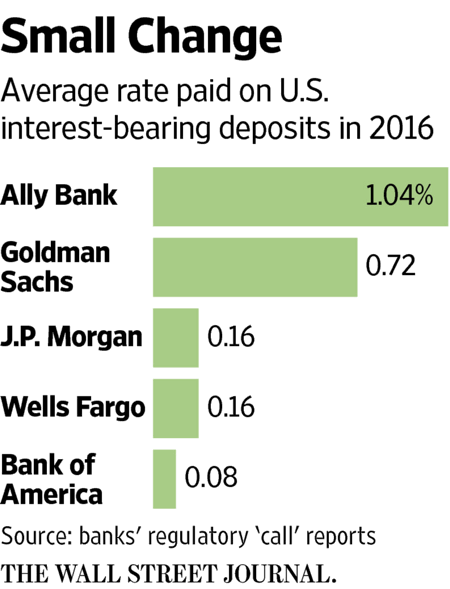
The WSJ article Bank of America Pays Peanuts for Deposits, but the Money Keeps Flowing In (paywall) outlines how BofA gets away with paying less interest on its deposits than nearly any other US bank (not that the other mega-banks are that much better). BofA only pays an average of 0.08% on $796 billion of cash deposits, including certificates of deposit:

bofa_int450

Keep your savings somewhere else! Even if you have a BofA account for the ATM network, you can avoid fees on their basic checking accounts with either a monthly direct deposit, a minimum balance of $1,500 with no direct deposit, or by keeping $20,000 in stocks/ETFs at Merrill Edge with no direct deposit and no minimum balance. Anything above that can easily earn more interest with a companion account like Ally Bank Savings that now has 1-day transfers between linked accounts.

On that note, here is my monthly roundup of the best safe rates available, roughly sorted from shortest to longest maturities. Rates checked as of 5/11/17.

High-yield savings accounts
While the huge brick-and-mortar banks rarely offer good yields, the online banks with a history of competitive rates offer online savings accounts clustered around 1% APY. An important feature to note with savings account is that their interest rates can change at any time.

  • As I’ve been “bait-and-switched” a few times and there are no lucrative rates that make it worth taking another risk, I am currently sticking with Ally Bank for their reliably competitive rates and overall good user experience. Their online savings is currently at 1.05% APY.

Money market mutual funds
If you like to keep cash in a brokerage account, you should know that money market and short-term Treasury rates have been inching upwards. It may be worth the effort to move your money into a higher-yielding money market fund.

  • The Vanguard Prime Money Market Fund has increased their SEC yield to a half-decent 0.95%. The default sweep option is the Vanguard Federal Money Market Fund, which only has an SEC yield of 0.69%. You can manually move the money over to Prime if you meet the $3,000 minimum investment.

Short-term guaranteed rates (under 1 year)
I am often asked what to do with a big wad of cash that you’re waiting to deploy shortly (just sold your house, just sold your business, inheritance). Honestly, I wouldn’t get fancy or take unnecessary risk. Just keep it safe in a short-term CD or online savings account that in insured under the FDIC limits until you have a plan.

  • Palladian Private Bank has a 6-month promotional rate of 1.30% APY guaranteed (maximum initial deposit of $100k) for new accounts. After the first 6 months, the rate reverts back to their normal rate (currently 0.90% APY). Since the initial promo rate is fixed, this makes it the highest guaranteed 6-month CD rate available.

US Savings Bonds
Series I Savings Bonds offer rates that are linked to inflation and backed by the US government. You must hold them for at least a year. There are annual purchase limits. If you redeem them within 5 years there is a penalty of the last 3 months of interest.

  • “I Bonds” bought through the end of April 2017 now will earn a 1.96% rate for the first six months, and then a variable rate based on ongoing inflation after that. While that next 6-month rate is currently unknown, at the very minimum the total yield after 12 months will around 1% with additional upside potential. More info here.
  • In mid-October, the CPI will be announced and you will have a short period where you will have a very close estimate of the rate for the next 12 months. I will have another post up at that time.

Prepaid Cards with Attached Savings Accounts
A small subset of prepaid debit cards have an “attached” FDIC-insured savings account with high interest rates. The risks are that balances are capped, and there are many fees that you must be careful to avoid (lest they eat up your interest). The other catch is that these good features may be killed off without much notice. My NetSpend card now only has an eligible balance up to $1,000.

  • Insight Card is one of the best remaining cards with 5% APY on up to $5,000 as of this writing. Fees to avoid include the $1 per purchase fee, $2.50 for each ATM withdrawal, and the $3.95 inactivity fee if there is no activity within 90 days. If you can navigate it carefully (basically only use ACH transfers and keep up your activity regularly) you can still end up with more interest than other options.

Rewards checking accounts
These unique checking accounts pay above-average interest rates, but with some risk. You have to jump through certain hoops, and if you make a mistake you won’t earn any interest for that month. Rates can also drop quickly, leaving a “bait-and-switch” feeling. But the rates can be high while they last.

  • Consumers Credit Union offers up to 4.59% APY on up to a $20k balance, although 3.09% APY on a $10k balance might be easier to achieve unless you satisfy a long list of requirements. Note that the 4.59% APY requires you to apply and get approved for an additional credit card through them (other credit cards offer $500+ in sign-up bonuses). Keep your 12 debit purchases small as well, as for every $500 in monthly purchases you may be losing out on 2% cashback (or $10 a month on after-tax benefit). Find a local rewards checking account at DepositAccounts.

Certificates of deposit
If you have a large cushion, it’s quite likely to just sit there for years. One option is to keep your money in longer-term investments where you can still take it out in a true emergency and pay a reasonable early withdrawal penalty. Alternatively, you could create a CD ladder of different maturity lengths such that you have access to part of the ladder each year, but your blended interest rate is higher than a savings account.

  • Connexus Credit Union is offering a 1-year Share Certificate at 1.50% APY (90-day early withdrawal penalty) and a 3-year Share Certificate (180-day early withdrawal penalty) at 2.00% APY. Both have a $5,000 minimum deposit. Anyone can join this credit union via partner organization Connexus Association for a one-time $5 fee.
  • Hanscom Federal Credit Union is offering a 4-year Share Certificate at 2.50% APY (180-day early withdrawal penalty) if you also have Premier Checking (no monthly fee if you keep $6,000 in total balances or $2,000 in checking). HFCU also offer a 3% APY CU Thrive “starter” savings account. HFCU membership is open to active/retired military or anyone who makes a one-time $35 donation to the Nashua River Watershed Association.

Longer-term Instruments
I’d use these with caution, but I still track them to see the rest of the current yield curve.

  • Willing to lock up your money for 10+ years? Did you know that you can buy certificates of deposit via Vanguard’s bond desk? These “brokered CDs” still offer the same FDIC-insurance. As of this writing, you can get a 10-year non-callable CD that pays 2.75% APY. (Unfortunately, current long-term CD rates do not rise much higher even as you extend beyond a 5-year maturity.) Prices will vary daily.
  • How about two decades!? Series EE Savings Bonds are not indexed to inflation, but they have a guarantee that the value will double in value in 20 years, which equals a guaranteed return of 3.5% a year. However, if you don’t hold for that long, you’ll be stuck with the normal rate which is quite low (currently a sad 0.10% rate). You could view as a huge early withdrawal penalty. You could also view it as long-term bond and thus a hedge against deflation, but only if you can hold on for 20 years. Too long for me.

All rates were checked as of 5/11/17.

Savings I Bonds May 2017 Update: 1.96% Inflation Rate

savbonds4Savings I Bonds are a low-risk investment backed by the US Treasury that pay out a variable interest rate linked to inflation. You could own them as a replacement for cash reserves (they are liquid after 12 months) or bonds in your portfolio. New inflation numbers were just announced at BLS.gov, which allows us to make an early prediction of May 2017 savings bond rates a couple of weeks before the official announcement on the 1st. This also allows us the opportunity to know exactly what a April 2017 savings bond purchase will yield over the next 12 months, instead of just 6 months.

New Inflation Rate
September 2016 CPI-U was 241.428. March 2017 CPI-U was 243.801, for a semi-annual increase of 0.98%. Using the official formula, the variable component of interest rate for the next 6 month cycle will be approximately 1.96%. You add the fixed and variable rates to get the total interest rate. If you have an older savings bond, your fixed rate may be very different than one from recent years.

Purchase and Redemption Timing Reminder
You can’t redeem until 12 months have gone by, and any redemptions within 5 years incur an interest penalty of the last 3 months of interest. A known “trick” with I-Bonds is that if you buy at the end of the month, you’ll still get all the interest for the entire month as if you bought it in the beginning of the month. It’s best to give yourself a few business days of buffer time though, since if you wait too long your effective purchase date may be bumped into the next month.

Buying in April 2017
If you buy before the end of April, the fixed rate portion of I-Bonds will be 0.0%. You will be guaranteed the current variable interest rate of 2.76% for the next 6 months, for a total 0.00 + 2.76 = 2.76%. For the 6 months after that, the total rate will be 0.00 + 1.96 = 1.96%.

Let’s say we hold for the minimum of one year and pay the 3-month interest penalty. If you theoretically buy on April 30th, 2017 and sell on April 1, 2018, you’ll earn a ~2.04% annualized return for an 11-month holding period, for which the interest is also exempt from state income taxes. If you held for three months longer, you’d be looking at a ~2.02% annualized return for a 14-month holding period. Compare with the current highest 1-year bank CD rates of roughly 1.5% and online savings accounts rates of roughly 1%.

Buying in May 2017
If you wait until May, you will get 1.98% plus an unknown fixed rate for the first 6 months. The fixed rate is likely to be either zero or 0.1%. Every six months, your rate will adjust to the fixed rate plus a variable rate based on inflation. If inflation picks up, you’ll get a hiked rate earlier than versus buying in April.

The primary reason to wait until May is that the current fixed rate is zero and it has a small chance of going up in May. I would personally rather lock in the solid 12-month return by buying in April rather than chase a possible 0.1% long-term bump. I plan on buying my annual limit this week, and I intend to hold these indefinitely for the reasons listed below.

Existing I-Bonds and Unique Features
If you have an existing I-Bond, the rates reset every 6 months depending on your purchase month. Your bond rate = your specific fixed rate + variable rate (minimum floor of 0%). Due to their annual purchase limits, you should still consider their unique advantages before redeeming them. These include ongoing tax deferral, exemption from state income taxes, and being a hedge against inflation (and even a bit of a hedge against deflation).

Annual Purchase Limits
The annual purchase limit is now $10,000 in online I-bonds per Social Security Number. For a couple, that’s $20,000 per year. Buy online at TreasuryDirect.gov, after making sure you’re okay with their security protocols and user-friendliness. You can also buy an additional $5,000 in paper bonds using your tax refund (see IRS Form 8888). If you have children, you may be able to buy additional savings bonds by using a minor’s Social Security Number.

For more background, see the rest of my posts on savings bonds.

Best Interest Rates on Cash Savings – April 2017

percentage2

Our family keeps a year’s worth of expenses (not income) put aside in cash reserves. Even if you think that’s too much, you still need something. There are many ways that the ROI on emergency funds can be higher than simply the interest rate on your bank statement.

If you have cash, it pays to shop around for the most highest interest rates since they are all equally “safe” as long as they are backed by the US government (FDIC-insured, NCUA-insured, US Treasury Bonds, US Savings Bonds). Chase Bank on a 1-year CD? 0.02% APY. Bank of America on a 10-year CD? 0.15% APY. Seriously, who buys these things?!? As of 4/2/2017, below is a roundup of the best safe rates available, roughly sorted from shortest to longest maturities.

High-yield savings accounts
While the huge brick-and-mortar banks rarely offer good yields, the online banks with a history of competitive rates offer online savings accounts clustered around 1% APY. An important feature to note with savings account is that their interest rates can change at any time.

  • As I’ve been “bait-and-switched” a few times and there are no lucrative rates that make it worth taking another risk, I am currently sticking with Ally Bank for their reliably competitive rates and overall good user experience. Their online savings is currently at 1.05% APY.

Short-term guaranteed rates (under 1 year)
I am often asked what to do with a big wad of cash that you’re waiting to deploy shortly (just sold your house, just sold your business, inheritance). Honestly, I wouldn’t get fancy or take unnecessary risk. Just keep it safe in a short-term CD or online savings account that in insured under the FDIC limits until you have a plan.

  • Palladian Private Bank has a 6-month promotional rate of 1.30% APY guaranteed (maximum initial deposit of $100k) for new accounts. After the first 6 months, the rate reverts back to their normal rate (currently 1.10% APY). Since the initial promo rate is fixed, this makes it the highest 6-month CD rate available.

US Savings Bonds
Series I Savings Bonds offer rates that are linked to inflation and backed by the US government. You must hold them for at least a year. There are annual purchase limits. If you redeem them within 5 years there is a penalty of the last 3 months of interest.

  • “I Bonds” bought through the end of April 2017 now will earn a 2.76% rate for the first six months, and then a variable rate based on ongoing inflation after that. While that next 6-month rate is currently unknown, at the very minimum the total yield after 12 months will be competitive with the best current 1-year CD rates. More info here.
  • In mid-April, the CPI will be announced that factors into the new fixed rate in May, which would give you a very close estimate of the rate for the next 12 months. I will have another post up at that time.

Prepaid Cards with Attached Savings Accounts
A small subset of prepaid debit cards have an “attached” FDIC-insured savings account with high interest rates. The risks are that balances are capped, and there are many fees that you must be careful to avoid (lest they eat up your interest). The other catch is that these good features may be killed off without much notice. My NetSpend card now only has an eligible balance up to $1,000.

  • Insight Card is one of the best remaining cards with 5% APY on up to $5,000 as of this writing. Fees to avoid include the $1 per purchase fee, $2.50 for each ATM withdrawal, and the $3.95 inactivity fee if there is no activity within 90 days. If you can navigate it carefully (basically only use ACH transfers and keep up your activity regularly) you can still end up with more interest than other options.

Rewards checking accounts
These unique checking accounts pay above-average interest rates, but with some risk. You have to jump through certain hoops, and if you make a mistake you won’t earn any interest for that month. Rates can also drop quickly, leaving a “bait-and-switch” feeling. But the rates can be high while they last.

  • Consumers Credit Union offers up to 4.59% APY on up to a $20k balance, although 3.09% APY on a $10k balance might be easier to achieve unless you satisfy a long list of requirements. Note that the 4.59% APY requires you to apply and get approved for an additional credit card through them (other credit cards offer $500+ in sign-up bonuses). Keep your 12 debit purchases small as well, as for every $500 in monthly purchases you may be losing out on 2% cashback (or $10 a month on after-tax benefit). Find a local rewards checking account at DepositAccounts.

Certificates of deposit
If you have a large cushion, it’s quite likely to just sit there for years. One option is to keep your money in longer-term investments where you can still take it out in a true emergency and pay a reasonable early withdrawal penalty. Alternatively, you could create a CD ladder of different maturity lengths such that you have access to part of the ladder each year, but your blended interest rate is higher than a savings account.

  • Connexus Credit Union is offering a 1-year Share Certificate at 1.50% APY (90-day early withdrawal penalty) and a 3-year Share Certificate (180-day early withdrawal penalty) at 2.00% APY. Both have a $5,000 minimum deposit. Anyone can join this credit union via partner organization Connexus Association for a one-time $5 fee.
  • Mountain America Credit Union is offering a 5-year Share Certificate at 2.75% APY (365-day early withdrawal penalty). You are even allowed a one-time rate bump if the rates on this certificate rise. $500 minimum deposit. Anyone can join this credit union via partner organization American Consumer Council for a one-time $5 fee.

Longer-term Instruments
I’d use these with caution, but I still track them to see the rest of the current yield curve.

  • Willing to lock up your money for 10+ years? Did you know that you can buy certificates of deposit via Vanguard’s bond desk? These “brokered CDs” offer the same FDIC-insurance and are often through commercial banks like Goldman Sachs. As of this writing, you can get a 10-year non-callable CD that pays 2.85% APY. (Unfortunately, current long-term CD rates do not rise much higher even as you extend beyond a 5-year maturity.) Prices will vary daily.
  • How about two decades!? Series EE Savings Bonds are not indexed to inflation, but they have a guarantee that the value will double in value in 20 years, which equals a guaranteed return of 3.5% a year. However, if you don’t hold for that long, you’ll be stuck with the normal rate which is quite low (currently a sad 0.10% rate). You could view as a huge early withdrawal penalty. You could also view it as long-term bond and thus a hedge against deflation, but only if you can hold on for 20 years. Too long for me.

All rates were checked as of 4/2/17.

Dimensional Fund Advisors Profile + 529 College Savings Plan Access

dfalogoInstitutional Investor has an interesting profile of Dimensional Fund Advisors (DFA). Since DFA doesn’t do much marketing, there are very few articles about them in the mainstream financial media. A rare example is this 2007 article (backup copy) by Michael Lewis for a now-defunct magazine.

DFA funds are similar to Vanguard index funds in that they provide low-cost, diversified, tax-efficient funds that try to capture the market’s overall return. DFA differs from Vanguard in that it tries to beat an index benchmark with various tweaks that target systemic market “risk factors” including size, value, and profitability. (They still believe that prices are efficient and thus don’t pick specific stocks.) They also charge a bit more than pure index funds from Vanguard, Fidelity, Schwab, and iShares.

DFA doesn’t accept money directly from individual investors. You must buy their funds through approved financial advisors or via institutional accounts like 401(k), pension, and 529 plans. Their rationale is that retail investors move their money around too much and at the wrong time. Here’s an impressive statistic:

In 2008, while investors pulled an overall $500 billion from equity funds, the firm had positive flows. It wasn’t because of performance: Dimensional’s funds lost more than the market. According to the group gathered for the September dinner in Austin, clients chose to stay because they understood the firm’s philosophy and the small judgment calls it was making on market portfolios.

DFA is privately-owned and highly academic. DFA executives are “engineers, Nobel Prize winners, physicists, and fluid-mechanics experts”. As such, they are all about the science as opposed to the marketing. The article asks what will happen when the founding members eventually die or leave the firm. Will it have an IPO and be publicly-traded? Will this change the culture to be more focused on short-term profits? Will they someday allow Average Jane investors with $500 to invest? Will the new executives be able to continue the superior performance from understanding market factors?

Succession an interesting question that comes up whenever there is a “special sauce” to your investment’s outperformance. I think Vanguard has done a pretty good job of moving on without Bogle, and I can’t name the current CEO. If you own plain, vanilla index funds there are fewer risks tied to specific people. To simply achieve market return at rock-bottom costs, the current structure should still work 50 or 100 years from now.

DFA doesn’t offer a momentum strategy. The hot trend right now is “smart beta”, and momentum is a big part of that:

It’s instructive to consider other things Dimensional doesn’t have. For example, it doesn’t offer a momentum stock strategy even though the pattern of outperformance is seen clearly in the data. The firm believes a portfolio of momentum stocks generates too much turnover and creates a fund whose characteristics look very different from a market portfolio. Instead, Dimensional uses information on momentum to inform its trading strategies, such as delaying purchases and sales at certain times.

Owning a little bit of DFA funds. I remain intrigued by DFA and their unique culture and methods. Since DFA doesn’t trust us DIY investors (probably rightfully so in aggregate) and many financial advisors charge roughly 1% annually on top of the higher costs of DFA funds themselves, I choose not to invest in DFA funds with my primary portfolio. I’m happy retaining full control and keeping costs as low as possible.

However, I do invest in DFA funds through the Utah 529 College Savings plan. A few other 529 plans also offer DFA funds, but I believe Utah has the biggest selection at a reasonable cost. Here are the currently available options:

  • DFA Global Equity Portfolio
  • DFA Global Allocation 60/40 Portfolio
  • DFA Global Allocation 25/75 Portfolio
  • DFA Five-Year Global Fixed Income Portfolio
  • DFA U.S. Large Cap Value Portfolio
  • DFA U.S. Small Cap Value Portfolio
  • DFA Real Estate Securities Portfolio
  • DFA International Value Portfolio
  • DFA One-Year Fixed Income Portfolio

I kept it simple and picked the all-in-one DFA Global Equity fund. I figure, I’ll let DFA take the wheel and see what happens in 20 years. I don’t have to worry about taxes or withdrawals for a long time. As it’s mostly a low-cost index fund at its core, I don’t worry about the downside too much. I just hope Utah does’t change up their fund options down the road and force me into something different.

Best Interest Rates on Cash Reserves – November 2016

percentage2

Our family keeps a year’s worth of expenses (not income) put aside in cash reserves; it provides financial insurance with the side benefits of lower stress and less concern about stock market gyrations. Emergency funds can have a better return on investment than what you see on your bank statement. In my experience, having a solid cash cushion is the first step towards financial independence.

I don’t chase rates nearly as much as I used to, but it still pays to shop around. Chase Bank on a 1-year CD? 0.02% APY. Bank of America on a 10-year CD? 0.15% APY. Who buys these things?!? Meanwhile, the rates below vary from 1% up to over 3% annualized.

As of 11/6/2016, below is a roundup of the best rates backed by the full faith and credit of the US government (FDIC-insured, NCUA-insured, US Treasury Bonds, US Savings Bonds). I will try to sort them from the shortest to longest maturities.

High-yield savings accounts

  • Online savings accounts, everyone’s got one these days. Currently, the ones with a history of competitive rates are around 1% APY. These savings accounts can change their interest rate at any time, so if you’re going to just pick the highest one, be ready to move your money. I prefer the ones with a history of competitive rates, and I’ve been with Ally Bank for over 5 years. Their online savings is currently at 1% APY.

Short-term guaranteed rates (under 1 year)

  • If you’ve got a big wad of cash that you’re waiting to deploy shortly (just sold your house, just sold your business, inheritance), I say just keep it safe until you’re ready to invest it properly. Palladian Private Bank has a 6-month promotional rate of 1.30% APY guaranteed (maximum initial deposit of $100k) for new accounts. After the first 6 months, the rate reverts back to their normal rate (currently 1.10% APY). Since the initial promo rate is fixed, this makes it the higher 6-month CD rate available.

Flexible Savings Bonds

  • Series I Savings Bonds offer rates that are linked to inflation. “I Bonds” bought right now will earn a 2.76% rate for the first six months, and then a variable rate based on ongoing inflation after that. You must hold them for a year, and if you redeem them within 5 years there is a penalty of the last 3 months of interest. While future rates are unknown, at the very minimum it will be competitive with the best 1-year CD rates. More info here.

Prepaid Cards with Attached Savings Accounts

  • A small subset of prepaid debit cards have an “attached” FDIC-insured savings account with high interest rates. The risks are that balances are capped, and there are many fees that you must be careful to avoid (lest they eat up your interest). The other catch is that these good features may be killed off without much notice. I pulled my money out of my NetSpend card after the eligible balance dropped to $1,000 (no longer worth the effort for extra $3 a month in interest).
  • Insight Card is one of the best remaining cards with 5% APY on up to $5,000 as of this writing. Fees to avoid include the $1 per purchase fee, $2.50 for each ATM withdrawal, and the $3.95 inactivity fee if there is no activity within 90 days. If you can navigate it carefully (basically only use ACH transfers and keep up your activity regularly) you can still end up with more interest than other options.

Rewards checking accounts

  • These unique checking accounts pay above-average interest rates, but with some risk. You have to jump through certain hoops, and if you make a mistake you won’t earn any interest for that month. Rates can also drop quickly, leaving a “bait-and-switch” feeling. But the rates can be high while they last.
  • Consumers Credit Union offers up to 4.59% APY on up to a $20k balance, although 3.09% APY on a $10k balance might be easier to achieve unless you satisfy a long list of requirements. Note that the 4.59% APY requires you to apply and get approved for an additional credit card through them (other credit cards offer $500+ in sign-up bonuses). Keep your 12 debit purchases small as well, as for every $500 in monthly purchases you may be losing out on 2% cashback (or $10 a month on after-tax benefit).

Certificates of deposit

  • If you have a large cushion, it’s quite likely to just sit there for years. Why not put some money in longer-term investments where you can still take it out in a true emergency and pay an early withdrawal penalty. For example, UNIFY Financial Credit Union (formerly Western Federal Credit Union) is offering a 5-year Share Certificate paying 2.00% APY ($1,000 minimum balance) with an early withdrawal penalty of only 90 days interest. For example, if you withdraw from this CD after 2 years and pay the penalty, your effective rate earned will still be 1.76%. Anyone can join this credit union via partner organization, it appears it might be free or at most a one-time $25 fee.

Longer-term Instruments

  • Willing to lock up your money for 10+ years? Did you know that you can buy certificates of deposit via Vanguard’s bond desk? These “brokered CDs” offer the same FDIC-insurance and are often through commercial banks like Goldman Sachs. As of this writing, you can get a 10-year CD maturing 11/9/2026 that pays 2.10% APY. (Unfortunately, current long-term CD rates do not rise much higher even as you extend beyond a 5-year maturity.) Prices will vary regularly.
  • How about two decades!? Series EE Savings Bonds are not indexed to inflation, but they have a guarantee that the value will double in value in 20 years, which equals a guaranteed return of 3.5% a year. However, if you don’t hold for that long, you’ll be stuck with the normal rate which is quite low (currently a sad 0.10% rate). Think of it as a huge early withdrawal penalty. You really, really want to be sure you’ll keep it for 20 years.

All rates were checked as of 11/6/16.

Savings I Bonds November 2016 Update: 2.76% Inflation Rate

savbonds4

Update for I bonds issued from November 1, 2016, through April 30, 2017. The new fixed rate as of November 1st, 2016 is 0.0%, which was a decrease from 0.1% during the last 6-month period. For comparison, 5-year TIPS real yield on 11/1/16 was actually negative at -0.29%. The variable inflation-indexed rate is 2.76% (as was predicted). Your total rate is the sum of your fixed rate and the variable rate. See you again in mid-April 2017 for the next early prediction.

Original post 10/18/16:

Savings I Bonds are a low-risk investment backed by the US Treasury that pay out a variable interest rate linked to inflation. You could own them as a short-term investment in place of bank CDs or savings accounts, or you could hold them as long-term investments in place of government, corporate, or municipal bonds.

New inflation numbers were just announced at BLS.gov, which allows us to make an early prediction of November 2016 savings bond rates a couple of weeks before the official announcement on May 1st. This also allows us the opportunity to know exactly what a October 2016 savings bond purchase will yield over the next 12 months, instead of just 6 months.

New Inflation Rate
March 2016 CPI-U was 238.132. September 2016 CPI-U was 241.428, for a semi-annual increase of 1.38%. Using the official formula, the variable component of interest rate for the next 6 month cycle will be approximately 2.76%. You add the fixed and variable rates to get the total interest rate. If you have an older savings bond, your fixed rate may be very different than one from recent years.

Purchase and Redemption Timing Reminder
You can’t redeem until 12 months have gone by, and any redemptions within 5 years incur an interest penalty of the last 3 months of interest. A known “trick” with I-Bonds is that if you buy at the end of the month, you’ll still get all the interest for the entire month as if you bought it in the beginning of the month. It’s best to give yourself a few business days of buffer time though, since if you wait too long your effective purchase date may be bumped into the next month.

Buying in October 2016
If you buy before the end of October, the fixed rate portion of I-Bonds will be 0.1%. You will be guaranteed the current variable interest rate of 0.16% for the next 6 months, for a total 0.10 + 0.16 = 0.26%. For the 6 months after that, the total rate will be 0.10 + 2.76 = 2.86%. 0.26% for 6 months, then 2.86% for 6 months.

Let’s say we hold for the minimum of one year and pay the 3-month interest penalty. If you theoretically buy on October 31st, 2016 and sell on October 1, 2017, you’ll earn a ~0.92% annualized return for an 11-month holding period, for which the interest is also exempt from state income taxes. If you held for three month longer, you’d be looking at a ~1.34% annualized return for a 14-month holding period. Compare with the current highest 1-year bank CD rates of roughly 1.25% and online savings accounts rates of roughly 1%.

Buying in November 2016
If you wait until November, you will get 2.76% plus an unknown fixed rate for the first 6 months. The fixed rate is likely to be either zero or 0.1%. (Update: The fixed rate is 0.0%, making the total rate 2.76% for the first 6 months.) Every six months, your rate will adjust to the fixed rate plus a variable rate based on inflation. If inflation picks up, you’ll get a hiked rate earlier than versus buying in October.

If you buy on November 30th, 2016 and sell on November 1st, 2017, you’ll earn a minimum ~1.51% annualized return for an 11-month holding period, for which the interest is also exempt from state income taxes. As long as inflation isn’t zero or negative over the next 6 months, you’ll earn even more. Your rate is guaranteed to beat out any current 1-year CD rate, and you still have upside potential.

Which is better? If you really want to lock in that 0.1% fixed rate for the long-term, you could buy in October. I think you have more short-term upside if you buy in November, even if your fixed rate might drop to zero. I already bought my 2016 annual limit back in April, and I intend to hold these indefinitely for the reasons listed below.

Existing I-Bonds and Unique Features
If you have an existing I-Bond, the rates reset every 6 months depending on your purchase month. Your bond rate = your specific fixed rate + variable rate (minimum floor of 0%). Due to their annual purchase limits, you should still consider their unique advantages before redeeming them. These include ongoing tax deferral, exemption from state income taxes, and being a hedge against inflation (and even a bit of a hedge against deflation).

Annual Purchase Limits
The annual purchase limit is now $10,000 in online I-bonds per Social Security Number. For a couple, that’s $20,000 per year. Buy online at TreasuryDirect.gov, after making sure you’re okay with their security protocols and user-friendliness. You can also buy an additional $5,000 in paper bonds using your tax refund (see IRS Form 8888). If you have children, you may be able to buy additional savings bonds by using a minor’s Social Security Number.

For more background, see the rest of my posts on savings bonds.

SolarCity Bonds: 6.50% Interest for 18 Month Term

scty0bSome folks don’t like it when I write about investments that aren’t low-cost index funds. The thing is, when I find something intriguing, I like to dig deeper and then keep a record my findings. That way I can look back later and see how things turned out and compare with my opinions at the time. Just because I write about something doesn’t mean I recommend it, you have to read the entire post.

SolarCity is a company that installs and finances solar panels on commercial and residential properties. Back in October 2014, they started to allow individual investors to buy senior, unsecured corporate bonds directly from them online. You could invest as little as $1,000 in these SolarCity SolarBonds and pay no trade commissions or fees. The critical feature is that these “solar bonds” were backed only by the claims-paying abilities of the issuing company. If SolarCity fails, then you could lose your entire principal as well as any interest owed.

In general, the more confident you are that you’ll be paid back, the lower the interest rate the borrower has to pay. Other factors will come into play, such as the overall interest rate environment. With this in mind, check out the history of these bonds:

  • In 2014, SolarCity was issuing 7-year bonds paying a 4% annual interest rate.
  • In mid-2015, SolarCity was issuing 5-year bonds paying a 5% annual interest rate.
  • Currently in August 2016, SolarCity is offering a 18-month bond paying 6.5% annual interest rate. Ends August 30, 2016.

scty2

Supposedly, SolarCity is passing on the savings of doing things in-house and not having to pay investment banker fees. I still declined to write about these SolarCity bonds in the past because the yield and term lengths were not good enough to grab my interest. But 6.5% in 18 months? Okay, you’ve at least gotten my attention.

Consider that as of 8/24/16, an 18-month Treasury bill yields approximately 0.70%. The highest 18-month FDIC-insured CD pays roughly 1.35%. Investment-grade (A) corporate bonds are averaging ~1.15% for a 2 year maturity. Even a junk bond ETF like JNK may have a 6.5% yield but an average maturity of over 6 years.

What’s happening? Well, SolarCity is struggling in several areas. It’s been losing money reliably, every year. Here’s the stock price chart:

scty1

Perhaps more importantly, it has some big bills that are coming due soon. According to this TheStreet article, SolarCity has $3.25 billion in debt, with $1.23 billion due by the end of 2017. Note that date. At the same time, Tesla has offered to buy SolarCity in an all-stock deal.

Obviously Elon Musk and his SolarCity co-founder cousins want it to happen, as it has been widely-reported that they bought a big chunk of these bonds on their own. See Fortune, WSJ, and MarketWatch.

Why would they buy these bonds? My wild-guess opinion is that it looks like SolarCity is trying to extend its debt long enough so that Tesla can safely buy the company and then refinance things on better terms. I would say that if the deal closes, then these 6.5% bonds will pay off. I believe that Tesla will still be around in 18 months. However, if the deal doesn’t close for some reason, then SolarCity might be in big trouble.

Are these 6.5% bonds worth the risk? Given that Elon Musk and his cousins are a big shareholder in both companies and just bought $100 million of these bonds, that would seem to place your interest in line with theirs at this point. I’d actually rather hold these bonds for 18 months than be a shareholder for 18 months. However, you are still faced with the chance that the deal will hit some unforeseen obstacle, so it all depends on your confidence level. For me, the reward just isn’t high enough to justify the risk of permanent principal loss (I’d rather have a house as collateral), so I am going to pass and wait to see how it turns out.

Netspend Card 5% APY Savings Account Review

netspend0

(Update: On 5/31, NetSpend effectively issued a 30-day notice that the rate structure will be changed as of July 1st, 2016 such that the 5% APY will apply up to $1,000 and anything above that gets 0.50% APY. The 5% APY will apply to up to $5,000 until June 30, 2016 which is when the next quarterly interest payment will post. Thanks to all who notified me of this change.)

Prepaid debit cards are a growing niche for the “under-banked” or “un-banked” who can’t or don’t want to use traditional checking accounts to hold their cash. In order to promote the adoption of prepaid debit cards as their sole financial hub, many now offer the option of an attached high-interest savings account.

The NetSpend Prepaid Visa offers 5% APY on balances up to $5,000. For balances over $5,000, it pays 0.50% APY. Even with the balance limit, this is an attractive rate and worth a look even if you don’t need a prepaid debit card otherwise. I’ve had this card open since September 2015, but a quirk of this card is that interest is only paid quarterly, so I waited to see if the 5% APY (4.91% APR) would post correctly. As you can see in the screenshot below, the interest for all 3 months was credited as promised at roughly $20.50 per month. (The 0.50% APY on balances above $5,000 is credited on a separate line.)

netspend5

For the purposes of this review, I will not focus on most aspects of the prepaid debit card. I am primarily interested in maximizing the savings account feature and the avoidance of any fees.

Account opening process. Visit the Netspend website and enter your personal details to order a card (name, address, e-mail). No credit check. No application fee. You will eventually need to provide your Social Security number as required by law, since you’ll be opening a FDIC-insured bank account. If you are referred by an existing user (links above are mine, thanks if you use it), both get an additional $20 bonus after depositing at least $40. After signing up, you can also refer your own friend and family for more $20 bonuses.

Once the physical card arrives in about a week, follow the included directions and activate your account online. You will be provided your unique account number and a routing number, which will allow you to make electronic ACH transfers from your external bank accounts. You can also use this information to have direct deposit set up with your payroll or government benefits.

netspend1

5% APY savings account funding directions. Previously, you had to upgrade to Netspend Premier to get the 5% APY savings account option. This requirement appears to have been removed. You must use an external bank to “push” money over into the Netspend card. I used my Ally Bank savings account as the transfer agent (screenshot below). I used the account and routing numbers provided, which confirmed that the underlying FDIC-insured bank is MetaBank of Sioux Falls, South Dakota. Other banks that they say may be used are BofI Federal Bank and The Bancorp Bank.

netspend2

Then, all you need to do is move over $5,000 from your external bank to your Card Balance, and then move that $5,000 over to your Savings Balance. Your Card Balance is the part that can be spent via prepaid debit card, but it will not earn any interest, so be sure to move it over to Savings Balance. They are separate buckets! Here are the before and after screenshots (click to enlarge).

netspend3

netspend4

The Savings Account has no monthly minimum balance requirement and no monthly fees. Transfers between Card Balance and Savings Balance are free, but the number of withdrawals from Savings Balance are limited to 6 per calendar month by federal banking laws.

Avoiding Debit Card fees. Now, the Savings Account has no monthly fees, but the Debit Card does have a choice of plans with their own fee schedules. Since I don’t plan on making any actual purchases using this debit card, I chose the Pay As You Go plan with no monthly fee. Now, with this plan there is also an account maintenance fee of $5.95 per month:

Account Maintenance Fee $5.95 per month (fee applies if Card Account has not had any activity, that is, no purchases; no cash withdrawals; no load transactions; or no balance inquiry fee for 90 days). If enrolled in any FeeAdvantage Plan and your Card Account has had no activity as described above, this fee applies instead of the Plan Fee.

The simple solution to avoid this fee is to load a few dollars once every 90 days via your original ACH transfer source. Most banks will even let you set up an automated transfer schedule; I like every month just because it serves as a monthly reminder to check the balance, APY, etc. You could also use their mobile app and make a check deposit.

Withdrawals. The easiest way to make a withdrawal is again via “ACH pull” from your external transfer bank. Remember, you’ll have to move the funds over from “Savings” to “Card”. Another free alternative is to use the BillPay feature and pay down a credit card bill using your funds. If you have a credit card that you use regularly, you can even make an overpayment and simply hold a negative balance until it gets used up by future credit card purchases. Finally, you could just use the Visa feature to buy something or make an ATM withdrawal (subject to daily limits), but you may be subject to transaction fees.

Additional cards. If you have a spouse or partner, you could both get a NetSpend Prepaid card which would bring your 5% APY limit to $10,000. There are also other cards which offer a similar setup, including Brink’s Prepaid (I have this one as well), Ace Elite, and Western Union. If you had one of each of these (which is still allowed to the best of my knowledge), then that would bring your theoretical limit to $20,000 for an individual or $40,000 for a couple.

Recap. Yes, it really works, as long as you set it up properly and maintain an active account. As compared to a 1% APY savings account, each $5,000 balance at 5% APY would earn $200 more in taxable interest income each year. It is up to you to weigh the potential reward vs. effort, also taking into account the size of your cash balances.