Search Results for: High Interest Savings

Best Interest Rates on Cash – December 2018

Here’s my monthly roundup of the best interest rates on cash for December 2018, roughly sorted from shortest to longest maturities. Check out my Ultimate Rate-Chaser Calculator to get an idea of how much extra interest you’d earn if you are moving money between accounts. Rates listed are available to everyone nationwide. Rates checked as of 12/3/18.

High-yield savings accounts
While the huge megabanks like to get away with 0.01% APY, getting higher rates is as easy as transferring money electronically from your checking account to an online savings account. The interest rates on savings accounts can drop at any time, so I prioritize banks with a history of competitive rates. Some banks will bait you and then lower the rates in the hopes that you are too lazy to leave.

Short-term guaranteed rates (1 year and under)
I am often asked what to do with a big wad of cash that you’re waiting to deploy shortly (just sold your house, just sold your business, legal settlement, inheritance). My usual advice is to keep things simple and take your time. If not a savings account, then put it in a flexible short-term CD under the FDIC limits until you have a plan.

  • No Penalty CDs offer a locked-in rate with no early withdrawal penalty. That means your interest rate can never go down, but you can still take out your money (once) if you want to use it elsewhere. Ally Bank 11-month No Penalty CD is at 2.25% APY for $25k+ balance, Marcus Bank 13-month No Penalty CD at 2.15% APY with a $500 minimum deposit, and the CIT Bank 11-Month No Penalty CD at 2.05% APY with a $1,000 minimum deposit. You may wish to open multiple CDs in smaller increments for more flexibility.
  • Live Oak Bank has a 1-year CD at 2.85% APY ($2,500 minimum) with an early withdrawal penalty of 90 days of interest.

Money market mutual funds + Ultra-short bond ETFs
If you like to keep cash in a brokerage account, beware that many brokers pay out very little interest on their default cash sweep funds (and keep the money for themselves). The following money market and ultra-short bond funds are not FDIC-insured, but may be a good option if you have idle cash and cheap/free commissions.

  • Vanguard Prime Money Market Fund currently pays an 2.30% SEC yield. The default sweep option is the Vanguard Federal Money Market Fund, which has an SEC yield of 2.19%. You can manually move the money over to Prime if you meet the $3,000 minimum investment.
  • Vanguard Ultra-Short-Term Bond Fund currently pays 2.64% SEC Yield ($3,000 min) and 2.74% SEC Yield ($50,000 min). The average duration is ~1 year, so there is a little more interest rate sensitivity.
  • The PIMCO Enhanced Short Maturity Active Bond ETF (MINT) has a 2.66% SEC yield and the iShares Short Maturity Bond ETF (NEAR) has a 2.75% SEC yield while holding a portfolio of investment-grade bonds with an average duration of ~6 months.

Treasury Bills and Ultra-short Treasury ETFs
Another option is to buy individual Treasury bills which come in a variety of maturities from 4-weeks to 52-weeks. You can also invest in ETFs that hold a rotating basket of short-term Treasury Bills for you, while charging a small management fee for doing so. T-Bill interest is exempt from state and local income taxes.

  • You can build your own T-Bill ladder at TreasuryDirect.gov or via a brokerage account with a bond desk like Vanguard and Fidelity. Here are the current Treasury Bill rates. As of 11/30/18, a 4-week T-Bill had the equivalent of 2.30% annualized interest and a 52-week T-Bill had the equivalent of 2.69% annualized interest.
  • The Goldman Sachs Access Treasury 0-1 Year ETF (GBIL) has a 2.18% SEC yield and the SPDR Bloomberg Barclays 1-3 Month T-Bill ETF (BIL) has a 2.07% SEC yield. GBIL appears to have a slightly longer average maturity than BIL.

US Savings Bonds
Series I Savings Bonds offer rates that are linked to inflation and backed by the US government. You must hold them for at least a year. There are annual purchase limits. If you redeem them within 5 years there is a penalty of the last 3 months of interest.

  • “I Bonds” bought between November 2018 and April 2019 will earn a 2.82% rate for the first six months. The rate of the subsequent 6-month period will be based on inflation again. More info here.
  • In mid-April 2019, the CPI will be announced and you will have a short period where you will have a very close estimate of the rate for the next 12 months. I will have another post up at that time.

Prepaid Cards with Attached Savings Accounts
A small subset of prepaid debit cards have an “attached” FDIC-insured savings account with exceptionally high interest rates. The negatives are that balances are capped, and there are many fees that you must be careful to avoid (lest they eat up your interest). Some folks don’t mind the extra work and attention required, while others do. There is a long list of previous offers that have already disappeared with little notice. I don’t use any of these anymore.

  • The only notable card left in this category is Mango Money at 6% APY on up to $2,500, but there are many hoops to jump through. Signature purchases of $1,500 or more and a minimum balance of $25.00 at the end of the month is needed to qualify for the 6.00%.

Rewards checking accounts
These unique checking accounts pay above-average interest rates, but with unique risks. You have to jump through certain hoops, and if you make a mistake you won’t earn any interest for that month. Some folks don’t mind the extra work and attention required, while others do. Rates can also drop to near-zero quickly, leaving a “bait-and-switch” feeling. I don’t use any of these anymore, either.

  • The best one left is Consumers Credit Union, which offers 3.09% to 5.09% APY on up to a $10k balance depending on your qualifying activity. The highest tier requires their credit card in addition to their debit card (other credit cards offer $500+ in sign-up bonuses). Keep your 12 debit purchases just above the $100 requirement, as for every $500 in monthly purchases you may be losing out on cash back rewards elsewhere. Find a local rewards checking account at DepositAccounts.
  • If you’re looking for a non-rewards high-yield checking account, MemoryBank has a checking account with no debit card requirements at 1.60% APY.

Certificates of deposit (greater than 1 year)
You might have larger balances, either because you are using CDs instead of bonds or you simply want a large cash reserves. By finding a bank CD with a reasonable early withdrawal penalty, you can enjoy higher rates but maintain access in a true emergency. Alternatively, consider building a CD ladder of different maturity lengths (ex. 1/2/3/4/5-years) such that you have access to part of the ladder each year, but your blended interest rate is higher than a savings account. When one CD matures, use that money to buy another 5-year CD.

  • Mutual One Bank has a 19-month CD at 3.04% APY ($500 min). 6 month early withdrawal penalty.
  • Greenwood Credit Union has a 5-year certificate at 3.75% APY ($1,000 min). Early withdrawal penalty is 6 months interest. United States Senate Federal Credit Union has a 5-year Share Certificate at 3.63% APY ($60k min), 3.57% APY ($20k min), or 3.51% APY ($1k min). Note that the early withdrawal penalty is a full year of interest. Anyone can join this credit union via American Consumer Council.
  • You can buy certificates of deposit via the bond desks of Vanguard and Fidelity. These “brokered CDs” offer FDIC insurance, but they don’t come with predictable fixed early withdrawal penalties. As of this writing, Vanguard is showing a 2-year non-callable CD at 3.10% APY and a 5-year non-callable CD at 3.55% APY. Watch out for higher rates from callable CDs listed by Fidelity.

Longer-term Instruments
I’d use these with caution due to increased interest rate risk, but I still track them to see the rest of the current yield curve.

  • Willing to lock up your money for 10+ years? You can buy long-term certificates of deposit via the bond desks of Vanguard and Fidelity. These “brokered CDs” offer FDIC insurance, but they don’t come with predictable fixed early withdrawal penalties. As of this writing, Vanguard is showing a 10-year non-callable CD at 3.60% APY. Watch out for higher rates from callable CDs from Fidelity. Matching the overall yield curve, current CD rates do not rise much higher as you extend beyond a 5-year maturity.
  • How about two decades? Series EE Savings Bonds are not indexed to inflation, but they have a guarantee that the value will double in value in 20 years, which equals a guaranteed return of 3.5% a year. However, if you don’t hold for that long, you’ll be stuck with the normal rate which is quite low (currently a sad 0.10% rate). I view this as a huge early withdrawal penalty. You could also view it as long-term bond and thus a hedge against deflation, but only if you can hold on for 20 years. As of 11/30/18, the 20-year Treasury Bond rate was 3.19%, so this EE bond is no longer offering a huge premium.

All rates were checked as of 12/3/18.


Garden Savings Federal Credit Union: 4-Year CD at 4.08% APY

(Update: “Due to the tremendous success of our certificate promotion, we have concluded the special rates that were being offered as of the end of business on Friday, November 9th.” Reader Ryan adds that as long as you started the application process before the end of business on Friday, they will let you complete the process but you must fund by the next Friday.)

Garden Savings Federal Credit Union has a limited-time certificate special on their 4-Year Share Certificate at 4.08% APY. They also have a 2-Year certficiate at 3.04% APY. NCUA-insured. Here are the highlights:

  • $500 minimum deposit.
  • Interest paid monthly.
  • Penalty for early withdrawal is 180 days of dividends.
  • Membership with at least $5 deposited in a Share Savings account required.

According to a myFICO forum post from 2016, the membership application is a soft credit pull. This is not a guarantee, of course. Please share your own experience if you apply.

If you have the big bucks, Garden Savings FCU has the usual NCUA-insurance up to $250,000, but also another $250,000 in additional deposit insurance through Excess Share Insurance.

Credit union membership eligibility. You are eligible for membership if you live, work, worship, attend school, volunteer or regularly conduct business in Newark, Elizabeth, or Jersey City. Select employer groups are also eligible. In addition, anyone can join by being a member of the American Consumer Council (ACC), a non-profit organization dedicated to consumer education, advocacy and financial literacy. The cost is a one-time $8, although there is a promo code “consumer” that has worked to get the membership fee waived. You can make additional donations as you wish, but it is not required. They will send you an e-mail shortly with your ACC membership number. I’ve joined a couple of credit unions with my ACC membership.

Good deal? 4.08% APY is the best rate that I know of for a 4-year CD, with the current competitive range for a 4-year CD being around 3% to 3.35% APY. The closest deal from my Best Cash Rates November 2018 post was a 5-year CD at 3.63% APY that required a $60,000 deposit. A 5-year Treasury bond currently yields about 3.05% and is exempt from state and local income taxes. The 180-day early withdrawal penalty is on the reasonable side.

I think the deal is good enough that it won’t last very long. This credit union is not tiny, but it isn’t huge either. It is quite possible that there will be enough new applications to overwhelm their staff (and deposit needs). If you’re interested, I would act quickly as these deals can end abruptly. I’d be ready to send in additional paperwork (like a copy of your driver’s license) if requested to expedite things.

Best Interest Rates on Cash – November 2018

Here’s my monthly roundup of the best interest rates on cash for November 2018, roughly sorted from shortest to longest maturities. Check out my Ultimate Rate-Chaser Calculator to get an idea of how much extra interest you’d earn if you are moving money between accounts. Rates listed are available to everyone nationwide. Rates checked as of 11/5/18.

High-yield savings accounts
While the huge megabanks like to get away with 0.01% APY, getting higher rates is as easy as transferring money electronically from your checking account to an online savings account. The interest rates on savings accounts can drop at any time, so I prioritize banks with a history of competitive rates. Some banks will bait you and then lower the rates in the hopes that you are too lazy to leave.

  • MemoryBank and Redneck Bank offer 2.25% APY with no minimum balance (Redneck has $50k maximum balance). Northpointe Bank offers 2.30% APY with a higher $25,000+ minimum, guaranteed for 12 months. If you have existing accounts at CIT Bank, you may wish to move some money over to their new Savings Builder account at 2.15% APY. There was a bank (EBSB Direct) that offered 2.50% APY for a bit last month, but has since pulled the account information completely from their website. I hope they keep the rate high for existing accountholders. There are several other established high-yield savings accounts at 1.80% APY and up.
  • My primary “hub” bank account is the Ally Bank Savings + Checking combo due to their history of competitive rates, 1-day external bank transfers, and overall ease of use. The free overdraft transfers from savings allows to me to keep my checking balance at a minimum. Ally Savings is currently at 1.90% APY. From here, I open “spoke” accounts and CDs from other banks to lock in higher rates. (Ally Bank also recently had a good promotion that offered a 1% bonus on new deposits held for 3 months, but enrollment is now closed.)

Short-term guaranteed rates (1 year and under)
I am often asked what to do with a big wad of cash that you’re waiting to deploy shortly (just sold your house, just sold your business, legal settlement, inheritance). My usual advice is to keep things simple. If not a savings account, then put it in a flexible short-term CD under the FDIC limits until you have a plan.

  • No-Penalty CDs offer a locked-in rate with no early withdrawal penalty. That means your interest rate can never go down, but you can still take out your money (once) if you want to use it elsewhere. The Marcus 13-month No Penalty CD is at 2.15% APY with a $500 minimum deposit. Ally Bank 11-month No Penalty CD is at 2.10% APY ($25k minimum) and the CIT Bank 11-Month No-Penalty CD is at 2.05% APY ($1,000 minimum). The lack of early withdrawal penalty means that your interest rate can never go down for 11 months, but you keep full liquidity. You can open multiple CDs in smaller $1,000 increments to get even more flexibility.
  • VirtualBank has a 1-year CD at 2.75% APY ($10,000 minimum) with an early withdrawal penalty of 1% of principal.

Money market mutual funds + Ultra-short bond ETFs
If you like to keep cash in a brokerage account, you should know that money market and short-term Treasury rates have been rising. The following money market and ultra-short bond funds are not FDIC-insured, but may be a good option if you have idle cash and cheap/free commissions.

  • Vanguard Prime Money Market Fund currently pays an 2.21% SEC yield. The default sweep option is the Vanguard Federal Money Market Fund, which has an SEC yield of 2.10%. You can manually move the money over to Prime if you meet the $3,000 minimum investment.
  • Vanguard Ultra-Short-Term Bond Fund currently pays 2.58% SEC Yield ($3,000 min) and 2.68% SEC Yield ($50,000 min). The average duration is ~1 year, so there is a little more interest rate sensitivity.
  • The PIMCO Enhanced Short Maturity Active Bond ETF (MINT) has a 2.55% SEC yield and the iShares Short Maturity Bond ETF (NEAR) has a 2.64% SEC yield while holding a portfolio of investment-grade bonds with an average duration of ~6 months.

Treasury Bills and Ultra-short Treasury ETFs
Another option is to buy individual Treasury bills which come in a variety of maturities from 4-weeks to 52-weeks. You can also invest in ETFs that hold a rotating basket of short-term Treasury Bills for you, while charging a small management fee for doing so. T-Bill interest is exempt from state and local income taxes.

  • You can buy individual Treasury Bills at certain brokerage accounts with a bond desk like Vanguard and Fidelity, or individuals can buy them directly at TreasuryDirect.gov. Here is my post on building your own T-Bill ladder. Here are the current Treasury Bill rates. As of 11/2/18, a 4-week T-Bill had the equivalent of 2.18% annualized interest and a 52-week T-Bill had the equivalent of 2.69% annualized interest.
  • The Goldman Sachs Access Treasury 0-1 Year ETF (GBIL) has a 2.05% SEC yield and the SPDR Bloomberg Barclays 1-3 Month T-Bill ETF (BIL) has a 1.97% SEC yield. GBIL appears to have a slightly longer average maturity than BIL.

US Savings Bonds
Series I Savings Bonds offer rates that are linked to inflation and backed by the US government. You must hold them for at least a year. There are annual purchase limits. If you redeem them within 5 years there is a penalty of the last 3 months of interest.

  • “I Bonds” bought between November 2018 and April 2018 will earn a 2.82% rate for the first six months. The rate of the subsequent 6-month period will be based on inflation again. More info here.
  • In mid-April 2019, the CPI will be announced and you will have a short period where you will have a very close estimate of the rate for the next 12 months. I will have another post up at that time.

Prepaid Cards with Attached Savings Accounts
A small subset of prepaid debit cards have an “attached” FDIC-insured savings account with exceptionally high interest rates. The negatives are that balances are capped, and there are many fees that you must be careful to avoid (lest they eat up your interest). Some folks don’t mind the extra work and attention required, while others do. There is a long list of previous offers that have already disappeared with little notice.

  • The only notable card left in this category is Mango Money at 6% APY on up to $5,000, but there are many hoops to jump through. There is a $3 monthly fee and you need to maintain a minimum $800 net direct deposit each month. This means you can’t direct deposit $800 and also take out $800 via online transfer. Checks and ATM withdrawals have additional fees. This means you have to spend the money via the Visa debit card (and miss out on flat 2% cash back on all purchases).

Rewards checking accounts
These unique checking accounts pay above-average interest rates, but with unique risks. You have to jump through certain hoops, and if you make a mistake you won’t earn any interest for that month. Some folks don’t mind the extra work and attention required, while others do. Rates can also drop to near-zero quickly, leaving a “bait-and-switch” feeling. That’s just how it goes with these types of accounts.

  • Consumers Credit Union offers 3.09% to 5.09% APY on up to a $10k balance depending on your qualifying activity. The highest tier requires their credit card in addition to their debit card (other credit cards offer $500+ in sign-up bonuses). Keep your 12 debit purchases just above the $100 requirement, as for every $500 in monthly purchases you may be losing out on 2% cash back elsewhere (or $10 a month after-tax). Find a local rewards checking account at DepositAccounts.
  • If you’re looking for a non-rewards high-yield checking account, MemoryBank has a checking account with no debit card requirements at 1.60% APY.

Certificates of deposit (greater than 1 year)
You might have larger balances, either because you are using CDs instead of bonds or you simply want a large cash reserves. By finding a bank CD with a reasonable early withdrawal penalty, you can enjoy higher rates but maintain access in a true emergency. Alternatively, consider building a CD ladder of different maturity lengths (ex. 1/2/3/4/5-years) such that you have access to part of the ladder each year, but your blended interest rate is higher than a savings account. When one CD matures, use that money to buy another 5-year CD.

  • Mutual One Bank has a 19-month CD at 3.04% APY ($500 min). 6 month early withdrawal penalty.
  • United States Senate Federal Credit Union has a 5-year Share Certificate at 3.63% APY ($60k min), 3.57% APY ($20k min), or 3.51% APY ($1k min). Note that the early withdrawal penalty is a full year of interest. Anyone can join this credit union via American Consumer Council.
  • You can buy certificates of deposit via the bond desks of Vanguard and Fidelity. These “brokered CDs” offer FDIC insurance, but they don’t come with predictable fixed early withdrawal penalties. As of this writing, Vanguard is showing a 2-year non-callable CD at 3.05% APY and a 5-year non-callable CD at 3.55% APY. Watch out for higher rates from callable CDs listed by Fidelity.

Longer-term Instruments
I’d use these with caution due to increased interest rate risk, but I still track them to see the rest of the current yield curve.

  • Willing to lock up your money for 10+ years? You can buy long-term certificates of deposit via the bond desks of Vanguard and Fidelity. These “brokered CDs” offer FDIC insurance, but they don’t come with predictable fixed early withdrawal penalties. As of this writing, Vanguard is showing a 10-year non-callable CD at 3.60% APY. Watch out for higher rates from callable CDs from Fidelity. Matching the overall yield curve, current CD rates do not rise much higher as you extend beyond a 5-year maturity.
  • How about two decades? Series EE Savings Bonds are not indexed to inflation, but they have a guarantee that the value will double in value in 20 years, which equals a guaranteed return of 3.5% a year. However, if you don’t hold for that long, you’ll be stuck with the normal rate which is quite low (currently a sad 0.10% rate). I view this as a huge early withdrawal penalty. You could also view it as long-term bond and thus a hedge against deflation, but only if you can hold on for 20 years. As of 11/2/18, the 20-year Treasury Bond rate is now 3.37%, so this EE bond is no longer offering a huge premium.

All rates were checked as of 11/5/18.

Chase Bank Bonus: $600 Total Checking + Savings, 60,000 Point Upgrade to Sapphire Banking

Chase Bank has updated banking promotions for new customers without a Chase Bank account (closed more than 90 days ago and haven’t gotten a bonus in the last 2 years). The first bonus is for their Total Checking and Savings accounts, and if you satisfy that and have a Sapphire credit card, you can upgrade to the Sapphire Banking with higher requirements.

  • Up to $600 for opening a new Total Checking + Savings account. You must move over a direct deposit on the new checking account ($300 bonus), and/or deposit and maintain $15,000 in the savings account for 90 days ($200). Do both, and get another $100, for $600 total. The easiest way to avoid monthly fee is to keep $1,500 in Total Checking and $300 in Savings.
  • 60,000 Ultimate Rewards points for upgrading to a Chase Sapphire bank account. Got a Chase bank account and a Sapphire credit card? They want your business, so take a look at their upgrade offer to Sapphire Banking. You must move over $75,000 in assets (bank deposits or securities) to Chase Bank or Chase You Invest brokerage. You can simply move over some existing stocks, ETFs, or mutual funds via ACAT transfer and your tax cost basis should transfer. Alternatively, you could buy US Treasury bills in the brokerage account as an alternative to Chase Bank’s sad interest rates. You need to also have the Chase Sapphire Preferred or Chase Sapphire Reserve credit card.

Together, this could be up to $1,500 total value. If you have the Chase Sapphire Reserve card, the 60,000 points are worth $900 towards travel (or 60,000 airline miles). $900 airfare/hotel/car rental value + $600 cash = $1,500. If you have the Chase Sapphire Preferred card, the 60,000 points are worth $750 towards travel (or 60,000 airline miles).

Here are previous posts on the Chase Total Checking bonus and Chase Sapphire Banking bonus with more details.

Best Interest Rates on Cash – October 2018

Here’s my monthly roundup of the best interest rates on cash, roughly sorted from shortest to longest maturities. Check out my Ultimate Rate-Chaser Calculator to get an idea of how much extra interest you’d earn if you are moving money between accounts. Rates listed are available to everyone nationwide. Rates checked as of 10/1/18.

High-yield savings accounts
While the huge megabanks like to get away with 0.01% APY, getting higher rates is as easy as transferring money electronically from your checking account to an online savings account. The interest rates on savings accounts can drop at any time, so I prioritize banks with a history of competitive rates. Some banks will bait you and then lower the rates in the hopes that you are too lazy to leave.

Money market mutual funds + Ultra-short bond ETFs
If you like to keep cash in a brokerage account, you should know that money market and short-term Treasury rates have been rising. The following money market and ultra-short bond funds are not FDIC-insured, but may be a good option if you have idle cash and cheap/free commissions.

  • Vanguard Prime Money Market Fund currently pays an 2.13% SEC yield. The default sweep option is the Vanguard Federal Money Market Fund, which has an SEC yield of 2.00%. You can manually move the money over to Prime if you meet the $3,000 minimum investment.
  • Vanguard Ultra-Short-Term Bond Fund currently pays 2.46% SEC Yield ($3,000 min) and 2.56% SEC Yield ($50,000 min). The average duration is ~1 year.
  • The PIMCO Enhanced Short Maturity Active Bond ETF (MINT) has a 2.44% SEC yield and the iShares Short Maturity Bond ETF (NEAR) has a 2.56% SEC yield while holding a portfolio of investment-grade bonds with an average duration of ~6 months.

Short-term guaranteed rates (1 year and under)
I am often asked what to do with a big wad of cash that you’re waiting to deploy shortly (just sold your house, just sold your business, legal settlement, inheritance). My usual advice is to keep things simple. If not a savings account, then put it in a flexible short-term CD under the FDIC limits until you have a plan.

  • Customers Bank has a liquid savings account at 2.25% APY guaranteed until 6/30/19, but with a minimum balance of $25k.
  • The Ally Bank 11-month No Penalty CD is at 2.10% APY ($25k minimum) and the CIT Bank 11-Month No-Penalty CD is at 2.05% APY with a lower $1,000 minimum. The lack of early withdrawal penalty means that your interest rate can never go down for 11 months, but you keep full liquidity. You can open multiple CDs in smaller $1,000 increments to get even more flexibility.
  • USALLIANCE Financial Credit Union has a 1-year CD at 2.75% APY ($500 minimum new money) with an early withdrawal penalty of 6 months interest. You must join the credit union first, but anyone can join via American Consumer Council (ACC).

US Savings Bonds
Series I Savings Bonds offer rates that are linked to inflation and backed by the US government. You must hold them for at least a year. There are annual purchase limits. If you redeem them within 5 years there is a penalty of the last 3 months of interest.

  • “I Bonds” bought between May 2018 and October 2018 will earn a 2.52% rate for the first six months. The rate of the subsequent 6-month period will be based on inflation again. More info here.
  • In mid-October 2018, the CPI will be announced and you will have a short period where you will have a very close estimate of the rate for the next 12 months. I will have another post up at that time.

Prepaid Cards with Attached Savings Accounts
A small subset of prepaid debit cards have an “attached” FDIC-insured savings account with exceptionally high interest rates. The negatives are that balances are capped, and there are many fees that you must be careful to avoid (lest they eat up your interest). Some folks don’t mind the extra work and attention required, while others do. There is a long list of previous offers that have already disappeared with little notice.

  • The only notable card left in this category is Mango Money at 6% APY on up to $5,000, but there are many hoops to jump through. There is a $3 monthly fee and you need to maintain a minimum $800 net direct deposit each month. This means you can’t direct deposit $800 and also take out $800 via online transfer. Checks and ATM withdrawals have additional fees. This means you have to spend the money via the Visa debit card (and miss out on flat 2% cash back on all purchases).

Rewards checking accounts
These unique checking accounts pay above-average interest rates, but with unique risks. You have to jump through certain hoops, and if you make a mistake you won’t earn any interest for that month. Some folks don’t mind the extra work and attention required, while others do. Rates can also drop to near-zero quickly, leaving a “bait-and-switch” feeling. That’s just how it goes with these types of accounts.

  • Consumers Credit Union recently announced changes starting 10/1/18, including lower balance limits ($10k down from $20k) and more restrictive requirements, but also higher interest rates in some tiers. Free Rewards Checking now offers 3.09% to 5.09% APY on up to a $10k balance depending on your qualifying activity. The highest tier requires their credit card in addition to their debit card (other credit cards offer $500+ in sign-up bonuses). Keep your 12 debit purchases just above the $100 requirement, as for every $500 in monthly purchases you may be losing out on 2% cash back elsewhere (or $10 a month after-tax). Thanks to reader Jonathan for the heads up. Find a local rewards checking account at DepositAccounts.
  • If you’re looking for a non-rewards high-yield checking account, MemoryBank has a checking account with no debit card requirements at 1.60% APY.

Certificates of deposit (greater than 1 year)
You might have larger balances, either because you are using CDs instead of bonds or you simply want a large cash reserves. By finding a bank CD with a reasonable early withdrawal penalty, you can enjoy higher rates but maintain access in a true emergency. Alternatively, consider building a CD ladder of different maturity lengths such that you have access to part of the ladder each year, but your blended interest rate is higher than a savings account.

  • Luther Burbank Savings has an 18-month Step Up CD that pays a blended 2.83% APY ($1,000 min). 6 month early withdrawal penalty.
  • Ally Bank has a 5-year CD at 3.00% APY ($25k min) with a relatively short 150-day early withdrawal penalty. For example, if you closed this CD after 2 years you’d still get a 2.39% effective APY even after accounting for the penalty. 2.61% at 3 years.
  • United States Senate Federal Credit Union has a 5-year Share Certificate at 3.63% APY ($60k min), 3.51% APY ($20k min), or 3.45% APY ($1k min). Note that the early withdrawal penalty is a full year of interest. Anyone can join this credit union via American Consumer Council.
  • You can buy certificates of deposit via the bond desks of Vanguard and Fidelity. These “brokered CDs” offer FDIC insurance, but they don’t come with predictable fixed early withdrawal penalties. As of this writing, Vanguard is showing a 3-year non-callable CD at 3.10% APY and a 5-year non-callable CD at 3.40% APY. Watch out for higher rates from callable CDs listed by Fidelity.

Longer-term Instruments
I’d use these with caution due to increased interest rate risk, but I still track them to see the rest of the current yield curve.

  • Willing to lock up your money for 10+ years? You can buy long-term certificates of deposit via the bond desks of Vanguard and Fidelity. These “brokered CDs” offer FDIC insurance, but they don’t come with predictable fixed early withdrawal penalties. As of this writing, Vanguard is showing a 10-year non-callable CD at 3.50% APY. Watch out for higher rates from callable CDs from Fidelity. Matching the overall yield curve, current CD rates do not rise much higher as you extend beyond a 5-year maturity.
  • How about two decades? Series EE Savings Bonds are not indexed to inflation, but they have a guarantee that the value will double in value in 20 years, which equals a guaranteed return of 3.5% a year. However, if you don’t hold for that long, you’ll be stuck with the normal rate which is quite low (currently a sad 0.10% rate). I view this as a huge early withdrawal penalty. You could also view it as long-term bond and thus a hedge against deflation, but only if you can hold on for 20 years.

All rates were checked as of 10/1/18.

Beware Fintech Making High-Interest Debt Easier Than Ever

Fintech (financial technology) is supposed to make our lives better. You’ll hear how they want to nudge us to save more, invest better, spread risk, and lower costs. But if you look a little deeper, another thing many want to make easier is debt.

Fintech doesn’t make you financially literate. Did you know that banks still make $35 billion a year in overdraft fees? Consider the recent findings of a TIAA Institute study Millennial Financial Literacy and Fin-tech Use reported by Felix Salmon:

One might view fin-tech as a tool that provides convenience, but one that also has the potential to improve personal finance decisions and behavior. It could then promote better personal finance outcomes. But the dynamic is more complex and nuanced, especially when viewed at the level of separate fin-tech activities.

  • Millennials are 40% more likely to overdraw their checking accounts if they use mobile payments.
  • Budgeting tools don’t help either. Millennials who use their mobile devices to track their spending are 25% more likely to overdraw their checking account.

Everyone wants to lend you money, from Goldman Sachs to the mall kiosk cashier. Goldman Sachs started a new high-yield savings account and renamed it Marcus. Many people found it prestigious to “have an account” at Goldman Sachs. But really, that savings account only exists so that Marcus has a cheap source of funds to offer personal loans online at up to 25% APR. A Marcus smartphone app is coming soon. SoFi and every other popular student-loan refinance company is expanding to consumer loans as well. Micro-loan companies like Affirm will let you put a $100 pair of jeans on a monthly payment plan.

Here’s the growth of personal loans since 2010, per Quartz:

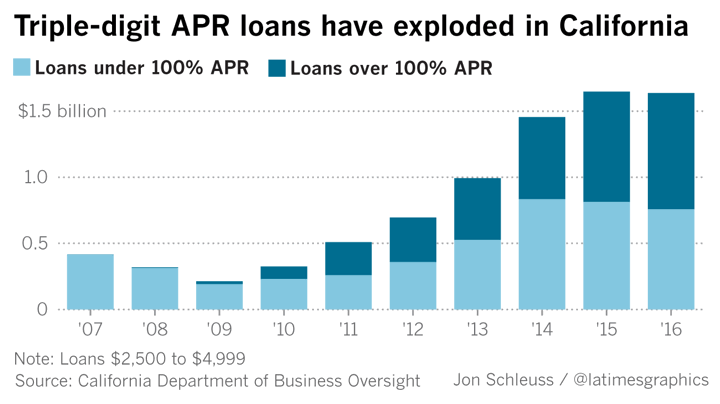
Got bad or no credit? Fintech to the rescue! LendUp, Elevate, and others already provide payday-type loans with 100%+ APRs. Except they aren’t “payday” loans, they are structured as “installment” loans. Instead of just $300, they’ll lend you more money because they lets them escape the payday loan regulations. See the LA Times article Borrow $5,000, repay $42,000 — How super high-interest loans have boomed in California:

They may be new start-ups, but they can still exhibit old-fashioned bad behavior, like promising to help customers build credit but never actually reporting anything to the credit agencies. CFPB Orders LendUp to Pay $3.63 Million for Failing to Deliver Promised Benefits:

“LendUp pitched itself as a consumer-friendly, tech-savvy alternative to traditional payday loans, but it did not pay enough attention to the consumer financial laws,” said CFPB Director Richard Cordray. “The CFPB supports innovation in the fintech space, but start-ups are just like established companies in that they must treat consumers fairly and comply with the law.”

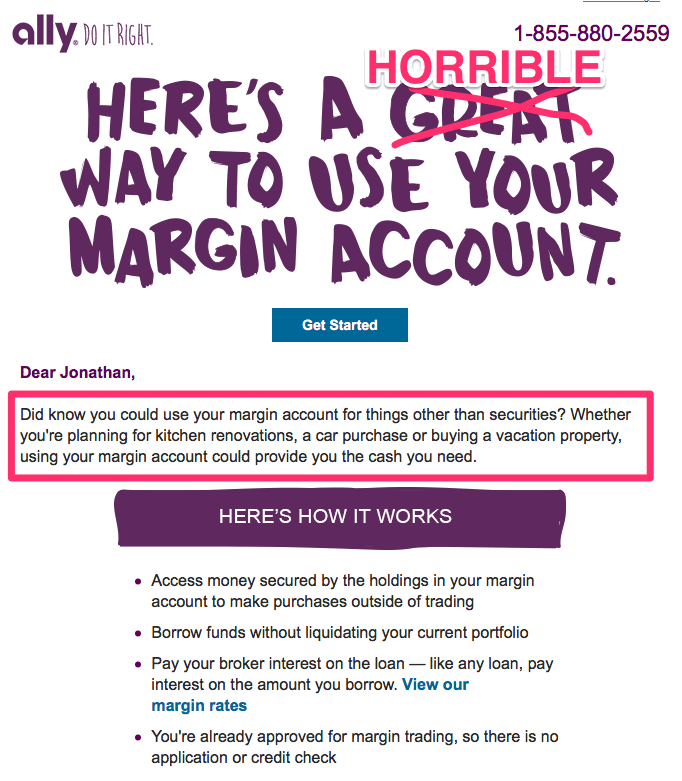
Margin loan for your next iPhone? Right after writing about buying productive assets instead of going into debt, I get this email from Ally Invest:

Margin is something that short-term traders use in order to increase their buying power temporarily. Long-term investors have little to no use for margin since the interest rates will eat up returns. But at least they’d be buying a productive asset if they bought stocks.

Here’s why using margin loans to buy a car or smartphone is a bad idea. First, your interest rate at Ally Invest starts at 9.50% APR and isn’t fixed. So it’s not like you’re getting some awesome rate. 10%-15% APR is as high as credit card interest. Second, this is a collateralized loan backed by your stock holdings. If you don’t pay it back, you don’t just get a ding on your credit score like with a credit card. They sell your stocks and take the money. A home-equity loan is backed by your house, but at least your interest rates are low. Even worse, if the market value of your portfolio drops enough (something not under your control), your broker will issue a margin call. If you don’t pay up immediately, they will forcibly sell your stocks at that low price to pay off your loan.

Bottom line. Fintech may be new, but some things never change. There will always be people selling you things you don’t absolutely need, and now it will be easier than ever to go into debt to buy those things. Be on the lookout for wolves dressed in slick smartphone apps.

Best Interest Rates on Cash – September 2018

This is my monthly roundup of the best interest rates on cash, roughly sorted from shortest to longest maturities. Check out my Ultimate Rate-Chaser Calculator to get an idea of how much additional interest you’d earn if you are moving money between accounts. Rates listed are available to everyone nationwide. Rates checked as of 9/4/18.

High-yield savings accounts
While the huge megabanks like to get away with 0.01% APY, getting higher rates is as easy as transferring some money electronically from your checking account to an online savings account. Keep in mind that the interest rates on savings accounts can drop at any time, so consider prioritizing banks with a history of competitive rates.

  • CIT Bank Money Market offers 1.85% APY with no minimum balance ($100 to open), no max balance cap. Redneck Bank offers 2.00% APY on a maximum balance of $50k. Several other established high-yield savings accounts are in this close range.
  • In terms of newcomers, Customers Bank offers 2.25% APY guaranteed until 6/30/19, but with a minimum balance of $25k+. Northfield Bank has a Platinum Savings Online (not their regular Platinum Savings) at 2.25% APY up to $100k, but there is an $8 monthly fee if under $2,500.
  • My “hub” bank account is the Ally Bank Savings + Checking combo due to their history of competitive rates, 1-day external bank transfers, and overall ease of use. The free overdraft transfers from savings allows to me to keep my checking balance at a minimum. Ally Savings is currently at 1.85% APY. From here, I open “spoke” accounts and CDs to lock in higher rates.

Money market mutual funds + Ultra-short bond ETFs
If you like to keep cash in a brokerage account, you should know that money market and short-term Treasury rates have been rising. The following money market and ultra-short bond funds are not FDIC-insured, but may be a good option if you have idle cash and cheap/free commissions.

  • Vanguard Prime Money Market Fund currently pays an 2.08% SEC yield. The default sweep option is the Vanguard Federal Money Market Fund, which has an SEC yield of 1.93%. You can manually move the money over to Prime if you meet the $3,000 minimum investment.
  • Vanguard Ultra-Short-Term Bond Fund currently pays 2.42% SEC Yield ($3,000 min) and 2.52% SEC Yield ($50,000 min). The average duration is ~1 year.
  • The PIMCO Enhanced Short Maturity Active Bond ETF (MINT) has a 2.42% SEC yield and the iShares Short Maturity Bond ETF (NEAR) has a 2.54% SEC yield while holding a portfolio of investment-grade bonds with an average duration of ~6 months.

Short-term guaranteed rates (1 year and under)
I am often asked what to do with a big wad of cash that you’re waiting to deploy shortly (just sold your house, just sold your business, legal settlement, inheritance). My usual advice is to keep things simple. If not a savings account, then put it in a flexible short-term CD under the FDIC limits until you have a plan.

  • USALLIANCE Financial Credit Union has a 1-year CD at 2.75% APY ($500 minimum new money) with an early withdrawal penalty of 6 months interest. You must join the credit union first, but anyone can join via American Consumer Council (ACC). CIT Bank 1-year CD is at 2.50% APY ($1,000 minimum) with an early withdrawal penalty of 3 months interest.
  • For more flexibility, the Ally Bank 11-month No Penalty CD is at 2.00% APY ($25k minimum) and the CIT Bank 11-Month No-Penalty CD is at 1.85% APY with a lower $1,000 minimum. The lack of early withdrawal penalty means that your interest rate can never go down for 11 months, but you keep full liquidity. You can open multiple CDs in smaller $1,000 increments to get even more flexibility.

US Savings Bonds
Series I Savings Bonds offer rates that are linked to inflation and backed by the US government. You must hold them for at least a year. There are annual purchase limits. If you redeem them within 5 years there is a penalty of the last 3 months of interest.

  • “I Bonds” bought between May 2018 and October 2018 will earn a 2.52% rate for the first six months. The rate of the subsequent 6-month period will be based on inflation again. More info here.
  • In mid-October 2018, the CPI will be announced and you will have a short period where you will have a very close estimate of the rate for the next 12 months. I will have another post up at that time.

Prepaid Cards with Attached Savings Accounts
A small subset of prepaid debit cards have an “attached” FDIC-insured savings account with exceptionally high interest rates. The negatives are that balances are capped, and there are many fees that you must be careful to avoid (lest they eat up your interest). Some folks don’t mind the extra work and attention required, while others do. There is a long list of previous offers that have already disappeared with little notice.

  • The only notable card left in this category is Mango Money at 6% APY on up to $5,000, but there are many hoops to jump through. There is a $3 monthly fee and you need to maintain a minimum $800 net direct deposit each month. This means you can’t direct deposit $800 and also take out $800 via online transfer. Checks and ATM withdrawals have additional fees. The only thing left is to spend the money via the Visa debit feature (and miss out on flat 2% cash back on all purchases).

Rewards checking accounts
These unique checking accounts pay above-average interest rates, but with unique risks. You have to jump through certain hoops, and if you make a mistake you won’t earn any interest for that month. Some folks don’t mind the extra work and attention required, while others do. Rates can also drop to near-zero quickly, leaving a “bait-and-switch” feeling. That’s just how it goes with these types of accounts.

  • Consumers Credit Union recently announced changes starting 10/1/18, including lower balance limits ($10k down from $20k) and more restrictive requirements, but also higher interest rates in some tiers. Free Rewards Checking now offers 3.09% to 5.09% APY on up to a $10k balance depending on your qualifying activity. The highest tier requires their credit card in addition to their debit card (other credit cards offer $500+ in sign-up bonuses). Keep your 12 debit purchases just above the $100 requirement, as for every $500 in monthly purchases you may be losing out on 2% cash back elsewhere (or $10 a month after-tax). Thanks to reader Jonathan for the heads up. Find a local rewards checking account at DepositAccounts.

Certificates of deposit (greater than 1 year)
You might have larger balances, either because you are using CDs instead of bonds or you simply want a large cash reserves. By finding a bank CD with a reasonable early withdrawal penalty, you can enjoy higher rates but maintain access in a true emergency. Alternatively, consider building a CD ladder of different maturity lengths such that you have access to part of the ladder each year, but your blended interest rate is higher than a savings account.

  • Synchrony Bank has a special 13-month CD at 2.65% APY ($2,000 min). Note that the early withdrawal penalty is relatively big at 6 months of interest. NASA Federal Credit Union has a special 15-month Share Certificate at 3.25% APY ($5,000 min, EWP 6 months). Anyone can join this credit union by joining the National Space Society (free). However, NASA FCU will perform a hard credit check as part of new member application.
  • Ally Bank has a 5-year CD at 3.00% APY ($25k minimum) with a relatively short 150-day early withdrawal penalty. For example, if you closed this CD after 2 years you’d still get a 2.39% effective APY even after accounting for the penalty. (2.61% at 3 years.)
  • United States Senate Federal Credit Union has a 5-year Share Certificate at 3.53% APY ($60k min), 3.47% APY ($20k min), or 3.41% APY ($1k min). Note that the early withdrawal penalty is a full year of interest. Anyone can join this credit union via American Consumer Council.
  • You can buy certificates of deposit via the bond desks of Vanguard and Fidelity. These “brokered CDs” offer FDIC insurance, but they don’t come with predictable fixed early withdrawal penalties. As of this writing, Vanguard is showing a 3-year non-callable CD at 3.00% APY and a 5-year non-callable CD at 3.35% APY. Watch out for higher rates from callable CDs listed by Fidelity.

Longer-term Instruments
I’d use these with caution due to increased interest rate risk, but I still track them to see the rest of the current yield curve.

  • Willing to lock up your money for 10+ years? You can buy long-term certificates of deposit via the bond desks of Vanguard and Fidelity. These “brokered CDs” offer FDIC insurance, but they don’t come with predictable fixed early withdrawal penalties. As of this writing, Vanguard is showing a 10-year non-callable CD at 3.45% APY. Watch out for higher rates from callable CDs from Fidelity. Matching the overall yield curve, current CD rates do not rise much higher as you extend beyond a 5-year maturity.
  • How about two decades? Series EE Savings Bonds are not indexed to inflation, but they have a guarantee that the value will double in value in 20 years, which equals a guaranteed return of 3.5% a year. However, if you don’t hold for that long, you’ll be stuck with the normal rate which is quite low (currently a sad 0.10% rate). I view this as a huge early withdrawal penalty. You could also view it as long-term bond and thus a hedge against deflation, but only if you can hold on for 20 years.

All rates were checked as of 9/4/18.

Warren Buffett on Reaching Stock Market Highs

Warren Buffett had his annual charity lunch today and was on CNBC for a short interview. As usual, he was asked about the current stock market situations and, as usual, he managed to sum everything up in a few folksy sentences. Here’s a direct quote from the full CNBC interview:

If you had your choice between buying and holding a 30-year bond for 30 years or holding a basket of American stocks, there’s just no question, you’re going to do better owning stocks. It’s more attractive than, considerably more attractive than fixed income securities. That doesn’t meant they’re going to go up or down tomorrow, next week, or next year, but over time, a bunch of businesses that are earning high returns on capital are going to beat a bond that’s fixed at roughly 3% or 30 years. And it’s not my field of specialty, but actually they look, stock generally (American businesses), they look cheaper than, generally, real estate.

[…] That’s what you have to do in investing. I mean, you’re sitting with some cash in your pocket. You have savings, and the question is what do you do with it? You can buy a duplex next door and rent it out to people and do fine over time or buy a small piece of farmland or something of the sort or you can put it into something fixed income, bonds, or bank deposits, or whatever it may be.

My interpretation is that you have invest your money somewhere, and if you have a 30-year time horizon and you don’t plan on timing the market in and out, then stocks are still your best bet. Over the long haul, stocks will still outperform bonds and cash (at current interest rates), and he thinks real estate as well right now. Timing the market is too hard to do. Predicting returns over the next 5 years is too hard to do. If you don’t have a long enough time horizon or can’t handle the swings, you shouldn’t be in stocks.

Long-term stock investors just have to take some lumps if prices drop for a while. Keep enough money in bonds and cash so you don’t panic and have money to spend in the meantime.

[I actually have an issue with the CNBC caption “Buffett: Stocks always more attractive than bonds”. He never said that. He specifically noted that the 30-year bond was paying 3%. In the past (1970s?), Buffett has invested in Treasury bonds when the rates were really high and the stock market was overvalued. If today’s rates were 8% instead of 3%, Mr. Buffett would be rational enough to adjust his opinion.]

Reasons To Own Series I Savings Bonds

sb_posterSeries I Savings Bonds (aka “I Bonds”) are a unique investment sold directly to individuals by the US Treasury that pay out a variable interest rate linked to inflation. This post collects general reasons to own these savings bonds without going into the internal details of how they work. Please also see my related post Reasons To Own TIPS, Treasury Inflation-Protected Securities.

Backed by the US government and will never decrease in nominal value. If you buy an I Bond for $1,000, you’ll never get less than $1,000 back. Sometimes it’s nice to know that something will only go up in numerical value.

Pays interest that is the sum of a fixed rate and an inflation-linked rate. The fixed rate is set at purchase. The inflation-linked rate is reset every 6 months based on a preset formula tracking the CPI-U (Consumer Price Index for All Urban Consumers). This is unique and would come in helpful in times of unexpectedly higher inflation. I write about the upcoming I bond rate changes every 6 months as well.

Sold directly by US Treasury with no fees. You must either buy them directly online at TreasuryDirect.gov or via paper bonds via tax return. There are no purchase fees or annual maintenance fees.

Interest from I-Bonds are exempt from state and/or local income taxes. Same as with US Treasury bonds and TIPS.

Federal income tax on interest is not due until redemption. This means that you can defer paying taxes on accrued interest for up to 30 years. You don’t owe taxes until you cash out. This also means that you can time your eventual withdrawal during a year where you have the lowest tax rate (i.e. when your income drops after retirement).

Possible tax-free interest when used for qualified educational expenses. If you meet all the requirements, you can even avoid federal income taxes completely when paying qualified higher education expenses at an eligible institution. These include income phase-out limits.More information at this TreasuryDirect page. You can even contribute your proceeds to a 529 plan or Coverdell Educational Savings Account. Here are some tips from Finaid.org.

Series EE and I US Savings Bonds issued after December 31, 1989 may be redeemed tax-free in order to contribute the proceeds to a section 529 plan or Coverdell Education Savings Account. (To take advantage of this, file IRS Form 8815 to claim an exclusion for the interest after rolling the proceeds of these US Savings Bonds into a section 529 college savings plan or Coverdell Education Savings account. Write “529 College Savings Plan” or “Coverdell Education Savings Account” in the answer to 1(b), where it asks for the name of the educational institution. The specific citation in the tax code for this guidance is IRC Section 135(c)((2)(C).)

Reasons for NOT owning I Bonds.

  • There are purchase limits for I Bonds of $10,000 per person per year in electronic format. You can also buy an additional $5,000 in paper bonds per year using your tax refund with IRS Form 8888. If you have children, you may be able to buy additional savings bonds by using a minor’s Social Security Number.
  • The fixed rate has been low in recent years. Here, the inflation-linking may help you get an interest rate slightly above inflation, but after taxes, your net return may still lag inflation. For example if the fixed rate was zero and inflation was 2%, you would probably get less than a 2% return after taxes.
  • As with interest earned from bank accounts and taxable bonds, interest is eventually taxed at ordinary income rates. Long-term capital gains and dividends from stocks are usually taxed at lower rate.
  • You can’t redeem your savings bonds at all during the first 12 months. I believe there is a small exception if you can show yourself to be affected by an official natural disaster.
  • If you redeem within the first 5 years, you will be subject to an early redemption penalty of your last 3 months of interest.
  • TIPS are analyzed more deeply by financial professionals, and have not been found to lie on the “efficient frontier” curve. Thus, it is also unlikely that I bonds will optimal in that way.
  • You may not want to open and track a separate Treasury Direct account just to hold your I Bonds.
  • If you lose your online login and password to TreasuryDirect.gov and someone jumps through all the hoops necessary to steal your electronic I bonds, then the US Treasury will not reimburse you. If you lose paper bonds, there is a replacement policy.

TIPS vs. I Bonds.
Both have interest that both linked to inflation and is exempt from state/local taxes. You should compare the fixed rate from I Bonds with the current real rate in the TIPS market. Things that might make I Bonds more attractive than TIPS include the tax-deferral ability and the ability to avoid taxes when spent on qualified educational expenses. Things that might makes TIPS more attractive are the intra-day liquidity at all times and the ability to buy unlimited amounts via your choice of broker.

I own both TIPS and I Bonds in my personal portfolio. Inflation-protected bonds are part of my chosen asset allocation, and I prefer to use a lot of my tax-deferred account space for REITs. Series I Bonds allow me to own inflation-linked bonds in effectively a tax-deferred manner. I may also be able to use the interest tax-free for educational expenses as I have three young kids with 12-16 years to go before college.

Best Interest Rates on Cash – August 2018

Here is my monthly roundup of the best safe rates available, roughly sorted from shortest to longest maturities. Check out my Ultimate Rate-Chaser Calculator to get an idea of how much additional interest you’d earn if you are moving money between accounts. Rates listed are available to everyone nationwide. Rates checked as of 8/4/18.

High-yield savings accounts
While the huge brick-and-mortar banks like to get away with 0.01% APY, there are a number of online savings accounts offering much higher rates. Keep in mind that with savings accounts, the interest rates can change at any time.

  • CIT Bank Money Market offers 1.85% APY with no minimum balance ($100 to open) and no max balance cap. Several others have similar rates (see interactive tool below). Customers Bank offers 2.25% APY guaranteed until 6/30/19, but with a minimum balance of $25k+. On the flip side, Redneck Bank offers 2.00% APY but on a maximum balance of $50k.
  • My “hub” bank account is the Ally Bank Savings + Checking combo due to their history of competitive savings/CD rates, 1-day external bank transfers, and overall user experience. The free overdraft transfers from savings allows to me to keep my checking balance at a minimum. Ally Savings is currently at 1.80% APY. From here, I open “spoke” accounts and CDs to lock in higher rates.

Money market mutual funds + Ultra-short bond ETFs
If you like to keep cash in a brokerage account, you should know that money market and short-term Treasury rates have been rising. The following money market and ultra-short bond funds are not FDIC-insured, but may be a good option if you have idle cash and cheap/free commissions.

  • Vanguard Prime Money Market Fund currently pays an 2.06% SEC yield. The default sweep option is the Vanguard Federal Money Market Fund, which has an SEC yield of 1.87%. You can manually move the money over to Prime if you meet the $3,000 minimum investment.
  • Vanguard Ultra-Short-Term Bond Fund currently pays 2.44% SEC Yield ($3,000 min) and 2.54% SEC Yield ($50,000 min). The average duration is ~1 year.
  • The PIMCO Enhanced Short Maturity Active Bond ETF (MINT) has a 2.45% SEC yield and the iShares Short Maturity Bond ETF (NEAR) has a 2.47% SEC yield while holding a portfolio of investment-grade bonds with an average duration of ~6 months.

Short-term guaranteed rates (1 year and under)
I am often asked what to do with a big wad of cash that you’re waiting to deploy shortly (just sold your house, just sold your business, legal settlement, inheritance). My usual advice is to keep things simple. If not a savings account, then put it in a flexible short-term CD under the FDIC limits until you have a plan.

  • United Texas Bank has a 1-year CD at 2.80% APY. CIT Bank 1-year CD is at 2.50% APY ($1,000 minimum). Early withdrawal penalty is 3-months of interest. For more flexibility, the Ally Bank 11-month No Penalty CD is at 2.00% APY ($25k minimum) and the CIT Bank 11-Month No-Penalty CD is at 1.85% APY with a lower $1,000 minimum. The lack of early withdrawal penalty means that your interest rate can never go down for 11 months, but you keep full liquidity. You can open multiple CDs in smaller $1,000 increments to get even more flexibility.
  • Several other banks now have 12-month CDs at 2% APY and above. Watch the early withdrawal penalties. For example, Synchrony Bank has a 2.45% APY 12-month CD, but the early withdrawal penalty is 90 days of interest. Meanwhile, Ally Bank has a 12-month CD at 2.40% APY with $25k+ deposit (2.25% APY for $5k+) and early withdrawal penalty of 60 days interest.

US Savings Bonds
Series I Savings Bonds offer rates that are linked to inflation and backed by the US government. You must hold them for at least a year. There are annual purchase limits. If you redeem them within 5 years there is a penalty of the last 3 months of interest.

  • “I Bonds” bought between May 2018 and October 2018 will earn a 2.52% rate for the first six months. The rate of the subsequent 6-month period will be based on inflation again. More info here.
  • In mid-October 2018, the CPI will be announced and you will have a short period where you will have a very close estimate of the rate for the next 12 months. I will have another post up at that time.

Prepaid Cards with Attached Savings Accounts
A small subset of prepaid debit cards have an “attached” FDIC-insured savings account with exceptionally high interest rates. The negatives are that balances are capped, and there are many fees that you must be careful to avoid (lest they eat up your interest). Some folks don’t mind the extra work and attention required, while others do. There is a long list of previous offers that have already disappeared with little notice.

  • The only notable card left in this category is Mango Money at 6% APY on up to $5,000, but there are many hoops to jump through. There is a $3 monthly fee and you need to maintain a minimum $800 net direct deposit each month. This means you can’t direct deposit $800 and also take out $800 via online transfer. Checks and ATM withdrawals have additional fees. The only thing left is to spend the money via the Visa debit feature (and miss out on 2% or similar credit card rewards).

Rewards checking accounts
These unique checking accounts pay above-average interest rates, but with unique risks. You have to jump through certain hoops, and if you make a mistake you won’t earn any interest for that month. Some folks don’t mind the extra work and attention required, while others do. Rates can also drop to near-zero quickly, leaving a “bait-and-switch” feeling. That’s just how it goes with these types of accounts.

  • Consumers Credit Union offers up to 4.59% APY on up to a $20k balance, although getting 3.09% APY on a $10k balance has a much shorter list of requirements. The 4.59% APY requires you to apply for a credit card through them (other credit cards offer $500+ in sign-up bonuses). Keep your 12 debit purchases small as well, as for every $500 in monthly purchases you may be losing out on 2% cashback (or $10 a month after-tax). Find a local rewards checking account at DepositAccounts.

Certificates of deposit (greater than 1 year)
You might have larger balances, either because you are using CDs instead of bonds or you simply want a large cash reserves. By finding a bank CD with a reasonable early withdrawal penalty, you can enjoy higher rates but maintain access in a true emergency. Alternatively, consider building a CD ladder of different maturity lengths such that you have access to part of the ladder each year, but your blended interest rate is higher than a savings account.

  • Ally Bank has a 5-year CD at 3.00% APY ($25k minimum) with a relatively short 150-day early withdrawal penalty. For example, if you closed this CD after 2 years you’d still get a 2.39% effective APY even after accounting for the penalty. (2.61% at 3 years.)
  • Connexus Credit Union is offering a 1-year Share Certificate at 2.50% APY (90-day early withdrawal penalty), a 3-year Share Certificate (180-day early withdrawal penalty) at 2.75% APY, and a 5-year Share Certificate (365-day early withdrawal penalty) at 3.25% APY. All have a $5,000 minimum deposit. Anyone can join this credit union via partner organization Connexus Association for a one-time $5 fee.
  • You can buy certificates of deposit via the bond desks of Vanguard and Fidelity. These “brokered CDs” offer FDIC insurance, but they don’t come with predictable fixed early withdrawal penalties. As of this writing, Vanguard is showing a 3-year non-callable CD at 3.00% APY and a 5-year non-callable CD at 3.30% APY from a few banks including American Express and Citibank. Watch out for higher rates from callable CDs listed by Fidelity.

Longer-term Instruments
I’d use these with caution due to increased interest rate risk, but I still track them to see the rest of the current yield curve.

  • Willing to lock up your money for 10+ years? You can buy long-term certificates of deposit via the bond desks of Vanguard and Fidelity. These “brokered CDs” offer FDIC insurance, but they don’t come with predictable fixed early withdrawal penalties. As of this writing, Vanguard is showing a 10-year non-callable CD at 3.45% APY. Watch out for higher rates from callable CDs from Fidelity. Matching the overall yield curve, current CD rates do not rise much higher as you extend beyond a 5-year maturity.
  • How about two decades? Series EE Savings Bonds are not indexed to inflation, but they have a guarantee that the value will double in value in 20 years, which equals a guaranteed return of 3.5% a year. However, if you don’t hold for that long, you’ll be stuck with the normal rate which is quite low (currently a sad 0.10% rate). I view this as a huge early withdrawal penalty. You could also view it as long-term bond and thus a hedge against deflation, but only if you can hold on for 20 years.

All rates were checked as of 8/4/18.

Interactive rate table. Above, I work to curate only the banks with top nationwide rates. I don’t include every bank. Below is an interactive widget that lets you filter by account type (savings, CD term) and deposit amount. I don’t control the results, but it can be useful for comparison purposes to see other competitive rates. Disclosure: If you end up opening a new account using this widget, I may receive a commission.


Best Interest Rates on Cash – July 2018

Here is my monthly roundup of the best safe rates available, roughly sorted from shortest to longest maturities. Check out my Ultimate Rate-Chaser Calculator to get an idea of how much additional interest you’d earn if you are moving money between accounts. Rates listed are available to everyone nationwide. Rates checked as of 7/4/18.

High-yield savings accounts
While the huge brick-and-mortar banks like to get away with 0.01% APY, there are a number of online savings accounts offering much higher rates. Keep in mind that with savings accounts, the interest rates can change at any time.

  • CIT Bank Money Market offers 1.85% APY with no minimum balance ($100 to open). Purepoint Financial offers 1.90% APY, but requires a $10k+ balance. Northpointe Bank is at 2.05% APY, but requires a $25k+ balance. On the flip side, Redneck Bank offers 2% APY but on a maximum balance of $50k.
  • My “hub” bank account is the Ally Bank Savings + Checking combo due to their history of competitive savings/CD rates, 1-day external bank transfers, and overall user experience. The free overdraft transfers from savings allows to me to keep my checking balance at a minimum. Ally Savings is currently at 1.75% APY. I then open other “spoke” accounts and CDs to lock in higher rates.

Money market mutual funds + Ultra-short bond ETFs
If you like to keep cash in a brokerage account, you should know that money market and short-term Treasury rates have been rising. The following money market and ultra-short bond funds are not FDIC-insured, but may be a good option if you have idle cash and cheap/free commissions.

  • Vanguard Prime Money Market Fund currently pays an 2.04% SEC yield. The default sweep option is the Vanguard Federal Money Market Fund, which has an SEC yield of 1.83%. You can manually move the money over to Prime if you meet the $3,000 minimum investment.
  • Vanguard Ultra-Short-Term Bond Fund currently pays 2.39% SEC Yield ($3,000 min) and 2.49% SEC Yield ($50,000 min). The average duration is ~1 year.
  • The PIMCO Enhanced Short Maturity Active Bond ETF (MINT) has a 2.44% SEC yield and the iShares Short Maturity Bond ETF (NEAR) has a 2.47% SEC yield while holding a portfolio of investment-grade bonds with an average duration of ~6 months.

Short-term guaranteed rates (1 year and under)
I am often asked what to do with a big wad of cash that you’re waiting to deploy shortly (just sold your house, just sold your business, legal settlement, inheritance). My usual advice is to keep things simple. If not a savings account, then put it in a flexible short-term CD under the FDIC limits until you have a plan.

  • CIT Bank 1-year CD is now at 2.50% APY. Early withdrawal penalty is 3-months of interest. Alternatively, the CIT Bank 11-Month No-Penalty CD at 1.85% APY with a $1,000 minimum deposit and no withdrawal penalty seven days or later after funds have been received. The lack of early withdrawal penalty means that your interest rate can never go down for 11 months, but you keep full liquidity. Full review. You can open multiple CDs in $1,000 increments if you want more flexibility.
  • Several other banks now have 12-month CDs at 2% APY and above. Watch the early withdrawal penalties. For example, Synchrony Bank has a 2.45% APY 14-month CD, but the early withdrawal penalty is 180 days of interest. Meanwhile, Ally Bank has a 12-month CD at 2.30% APY with $25k+ deposit (2.20% APY for $5k+) and early withdrawal penalty of 60 days interest.

US Savings Bonds
Series I Savings Bonds offer rates that are linked to inflation and backed by the US government. You must hold them for at least a year. There are annual purchase limits. If you redeem them within 5 years there is a penalty of the last 3 months of interest.

  • “I Bonds” bought between May 2018 and October 2018 will earn a 2.52% rate for the first six months. The rate of the subsequent 6-month period will be based on inflation again. More info here.
  • In mid-October 2018, the CPI will be announced and you will have a short period where you will have a very close estimate of the rate for the next 12 months. I will have another post up at that time.

Prepaid Cards with Attached Savings Accounts
A small subset of prepaid debit cards have an “attached” FDIC-insured savings account with exceptionally high interest rates. The negatives are that balances are capped, and there are many fees that you must be careful to avoid (lest they eat up your interest). The offers also tend to disappear with little notice. Some folks don’t mind the extra work and attention required, while others do. The Insight Card used to offer 5% APY on up to $5,000, but as of July 2018 is completely shut down.

  • The only notable card left in this category is Mango Money at 6% APY on up to $5,000, but there are many hoops to jump through. There is a $3 monthly fee and you need to maintain a minimum $800 net direct deposit each month. This means you can’t direct deposit $800 and also take out $800 via online transfer. Checks and ATM withdrawals have additional fees. The only thing left is to spend the money via the Visa debit feature (and miss out on 2% or similar credit card rewards).

Rewards checking accounts
These unique checking accounts pay above-average interest rates, but with unique risks. You have to jump through certain hoops, and if you make a mistake you won’t earn any interest for that month. Some folks don’t mind the extra work and attention required, while others do. Rates can also drop to near-zero quickly, leaving a “bait-and-switch” feeling. That’s just how it goes with these types of accounts.

  • Consumers Credit Union offers up to 4.59% APY on up to a $20k balance, although getting 3.09% APY on a $10k balance has a much shorter list of requirements. The 4.59% APY requires you to apply for a credit card through them (other credit cards offer $500+ in sign-up bonuses). Keep your 12 debit purchases small as well, as for every $500 in monthly purchases you may be losing out on 2% cashback (or $10 a month after-tax). Find a local rewards checking account at DepositAccounts.

Certificates of deposit (greater than 1 year)
You might have larger balances, either because you are using CDs instead of bonds or you simply want a large cash reserves. By finding a bank CD with a reasonable early withdrawal penalty, you can enjoy higher rates but maintain access in a true emergency. Alternatively, consider a custom CD ladder of different maturity lengths such that you have access to part of the ladder each year, but your blended interest rate is higher than a savings account.

  • Connexus Credit Union is offering a 1-year Share Certificate at 2.50% APY (90-day early withdrawal penalty), a 3-year Share Certificate (180-day early withdrawal penalty) at 2.75% APY, and a 5-year Share Certificate (365-day early withdrawal penalty) at 3.25% APY. All have a $5,000 minimum deposit. Anyone can join this credit union via partner organization Connexus Association for a one-time $5 fee.
  • You can buy certificates of deposit via the bond desks of Vanguard and Fidelity. These “brokered CDs” offer FDIC insurance, but they don’t come with predictable fixed early withdrawal penalties. As of this writing, Vanguard is showing a 3-year non-callable CD at 3.00% APY and a 5-year non-callable CD at 3.30% APY from a few banks including American Express and Citibank. Watch out for higher rates from callable CDs listed by Fidelity.

Longer-term Instruments
I’d use these with caution due to increased interest rate risk, but I still track them to see the rest of the current yield curve.

  • Willing to lock up your money for 10+ years? You can buy long-term certificates of deposit via the bond desks of Vanguard and Fidelity. These “brokered CDs” offer FDIC insurance, but they don’t come with predictable fixed early withdrawal penalties. As of this writing, Vanguard is showing a 10-year non-callable CD at 3.40% APY. Watch out for higher rates from callable CDs from Fidelity. Matching the overall yield curve, current CD rates do not rise much higher as you extend beyond a 5-year maturity.
  • How about two decades? Series EE Savings Bonds are not indexed to inflation, but they have a guarantee that the value will double in value in 20 years, which equals a guaranteed return of 3.5% a year. However, if you don’t hold for that long, you’ll be stuck with the normal rate which is quite low (currently a sad 0.10% rate). I view this as a huge early withdrawal penalty. You could also view it as long-term bond and thus a hedge against deflation, but only if you can hold on for 20 years.

All rates were checked as of 7/4/18.


CIT Bank No-Penalty CD

Best Interest Rates on Cash – June 2018

Here is my monthly roundup of the best safe rates available, roughly sorted from shortest to longest maturities. Check out my Ultimate Rate-Chaser Calculator to get an idea of how much additional interest you’d earn if you are moving money between accounts. Rates listed are available to everyone nationwide. Rates checked as of 6/3/18.

High-yield savings accounts
While the huge brick-and-mortar banks rarely offer good yields, there are a number of online savings accounts offering much higher rates. Keep in mind that with savings accounts, the interest rates can change at any time.

  • VirtualBank has a special rate of 2.01% APY (guaranteed for first year) for new money ($100 min to open). After the first year, it goes back to the “normal” rate (currently 0.80% APY). CIT Bank Money Market recently raised to 1.85% APY (no min, $100 to open).
  • My “hub” bank account is the Ally Bank Savings + Checking combo due to their history of competitive savings/CD rates, 1-day external bank transfers, and overall user experience. The free overdraft transfers from savings allows to me to keep my checking balance at a minimum. Ally Savings is no longer at the very top anymore, with a current rate of 1.60% APY. I’ve moved some money into 12-month CDs, right now they have a 12-month CD at 2.25% APY ($25k min).

Money market mutual funds + Ultra-short bond ETFs
If you like to keep cash in a brokerage account, you should know that money market and short-term Treasury rates have been rising. The following money market and ultra-short bond funds are not FDIC-insured, but may be a good option if you have idle cash and cheap/free commissions.

  • Vanguard Prime Money Market Fund currently pays an 1.91% SEC yield. The default sweep option is the Vanguard Federal Money Market Fund, which has an SEC yield of 1.72%. You can manually move the money over to Prime if you meet the $3,000 minimum investment.
  • Vanguard Ultra-Short-Term Bond Fund currently pays 2.32% SEC Yield ($3,000 min) and 2.42% SEC Yield ($50,000 min). The average duration is ~1 year.
  • The PIMCO Enhanced Short Maturity Active Bond ETF (MINT) has a 2.3% SEC yield and the iShares Short Maturity Bond ETF (NEAR) has a 2.32% SEC yield while holding a portfolio of investment-grade bonds with an average duration of ~6 months.

Short-term guaranteed rates (1 year and under)
I am often asked what to do with a big wad of cash that you’re waiting to deploy shortly (just sold your house, just sold your business, legal settlement, inheritance). My usual advice is to keep things simple. If not a savings account, then put it in a flexible short-term CD under the FDIC limits until you have a plan.

  • As noted above, VirtualBank has a 1-year guarantee at 2.01% APY on their eMoney Market, where you can take out money at any time. Another alternative is the CIT Bank 11-Month No-Penalty CD at 1.85% APY with a $1,000 minimum deposit and no withdrawal penalty seven days or later after funds have been received. The lack of early withdrawal penalty means that your interest rate can never go down for 11 months, but you keep full liquidity. Full review. You can open multiple CDs in smaller increments if you want more flexibility.
  • Connexus Credit Union is offering a 1-year Share Certificate at 2.50% APY (90-day early withdrawal penalty) and a 3-year Share Certificate (180-day early withdrawal penalty) at 2.75% APY. Both have a $5,000 minimum deposit. Anyone can join this credit union via partner organization Connexus Association for a one-time $5 fee.
  • Several other banks have 12-month CDs at 2% APY and above. Watch the early withdrawal penalties. For example, Synchrony Bank has a 2.35% APY 14-month CD, but the early withdrawal penalty is 180 days of interest. Meanwhile, Ally Bank has a 9-month CD at 2% APY and a 12-month CD at 2.25 APY with $25,000 minimum deposit and early withdrawal penalty of 60 days interest.

US Savings Bonds
Series I Savings Bonds offer rates that are linked to inflation and backed by the US government. You must hold them for at least a year. There are annual purchase limits. If you redeem them within 5 years there is a penalty of the last 3 months of interest.

  • “I Bonds” bought between May 2018 and October 2018 will earn a 2.52% rate for the first six months. The rate of the subsequent 6-month period will be based on inflation again. More info here.
  • In mid-October 2018, the CPI will be announced and you will have a short period where you will have a very close estimate of the rate for the next 12 months. I will have another post up at that time.

Prepaid Cards with Attached Savings Accounts
A small subset of prepaid debit cards have an “attached” FDIC-insured savings account with exceptionally high interest rates. The negatives are that balances are capped, and there are many fees that you must be careful to avoid (lest they eat up your interest). The offers also tend to disappear with little notice. Some folks don’t mind the extra work and attention required, while others do.

  • The Insight Card used to offer 5% APY on up to $5,000, but as of June 2018 is no longer accepting new accounts. Current cardholders will cease earning 5% APY at the end of June. The only notable card left in this category is Mango Money at 6% APY on up to $5,000, but there are so many hoops and restrictions that in my opinion make it not worth the troubl (especially when it likely won’t last much longer either).

Rewards checking accounts
These unique checking accounts pay above-average interest rates, but with unique risks. You have to jump through certain hoops, and if you make a mistake you won’t earn any interest for that month. Some folks don’t mind the extra work and attention required, while others do. Rates can also drop quickly, leaving a “bait-and-switch” feeling. For example, Northpointe Bank was mentioned for several months here but later dropped to 1% APY. That’s just how it goes with these types of accounts.

  • Consumers Credit Union offers up to 4.59% APY on up to a $20k balance, although getting 3.09% APY on a $10k balance has a much shorter list of requirements. The 4.59% APY requires you to apply for a credit card through them (other credit cards offer $500+ in sign-up bonuses). Keep your 12 debit purchases small as well, as for every $500 in monthly purchases you may be losing out on 2% cashback (or $10 a month after-tax). Find a local rewards checking account at DepositAccounts.

Certificates of deposit (greater than 1 year)
You might have larger balances, either because you are using CDs instead of bonds or you simply want a large cash reserves. By finding a bank CD with a reasonable early withdrawal penalty, you can enjoy higher rates but maintain access in a true emergency. Alternatively, consider a custom CD ladder of different maturity lengths such that you have access to part of the ladder each year, but your blended interest rate is higher than a savings account.

  • Connexus Credit Union is offering a 1-year Share Certificate at 2.50% APY (90-day early withdrawal penalty), a 3-year Share Certificate (180-day early withdrawal penalty) at 2.75% APY, and a 5-year Share Certificate (365-day early withdrawal penalty) at 3.25% APY. All have a $5,000 minimum deposit. Anyone can join this credit union via partner organization Connexus Association for a one-time $5 fee.
  • You can buy certificates of deposit via the bond desks of Vanguard and Fidelity. These “brokered CDs” offer FDIC insurance, but they don’t come with predictable fixed early withdrawal penalties. As of this writing, Vanguard and Fidelity are showing a 3-year non-callable CD at 3.00% APY and a 5-year non-callable CD at 3.25% APYfrom a few banks including Goldman Sachs and Wells Fargo. Watch out for higher rates from callable CDs listed by Fidelity.
  • Ally Bank has a 5-year CD at 2.60% APY ($25k minimum) with a relatively short 150-day early withdrawal penalty. For example, if you closed this CD after 2 years you’d get a 2.07% effective APY after accounting for the penalty.

Longer-term Instruments
I’d use these with caution due to increased interest rate risk, but I still track them to see the rest of the current yield curve.

  • Willing to lock up your money for 10+ years? You can buy certificates of deposit via the bond desks of Vanguard and Fidelity. These “brokered CDs” offer FDIC insurance, but they don’t come with predictable fixed early withdrawal penalties. As of this writing, Vanguard is showing a 10-year non-callable CD at 3.40% APY (Watch out for higher rates from callable CDs from Fidelity.) Unfortunately, current CD rates do not rise much higher even as you extend beyond a 5-year maturity.
  • How about two decades? Series EE Savings Bonds are not indexed to inflation, but they have a guarantee that the value will double in value in 20 years, which equals a guaranteed return of 3.5% a year. However, if you don’t hold for that long, you’ll be stuck with the normal rate which is quite low (currently a sad 0.10% rate). I view this as a huge early withdrawal penalty. You could also view it as long-term bond and thus a hedge against deflation, but only if you can hold on for 20 years.

All rates were checked as of 6/3/18.


CIT Bank No-Penalty CD