 T. Rowe Price has an article Evaluating Roth and Pretax Retirement Savings Options by Roger Young that covers the basics on the choice between a “Traditional” pretax or Roth IRA or 401k account:
The primary factor to consider is whether your marginal tax rate will be higher or lower during retirement. If your tax rate will be higher later, paying taxes now with the Roth makes sense. If your tax rate will be lower, you want to defer taxes until then by using the pretax approach.
With the Traditional pretax, you get to avoid paying income taxes on the contribution now, but you must pay taxes up on withdrawal. With the Roth, you pay income taxes now, but you don’t own any taxes upon withdrawal. However, I am linking to it because it also includes a table with some sample worker profiles. This may help clarify things for people who are still confused about which to pick.
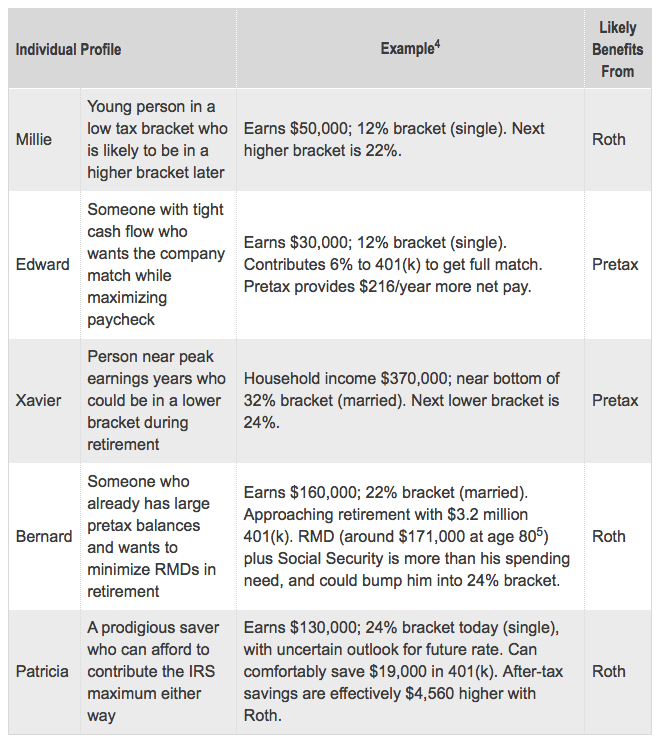
There are other considerations due to our overly-complex tax code, but I think this is still a helpful tool.

 One of the newer work perks that we took advantage of this year was the Dependent Care Flexible Spending Account (DCFSA). This is separate from the Health Care Flexible Spending Account (HCFSA) and the Health Savings Account (HSA). However, they do work in a similar way in that you can pay for eligible expenses with pre-tax money and thus save money by being exempt from income taxes on that amount. For example, we were able to pay for $5,000 in preschool expenses using your DCFSA in 2018. At a a 30% marginal total tax rate (see below), that was a $1,500 savings.
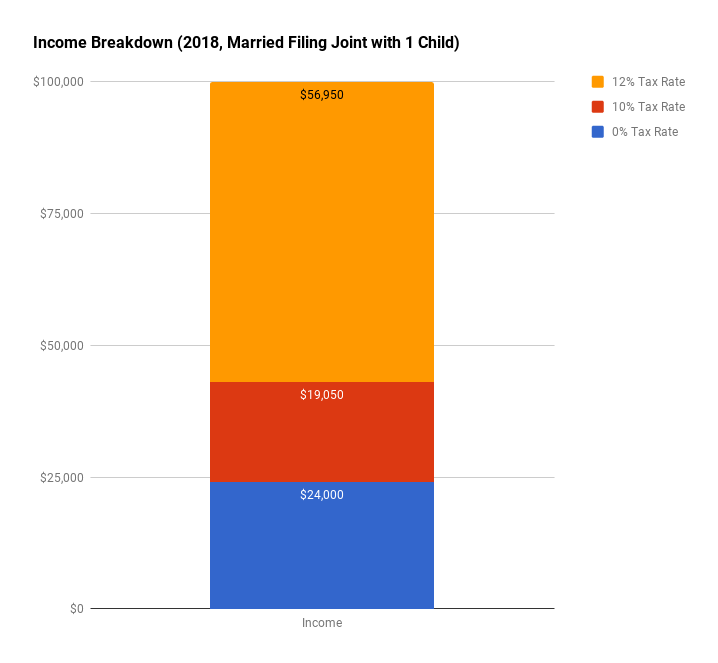
  The Tax Cuts and Jobs Act (TCJA) changed up the personal income tax brackets, exemptions, and deductions. Here is an updated graphical breakdown of a simple scenario for a married filing joint couple with no children in Tax Year 2018. I’ll also try to illustrate the relationship between gross income, taxable income, marginal tax rate, and effective tax rates. See also:



 Updated. Let’s say you are fortunate enough to be able to make a large contribution to a 529 college savings plan, perhaps for your children or grandchildren. You read from multiple sources that you are able to contribute up to $75,000 at once for a single person or up to $150,000 as a married couple (2018), all without triggering any gift taxes or affecting your lifetime gift tax exemptions. (From 2013-2017, these numbers were $70k/$140k). What you are doing is “superfunding” or “front-loading” with 5 years of contributions, with no further contributions the next four years.



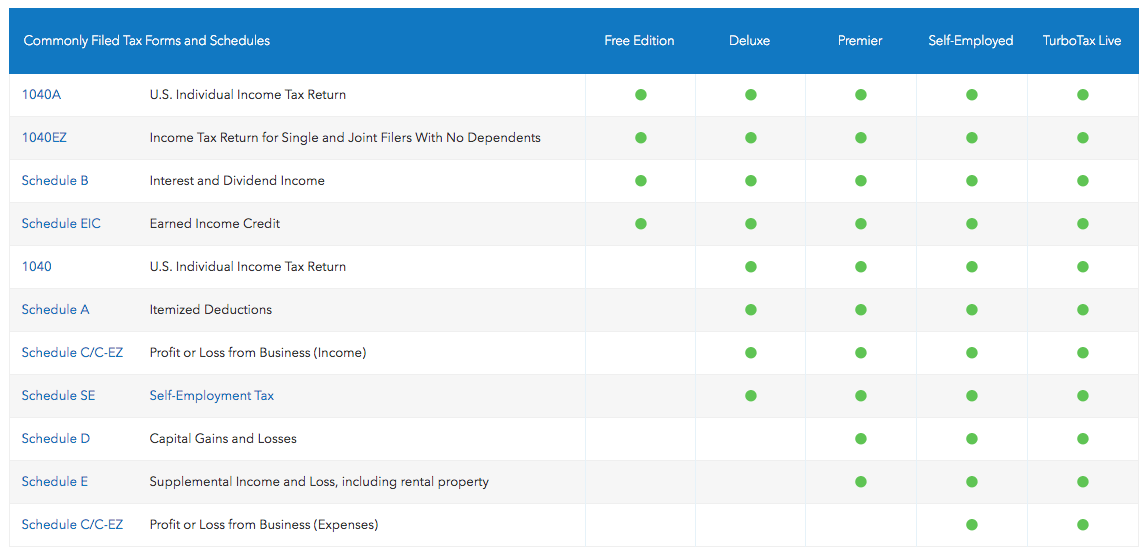
 The new tax bill that takes effect in 2018 raises the standard deduction and caps certain itemized deductions. Therefore, if you will itemize your deduction in 2017, you may want to grab whatever you can this year to get the full value of those deductions. (This assumes you are not subject to AMT.) Here’s a brief summary of your options.
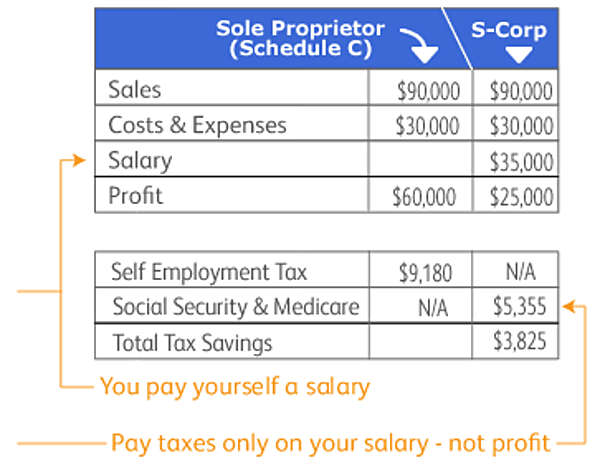
 The wealth management group Del Monte published a


 The Best Credit Card Bonus Offers – 2025
 Big List of Free Stocks from Brokerage Apps
 Best Interest Rates on Cash - 2025
 Free Credit Scores x 3 + Free Credit Monitoring
 Best No Fee 0% APR Balance Transfer Offers
 Little-Known Cellular Data Plans That Can Save Big Money
 How To Haggle Your Cable or Direct TV Bill
 Big List of Free Consumer Data Reports (Credit, Rent, Work)