The NYT Economix blog points out that rents are rising again according to inflation data from the Bureau of Labor Statistics. The chart included doesn’t have zero on the y-scale, but a value of 100 corresponds to rent from 1982-1984. Rents nationwide are about 40% above their values in 2000. I recently saw the last house I used to rent on Craiglist and the rent was up 15% from 4 years ago.

Credit: NY Times, Bureau of Labor Statistics, IHS Global Insight
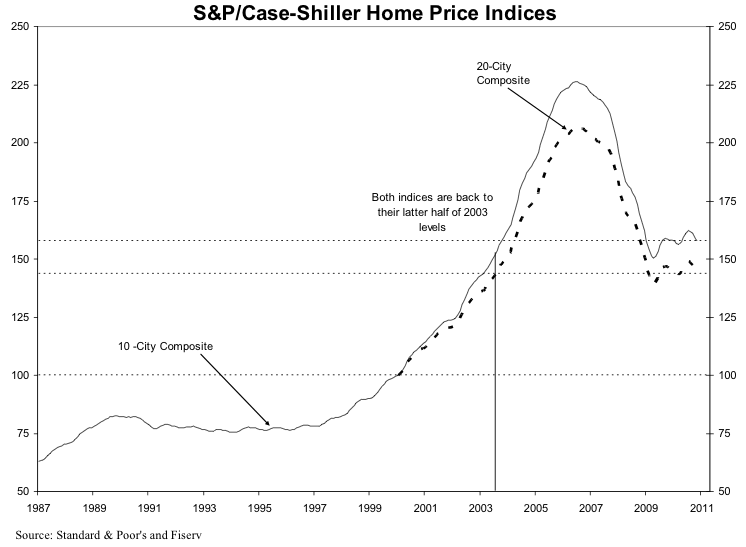
There is definitely an increase in the number of renters, and perhaps there is also an overall psychological shift in that less people think homeownership is a part of the American Dream. Perhaps this means it’s a better time to be landlord? Home prices are still hanging around 2003 levels:

Although I know many successful people who are landlords, I don’t now if I’m cut out for it. However, I do like buying real estate investment trust (REITs), which allows me to collect rent like I collect stock dividends. (Not familiar with them? Here’s a post all about REITs.) I even did a comparison post of rental property vs. REZ, a residential ETF. I see REZ has done quite well recently.
Now, I’m not pushing REZ, and don’t own it myself. I continue to get my real estate exposure through the low-cost, passively-managed Vanguard REIT Index Fund, available both as a mutual fund and ETF. It tracks the MSCI US REIT Index and includes all kinds of real estate, currently holding 20% in residential ETFs that own things like apartment complexes. It like the diversification of this fund, even though it can be a rough ride, and in a struggling economy things like commercial properties will be harder to rent out.
Here’s the growth of $10,000 chart of both the Vanguard REIT Index Fund and the S&P 500 index, from mid-1996 to today. This type of chart accounts for total return, including dividends.

The REIT fund has done better than the S&P 500, which some may find surprising (or not) given the housing bust. As you can also see, they don’t always move together, which is good. Including REITs and rebalancing has offered a way to achieve better returns even if you like a simple buy and hold portfolio. I can’t guarantee that this type of helpful diversification will continue in the future, but I’m happy with my current portfolio right now, and am glad to be a lazy “landlord” in this manner.
 After the interest rate drama last week, I managed to lock in a refinance of my current 30-year mortgage (with 26 years left) which had a 4.75% fixed rate into a new 15-year mortgage at a 3.875% fixed rate. You’ll probably see lower rates in ads and elsewhere, but it did come with negative points that offset my closing costs completely and then some. Anyhow, I wanted to run the numbers to see the potential financial benefit.



 The Best Credit Card Bonus Offers – 2025
 Big List of Free Stocks from Brokerage Apps
 Best Interest Rates on Cash - 2025
 Free Credit Scores x 3 + Free Credit Monitoring
 Best No Fee 0% APR Balance Transfer Offers
 Little-Known Cellular Data Plans That Can Save Big Money
 How To Haggle Your Cable or Direct TV Bill
 Big List of Free Consumer Data Reports (Credit, Rent, Work)