 The Wall Street Journal recently published (paywall?) a chart showing how the average cost of employer-provided health coverage for a family has changed from 1999-2017. The total average annual cost was $18,764 for a family and $6,690 for an individual in 2017. The data source is an annual poll of employers performed by the nonprofit Kaiser Family Foundation along with the Health Research & Educational Trust, a nonprofit affiliated with the American Hospital Association.

In very rough terms: a single adult is ~$500 per month ($6,000 per year), and a family is about $20,000 a year. These numbers agree overall with the preliminary health insurance quotes that I have gotten for my own family.
In addition to the rising premiums, the average annual deductible is now over $1,200 for a single worker.
The implications for an prospective early retirees are obvious. How are you going to cover this huge expense? Here’s a quick brainstorm of options. Spoiler alert: There is no easy fix.
- Use an Affordable Care Act (ACA) plan and get a subsidy if your income is low enough to qualify. Do a lot of reading, then hope it doesn’t change?
- Plan ahead with a job that offers health insurance benefits in early retirement (don’t have to be a certain age). You’ll probably have to hunker down with the same employer for a number of years.
- Save enough money (or create enough income) to pay for health insurance premiums. Try a managed-care system like Kaiser for a low-cost HMO plan.
- Find a part-time job that you both enjoy and offers health benefits.
- Run a part-time side business that earns enough profit to cover health insurance costs. Look for potential group discounts or tax breaks that are available as a business instead of a consumer.
- Now and later, look for a high-deductible health plan (HDHP) and fund a Health Savings Account (HSA) due to the tax advantages.
- Join a direct primary care arrangement or health care sharing ministry that is exempt from ACA.
- Extend your current employer coverage for up to 18 months through COBRA (check cost).
- Move to a foreign country with reasonable and transparent cash pricing.
Am I missing anything? Right now, we have #4. My family’s future plan is a mix of #1, 3, and 5. However, #5 could push us over the income limits for #1.
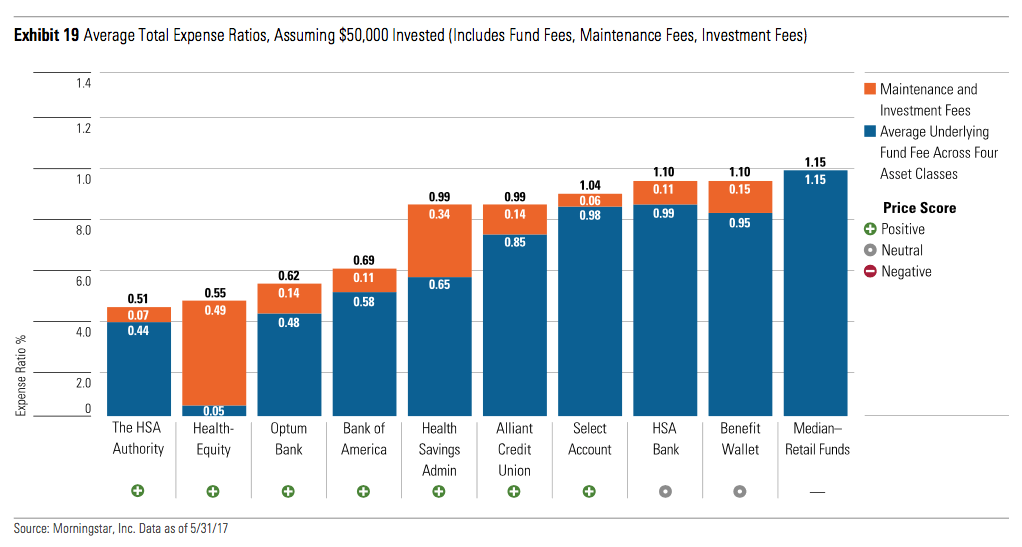
 Nearly 30% of covered workers are now enrolled in a high-deductible health plan (HDHP). This means a lot more people are also eligible to contribute to a Health Savings Account (HSA). HSAs have the unique feature of triple-tax-free savings when used as designed:


 After my initial


 This post is for the fortunate folks who may possibly exceed the often-quoted $500,000 limits for SIPC insurance ($250,000 for cash). The way this insurance works wasn’t necessarily obvious to me, and although it is often compared to the FDIC insurance of banks, there are many important differences.
  High-deductible health plans are still growing in popularity. While these can be a great way to save on your monthly premiums, it also means that when you do have to visit the emergency room, you get to tackle nearly the entire bill instead of a small co-pay. The problem is that most medical bills cannot be understood by mere mortals. Likely, the doctors and nurses themselves have no clue how that $6,344 bill for a broken arm got generated.

 Consumer Reports (CR) has released a multi-part

 I would say that the insurance with the highest ratio of most-needed to least-bought would be long-term disability insurance. According to the Social Security Administration, just over 1 in 4 of today’s 20-year-olds will be become disabled at some point before reaching 67. According to a Harvard study, lost income due to illness was a contributor in 40.3% of all personal bankruptcies in the US. Here is a chart that shows the average duration of disability claims lasting more than 90 days, measured from the start of disability to (at most) age 65.


 One of the few benefits of getting older is that my car insurance premiums are much lower today than in my 20s. But is that low rate caused by insurance companies knowing that I recently switched high-speed internet and refinanced my mortgage twice? Via drawpoker of
 The
The  The Best Credit Card Bonus Offers – 2025
 Big List of Free Stocks from Brokerage Apps
 Best Interest Rates on Cash - 2025
 Free Credit Scores x 3 + Free Credit Monitoring
 Best No Fee 0% APR Balance Transfer Offers
 Little-Known Cellular Data Plans That Can Save Big Money
 How To Haggle Your Cable or Direct TV Bill
 Big List of Free Consumer Data Reports (Credit, Rent, Work)