 I’m currently reading The One-Page Financial Plan by Carl Richards, who also writes for the New York Times. Given the title, I thought it would be a quick read but it turns out to cover a variety of topics over its 200+ pages. So far, I like that it comes from the point of view of an experienced financial planner who spends his days talking with clients.
A valuable observation is that the most common financial mistake most people make is simply doing nothing. Either they are scared of what they might find, or they are overwhelmed by how hard it is to plan for something with such uncertainty. Future jobs and/or income? Uncertain. Childcare/Healthcare/Retirement costs? Uncertain. Future investment returns? Uncertain.
As a financial planner, his job is get people over this hurdle. Guessing is okay! You can always correct your course as you go along, but as long as you are facing the problem and doing something, you are much more likely to have a good result. Carl Richards is also known as “The Sketch Guy” and this one from the book illustrates things well:

However, you could replace “investment” with any decision that you have been putting off. Don’t worry about making mistakes (you will). Don’t worry about making the perfect or optimal decision (you won’t). Financial planning is not an exact science.
Here’s another take from inspirational speaker and writer James Clear in Why Getting Started is More Important Than Succeeding:
I can’t think of any skill more critical to the active pursuit of a healthy life than the willingness to start. Everything that signifies a happy, healthy and fulfilled existence — strong relationships, vibrant creativity, valuable work, a physical lifestyle, etc. — it all requires a willingness to get started over and over again.
Take note: being the best isn’t required to be happy or fulfilled, but being in the game is necessary.
Get started and correct your course as needed. In terms of personal finance, so many people have never drilled down to the real reasons why money is important to them, they have never calculated their net worth, never tracked and broken down their monthly expenses, and thus never properly prioritized their time, energy, and money accordingly. But that’s okay, as now is still a great time to get started! I have finished the book yet, but apparently you can fit an entire plan on one page. 🙂




 Our goal is to always have a full year of expenses in cash equivalents as our “emergency fund”. (This is not the same as a year of income. Our expenses are much lower than our income.) This is a cushion for a variety of potential events including job loss, health concerns, or other unplanned costs. It also allows us to take a more long-term view with our investment portfolio since we know we won’t have to touch it.
 I don’t think everyone should buy a house (or more accurately, take out a huge loan on a house), as it historically doesn’t necessarily work out to be a very good investment over short or even long periods. However, if you are geographically stable, I do think buying and eventually owning a house free and clear can be a solid component of an early retirement plan. My current forecast is to have our house paid off in
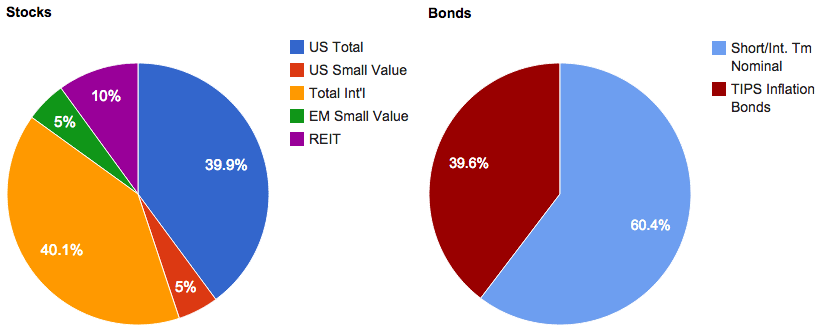
  The goal of my investment portfolio is allow withdrawals to support our needed expenses in “retirement”. Again, income and expenses are not the same thing. After mortgage payoff, I expect our required expenses to be less than 25% of our current income. I like to assume a simple 3% safe withdrawal rate, which means for every $100,000 saved, I can generate $3,000 a year of inflation-adjusted income for the rest of our lives. I used to assume 4%, but since our target “retirement” age is in our 40s and not 60s, I feel that 3% is better. Even 3% is not guaranteed, but again it does provide a quick estimate of progress. Here are recent portfolio updates:
 The Best Credit Card Bonus Offers – 2025
 Big List of Free Stocks from Brokerage Apps
 Best Interest Rates on Cash - 2025
 Free Credit Scores x 3 + Free Credit Monitoring
 Best No Fee 0% APR Balance Transfer Offers
 Little-Known Cellular Data Plans That Can Save Big Money
 How To Haggle Your Cable or Direct TV Bill
 Big List of Free Consumer Data Reports (Credit, Rent, Work)