November 2008 Financial Status / Net Worth Update

Net Worth Chart 2008

Credit Card Debt
If you’re a new reader, let me start out as usual by explaining the credit card debt. I’m actually taking money from 0% APR balance transfer credit cards and instead of spending it, I am placing it in high-yield savings accounts that actually earn 3-4% interest or more, and keeping the difference as profit. I put together a series of step-by-step posts on how I do this. Please check it out first if you have any questions. This is why I have credit card balances – I am not accumulating more consumer debt.

Retirement and Brokerage accounts
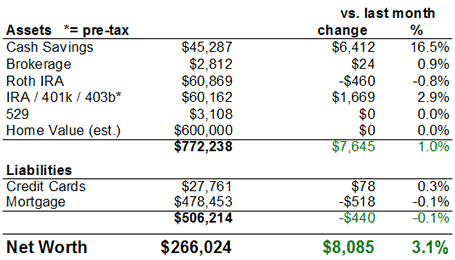
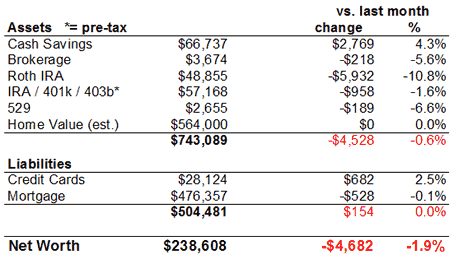
Well, it’s time to uncover my eyes and peek at my financial statements. My retirement accounts have lost another $15,000 (14%) over the last month, in addition to the $12,000 from last month. I did not make any further investments besides the $5,000 in early October.

However, I am still planning to max out my 401k salary deferral by the end of the year, and will still be buying stocks according to my previously set asset allocation plan. I still believe that stocks are the best bet for inflation-beating returns in the long run.

Cash Savings and Emergency Funds
I remain a big proponent of emergency funds held in safe cash or cash-equivalent accounts. We now have approximately 7 months of our actual monthly expenses saved up. Increasing this is a lower priority than the 401k contributions, though.

Home Equity
I am testing out a new way of estimating our house’s value. First, I take the average estimates provided by Zillow, Cyberhomes, Coldwell Banker, and Bank of America. Then, I shave off 5% to be conservative and subtract 6% for expected real estate agent commissions (11% total). I use this final number as my estimate for home value.

I know that each of these sites can be inaccurate, but I am primarily looking for overall trends based on recent comparable sales, and this should take care of that with minimal effort. Feedback is welcome. The mortgage amount is taken directly from my loan statement. Which reminds me, I might need to see if I can argue with the tax collector about my property tax appraisal.

We are still socking away about half of our take-home pay each month, but this looks like the worst drop ever in our net worth. Let’s hope it stays the worst! 😉

You can see our previous net worth updates here.

Your Own Financial Rescue Plan, Part 1: Adequate Cash Reserves

Well, the big boys are getting their rescue/bailout plan, but I guess ours got lost in the mail… So what should we do? I think that everyone should take a second look at their cash reserves. Do you have enough?

What Job Security?
These days, I don’t see any job as safe. My company went from interviewing people to hiring… nobody. Even local and state governments are facing major budget deficits. At a minimum, I would want a few months of living expenses to tide me over until I find another job. I still remember the dot-com bust days when former tech workers ended up living in their cars.

A Reason Not To Invest In Stocks
Hey, if you’re looking for an excuse not to buy any more stocks for a while, beefing up your emergency fund is not a bad one. Any money you may need within 5 years should be in cash or short-term investments anyway.

A Reason *To* Invest In Stocks
Ironically, after you build up a nice cushion, it may actually make you feel better about investing in the stock market. I definitely helps me to keep short-term money separate from long-term money. As such, I’m still applying my upcoming income towards maxing out my 401(k) for 2008. But after that, I will probably start to save another three months of living expenses, for a total of 9 months in cash.

Less Credit Available
A lot of people used to simply assume that their home equity line of credit (HELoC) could serve as their emergency fund. But these days, it just takes one letter in the mail that says your HELOC is frozen or greatly reduced. You don’t want to be forced into taking an early withdrawal from your 401(k) or IRA, or paying exorbitant credit card interest.

If anything, apply for a credit card with a low fixed interest rate now while it is still offered. Here is a list of no fee 0% APR balance transfer credit cards. Just buy goods as you regularly would, and pay the minimum while saving the difference in an interest-bearing account. (Don’t go buying more stuff, obviously!)

Looking Ahead
For me, an alternative reason for increasing my cash reserves is that I can also use it later for investing in real estate. I still don’t see many opportunities with good cashflow right now, and may not see them for another couple of years. But I want to be ready, as the no-money-down days may never come back.

Where do you keep it?
As long as it is safe and liquid, I just go by rate. Use the new FDIC insurance estimator if you have lots of money. Both Vanguard and Fidelity are participating the money market fund insurance program, so they are super-duper safe now. . Well, your old money is safe. Still, I consider money market funds with Fidelity and Vanguard as safe as FDIC-insured, although this is only my opinion. However, my cash is currently split between:

  1. Series I US Savings Bonds – Bought in April with 1.2% fixed rate, now only 0% fixed rate available. Note that they are illiquid for the first 12 months. Rates adjust semi-annually. I earn 4.38% for 1st six months, 6.06% for 2nd six months. With recent inflation, my 3rd six months should also be pretty good. Exempt from state income tax as well.
  2. 12-Month 5% APY CD at WaMu/Chase – Sadly, no longer available.
  3. Low or no-minimum banks with high liquidity – A big chunk currently in transit to Everbank at 1.10% for first 6 months.

October 2008 Financial Status / Net Worth Update

Net Worth Chart 2008

Credit Card Debt
If you’re a new reader, let me start out as usual by explaining the credit card debt. I’m actually taking money from 0% APR balance transfer offers and instead of spending it, I am placing it in high-yield savings accounts that actually earn 3-4% interest or more, and keeping the difference as profit. Along with other deals that I blog about, this helps me earn extra side income of thousands of dollars a year. Recently I put together a series of step-by-step posts on how I do this. Please check it out first if you have any questions. This is why, although I have the ability to pay the credit card balances off, I choose not to.

Retirement and Brokerage accounts
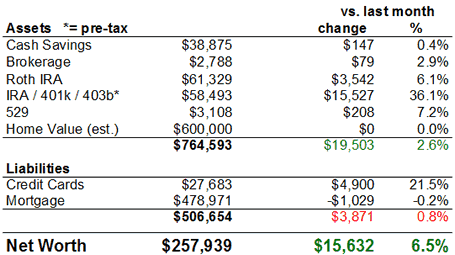
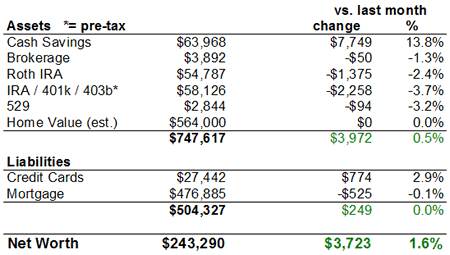
Whew! Ignoring new investments, the value of my holdings lost nearly $12,000. I won’t go into why, I think most people have heard the overall reasons. I did a portfolio update in mid-September to better understand what happened specifically. Accordingly, I am directing future contributions as I can to help rebalance my portfolio back towards the target asset allocations (mainly international developed and emerging markets stocks).

I did make an $5,000 contribution to my self-employed 401k, although I am still left in negative territory for the month. I do hope to contribute at least the $15,500 maximum salary deferral in 2008, as this has been my only contribution so far this year. My wife has already maxed out her 401(k).

Cash Savings and Emergency Funds
Last month, we achieved our mid-term goal of six months of expenses ($30,000) in net cash put aside for emergencies. Once my retirement accounts are funded, I may try to increase this cushion. An alternate reason for increasing cash is for potential real estate opportunities (way) down the road.

Home Mortgage
Another ~$500 of loan principal paid off. According to Zillow, the estimate of the value of my house is still higher than what I originally paid for it, but has also dropped 3% in the last month alone.

Big Expenses
We are taking a trip to Spain in November, which will cost us about $1,000 each. I wrote earlier about how we tried to save money on travel and how we manage cash and credit cards abroad. The airfare has already been paid for (charged on the credit cards to earn rewards, of course).

Basically, I still consider myself doing well, but I guess it is hard to avoid what everyone else is experiencing. Shrinking 401(k). Dropping house value. Rumors of potential layoffs for part-time employees at work (who’s next?). Lots of red in my net worth chart. 🙁 Fun times, eh?

You can see our previous net worth updates here.

September 2008 Financial Status / Net Worth Update

Finally got around to adding up the numbers for the last month:

Net Worth Chart July 2008

Credit Card Debt
If you’re a new reader, let me start out as usual by explaining the credit card debt. I’m actually taking money from 0% APR balance transfer offers and instead of spending it, I am placing it in high-yield savings accounts that actually earn 3-4% interest or more, and keeping the difference as profit. Along with other deals that I blog about, this helps me earn extra side income of thousands of dollars a year. Recently I put together a series of step-by-step posts on how I do this. Please check it out first if you have any questions. This is why, although I have the ability to pay the credit card balances off, I choose not to.

Retirement and Brokerage accounts
The bad news is that the market value of our investments went down over $3,500. And this is despite my wife being able to finally max out her 401k for 2008 (total of $15,500 as of this month). At least I don’t own much Fannie Mae stock…

The good news is that I am finally ready to make some big contributions to my Fidelity Self-Employed 401k, at the same time that the markets are near their 2008 lows. Buy low, sell high! Why now? I like to wait because my income fluctuates and this way I have a clearer idea of what my contribution limits will be, as they are based on gross income.

Cash Savings and Emergency Funds
Our mid-term goal was to have six months of expenses ($30,000) in net cash put aside for emergencies. This is now done. As mentioned, future cashflow will be put towards retirement accounts. Speaking of emergencies, with all these hurricanes, I have been checking out portable generators as well.

Home Mortgage
Another ~$500 of loan principal paid off. Housing prices are still dropping in my area. I will probably have to adjust my home value estimate in the future, a short-term goal might be to pick a simple benchmark to follow. After a few other financial priorities are taken care of, perhaps I’ll start a DIY biweekly mortgage plan.

We had some visitors and took a tiny bit of vacation this month, so it was a nice end to the summer. You can see our previous net worth updates here.

Utilizing The Public Library To Complete Some Goals

Have you heard of the Olympics Hangover? It’s when you stay up way too late watching “just one more event” and end up being red-eyed and unproductive the next day. So to counteract this, I used the public library for the first time in a long while. Funny thing: childless friends and co-workers had no idea where the library was. Only the parents did, since their kids use them. Why do we stop using the library as we grow older?
It was a productive visit, helping me to complete both a few short-term and lifetime goals:

  1. Read one financial book per week. Obvious one first. 😉 I put the following books on hold: Work Less, Live More and The Complete Idiot’s Guide to Retiring Early. Hope to find some good nuggets.
  2. Visit a Foreclosure auction. In most areas, listing notices are required to be in the newspaper. I don’t have a subscription anymore, but I was able to look through the last 3 days of papers at the library for free. Looks like there will be one on September 9th at Noon at the county courthouse. Also, I found an announcement that a local self-storage place is also auctioning off the contents of the lockers that have been abandoned and unpaid. That might be interesting to go to as well.
  3. Learn more about financial analysis of potential rental property. Also found the Landlord’s Survival Guide and The complete guide to your first rental property. To judge the quality of books I’ve never heard of, I consider both Amazon.com review (if any) and also the number of copies in the city-wide system. I simply assume (right or wrong) that the better books will have more copies.
  4. Plan international travel. The in-branch pickings were slim, but I found a nice book on Spain. I should be able to find many more online. I’ve actually brought library travel books with me on international trips. (Well taken care of and returned on time, of course!)
  5. Learn a Foreign Language. Borrowed a few Pimsleur language audio CDs (intro to Cantonese and Spanish). The full sets of these often cost over $200. These will go great in the car and in my iPod while jogging.

Of course, not all goals can be done at the library. 🙂 I also recently signed up for a 3-day PADI scuba diving certification course over Labor Day weekend that will cost around $400 altogether. I’m really looking forward to it.

Writing Down Some Short-Term Goals

Watching the Olympics has been both inspiring, entertaining, and also taking up a lot of free time. I can’t believe the amount of dedication these people have towards their goals. I am trying to go back to setting regular monthly goals, and writing them down always helps.

A rough list:

  • Visit a live foreclosure auction at county courthouse, just for the experience.
  • Buy a term life insurance policy.
  • Learn more about long-term disability insurance.
  • Read one financial book per week, and take notes.
  • Learn more about financial analysis of potential rental property.
  • Investigate solar water heater credits, and get quotes from contractors. Also look into solar fan for roof/attic.
  • Have a series of dinner conversations about finances with wife. Teach her the details of managing all household finances if I am incapacitated. (Show her where I stashed all the money in all these bank accounts…)
  • Help parents firm up outlook for retirement based on current assets. Help them complete rollovers of 401k/IRAs to Vanguard.
  • Plan international travel somewhere. Currently thinking of hiking the Inca trail in Peru.

August 2008 Financial Status / Net Worth Update

Net Worth Chart July 2008

Credit Card Debt
If you’re a new reader, let me start out as usual by explaining the credit card debt. I’m actually taking money from 0% APR balance transfer offers and instead of spending it, I am placing it in high-yield savings accounts that actually earn 3-4% interest or more, and keeping the difference as profit. Along with other deals that I blog about, this helps me earn extra side income of thousands of dollars a year. Recently I put together a series of step-by-step posts on how I do this. Please check it out first if you have any questions. This is why, although I have the ability to pay the credit card balances off, I choose not to.

Retirement and Brokerage accounts
We added another $3,048 in 401(k) contributions, which given the numbers above means our retirement accounts actually lost about $1,000 in value. YTD performance numbers are… not good. I just hope that the prices stay low until I can start buying again now that I am done with the Emergency Fund.

In my brokerage accounts, I sold all of my “play money” stocks (only valued at ~$2,000) and instead participated in a minor arbitrage attempt. It worked out well, I made a gain of 10% in 17 days. It’s all in cash now and I again have no position in individual stocks at all.

Cash Savings and Emergency Funds
Our mid-term goal is to have $30,000 in net cash put aside for emergencies, for example if both of us find ourselves unemployed for an extended period and even have to start paying for things like health insurance on our own. We are basically done, with about $500 to go. Now to find better uses for our incoming cashflow.

Home Mortgage
Another ~$500 of loan principal paid off. I am debating whether to start paying extra towards my mortgage right now. In my mind, it would feel nice to have a home paid off as part of my grand early retirement plan. However, I also like the idea that such a long-term loan at <6% can act a nice inflation hedge. Besides healthcare costs, I view unexpected inflation as another scary unknown for early retirees.

You can see our previous net worth updates here.

One Way To Track Your Progress Towards Financial Independence

Another more conventional definition of financial freedom is when you have “passive” income that covers your expenses so that you no longer have to work. Usually, this comes from paper investments like stocks, bonds, or annuities. In the book Your Money or Your Life, the authors outline a somewhat unique way to track your progress towards financial independence (FI).

First, you should go out and buy a huge wall-sized piece of graph paper and put it up somewhere you’ll see every day. Create a chart with the horizontal axis being time, and the vertical axis being money. Each month, you should record the following items:

  1. Your monthly income
  2. Your total monthly expenses
  3. Estimated investment income

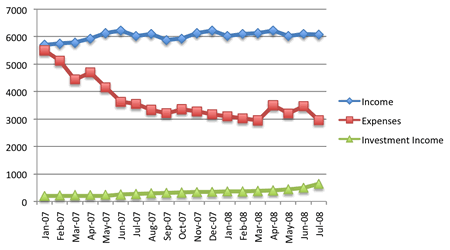
Here is a sample of what it might look like:

Line 1 – Graphing Your Income Each Month
While many personal finance articles focus on spending less, the book does a good job of reminding us that income matters and we can always do something to increase it. It also tells us that the path towards a happier life and a career you enjoy of also tends to increase your income. The book summarizes this with the following:

“Increase your income by valuing the life energy you invest in your job, exchanging it for the highest pay consistent with your health and integrity.”

Line 2 – Graphing Your Expenses Each Month
Note that we are not making a budget here. A budget often seems to suggest a goal of “I will spend this much”. Instead, here you are first making an assessment of your situation from last month. You then attempt a few (or several) changes, and re-assess again a month later. This continual feedback should ideally help you see what is working and what’s not.

For those dealing with debt, the Expenses line might even be higher than your Income line at first. This should provide a nice incentive to get to the first “crossover point” where you at least earn what you spend. Gradually, we can shave off those lower priority expenditures as we keep seeing that gap between income and expenses grow wider and wider.

Line 3 – Graphing Your Expected Income From Investments
Here, the simple formula given for finding the income you can derive from your investments is this:

savings x interest rate / 12 = monthly investment income

The suggested investment here is to use is that of the 30-year U.S. Treasury Bond, currently yielding somewhere around 4.5%. This means if you bought $100,000 of these bonds with your savings, you would earn $375 reliably every month for 30 years without risking your principal. Other people might use dividend payments from stocks, or use a historically-safe withdrawal rate.

Either way, the big goal is to make this third line meet up with the expenses line. As time goes on this line will hopefully curve up exponentially, providing inspiration to reach this “crossover point”. The idea of working for only a finite period of time can be very motivating.

Given that this book was written in 1992, I am going to guess that doing this using a spreadsheet program like Excel is also acceptable. While a physical chart may work better for some people and provide a more constant and tangible reminder, I think perhaps making the chart your Desktop wallpaper might serve a similar purpose. (Or you could create blog about it…)

This is a pretty cool idea. Perhaps I should stop tracking net worth and simply do this? For us, as mentioned before, once our mortgage is paid off the expense line should drop dramatically. Separating out the non-housing expenses into a separate line might help me focus better.

July 2008 Financial Status / Net Worth Update

Net Worth Chart July 2008

Credit Card Debt
If you’re a new reader, let me start out as usual by explaining the credit card debt. I’m actually taking money from 0% APR balance transfer offers and instead of spending it, I am placing it in high-yield savings accounts that actually earn 3-4% interest or more, and keeping the difference as profit. Along with other deals that I blog about, this helps me earn extra side income of thousands of dollars a year. Recently I put together a series of step-by-step posts on how I do this. Please check it out first if you have any questions. This is why, although I have the ability to pay the credit card balances off, I choose not to.

Retirement and Brokerage accounts
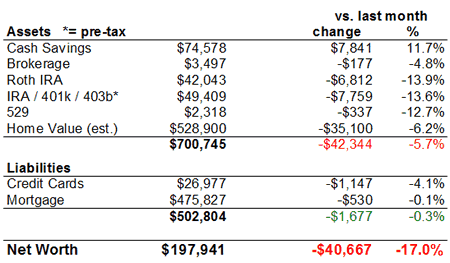
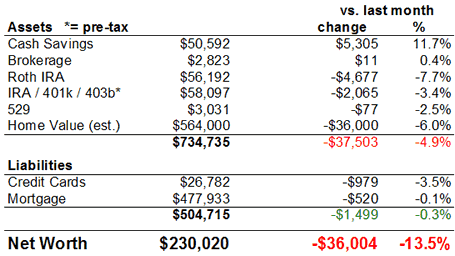
Apparently this was the worst June since the Great Depression, with the S&P 500, Nasdaq, and Dow all losing around 9 to 10% last month alone. But it was only the worst June, not the worst month ever. Our overall portfolio didn’t fair quite so poorly due to our diversification into international stocks and bonds, but still sank nearly $7,000 in one month.

However, I remain confident in the fact that a globally diversified portfolio will perform adequately well over my time horizon of 20+ years. Add in the fact that shuffling investments around only serves to worsen my chances, and you get my same old brilliant plan of… doing nothing. I seriously had to skip over half of my financial magazines this month, with all their suggestions for “recession-proof” stocks.

Cash Savings and Emergency Funds
Our mid-term goal is to have $30,000 in net cash put aside for emergencies, for example if both of us find ourselves unemployed for an extended period and even have to start paying for things like health insurance on our own. We are now nearly 80% there at $23,810. After this is done, then I will focus on more contributions to my Self-Employed 401(k) plan at Fidelity. My timing just happened to work out well so far, with us accumulating cash while the markets are dropping.

Home Equity
Another tiny ~$500 of loan principal paid off. Since this is a “bad” month, I decided to pile on and reduce our estimated home value by 6%. Six percent is the approximate amount charged by a real estate agent, so we might as well count that in. I don’t like how our net worth is overly affected by such home value guesses, and am looking for a better way to measure our progress towards financial freedom.

You can see our previous net worth updates here.

June 2008 Financial Status / Net Worth Update

Net Worth Chart June 2008

Credit Card Debt
If you’re a new reader, let me start out as usual by explaining the credit card debt. I’m actually taking money from 0% APR balance transfer offers and instead of spending it, I am placing it in high-yield savings accounts that actually earn me 4% interest or more, and keeping the difference as profit. Along with other deals that I blog about, this helps me earn extra side income of thousands of dollars a year. Recently I put together a series of step-by-step posts on how I do this. Please check it out first if you have any questions. This is why, although I have the ability to pay the credit card balances off, I choose not to.

Retirement and Brokerage accounts
It seems like the markets were relatively idle over the last month. We made $2,141 in pre-tax 403(b) contributions. Not much else to report here, although our 403(b) plan did announce some new lower-cost fund choices for later this year, which is nice. I should do another portfolio update soon.

Cash Savings and Emergency Funds
Our mid-term goal is still to have $30,000 in net cash put aside for emergencies, which is 6 months x $5,000 per month in estimated expenses if both of us find ourselves unemployed. We are now a bit over halfway there at at $17,526. This fits in with our overall “just-in-case” focus for this month, hopefully we will also be getting some life insurance soon.

Home Equity
Another $500 of loan principal paid off. Housing values look to continue to be dropping a bit in our neighborhood, although nothing is really selling so it’s hard to tell. I’m definitely aware of this, but I’m still not going to try and re-value my house every month. I’ve found that Cyberhomes.com offers some good data on tracking median prices by zip code. Again, can be tricky to apply if only a few houses sell in your zip code and they aren’t really comparable in size or neighborhood.

Overall, a relatively quiet month financially. You can see our previous net worth updates here.

(By the way, my post yesterday on emergency planning was messed up due to some typos which cut out some parts, you can re-read it if you’d like.)

May 2008 Financial Status / Net Worth Update

Net Worth Chart May 2008

Credit Card Debt
If you’re a new reader, let me start out as usual by explaining the credit card debt. I’m actually taking money from 0% APR balance transfer offers and instead of spending it, I am placing it in high-yield savings accounts that actually earn me 4% interest or more, and keeping the difference as profit. Along with other deals that I blog about, this boring activity helps me earn extra side income of thousands of dollars a year. Recently I put together a series of step-by-step posts on how I do this. Please check it out first if you have any questions. This is why, although I have the ability to pay the balances off, I choose not to.

Retirement and Brokerage accounts
There were three paydays in April for us based on a biweekly pay schedule. In addition stock prices are up about 6% from my last update on April 1st, making this month extra juicy. I estimate that capital gains accounted for ~$6,000 of the net worth increase. We also made our IRA contributions for 2007 before the April 15th deadline ($4,000 x 2), as well as $4,451 in 401k contributions in order to be on track to max out this year. All these things together made the value of our portfolio jump a lot.

Cash Savings and Emergency Funds
We did a bad job on increasing our cash savings, due to a big hardwood flooring purchase on top of the late decision to contribute to non-deductible IRAs. Taking into account the increased credit card balances, our net cash actually shrank. Need to fix this next month.

Home Equity
I’ve decided to switch to a simpler way to track home equity, as the previous method was a bit confusing. I have my estimated home value in the asset column, and my remaining loan balance in the liabilities column. The difference is home equity. I don’t use a Zillow estimate because that would put my house at nearly $700,000 in value, and although that sounds nice it’s not very accurate.

You can see our previous net worth updates here.

The Financial Freedom Ratio: A Better Way To Measure Your Net Worth?

Most of you are reading this right now because you want that elusive “financial freedom”. This usually revolves around net worth, and many of us (ahem) have a specific net worth goal they want to achieve. Various formulas and calculators abound. The popular book The Millionaire Next Door suggests this formula for a target net worth:

altext

In addition, there are various debates on how to measure net worth. Do you include your primary residence, or not? What about cars or jewelry? How do you properly account for pre-tax accounts? However, while reading this post at Early Retirement Extreme amongst others I realized that these are not the things I need to be focused upon.

Financial Freedom Ratio
If someone tells you that they have a net worth of $1,000,000, you might be impressed. But what if they spent $150,000 per year? If they stopped working, the money wouldn’t last very long. However, if they only spent $15,000 per year, they might already be set for life. In other words, your income doesn’t matter. Your expenses do. It may be assumed that the two are related, but that is not necessarily true. We all have the power to disconnect the two.

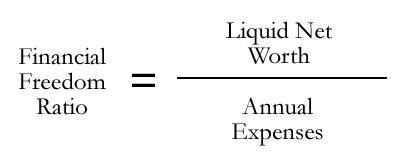
I’m sure somebody somewhere has already coined this term, but until told otherwise I will call it the Financial Freedom Ratio (FFR):

Liquid Net Worth divided by Annual Expenses

By liquid, I simply mean you can sell it for cash while not affecting your expenses. (Don’t count your car if you need it for work.) For example, if you had $200,000 but only spent $20,000 per year you would have the FFR value of 10 as someone with $1,000,000 but spent $100,000 per year. This also calls into focus how important spending patterns are when talking about financial freedom. Let’s say you had the 200,000 net worth and you wanted to increase your FFR from 10 to 11. You could either

  • increase your liquid net worth by $20,000 and spend the same,
  • decrease your annual spending by $1,820 and not earn any more money,
  • or some combination of spending less and accumulating more.

Sure, it can be very difficult to keep slashing expenses, but this ratio keeps you honest as to how close you are to financial independence.

What Is A Good Financial Freedom Ratio?
To find this, I went to the Vanguard Annuity website and looked up a price quote for their inflation-adjusted fixed immediate annuity (Lifetime income option, fixed payment, bottom right). This means that, if I give Vanguard a lump sum of money, they will give me a regular income that is adjusted every year for inflation per the CPI-U. (Annuities are subject to the claims-paying ability of the issuing insurance company, which is AIG Insurance.)

I input that I was 30 years old and wanted an inflation-adjusted $30,000 a year ($2,500 a month) for the rest of my life. The quote was $857,000. So a lifetime of my required income requires an FFR of 28.6 ($857,000/$30,000). As you get older, the number decreases.

Using the popular but controversial 4% safe-withdrawal-rate rule for a balanced stock/bond portfolio, you would need a FFR of 25 to have a good chance of living off of your investments without having to annuitize. Keep in mind the 4% value is not adjusted for inflation, so your buying power would decrease each year.

What’s My FFR?
I’m not sure exactly how much I spend per year. I need to fix this. I should be able to back out the numbers for 2007 pretty easily since I track our net worth and I just did my taxes, but I’d need to cancel out things like unrealized investment gains. Roughly, I would say that last year we spent somewhere between $25,000 to $30,000. This year, it will be much higher due to housing expenses, although one day the house will be paid off. My FFR is certainly less than 10 right now, more like in the 8 range. Single-digits! 🙁

Track Your Expenses
I like the FFR because it gives me a better idea of how close we really are to financial freedom. In addition, it reminds me that our expenses matter equally as much as our net worth. Do you know how much you spent last year? I am convinced that spending is a habit. If you spend modestly now, it will be easy to maintain this in the future. If you spend lavishly now, it will be very difficult to downgrade later on. We all have our luxuries which we hold dear, I know I certainly do, but it has to be weighed against how long you want to keep working and saving.

So, after all this I suppose I need to figure out how to gradually shift to a simpler and less costly lifestyle. Heck, forget cutting expenses, I spend a lot of effort simply trying not to accumulate more expenses these days…