TurboTax Deals at Amazon, Sam’s Club, Costco: Deluxe Federal & State

Update 1/18/25. Amazon has some sale prices for the TurboTax + $10 Amazon gift card bundles (not Product only). Might be 1-day only, might last through the holiday weekend. The benefit of “old-school” desktop tax software is that it doesn’t require your Social Security Number and income details to be stored in the “cloud”, a fancy word for a third-party server where it can be copied or hacked.

Amazon has listings for both the products alone and in a bundle with a $10 Amazon gift card. The prices for both keep changing, so I won’t list them anymore, but you can compare to see the lowest net price. Or compare and go with the Costco and Sam’s Club deals with $10 product credit below if you know you’ll pay the state e-File fee.

The products alone:

The bundles:

Costco also has TurboTax Deluxe Fed+State for $44.99 w/ $10 Add-on credit, so instead of a $10 Amazon credit you get a $10 credit towards a future TurboTax add-on like State e-File. Compare prices to Amazon for Premier and Business. Ends 1/26/25.

Sam’s Club joins with TurboTax Deluxe Fed+State for $44.99 w/ $10 Add-on credit. Works out if you plan on paying for State e-File anyway. Ends 2/2/25.

You also get 5 Federal e-Files so you can file taxes for other family member in your household. (Click here to view the Amazon links if you can’t see them.)

State e-File is extra (now $25 per state). I would personally just print the (usually shorter) state return out and snail mail it in if you don’t have a free State e-File option.

Note that TurboTax Deluxe lets you manually input stock gain/loss information, but does not include “guidance”. For that, they’ll try to nudge you to upgrade to Premier. This is what makes H&R Block Deluxe a more affordable alternative (as it does include guidance for stock sales), if you are willing to make the switch. However, I also understand the urge to stick with what works and TurboTax does offer auto-import of many 1099 forms.

Amazon Pharmacy: $15 Whole Foods Gift Card for New Orders

Amazon Pharmacy is offering a $15 Whole Foods gift card promo for your first order. Most insurance plans qualify, but not government insurance.

You are eligible to redeem this offer if you place your first Amazon Pharmacy order during the limited-time offer period, and do not have government insurance (Medicare, Tricare, etc.). If you cancel your order before it ships, you will not be eligible to redeem this offer.

Robinhood IRA Boost Promos: 3% IRA Contributions, 2% IRA Rollovers and 401(k) Transfers (Gold Required)

Robinhood brokerage app has some solid Retirement account promos for the New Year. There are much fewer brokerage promos that include both IRA rollovers and 401k rollovers. These can be very lucrative with a large retirement balance, especially as they are uncapped. Robinhood continues to aggressively collect assets. Keep in mind the 5-year minimum hold and 1-year minimum Gold subscription at $5/month.

  • 3% bonus on IRA contributions with a Robinhood Gold subscription. You can still make your 2024 contribution until April 15th, and also your 2025 contribution. Subject to the usual IRA annual maximum contribution limits. Five-year minimum hold period.
  • 2% on IRA and 401(k) transfers to your Robinhood IRA with a Robinhood Gold subscription. Five-year minimum hold period.

3% IRA Match Fine Print:

The 3% matching on contributions requires a subscription with Robinhood Gold ($5/mo) and customers must stay subscribed to Gold for 1 year after your first Gold match to keep the full Gold match. The funds that earned the match must be kept in the account for at least 5 years to avoid a potential Early IRA Match Removal Fee. Match rate subject to change. Non-Gold customers receive a 1% match. For more information refer to the IRA Match FAQ.

$420 match available to Robinhood Gold customers making the maximum 2024 IRA contribution by the IRS tax deadline, and the maximum 2025 IRA contribution. Robinhood does not provide tax advice; consult a tax adviser.

IRS contribution limit for 2024 and 2025 is $7,000 ($8,000 if you’re age 50 or older) annually. Visit the IRS site for more information. The annual tax filing deadline typically is April 15th but may vary by year or individual taxpayer circumstances. All IRA contributions count toward your annual limit.

2% Transfer Boost Fine Print:

The 2% matching on transfers requires a subscription with Robinhood Gold ($5/mo) and customers must stay subscribed to Gold for 1 year after receiving the first Gold match to keep the full Gold match. The funds that earned the match must be kept in the account for at least 5 years to avoid a potential Early IRA Match Removal Fee. Match rate subject to change. Non-Gold customers receive a 1% match. For more information refer to IRA Match 2025 FAQ.

If you contributed $7,000 for 2024, $7,000 for 2025, and roll over $100,000 in IRA/401k balances, that would add up to $2,420.

Robinhood will also reimburse up to $75 in outgoing transfer fees with transfers of $7,500 or more. This is a one-time reimbursement per account type, per external brokerage. You must send in a picture as evidence of the fee.

I’ve already written multiple articles about past flavors of these Robinhood promos, and I participated in the 3% IRA bonus previously. You will need to open up the appropriate IRA account at Robinhood first, and then transfer into that empty IRA container. You can attempt to offset some of the $5/month Robinhood Gold fee by using the free $1,000 in margin, or you might like the higher interest rate they pay on cash sweep with Gold.

Best Interest Rates Survey: Savings Accounts, Treasuries, CDs, ETFs – January 2025

Here’s my monthly survey of the best interest rates on cash as of January, roughly sorted from shortest to longest maturities. Banks love taking advantage of our tendency for idle cash, and you can often earning more money while keeping the same level of safety by moving to another FDIC-insured bank or NCUA-insured credit union. Check out my Ultimate Rate-Chaser Calculator to see how much extra interest you could earn from switching. Rates listed are available to everyone nationwide. Rates checked as of 1/10/2024.

TL;DR: Liquid, short-term rates are lower overall by roughly 0.25%. Very few at or near 5% APY liquid savings now. Longer-term rates actually went up a little; there are 4%+ APY 5-year CDs. Compare against Treasury bills and bonds at every maturity, taking into account state tax exemption. I no longer recommend fintech companies due to the possibility of loss due to poor recordkeeping and/or fraud.

High-yield savings accounts
Since the huge megabanks still pay essentially no interest, everyone should at least have a separate, no-fee online savings account to piggy-back onto your existing checking account. The interest rates on savings accounts can drop at any time, so I list the top rates as well as competitive rates from banks with a history of competitive rates and solid user experience. Some banks will bait you with a temporary top rate and then lower the rates in the hopes that you are too lazy to leave.

  • The top saving rates at the moment include TIMBR at 4.80% APY ($1k min) and Peak Bank at 4.75% APY ($100 min). Roger.bank is another new arrival at 5.00% APY (no min), but does require an additional checking account. Most others have dropped at least a little. For example, CIT Platinum Savings is now at 4.35% APY with $5,000+ balance.
  • SoFi Bank is at 4.00% APY + up to $325 new account bonus with direct deposit. You must maintain a direct deposit of any amount (even $1) each month for the higher APY. SoFi has historically competitive rates and full banking features. See details at $25 + $300 SoFi Money new account and deposit bonus.
  • Here is a limited survey of high-yield savings accounts. They aren’t the top rates, but a group that have historically kept it relatively competitive such that I like to track their history.

Short-term guaranteed rates (1 year and under)
A common question is what to do with a big pile of cash that you’re waiting to deploy shortly (plan to buy a house soon, just sold your house, just sold your business, legal settlement, inheritance). My usual advice is to keep things simple and take your time. If not a savings account, then put it in a flexible short-term CD under the FDIC limits until you have a plan.

  • No Penalty CDs offer a fixed interest rate that can never go down, but you can still take out your money (once) without any fees if you want to use it elsewhere. Marcus has a 7mo/9mo/11mo No Penalty CD at 4.00% APY with a $500 minimum deposit. Farmer’s Insurance FCU has 9-month No Penalty CD at 4.25% APY with a $1,000 minimum deposit. Consider opening multiple CDs in smaller increments for more flexibility.
  • Abound Credit Union has a 8-month certificate special at 4.75% APY ($500 min). Anyone can join this credit union nationwide with $10 fee. Early withdrawal penalty is 90 days of interest.

Money market mutual funds
Many brokerage firms that pay out very little interest on their default cash sweep funds (and keep the difference for themselves). Note: Money market mutual funds are highly-regulated, but ultimately not FDIC-insured, so I would still stick with highly reputable firms.

  • Vanguard Federal Money Market Fund (VMFXX) is the default sweep option for Vanguard brokerage accounts, which has an SEC yield of 4.28% (changes daily, but also works out to a compound yield of 4.36%, which is better for comparing against APY). Odds are this is much higher than your own broker’s default cash sweep interest rate.
  • Vanguard Treasury Money Market Fund (VUSXX) is an alternative money market fund which you must manually purchase, but the interest will be mostly (80% for 2023 tax year) exempt from state and local income taxes because it comes from qualifying US government obligations. Current SEC yield of 4.35% (compound yield of 4.44%).

Treasury Bills and Ultra-short Treasury ETFs
Another option is to buy individual Treasury bills which come in a variety of maturities from 4-weeks to 52-weeks and are fully backed by the US government. You can also invest in ETFs that hold a rotating basket of short-term Treasury Bills for you, while charging a small management fee for doing so. T-bill interest is exempt from state and local income taxes, which can make a significant difference in your effective yield.

  • You can build your own T-Bill ladder at TreasuryDirect.gov or via a brokerage account with a bond desk like Vanguard and Fidelity. Here are the current Treasury Bill rates. As of 1/10/25, a new 4-week T-Bill had the equivalent of 4.31% annualized interest and a 52-week T-Bill had the equivalent of 4.24% annualized interest.
  • The iShares 0-3 Month Treasury Bond ETF (SGOV) has a 4.48% SEC yield (0.09% expense ratio) and effective duration of 0.10 years. SPDR Bloomberg Barclays 1-3 Month T-Bill ETF (BIL) has a 4.34% SEC yield (0.136% expense ratio) and effective duration of 0.08 years.

US Savings Bonds
Series I Savings Bonds offer rates that are linked to inflation and backed by the US government. You must hold them for at least a year. If you redeem them within 5 years there is a penalty of the last 3 months of interest. The annual purchase limit for electronic I bonds is $10,000 per Social Security Number, available online at TreasuryDirect.gov.

  • “I Bonds” bought between November 2024 and April 2025 will earn a 3.11% rate for the first six months. The rate of the subsequent 6-month period will be based on inflation again. More on Savings Bonds here.
  • In mid-April 2025, the CPI will be announced and you will have a short period where you will have a very close estimate of the rate for the next 12 months. I will have another post up at that time.

Rewards checking accounts
These unique checking accounts pay above-average interest rates, but with unique risks. You have to jump through certain hoops which usually involve 10+ debit card purchases each cycle, a certain number of ACH/direct deposits, and/or a certain number of logins per month. If you make a mistake (or they judge that you did) you risk earning zero interest for that month. Some folks don’t mind the extra work and attention required, while others would rather not bother. Rates can also drop suddenly, leaving a “bait-and-switch” feeling.

  • OnPath Federal Credit Union (my review) pays 7.00% APY on up to $10,000 if you make 15 debit card purchases, opt into online statements, and login to online or mobile banking once per statement cycle. Anyone can join this credit union via $5 membership fee to join partner organization. You can also get a $100 Visa Reward card when you open a new account and make qualifying transactions.
  • Genisys Credit Union pays 6.75% APY on up to $7,500 if you make 10 debit card purchases of $5+ each per statement cycle, and opt into online statements. Anyone can join this credit union via $5 membership fee to join partner organization.
  • La Capitol Federal Credit Union pays 6.25% APY on up to $10,000 if you make 15 debit card purchases of at least $5 each per statement cycle. Anyone can join this credit union via partner organization, Louisiana Association for Personal Financial Achievement ($20).
  • NEW: Falcon National Bank pays 6.00% APY on up to $25,000 if you make at least 15 debit card purchases, 1 direct deposit OR ACH credit transaction, and enroll in online statements.
  • Credit Union of New Jersey pays 6.00% APY on up to $25,000 if you make 12 debit card purchases, opt into online statements, and make at least 1 direct deposit, online bill payment, or automatic payment (ACH) per statement cycle. Anyone can join this credit union via $5 membership fee to join partner organization.
  • Andrews Federal Credit Union pays 6.00% APY on up to $25,000 if you make 15 debit card purchases, opt into online statements, and make at least 1 direct deposit or ACH transaction per statement cycle. Anyone can join this credit union via partner organization.
  • Find a locally-restricted rewards checking account at DepositAccounts.

Certificates of deposit (greater than 1 year)
CDs offer higher rates, but come with an early withdrawal penalty. By finding a bank CD with a reasonable early withdrawal penalty, you can enjoy higher rates but maintain access in a true emergency. Alternatively, consider building a CD ladder of different maturity lengths (ex. 1/2/3/4/5-years) such that you have access to part of the ladder each year, but your blended interest rate is higher than a savings account. When one CD matures, use that money to buy another 5-year CD to keep the ladder going. Some CDs also offer “add-ons” where you can deposit more funds if rates drop.

  • KS State Bank has a 5-year certificate at 4.25% APY ($500 minimum), 4-year at 4.25% APY, 3-year at 4.20% APY, 2-year at 4.20% APY, and 1-year at 4.30% APY. $500 minimum. The early withdrawal penalty (EWP) for the 5-year is a huge 540 days of interest.
  • Mountain America Credit Union (MACU) has a 5-year certificate at 4.25% APY ($500 minimum), 4-year at 4.20% APY, 3-year at 4.15% APY, 2-year at 3.95% APY, and 1-year at 4.25% APY. Early withdrawal penalty for the 4-year and 5-year is 365 days of interest. Anyone can join this credit union via partner organization American Consumer Council for a one-time $5 fee (or try promo code “consumer”).
  • You can buy certificates of deposit via the bond desks of Vanguard and Fidelity. You may need an account to see the rates. These “brokered CDs” offer FDIC insurance and easy laddering, but they don’t come with predictable early withdrawal penalties. Right now, I see a 5-year non-callable CD at 4.10% APY (callable: no, call protection: yes). Be warned that both Vanguard and Fidelity will list higher rates from callable CDs, which importantly means they can call back your CD if rates drop later. (Issuers have indeed started calling some of their old 5%+ CDs during 2024.)

Longer-term Instruments
I’d use these with caution due to increased interest rate risk (tbh, I don’t use them at all), but I still track them to see the rest of the current yield curve.

  • Willing to lock up your money for 10 years? You can buy long-term certificates of deposit via the bond desks of Vanguard and Fidelity. These “brokered CDs” offer FDIC insurance, but they don’t come with predictable early withdrawal penalties. You might find something that pays more than your other brokerage cash and Treasury options. Right now, I see a 10-year CDs at 4.00% (non-callable) vs. 4.77% for a 10-year Treasury. Watch out for higher rates from callable CDs where they can call your CD back if interest rates drop.

All rates were checked as of 1/10/2024.

Photo by Giorgio Trovato on Unsplash

World Of Hyatt Business Credit Card Review: 60,000 Bonus Points Offer

The World of Hyatt Business Credit Card issued by Chase is the small business version of the consumer World of Hyatt credit card. Here are the highlights:

  • 60,000 Bonus Hyatt Points after you spend $5,000 on purchases in your first 3 months from account opening.
  • Up to $100 in Hyatt statement credits – spend $50 or more at any Hyatt property and earn $50 statement credits up to two times each anniversary year.
  • Up to 9X points total per $1 spent at Hyatt – 4 Bonus Points per $1 on qualifying purchases at Hyatt hotels & up to 5 Base Points per $1 from Hyatt as a World of Hyatt member
  • 2X Points per $1 spent in your top three spend categories each quarter.
  • 2X Points per $1 spent on fitness club and gym memberships
  • 1 Point per $1 spent on all other purchases.
  • 5 Tier-Qualifying night credits toward status and Milestone rewards for every $10,000 you spend in a calendar year.
  • World of Hyatt Discoverist status for as long as your account is open. Plus, gift Discoverist status to up to five employees.
  • 10% Redemption bonus. Spend $50,000 in a calendar year and get 10% of your redeemed points back for the rest of the year.
  • $199 annual fee.

Under-the-radar benefit: The “2 Bonus Points total per $1 spent in your top three spend categories each quarter” can cover a lot your spending at 2X Hyatt points per dollar spent. Eligible categories are:

  • Dining
  • Shipping
  • Airline tickets when purchased directly with the airline
  • Local transit & commuting
  • Social media & search engine Advertising
  • Car rental agencies
  • Gas stations
  • Internet, cable & phone services

Application details. Note the following:

This bonus offer is available to you if you do not have this card and have not received a new Cardmember bonus for this card in the past 24 months.

The 5/24 rule is believed to apply to this card. On many Chase cards, there is an unwritten rule that they will automatically deny approval on new credit cards if you have 5 or more new credit cards from any issuer on your credit report within the past 2 years (aka the 5/24 rule). This rule is designed to discourage folks that apply for high numbers of sign-up bonuses. This is applied on a per-person basis, so in our household one applies to Chase while the other applies at other card issuers.

The value of Hyatt hotel points. The most valuable redemption options are for free hotel nights, points+cash hotel combinations, and/or room upgrades. Hyatt allows you the flexibility of combining your points with any other World of Hyatt member to redeem an award. They are also somewhat unique in that you can book a suite directly with points.

Below is their points award chart, and here is their award search tool. Free rooms start at 3,500 points, and you can book suites with points as well.

If you compare with the cash cost of these hotels, the number varies but you are nearly always getting between 1 cent and 2 cents per point value on the low end, and possibly much more on the luxury end. We stayed at Grand Hyatt Kauai on Hyatt points (earned via credit cards), where the cash value is $701 per night when you include all taxes and the $35/night resort fee. That worked out to 2.8 cents per Hyatt point.

I am conservative with point valuations, so I prefer to use a simple value of 1 cent per Hyatt point. However, in reality, I am only going to redeem a Hyatt point if I can get 2 cents per point value. I believe that Hyatt points are now the most valuable hotel points on a per-point basis, above Bonvoy, IHG, etc. In general, I would rather convert my Chase Ultimate Rewards points into Hyatt points than any other hotel program.

As such, a Free Night Award that is valid on up to a Category 4 hotel is worth up to 18,000 Hyatt points at Peak times, which equates to $180 in value at a conservative 1 cent per point.

Hyatt points expire after 24 months of inactivity, but earning points via this credit card counts as activity. Chase Ultimate Rewards points also convert to Hyatt points and the transfer counts as activity.

The free Discoverist status from this card gets you a free bottle of water daily, a free upgrade to premium WiFi internet, dedicated check-in area, and a 2pm late checkout upon request at participating locations. You are also eligible for a minor room upgrade within your type booked.

Bottom line. The World of Hyatt Business Credit Card offers value to small business owners that regularly stay at Hyatt properties. (This is me – World of Hyatt is my favorite hotel rewards program.) The first-year value on this business card is very strong. 60,000 Hyatt points even at a conservative 1 cent per point value is worth $600. As long as you have two $50+ charges at a Hyatt property (including a food or spa purchase), that is another $100. Ignoring every other perk and subtracting the $199 annual fee, that’s still an estimated first-year value of over $500.

I will be adding this to my Top 10 Best Small Business Card Bonus Offers.

The information for the World of Hyatt Business Credit Card has been collected independently by My Money Blog. The card details on this page have not been reviewed or provided by the card issuer.

PSECU $300 New Checking Account Bonus (Updated 2025)

Updated with 2025 promo details. Pennsylvania State Employees Credit Union (PSECU) has a $300 new checking account bonus. That is also my referral link as I successfully did a similar $300 deal previously. PSECU is a digital-first credit union with a very open membership. If you don’t satisfy the available free options, anyone can join with $10:

Don’t meet any of the criteria above? No problem! You can still become eligible for PSECU membership by joining the Pennsylvania Recreation and Park Society (PRPS).

PRPS is a statewide association providing education, advocacy, and resources for those working and volunteering to manage Pennsylvania’s 6,000+ local parks. Park and recreation departments provide safe and affordable recreation opportunities, creating stronger and more inclusive communities.

PRPS membership dues are $20, but we cover $10 when you select to join PRPS during our application process.

There may also be a required $5 initial deposit into a share savings account. I also experienced a hard credit check on Experian when I joined over a year ago, but more recent reports are that they have switched to a soft pull. Here are the details on the bonus requirements:

$300 Checking Bonus Requirements

  • Become a PSECU member using promo link and promo code 300REFER (should be automatically applied) and be approved for at least one savings and one checking account with debit card.
  • Sign up and log into digital banking (online or mobile).
  • Set up and receive 2 Qualifying Payroll Direct Deposit(s), each of $500 or more, into either the new savings or checking accounts.
  • Above must be completed within 100 days of establishing your membership.

My application process went smoothly and similar to other credit unions. I did have to upload a scan of the front and back of my driver’s license to help verify my identity (which is a good thing in my opinion) as well as answer some identity verification questions based on my credit report. The application took a couple days to process but I was able to get my account information and online access without any phone call or paperwork required. I did have to call them briefly to get my checking account number (didn’t want to wait on the free checks to arrive) in order to set up my direct deposit. My bonus arrived without issue and as promised.

One bonus per tax ID, so a couple could each open their own PSECU accounts and get $300 each even if they live in the same household.

Greenlight perk. Another useful perk of PSECU for those with kids and teens is they include a free Greenlight subscription, which is a popular reloadable debit card service for kids. This is usually $5 a month ($60 a year). Here’s my Greenlight Kids Debit Card review.

More fine print:

$300 New Member Bonus Terms and Conditions

From 1.1.25 to 12.31.25, PSECU is running a new member incentive bonus. To receive $300, new members must sign up with promotional code 300REFER and satisfy each of the requirements listed below. After the first 100 days from establishing membership, your status to receive the bonus will be assessed and processed, which can take up to 45 days. This means, if all requirements are met, you can expect your bonus to be deposited into your Regular savings share within 145 days from establishing membership. Promotion open to U.S. Residents who are 18 years of age or older at the time membership is established. Limit one (1) new member $300 New Member Bonus per tax identification number used to open a new PSECU account. Joint owners listed on accounts are not eligible to be rewarded for this bonus unless they open their own account. You will not be eligible for the $300 New Member Bonus if you are a current PSECU member, have closed an account within the past 12 months, or have received any new member incentive bonus within the past 12 months.

Qualifying Payroll Direct Deposits are defined as paychecks, Social Security payments, and pension payment.

The following are not Qualifying Direct Deposits: person to person transfers (P2P), demand deposit account to demand deposit account transfers (for example, from a checking account to another checking account), and deposits or ACH transfers not from an employer or the government (for example, online transfers or bank transfers).

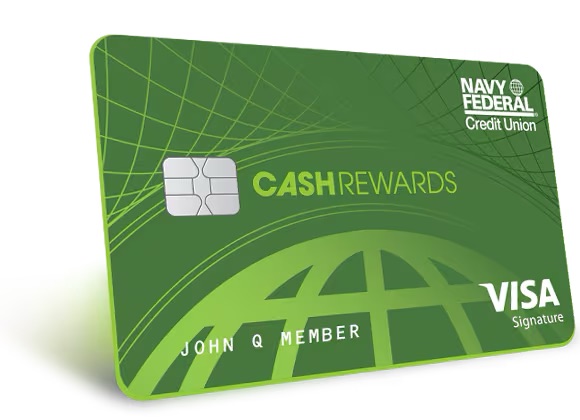
Navy Federal cashRewards Plus Card: $250 Bonus, 0% APR for 12 Months w/ No Balance Transfer Fee, 2% Cash Back, No Annual Fee

Updated with no balance transfer fee 0% APR offer. The Navy Federal cashRewards Plus Card is the new and improved sibling of the Navy Federal cashRewards Card (no “Plus”). The difference: If the credit limit you get is $5,000 and above, you get the Plus with a higher 2% cash back. Under $5,000; no Plus and the old 1.5% cash back. NavyFed has a limited-time offer starting January 2025. Rest of the highlights:

  • $250 cash back for new cardholders after $2,500 in purchases within 90 days of account opening.
  • NEW: 0% intro APR on balance transfers for 12 months, with no balance transfer fee. This limited-time offer ends 3/31/25.
  • Flat 2% cash back on all purchases with the cashRewards Plus card with $5,000+ credit limit.
  • Flat 1.5% cash back on all purchases with the cashRewards card with less than $5,000 credit limit.
  • No foreign transaction fees.
  • No annual fee.

There is no cap on cash back earned. Cash back does not expire as long as the account is open. Note: There is no longer any benefit to having direct deposit on a NavyFed checking account.

A few readers have commented that they don’t like dealing with miles or points, and prefer simple cash back. This is one of the better cash bonuses on a flat 2% cash back card with no annual fee. I would recommend to maximize your stated income to include all legitimate, eligible sources in order to get the highest credit limit possible.

The primary catch here is that in order to apply, you must be a NavyFed credit union member. Membership eligibility for NavyFed now goes beyond current and retired members of the armed forces to include their families and household members of veterans, Department of Defense personnel, and more. Eligible family members include your spouse, parents, siblings, grandparents, children, stepchildren and grandchildren. If you call them up, they can help you confirm the details on the veterans in your family. The effort can be worth it as NavyFed also offers other useful financial products like mortgages, car loans, certificates of deposit, etc.

M1 Review: DIY Robo-Advisor, $75 Bonus via Referral

I’ve tried out my share of robo-advisors, which always sounded nice in theory but I eventually became disillusioned as they kept generating lot of unnecessary capital gains every time they change their model portfolios to chase the latest and hottest trends. My favorite service for those that want a little extra help is one where I can pick my own custom target portfolio, but the robo still does the hard work: M1 Finance. Here’s a quick rundown of what makes them different:

  • Fully customizable. You pick your own target asset allocation “pie”. (You can add ETFs or individual stocks.) You can simply copy one of the many model portfolios out there, or make your own custom pie as you like. You have full control! M1 handles the tedious stuff, like rebalancing or dividing a $100 contribution across 8 different ETFs.
  • No commissions. Free stock/ETF trades with a low $100 initial minimum for taxable accounts and a $500 minimum opening amount for retirement accounts. After your initial deposit any amount greater than $10 can be deposited.
  • Free with $10,000 balance. Otherwise $3/month. Most robo-advisors charge an annual management fee of 0.25% to 0.50% of assets, or force you to own something bad, like a lot of low-interest cash. (Looking at you, Schwab…)
  • Free dynamic rebalancing. All new deposits (and withdrawals) will be invested (or sold) dynamically to bring your portfolio back toward your target asset allocation. M1 will also rebalance your entire portfolio back to the target allocation for you with a few clicks (for free) whenever you choose, on demand. You don’t need to do any math or maintain any spreadsheets.
  • Fractional shares (dollar-based). For example, you can just set it to automatically invest $100 a month, and your full amount will be spread across multiple ETFs. Dollar-based transactions were one of the advantages of buying a mutual fund, but fractional shares solve this problem. ETFs are also usually more tax-efficient than mutual funds.
  • Real brokerage account with off-the-shelf investments that you can move out. Some robo-advisors hold special, proprietary funds that you have to sell if you ever leave, possibly creating a big tax bill. (Looking at you, Fidelity…) M1 is built on a regular brokerage account, so you can move your Vanguard/iShares/Schwab ETFs and stock shares out to another broker whenever you want.

Now, for a long time, Vanguard didn’t offer automatic fractional investments into ETFs. But as of October 2024, Vanguard now offers fractional ETF investments.

Still, M1 Finance checks off many of the boxes of my brokerage wish list. The only thing they could add would be to have the high availability of knowledgeable customer service of a huge company like Fidelity or Schwab.

If you want to invest in newer factor ETFs that focus on Small-Cap, Value, Momentum, or Quality factors like those from DFA and Avantis, or a mix of dividend-oriented ETFs like SCHD/VIG/VYM, their service makes it much easier to set up a portfolio mix of different ETFs.

M1 Plus features are now available to everyone. M1 Plus was their premium subscription tier with several additional perks. As of May 2024, everyone gets these features, but they are only free with a $10,000 balance and $3/month otherwise.

  • High-yield savings (currently 4.00% APY as of 7/1/25). FDIC-insured up to $5 million.
  • Competitive margin rates.
  • Custodial accounts for kids.
  • Extra 3pm PM ET trade window.
  • Automated “smart” transfers.

$75 referral bonus. M1 has a $75 referral bonus if you open a new account with $10,000 and maintain it for 30 days. Here is my M1 referral link (thanks if you use it!) from which you must start opening your new account.

A bonus that amounts to 0.75% of your initial deposit with only a 30 day hold is technically a 9% annualized yield.

ACAT Transfer bonus. This is not currently available.

Bottom line. M1 Finance is a brokerage account that acts like a customizable robo-advisor with automatic rebalancing into a target portfolio. You control the model portfolio, and they do the tedious work. Great for implementation of a low-cost, index or passive ETF portfolio. New pricing structure as of May 2024: Free for those with $10,000 in assets, otherwise $3 a month.

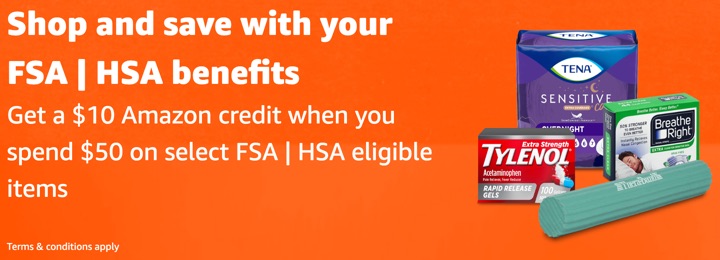
Last-Minute Healthcare FSA Reminder (Average Loss $441!), Amazon $10 FSA Offer

Updated for 2024, new $10 Amazon bonus. Here’s a year-end reminder to get back all the money sent into Healthcare Flexible Spending Accounts (HC FSA) due to their “use it or lose it” structure (see possible extensions below). According to the latest analysis by EBRI, roughly half (!) of FSA accountholders forfeited funds to their employer in 2022. The average forfeiture was $441.

I am picking up an extra pulse oximeter and forehead thermometer after our multiple fun journeys with kids and respiratory illnesses this year.

Quick ideas. If you didn’t exhaust your funds with insurance copays or deductibles, here are eligible items that you can still buy over-the-counter without a prescription. Just order things online and then submit the receipt. Amazon even has a special FSA-eligible page that directly accepts FSA/HSA debit cards, complete with an “under $25” and “little-known eligible items” section. Consider using this time to stock your hurricane/earthquake/snowstorm emergency kits.

Right now, they are also offering $10 Amazon credit when you spend $50 on eligible FSA items.

(You may need to view this page on the website to see all the Amazon links.)

The 2020 CARES Act added the following categories for 2021 and beyond:

Ideally, if you use an FSA card and shop through an eligible FSA store, things will be auto-approved. Otherwise, when getting a receipt, make sure it clearly includes the following:

  • Date of service or purchase
  • Name or description of the item
  • Amount of purchase

Deadline extensions. Employers have the option of adding one of the following:

  • Some plans allow a grace period until March 15th of the following year as opposed to a December 31st deadline to use your funds, but it may only apply to claims and not late purchases. Check with your employer on if they opted-in to these extensions.
  • Some plans allow participants to carry over up to $500 in unused FSA funds into next year. Check with your employer.

Big, exhaustive lists. Some of these are searchable by keyword as well.

But remember, your FSA administrator has the final say as to the exact guidelines for reimbursement according to your plan. Every year, I have to deal with claim rejections and extra paperwork. The skeptic in me suspects that this bureaucratic nightmare is part of their business model. (Remember mail-in rebates?) Guess who gets to keep unreimbursed FSA funds? The employer, which can then use the money to pay for… the FSA administrator.

Got a Health Savings Account (HSA) and think you are ineligible for an FSA? Look for a “limited-purpose FSA” option that is restricted to dental and vision care services. These have the same max annual salary deduction.

Amazon Last-Minute Gift Card Sale: Up to 20% Off (Lowe’s, Nordstrom, DoorDash, Uber, Instacart, Combos) + $200 No Fee Visa Gift Card

Tick, tock… Amazon is having a big last-minute gift card sale with up to 20% off many retailers. These aren’t the best deals ever for yourself, but they are useful as in-stock and on-time gifts for others. Accordingly, I like the combo cards with multiple options ($7.50 off $50).

In addition, you can get a $200 Virtual Visa eGift Card for exactly $200 (the $6.95 purchase fee is waived with promo code VISA). No physical card; Online use only. Notably, this card is both shipped and sold through Amazon, so it can trigger many of the Shop with Points promos from credit cards issuers mentioned in my Black Friday post. Use your Discover Cash Back, American Express Membership Rewards points, etc. and your net price may easily be much lower than $200.

  • “Happy Birthday” Combo: Lowe’s, Cheesecake Factory, AMC Movies, Outback, Gap
  • “Let’s Eat ” Combo: Cheesecake Factory, Chili’s, Cracker Barrel, Red Lobster, Panera Bread
  • “Fun & Fabulous” Combo: Sephora, Bloomingdales, Nordstrom
  • “On The Run” Combo: Panda Express, Krispy Kreme, Taco Bell
  • “Season’s Greetings” Combo: Macy’s, Gamestop, Lowe’s, Ulta
  • Lyft
  • Bath & Body Works
  • Instacart
  • DoorDash
  • Uber/Uber Eats
  • Google Play
  • Meta Quest
  • Panera Bread
  • Victoria’s Secret
  • Taco Bell
  • Under Armour
  • Domino’s
  • Petco
  • VUDU
  • Golden Corral
  • H&M
  • Chuck E. Cheese
  • Fandango
  • Foot Locker

(Please click here to view full post with Amazon links if viewing on RSS/email. I am an Amazon affiliate.)

TrueMed: Use Your Pre-Tax HSA/FSA Funds on Exercise Equipment

It’s that time of year, where I will soon remind you to use up your Healthcare Flexible Spending Account (FSA) funds before they expire. However, if you somehow have a large unused balance that you can’t offset with sunscreen and cold medicine, you may be interested in the possibility of using it towards exercise equipment.

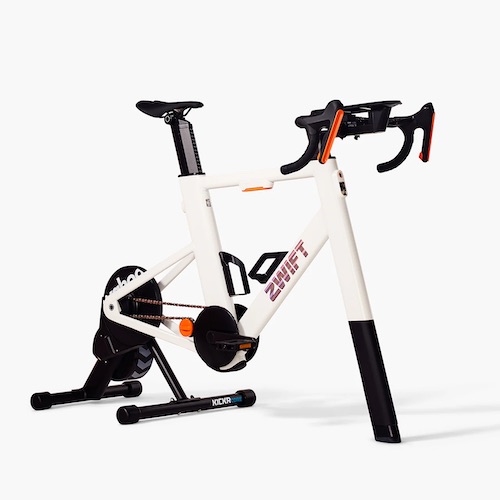
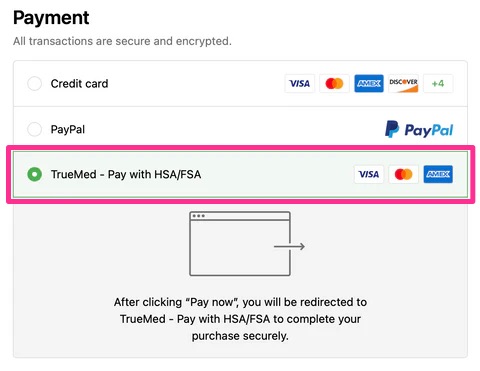
While shopping for a Zwift smart trainer bike, I came across a new checkout option called TrueMed that lets you “pay with HSA/FSA”. TrueMed claims to “unlock tax-free HSA/FSA spending for the leading exercise, healthy food and supplement companies”.

In order to use your HSA/FSA funds on these types of things, you need a Letter of Medical Necessity (LMN) – a signed document from a licensed healthcare provider that asserts that a product, treatment, or device is medically necessary for a patient. The LMN is valid for one year from the date it’s signed.

Check out this IRS alert: Beware of companies misrepresenting nutrition, wellness and general health expenses as medical care for FSAs, HSAs, HRAs and MSAs. For exercise equipment, you must be treating a specific medical condition (like a knee injury vs. general health):

Exercise equipment must be used to treat a specific medical condition in order to be considered eligible for reimbursement. Exercise equipment used for general health and wellbeing is not eligible for reimbursement.

It appears TrueMed provides the LMN after you fill out their online questionnaire. In some cases, I notice that they will charge you a fee like $15 to take the online questionnaire.

There is a movement redefining healthcare, focusing on proactive, root-cause solutions like fitness, nutrition, and innovative health technology. When you shop with Truemed merchants, you can seamlessly qualify for a Letter of Medical Necessity (LMN), enabling you to use pre-tax HSA/FSA funds for these transformative health interventions—saving you an average of 30%.

I’m not affiliated with TrueMed. I have not tried TrueMed and I have not submitted a claim for any exercise equipment using their Letter of Medical Necessity. In the end, it is still dependent on your specific claims administrator to approve the claim and accept the documentation you provide. I’ve come across a few examples of rejections, but also other reports that TrueMed later adjusted their practices in order to qualify. They appear to work with you:

My Claim Was Denied… Now What?

If you receive an alert of a denied claim, we are here to help! To best support you, please compile the following information.

– Denied Claim Information
– A screenshot or copy of the denial notice. This should include the denial reason clearly stated and also the denial code, if provided.
– The name of your HSA/FSA administrator, if not clearly shown on the denial notice.

Once you have this information compiled, please email support@truemed.com and include this information in the email body.

This may be worth further investigation if you are already committed to a specific exercise program or equipment as treatment. I’d prefer a bike as treatment for joint issues, hypertension, or obesity over more pills. As a checkout option, I like that it should come into play after you grab any other available discounts. I’ve historically had bad experiences with FSA claims administrators, so I would tread carefully.

Best Interest Rates Survey: Savings Accounts, Treasuries, CDs, ETFs – December 2024

Here’s my monthly roundup of the best interest rates on cash as of December 2024, roughly sorted from shortest to longest maturities. There are lesser-known opportunities available to individual investors, often earning more money while keeping the same level of safety by moving to another FDIC-insured bank or NCUA-insured credit union. Check out my Ultimate Rate-Chaser Calculator to see how much extra interest you could earn from switching. Rates listed are available to everyone nationwide. Rates checked as of 12/15/2024.

TL;DR: Slightly lower overall in the short-term. Only a few around 5% APY now. Still some 4%+ APY 5-year CDs. Compare against Treasury bills and bonds at every maturity, taking into account state tax exemption. I no longer recommend fintech companies due to the possibility of loss due to poor recordkeeping and/or fraud.

High-yield savings accounts
Since the huge megabanks still pay essentially no interest, everyone should at least have a separate, no-fee online savings account to piggy-back onto your existing checking account. The interest rates on savings accounts can drop at any time, so I list the top rates as well as competitive rates from banks with a history of competitive rates and solid user experience. Some banks will bait you with a temporary top rate and then lower the rates in the hopes that you are too lazy to leave.

  • The top rates at the moment are from newcomers TIMBR at 5.05% APY and Pibank at 5.00% APY. I have no personal experience with either, but they are the top rates at the moment. Most others have dropped at least a little. For example, CIT Platinum Savings is now at 4.55% APY with $5,000+ balance.
  • SoFi Bank is at 4.00% APY + up to $325 new account bonus with direct deposit. You must maintain a direct deposit of any amount (even $1) each month for the higher APY. SoFi has historically competitive rates and full banking features. See details at $25 + $300 SoFi Money new account and deposit bonus.
  • Here is a limited survey of high-yield savings accounts. They aren’t the top rates, but a group that have historically kept it relatively competitive such that I like to track their history.

Short-term guaranteed rates (1 year and under)
A common question is what to do with a big pile of cash that you’re waiting to deploy shortly (plan to buy a house soon, just sold your house, just sold your business, legal settlement, inheritance). My usual advice is to keep things simple and take your time. If not a savings account, then put it in a flexible short-term CD under the FDIC limits until you have a plan.

  • No Penalty CDs offer a fixed interest rate that can never go down, but you can still take out your money (once) without any fees if you want to use it elsewhere. Marcus has a 7mo/9mo/11mo No Penalty CD at 4.00% APY with a $500 minimum deposit. Farmer’s Insurance FCU has 9-month No Penalty CD at 4.50% APY with a $1,000 minimum deposit. Consider opening multiple CDs in smaller increments for more flexibility.
  • Langley Federal Credit Union has a 10-month certificate special at 5.25% APY ($500 min, $50,000 max). This is a promo for new members only. Anyone can join this credit union nationwide; you must maintain $5 in their share savings account. Early withdrawal penalty is 90 days of interest.

Money market mutual funds
Many brokerage firms that pay out very little interest on their default cash sweep funds (and keep the difference for themselves). Note: Money market mutual funds are highly-regulated, but ultimately not FDIC-insured, so I would still stick with highly reputable firms.

  • Vanguard Federal Money Market Fund (VMFXX) is the default sweep option for Vanguard brokerage accounts, which has an SEC yield of 4.54% (changes daily, but also works out to a compound yield of 4.64%, which is better for comparing against APY). Odds are this is much higher than your own broker’s default cash sweep interest rate.
  • Vanguard Treasury Money Market Fund (VUSXX) is an alternative money market fund which you must manually purchase, but the interest will be mostly (80% for 2023 tax year) exempt from state and local income taxes because it comes from qualifying US government obligations. Current SEC yield of 4.49% (compound yield of 4.58%).

Treasury Bills and Ultra-short Treasury ETFs
Another option is to buy individual Treasury bills which come in a variety of maturities from 4-weeks to 52-weeks and are fully backed by the US government. You can also invest in ETFs that hold a rotating basket of short-term Treasury Bills for you, while charging a small management fee for doing so. T-bill interest is exempt from state and local income taxes, which can make a significant difference in your effective yield.

  • You can build your own T-Bill ladder at TreasuryDirect.gov or via a brokerage account with a bond desk like Vanguard and Fidelity. Here are the current Treasury Bill rates. As of 12/13/24, a new 4-week T-Bill had the equivalent of 4.31% annualized interest and a 52-week T-Bill had the equivalent of 4.24% annualized interest.
  • The iShares 0-3 Month Treasury Bond ETF (SGOV) has a 4.88% SEC yield (this looks old) and effective duration of 0.10 years. SPDR Bloomberg Barclays 1-3 Month T-Bill ETF (BIL) has a 4.42% SEC yield and effective duration of 0.08 years.

US Savings Bonds
Series I Savings Bonds offer rates that are linked to inflation and backed by the US government. You must hold them for at least a year. If you redeem them within 5 years there is a penalty of the last 3 months of interest. The annual purchase limit for electronic I bonds is $10,000 per Social Security Number, available online at TreasuryDirect.gov.

  • “I Bonds” bought between November 2024 and April 2025 will earn a 3.11% rate for the first six months. The rate of the subsequent 6-month period will be based on inflation again. More on Savings Bonds here.
  • In mid-April 2025, the CPI will be announced and you will have a short period where you will have a very close estimate of the rate for the next 12 months. I will have another post up at that time.

Rewards checking accounts
These unique checking accounts pay above-average interest rates, but with unique risks. You have to jump through certain hoops which usually involve 10+ debit card purchases each cycle, a certain number of ACH/direct deposits, and/or a certain number of logins per month. If you make a mistake (or they judge that you did) you risk earning zero interest for that month. Some folks don’t mind the extra work and attention required, while others would rather not bother. Rates can also drop suddenly, leaving a “bait-and-switch” feeling.

  • OnPath Federal Credit Union (my review) pays 7.00% APY on up to $10,000 if you make 15 debit card purchases, opt into online statements, and login to online or mobile banking once per statement cycle. Anyone can join this credit union via $5 membership fee to join partner organization. You can also get a $100 Visa Reward card when you open a new account and make qualifying transactions.
  • Genisys Credit Union pays 6.75% APY on up to $7,500 if you make 10 debit card purchases of $5+ each per statement cycle, and opt into online statements. Anyone can join this credit union via $5 membership fee to join partner organization.
  • La Capitol Federal Credit Union pays 6.25% APY on up to $10,000 if you make 15 debit card purchases of at least $5 each per statement cycle. Anyone can join this credit union via partner organization, Louisiana Association for Personal Financial Achievement ($20).
  • NEW: Falcon National Bank pays 6.00% APY on up to $25,000 if you make at least 15 debit card purchases, 1 direct deposit OR ACH credit transaction, and enroll in online statements.
  • Credit Union of New Jersey pays 6.00% APY on up to $25,000 if you make 12 debit card purchases, opt into online statements, and make at least 1 direct deposit, online bill payment, or automatic payment (ACH) per statement cycle. Anyone can join this credit union via $5 membership fee to join partner organization.
  • Andrews Federal Credit Union pays 6.00% APY on up to $25,000 if you make 15 debit card purchases, opt into online statements, and make at least 1 direct deposit or ACH transaction per statement cycle. Anyone can join this credit union via partner organization.
  • Find a locally-restricted rewards checking account at DepositAccounts.

Certificates of deposit (greater than 1 year)
CDs offer higher rates, but come with an early withdrawal penalty. By finding a bank CD with a reasonable early withdrawal penalty, you can enjoy higher rates but maintain access in a true emergency. Alternatively, consider building a CD ladder of different maturity lengths (ex. 1/2/3/4/5-years) such that you have access to part of the ladder each year, but your blended interest rate is higher than a savings account. When one CD matures, use that money to buy another 5-year CD to keep the ladder going. Some CDs also offer “add-ons” where you can deposit more funds if rates drop.

  • Credit Human has a 59-month CD at 4.11% APY. 48-month at 4.11% APY. 35-month at 4.25% APY. 23-month at 4.30% APY. 1-year at 4.40% APY. $500 minimum. The early withdrawal penalty (EWP) for CD maturities of 36 months or more is 365 days of interest. For CD maturity of 1 year, the EWP is 270 days of interest. This is actually a credit union, but is open nationwide with a American Consumer Council (ACC) membership. Try promo code “consumer” when signing up at ACC for a free membership.
  • Synchrony Bank has a 5-year certificate at 4.00% APY (no minimum), 4-year at 3.50% APY, 3-year at 3.75% APY, 2-year at 3.50% APY, and 1-year at 4.00% APY. Early withdrawal penalty for the 4-year and 5-year is 365 days of interest.
  • BMO Alto has a 5-year CD at 3.90% APY. 4-year at 3.80% APY. 3-year at 3.80% APY. 2-year at 3.80% APY. 1-year at 4.20% APY. No minimum. The early withdrawal penalty (EWP) for CD maturities of 1 year or more is 180 days of interest. For CD maturities of 11 months or less, the EWP is 90 days of interest. However, note that they reserve the right to prohibit early withdrawals entirely (!). Online-only subsidiary of BMO Bank.
  • You can buy certificates of deposit via the bond desks of Vanguard and Fidelity. You may need an account to see the rates. These “brokered CDs” offer FDIC insurance and easy laddering, but they don’t come with predictable early withdrawal penalties. Right now, I see a 5-year non-callable CD at 3.90% APY (callable: no, call protection: yes). Be warned that both Vanguard and Fidelity will list higher rates from callable CDs, which importantly means they can call back your CD if rates drop later. (Issuers have indeed started calling some of their old 5%+ CDs during 2024.)

Longer-term Instruments
I’d use these with caution due to increased interest rate risk (tbh, I don’t use them at all), but I still track them to see the rest of the current yield curve.

  • Willing to lock up your money for 10 years? You can buy long-term certificates of deposit via the bond desks of Vanguard and Fidelity. These “brokered CDs” offer FDIC insurance, but they don’t come with predictable early withdrawal penalties. You might find something that pays more than your other brokerage cash and Treasury options. Right now, I see a 10-year CDs at [n/a] (non-callable) vs. 4.40% for a 10-year Treasury. Watch out for higher rates from callable CDs where they can call your CD back if interest rates drop.

All rates were checked as of 12/15/2024.

Photo by Giorgio Trovato on Unsplash