Can Having Too Many Credit Cards Hurt Your Credit Score?

I got three e-mails with this same question yesterday! Mostly, people want to either participate in balance transfer arbitrage or grab a few new rewards cards.

To start off, we must realize that all credit scores are based on secret formulas, supposedly generated by supercomputers and mountains of data to accurately predict our creditworthiness. This results in companies like FICO never truly revealing the ingredients to the secret sauce, otherwise we could just do it ourselves and they’d have nothing to sell.
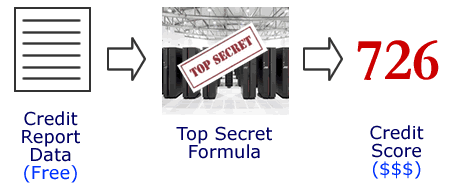
fico data turned into fico scores

In other words, nobody truly knows the answer. Now, I have never read anything official that specifically listed “number of credit cards” as a negative factor in scoring. We can only examine what they have revealed and try to read between the lines. For example, FICO has previously released this breakdown:
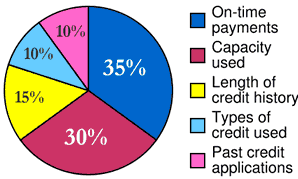
image altered from original in wikipedia: http://en.wikipedia.org/wiki/Credit_score

Some of these aren’t related at all to the number of credit cards you have, such as “on-time payments” and “mix of credit used”.

Capacity used – This simply means how much of your available credit you are using, sometimes referred to as utilization ratio. If you’re maxed out on all your cards, obviously that’s not a good sign. If anything, having more credit cards would mean more available credit would lower this your utilization ratio and be a good thing. Now, individual creditors might balk at someone having too much available credit, but it doesn’t appear to factor into the FICO score.

Length of credit history and past credit applications – To be specific, not the only length of your oldest line, but also the average age of all your accounts matters. Continuously opening new credit lines will hurt your credit score. At the same time, having a lot of old cards can “anchor” your average account age as well. For example, if I already have 20 cards averaging 7 years old, adding another new credit card won’t make that average budge hardly at all. Again, we see that if anything, having a lot of cards might actually be helpful. (This is why I also don’t cancel credit cards unless it’s profitable to do so.) However, opening a bunch of cards all at once is also an indicator of desperation, so I limit myself to about 3-5 credit cards per rolling 6-month period (for profit and more profit).

Another source of information is the FICO Score Estimator from myFICO. Here, how many credit cards you have is the first question asked! Uh-oh. But again, I think the first two questions mainly help determine your average account age. It’s also a filter as you need at least one card that is 6 months old for the estimator to work. If you look at all 10 questions you’ll see many parallels with the pie chart factors.

Finally, there is personal experience. I have over 20 credit cards (average is ~10 per consumer) and have seen no indication that having too many credit cards makes my score any lower. When not in 0% debt, my score is excellent. Therefore, if you ask me, having too many credit cards may give people too much temptation or too much clutter, but based on the evidence available I don’t believe that having too many cards by itself lowers one’s credit scores.
Make Money From Credit Cards: 0% Balance Transfer Profit Calculator Tool

My series of articles on How To Make “Free” Money From 0% APR Balance Transfers has been very popular and many readers have also jumped in. Despite the risks, I’m still happily earning some money from the credit card companies for a change, and haven’t missed any payments. From the beginning, people have asked me to make a spreadsheet or calculator in order to estimate the potential profit from such endeavors. I initially decided against doing so because there are lots of different variables at stake that make an exact prediction close to impossible. However, I think it may still be useful to obtain some more realistic numbers.

Without further ado, I present to you the…

0% Balance Transfer Profit Calculator

Enter savings account APY: %
Enter starting balance: $
Enter the monthly minimum payment percentage (2%) %
Your interest earned:   $
(See assumptions and definitions below)

Inputs and Definitions

  1. Arbitraged Interest Rate (APY) – Where are you putting the money you’re borrowing for free? This is the interest rate of the investment vehicle (savings account, CD, Treasury bond) you are using, or perhaps the interest rate of the existing loan (car, home equity, student) that you are paying down.
  2. Starting Balance (dollars) – How much money are you transferring?
  3. Monthly Minimum Payment (%) – Usually you must still make a monthly minimum payment on the outstanding balance during the 0% period, which will decrease your profit potential slightly. This is usually around 2%, but may vary between 1.5% and 4%.

Assumptions

  1. The balance transfer is for 12 months at 0% APR, with no balance transfer fee. You can find my list of the best 0% APR offers here with low or no balance transfer fees here.
  2. The interest is assumed to compound monthly, which allows me to convert from APY to APR, and then to a periodic rate. Compounding frequency is a variable here, but doesn’t change the numbers too much.
  3. I am ignoring the time required to actually convert the balance transfer into cash earning interest. Sometimes this can take up to a few weeks, sometimes it is much faster. Instead of guessing, I just leave it be.
  4. I am also ignoring things like grace periods and the timing of statement cycles and due dates, which can actually increase the time that your borrowed money is earning interest, and thus your profit.
  5. If you are earning interest in a taxable bank account, you will likely owe income tax on that interest at your marginal rate. This is not accounted for in the calculator, but is a simple calculation.

(If you’re confused about what I am talking about, please refer to the tutorial mentioned above.)

Example Profit Calculation
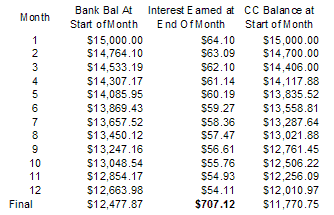
Let’s say you obtain $15,000 and place it in a bank account paying 5.25% APY, with a 2% monthly payment. Using our assumptions, the 5.25% APY is equivalent to 5.13% APR, or earning 0.4273% of the balance each month.

Beginning of Month #1: You have $15,000 in the bank. Total balance left on credit card: $15,000. Nothing is due yet.
End of Month #1: You earn $64.10 in interest, but also need to pay back $300 (2% of $15,000) out of your bank balance for the minimum payment.

Beginning of Month #2: Total in bank:$14,764.10. Total balance left on credit card: $14,700.
End of Month #2: You earn $63.09 in interest, but also need to pay back $294 (2% of 14,700).

This continues for 12 months, as shown below:

altext

At the end of the 12th month, your bank balance is $12,477.87, and you still owe $11,770.75 on the card. You pay it off completely, leaving you with the resulting estimated profit of $707.12.

Play around with the calculator. Some people actually have over $100,000 out at once, earning them thousands of dollars a year. My credit limits aren’t quite that high…. yet!

Reader Question: Pay Off Credit Cards vs. Invest Your Money?

I’ve gotten a few variations of this question recently:

I’ve only got about $5,000 in savings and about $4,000 in credit card debt. I’m not sure if I should pay off my cards first before I decide to invest or what. I’m just looking for a way to make my money work harder. – Michael, New Investor

I indirectly addressed this topic in my post titled You Have Some Money. Where Do You Put It?, where the my top 4 were listed as:

  1. Invest in your 401(k), if you have one, up until the match.
  2. Pay down your high-interest credit card debt.
  3. Create an emergency fund with at least 2 months.
  4. Fully fund your Roth IRA.

If you read through the many thoughtful follow-up comments, you’ll see that many people have differing views on this. I’ll try to clarify my own positions here, but although I will try to provide good reasons behind then, I do agree that this is all very subjective. As usual, the ultimate goal is to present all the arguments in order to help everyone better determine their own personal solution.

#1 Invest in your 401(k), if you have one, up until the match.
Many employers offer matching 401(k) contributions. So if you contribute $100 from your paycheck, your employer will also chip in $50-$100. This is an instant 50-100% return… Some would even call this free money! Unless your credit card interest rates are over 50%, mathematically you are ahead by far. In addition, you have now started your nest egg for retirement.

Exception: The benefit of this match gets a little hazy as often you have to work for a number of years before the matched amount “vests”, or officially becomes yours. You may never actually get to keep much of the match if you only work for a year or two, so take your long-term prospects into account.

#2 Pay down your high-interest credit card debt.
Here we reach one critical debate: Paying Down Debt vs. Roth IRA. On one side, we have high interest (say, over 8% right now) debt. On the other, we have the opportunity for tax-free growth.

My argument here is, again, simple math. If on one hand you have money in stocks growing (maybe) at 10% tax-free, and on the other hand you have money shrinking at 18% with no tax deductions, you’re still losing money! Therefore, I feel the best general decision is put all that money towards your debt. Yes, saving now may mean much larger balances later, but remember, here you are choosing one or the other here, and not paying off the credit cards puts you behind.

The counterargument to this is that you only get to put in $4,000 in a Roth every year and that is precious. You can’t put nothing in this year and $8,000 next year. If you are sure that your tax rate to be higher in retirement than now, and you don’t expect to have access to other similar options like a Roth 401(k) or 403(b) in the future, then I can see how putting money towards the Roth may be better.

(Now that I think of it, another reason might be that Roth IRAs are protected in case you decide to wipe out all your credit card debt in bankruptcy court…)

Exception: One should always try to lower their interest rates if possible by calling the credit card issuers directly or, if your credit is high enough, try to get a low interest balance transfer onto another card.

#3 Create an emergency fund with at least 2 months.
Here is another hard question: Where does an emergency fund play into all of this? Overall, I think people should pay down their high-interest debts as much as possible before saving up 6-12 months of emergency funds.

Why? For one thing, if an emergency does occur, many expenses can be simply be put back onto those same credit cards: utilities, food, clothing, medical bills, etc. Other things like rent can be paid via cash advance. Since it’s most likely an emergency won’t occur, you’ll be saving a lot of interest by paying off the high-interest debt now.

The reason I put 2 months down is because I wanted to designate this a “barebones” emergency fund. The actual amount needed depends heavily on the individual: How stable is your job? Do you have disability insurance? Would your parents or someone else bail you out?

Fully fund your Roth IRA.
Although you can withdraw your contributions out of a Roth if you need to, the Roth should be a last resort. Therefore, you have the “barebones” emergency fund first, and then the Roth IRA. Should a Roth be above even a barebones emergency fund? That’s a judgment call. In my mind, a barebones emergency fund is maybe $2,000. Otherwise, you’re literally living paycheck-to-paycheck, during which I would worry about now first before the future and Roth IRAs.

Exceptions: As noted earlier, the Roth IRA is really only better than a Traditional IRA or 401k if you expect your marginal tax rate to be higher in retirement than when you make your contributions. If you expect them to be the same, they are essentially equal, with the Roth taking perhaps a slight edge. Here’s the math showing why… Say you have $10,000 pre-tax income to contribute, 25% marginal income tax rate both now and in retirement, 8% annual return, and a 30 year horizon.

401k (pay tax later):
( 10,000 x 1.08^30 ) [compounding] x ( 1 – .25%[tax later] ) = $75,469

Roth (pay tax now):
( 10,000 x ( 1 – .25%[tax now] ) )x (1.08^30) [compounding] = $75,469

If your tax now > tax later, the 401k comes out ahead. If tax now < tax later, the Roth wins. Please share your thoughts in the comments, if I haven't confused you completely already...

Updates on the American Express Gold Card 25,000 Mile Bonus Offer

The New Business Gold Rewards Card from American Express Image

Update: The below promotion is now expired. The New Business Gold Rewards Card® from American Express OPEN now offers 3X points on airfare, 2X points on advertising, gas, and shipping and 1X point on everything else. The annual fee for this card is $175 but it is waived for all new cardholders. You can also get unlimited additional gold cards for an extra annual fee of $50 but this fee is waived for the first year as well.

I finally got around to opening some mail today and saw that my New Business Gold Rewards Card® from American Express OPEN arrived. I had almost forgotten I had applied for it in the whole move. (I convinced my wife to apply as we could really use the 25,000 Membership Reward sign-up bonus as frequent flier miles.)

As has been reported by other readers, the paperwork that came with it only mentions a bonus of 5,000 points after the first purchase and another 20,000 after spending $50,000. I really wanted to get to the bottom of this, so I called American Express and talked with multiple reps about the bonus. I explained to them that the wording is very clear, I have the specific bonus code, and is the offer still up after more than two weeks, so it is clearly not some unintentional misprint:

Upon the Basic Cardmember’s first purchase, a one time bonus of 25,000 points can be earned toward the Basic Business Gold Rewards Cardmember’s Membership Rewards? account and may appear as separate credits of 5,000 and 20,000 bonus points.

Most of the reps seemed like robots and just sounded confused as this wasn’t on one of their scripts, so I just ended the call quickly in that case. But two of them were familiar with this promotion, and said that they had already fielded several calls about it. The summary:

1. The same paperwork goes out to everybody, and what is mentioned is the standard, older promotion. This doesn’t mean you won’t get the 25,000 points, as this special promotion does exist and is valid.
2. The problem is that they can’t tell on their computers which promotion you signed up for. However, it should be tracked in their systems internally if you used the right link. I would keep a print-out of your page. If you want, you can call them and ask them to note specifically the Bonus ID 2329 on your account, which may help you dispute if anything does happen later.
4. Otherwise, there is really nothing you can do right now. Personally, I am confident that they will come through, as I have already scored $100 + 5,000 miles from the same card last year, and in that case nothing about any bonus was mentioned in the paperwork that came with the card! I’m just going to make my first purchase quickly, tuck it away, and wait the 6-8 weeks.

LifeLock Review: DIY and Protect Your Identity For Free

You’ve probably seen commercials for a service called LifeLock, which offers identity theft protection services ranging from $10 to $30 a month. After a $12 million settlement with the FTC over deceptive marketing practices, they are again in trouble with the FTC over… their deceptive marketing practices. The main problem that I have with this service is that they are charging you for things you could do yourself, and often you will have to do it yourself even if you pay them.

Here’s what they used to say:

First, we ask the credit bureaus to set fraud alerts on your behalf. Usually, this is done through our automated systems and the alerts are set within an hour. From time to time there may be a hitch and we have to do the first one manually, usually because they have a different address on file for you. If this happens, we’ll tell you right away and do what needs to be done to get the alerts set.

Since then, I believe the credit bureaus have gotten angry at Lifelock (making money off of your data is their job!) and now you have to set the credit freezes yourself.

Free – Just call the numbers below. Technically, alerting any single bureau should automatically initiate fraud alerts on all of them, but it may be more reliable to simply call each one separately.

* Equifax: 800-685-1111; Fraud Dept. 800-525-6285
* Experian: 888-397-3742 (same for Fraud Dept.)
* Trans Union: 800-916-8800; Fraud Dept. 800-680-7289

I should note that this will also hinder your ability to get quick approvals for things like auto loans or credit card applications. One good tip is to use your cell phone as the contact number so that the bureaus can quickly verify your identity when you really do want to apply for credit.

Second, unless your circumstances change and you tell us not to, every 90 days or so we ask the credit bureaus to do it again.

Free – Use Google Calendar (also free) to e-mail you a reminder to call again in 90 days. Rinse and repeat.

Third, we request that your name be removed from pre-approved credit card and junk mail lists and we keep making the requests as they expire. Statistics show that this is one of the most common ways that thieves hijack identities. Plus, all that mail is just so irritating. Many of our clients tell us that this alone is worth the price.

Free – Just go to OptOutPrescreen.com to get removed for 5 years. I’m probably in the minority here, but I kind of like getting pre-approved offers myself, it helps me track trends in interest rates, special offers, and gives me an idea of how good my credit score is.

Fourth, we order your free credit reports on your behalf from the major credit bureaus and they are sent directly to you. We do this every year.

Free – Yet another feature that is free to all by the Fair Credit Reporting Act, and can be found at AnnualCreditReport.com. In fact, here are 4 more ways to get a free credit report. One of them is simply placing a fraud alert as described about. If you keep setting one up every 90 days, you can technically get a total of 15 free reports every year (3 credit bureaus x 5 each).

Last, but certainly not least: If your Identity is stolen while you are our client, we?re going to do whatever it takes to recover your good name. If you need lawyers, we?re going to hire the best we can find. If you need investigators, accountants, case managers, whatever, they?re yours. If you lose money as a result of the theft, we?re going to give it back to you. We will do whatever it takes to help you recover your good name and we will spend up to $1,000,000 to do it.

Not free. But, you can get lower levels of identity theft protection for free at various financial institutions like your local credit union or at many major banks, just for having an account with them.

So, is the convenience of LifeLock, as well their $1 million dollar insurance policy worth $110-120 a year? My vote is no. Although I’m sure that identity theft can be very painful and costly, if you really did all the free things above your chances of being affected are very slim. The time saved is minimal and the “million dollar guarantee” seems to be overkill and more of a marketing ploy. If anything, I’d use the money to go buy a good paper shredder instead.

The Daily Show’s Take on Credit Card Debt

Here’s a funny clip about credit cards from the The Daily Show. Thanks to Ross for the tip.

I especially like the theory that as long as your carry your debt long enough, you can simply die and never pay it off! Why didn’t I think of that??

Future FICO Scores Won’t Consider Authorized Users

I had written previously about renting out your credit score, which takes advantage of a loophole in the credit score formula and allows people with poor credit scores to pay others with excellent credit so as to be added as an authorized user. This currently legal act can boosts a poor credit score as much as 200 points, and is most commonly used to obtain a lower rate on their mortgage loans. As you might expect, lenders aren’t too happy about this.

According this AP article ‘Piggybacking’ Roils Credit Industry, this has led to some potential significant upcoming changes in the FICO scoring process:

Ninety percent of the largest U.S. banks base their loan decisions on FICO scores, which currently includes authorized user accounts. However, after discussions with lenders and industry officials, Fair Isaac said it intends to announce this week that all future versions of its FICO score methodology will no longer consider authorized user accounts, said Tom Quinn, Fair Isaac’s vice president of scoring solutions.

The next version is slated to roll out in September to one of the three main credit reporting agencies — Equifax Inc., Experian Information Solutions Inc. or TransUnion LLC — with the other two agencies receiving the new version some time in 2008.

Quinn also noted that some lenders generate their own scores using authorized user accounts in their calculations, so the practice may not be easily negated.

Other consumers besides credit renters stand to lose with the change, namely those for whom authorized user accounts were designed: college students on their parents’ cards and spouses with little to no credit of their own.

That’s too bad, I would think that there would be a better way to close the loophole. Perhaps simply make it illegal for one to accept money for adding an authorized user? That would at least shut down the websites running openly.

Who Needs Extreme Sports When You Can Be A 0% APR DareDevil?

MSN Money recently wrote a new article titled 0% daredevils chase ‘free’ cash discussing the practice of borrowing cheap money from credit cards offering 0% APR interest and no fees, putting that money into an online savings account at 5-6%, and pocketing the difference as profit!

Now, I may be a tiny bit biased, but I think my series of step-by-step posts on how to make money with 0% APR balance transfers is a better. (I suspect she might have even read it before writing her article!) I even put my warnings in the very first post. 😉

Pay Your Mortgage On Credit Cards, Buyer’s Agent Rebates Are Not Taxable, Japan’s Real Estate Bubble

Buyer’s Agent Rebates Are Not Taxable
It struck me that the buyer’s agent rebates I am seeking may be taxable income. That would stink. But it seems that Redfin, another company that does rebates in selected areas, received a private letter ruling from the IRS that states that such rebates are not considered income. 1099s are not submitted, and nothing is reported to the IRS.

Japan’s Real Estate Bubble
Got Bubble? I stumbled upon this article comparing the Japanese real estate bubble with the situation in the US. Did you know that residential real estate in Tokyo dropped for 17 straight years? Definitely will be reading more about this.

Pay Your Mortgage On Credit Cards
It had to happen one day. Although there are some hoops to jump through (you can’t be sub-prime) and it’s only available through specific lenders, American Express is letting people pay their mortgages with a credit card. There’s a $395 initial fee paid at closing, but the potential rewards might let you break even after only a few years.

Are 0% APR Balance Transfer Offers Coming To An End?

If you are making money off of balance transfers or have been considering it, the following observations might be of interest to you. Otherwise, it probably won’t 😉

The Bad News
A few months ago, Citibank started saying “Balance transfer fees apply with this offer” on certain applications, even though the Terms and Conditions clearly stated that there was still no fee for initial balance transfers. Then, a few weeks afterwards, the longstanding Citi Platinum Select card, which used to offer a sweet deal of 0% APR on purchases and balance transfers for years, started charging a fee.

More recently, on May 1st, Discover stopped offering no-fee balance transfers on all their cards, instead implementing 3% fees with $50 to $75 caps. The Miles Card by Discover still offers 12,000 bonus miles, which is worth $100 in travel credit to offset the fee.

The Good News
Still, there are plenty of Citibank cards that remain which offer 12 months of 0% APR on balance transfers with no initial balance transfer fees: (none anymore)

For alternatives, please see my list of updated
best 0% APR balance transfer offers.

Should I Save Some For Later? (SFL)
Also, if you are concerned about having less 0% APR offers in the future, you can actually “tuck away” one or two of them for later. In the Terms and Conditions for the cards marked “SFL” above, you will see this:

Balance transfer APR: As long as first balance transfer is completed within 12 months from date of account opening, 0.00% for 12 months from date of first balance transfer. After that, XX.XX% variable.

So, you can actually wait 12 months from the date of account opening to start the balance transfer, and then still enjoy 12 months at 0% APR. Some of the cards also offer rewards programs (marked “Rewards” above), which can give you cashback on everything from utilities to restaurants, whatever fits your spending the best.

Got questions? Please read my details series of step-by-step posts on how I and others do this first. Lots of good stuff there!

Surprising Truths (and Half-Truths) About Credit Card Debt

You’ve probably heard that the average American has over $8,000 of credit card debt. It’s been quoted all over the place. But does that single stat accurately explain the whole picture?
A popular source of this data is CardWeb Inc., which tracks such credit card data. Let’s take their 2002 data, which says that American households had average credit card debt of $8,940. Wow! But look closer. This figure is arrived at by dividing total credit card debt outstanding at the end of 2002 ($750.9 billion) by the number of American households that have at least one credit card (84 million). So not only are you counting balances that will be paid in full within the grace period, you are also only dividing by just the households that have a credit card. There are 21 million families with no credit cards at all.

Instead, I think you should only take the the amount of debt that Americans actually paid interest on, and divide it by all American households. To me, this is a more accurate definition of “average credit card debt per American”. This is $612 billion divided by 105 million, or $5,829 per household. And that’s not all.

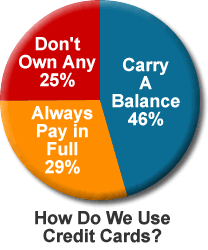
Another source of information is the Federal Reserve’s Survey of Consumer Finances (SCF). Here, the 2004 survey found that the average (mean) balance for those carrying a balance was $5,100, but the median was only $2,200. The large difference between the mean and median values indicates that the debt is not spread around equally – a small amount of borrowers have the majority of the debt. In addition, only 46% of families actually carried a balance, and 25% of families don’t even have any credit cards at all.
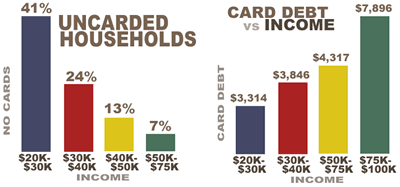

Now, what is the relationship between debt and income level?

altext

(This is actually based on Cardweb data, but the SCF data is very similar.)

Here, we see that as income increases, people are more likely to both use credit cards and also carry higher balances. But from a recent Gallup poll, while the overall debt-to-income ratio among credit card holders is 8.0%, it is over 10% among people earning less than $40,000 a year, and much smaller among people with higher incomes.

Also, I observed that the Federal Reserve total debt numbers are lower than the Cardweb numbers, but the other stats like card ownership and the distribution vs. income are very similar. I suspect that one major reason for this is the self-reported nature of the SCF: People are underestimating their debt due to either denial or embarrassment. So that $2,200 number above may be higher in reality, but still not as high as $5,000 or $9,000.

Summary
On one hand, you cannot refute the fact that credit card debt is indeed a huge problem for many families. Any way you cut it, $612 billion is a big number. And the families with the highest debt-to-income ratios are earning less than $40,000 a year. I think better education and more transparency in credit applications should be implemented.

However, many of the sound bites thrown around about credit cards are very misleading. The majority of households don’t pay any credit card interest at all. None. Zero. Zilch. Of the families that do carry a balance, the median amount owed is in the neighborhood of $2,000-$3,000. Paints a different picture, doesn’t it?

(Yes, people like me who profit from credit card debt probably skew the stats a little tiny bit as well. 😛 )

References
The idea for this post was taken from an older MSN Money article, which used 2001 data. You can find the 2004 Survey of Consumer Finances here, and the Cardweb data here.

Got Good Credit? Rent It Out For Cash!

You have bad credit. You want to buy a house. Why bother with such old-fashioned ideas like paying off debts and slowly building back your credit? You want that McMansion now! All those other sub-prime defaults are just crimping your style. Well, now you can simply buy good credit! Or more accurately, rent it.

It’s been a well-known practice for parents add to their kids as authorized users on their credit card accounts. Besides letting them buy textbooks, this can boost their credit scores because that larger and long-standing credit line will show up on their borrowing history as if it were theirs. Now add three critical facts:

1. Authorized users don’t have to be related to you.
2. There is no limit on how many authorized users you can.
3. There is no law against the rental or sale of authorized-user designations.

You see where this is going? From a recent Washington Post article titled Credit Scores for Sale:

Exploiting that loophole, numerous companies have popped up on the Internet offering to buy and rent out the credit card “trade lines,” or accounts, of credit card holders with high limits and perfect payment histories.

The person seeking a higher credit score does not obtain access to the credit card. Within 30 to 90 days of being added to the account, the national credit bureaus incorporate the primary cardholder’s ongoing account information into the files of the authorized user. The score-raising attributes of the primary cardholder’s stellar payment record then flow through to the new user.

One example site mentioned is AddaTradeLine.com. The site screams shady. Still, I wanted to see how much my “seasoned” credit lines were worth.

2) How much will I get paid?

The amount varies, and it depends on the age of the card, and the credit limit. We pay the most for old cards (30-40 years old) and high limits (100k or more) We do pay for any cards you have with a limit of at least 1k, and at least 6 months old. If the card is less than 6 months old, but has a credit limit of $5,000 or more, we can rent that as well. We are currently offering 25% payout on what our customers pay. Based on our current pricing, you would receive anywhere from $125 to $625 per transaction. To get paid at the higher tiers, you need to have a more attractive credit card account. An example would be a 30 year old Visa card with a reported limit of $150,000. A typical example of an $125 tradeline payout would be one 3months old, with a limit of $7,500.

They report people adding upwards of a hundred authorized users per card on a desirable credit line! That’s over $10,000, with no direct hit to your credit score.

But is this really safe? (Let me put on my evil thinking-cap.) If you add a stranger as an authorized user, they can get your credit card number from their credit reports (some have them partially blocked out, but not my old Transunion one). Since you’re having the extra card sent to your own home, your address may even show up on their credit reports as an alternate address. If they do a reverse phone book lookup on that address, they would have your name. So now they have your name, address, and credit card number. There are a very finite amount of possible expiration dates. And they are an authorized user. Hmm… even with ethical considerations aside, this doesn’t seem like a good idea. Thanks to Nathan for the tip.

Besides, I already profit from my good credit score by sacrificing a bit of it to borrow money for free and earn interest off it.