2024 Year-End Review: Annual Broad Asset Class & Target Fund Returns

Happy New Year! 🎉 🥳 Let’s see how the year went for the broad asset classes that I track. Per Morningstar, here are the total annual returns (includes price appreciation and dividends/interest) for select asset classes as benchmarked by popular ETFs after market close 12/31/24.
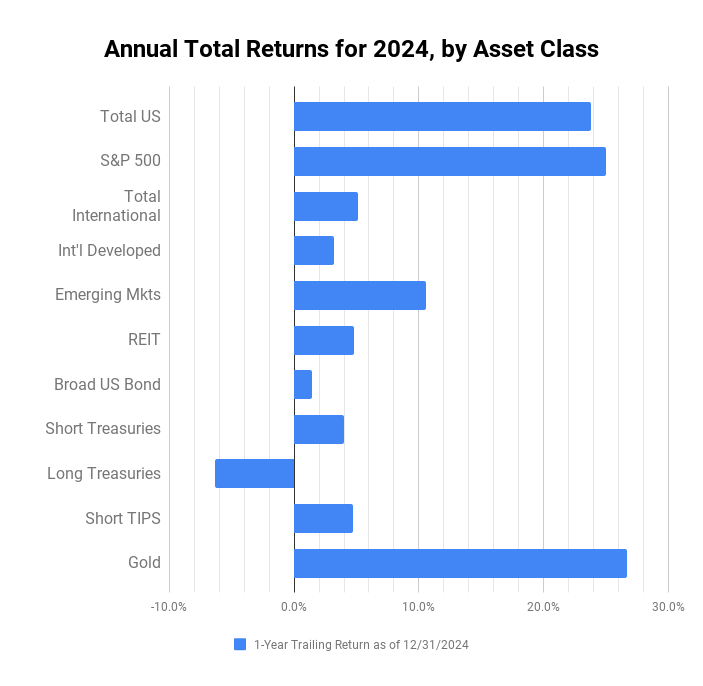
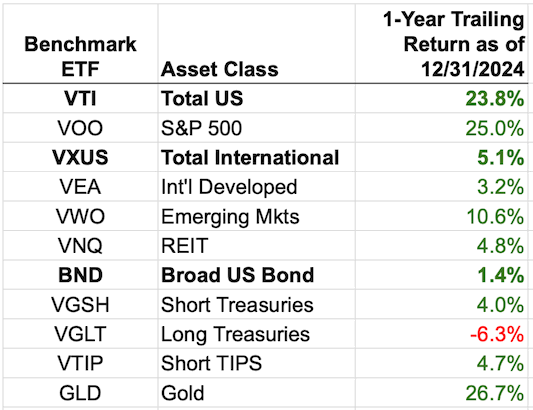
I didn’t include Bitcoin or any other crypto because I honestly don’t track it, don’t own it as part of my long-term portfolio, and would not advise my family to own it. However, I acknowledge that it went up something like 120% this year.

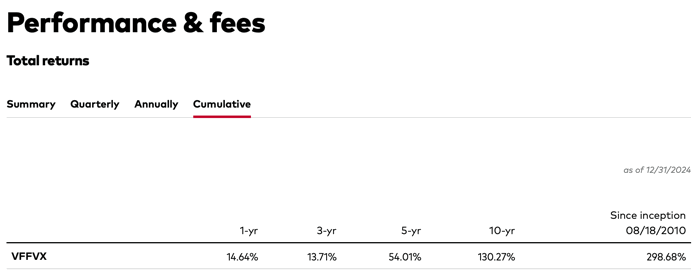
The “set and forget” Vanguard Target Retirement 2055 fund (VFFVX) , currently consisting of roughly 90% diversified stocks and 10% bonds, was up 14.6% in 2023.
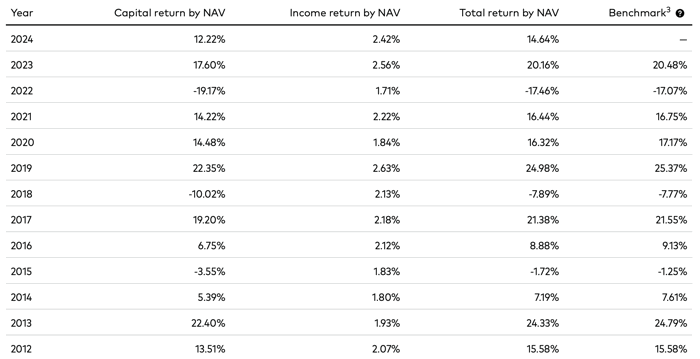
Commentary. 2024 again shows that you want to stay in the game. If you waited on the sidelines because stocks have historically high valuations and you were waiting for a dip… well, that didn’t work out. The S&P 500 had two great years in a row, the best two consecutive years in over 25 years according to the WSJ (gift article):
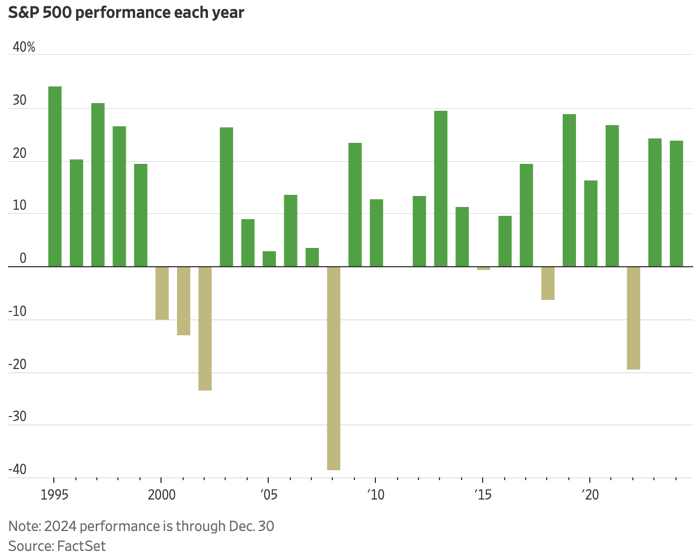
Historically, the S&P 500 annual return is negative in roughly every 1 in 4 years. But holding through that volatility is part of the price you pay for the long-term returns. For most of us, the best we can do is to “stay the course” and enjoy the up years while knowing that the down years will inevitably be sprinkled in there. I try my best not to skip and ignore all the predictions, or even listen to daily market close announcements. If you stand by the roulette table and stare long enough at the red and black numbers that come up, your mind will start to find patterns where they don’t exist.

Instead, here are your cumulative returns through the end of 2024 if you had been a steady investor in the Vanguard Target Retirement 2055 fund over the past several years, despite the many, many problems of the world:
(These work great inside 401ks and IRAs. I’d avoid buying Target Retirement funds in a taxable account.)

Holding cash would have been a lot less scary, but the returns would have been a lot less impressive. I will post more about my personal portfolio changes and performance shortly.


Best Interest Rates Survey: Savings Accounts, Treasuries, CDs, ETFs – December 2024

Here’s my monthly roundup of the best interest rates on cash as of December 2024, roughly sorted from shortest to longest maturities. There are lesser-known opportunities available to individual investors, often earning more money while keeping the same level of safety by moving to another FDIC-insured bank or NCUA-insured credit union. Check out my Ultimate Rate-Chaser Calculator to see how much extra interest you could earn from switching. Rates listed are available to everyone nationwide. Rates checked as of 12/15/2024.

TL;DR: Slightly lower overall in the short-term. Only a few around 5% APY now. Still some 4%+ APY 5-year CDs. Compare against Treasury bills and bonds at every maturity, taking into account state tax exemption. I no longer recommend fintech companies due to the possibility of loss due to poor recordkeeping and/or fraud.

High-yield savings accounts
Since the huge megabanks still pay essentially no interest, everyone should at least have a separate, no-fee online savings account to piggy-back onto your existing checking account. The interest rates on savings accounts can drop at any time, so I list the top rates as well as competitive rates from banks with a history of competitive rates and solid user experience. Some banks will bait you with a temporary top rate and then lower the rates in the hopes that you are too lazy to leave.

  • The top rates at the moment are from newcomers TIMBR at 5.05% APY and Pibank at 5.00% APY. I have no personal experience with either, but they are the top rates at the moment. Most others have dropped at least a little. For example, CIT Platinum Savings is now at 4.55% APY with $5,000+ balance.
  • SoFi Bank is at 4.00% APY + up to $325 new account bonus with direct deposit. You must maintain a direct deposit of any amount (even $1) each month for the higher APY. SoFi has historically competitive rates and full banking features. See details at $25 + $300 SoFi Money new account and deposit bonus.
  • Here is a limited survey of high-yield savings accounts. They aren’t the top rates, but a group that have historically kept it relatively competitive such that I like to track their history.

Short-term guaranteed rates (1 year and under)
A common question is what to do with a big pile of cash that you’re waiting to deploy shortly (plan to buy a house soon, just sold your house, just sold your business, legal settlement, inheritance). My usual advice is to keep things simple and take your time. If not a savings account, then put it in a flexible short-term CD under the FDIC limits until you have a plan.

  • No Penalty CDs offer a fixed interest rate that can never go down, but you can still take out your money (once) without any fees if you want to use it elsewhere. Marcus has a 7mo/9mo/11mo No Penalty CD at 4.00% APY with a $500 minimum deposit. Farmer’s Insurance FCU has 9-month No Penalty CD at 4.50% APY with a $1,000 minimum deposit. Consider opening multiple CDs in smaller increments for more flexibility.
  • Langley Federal Credit Union has a 10-month certificate special at 5.25% APY ($500 min, $50,000 max). This is a promo for new members only. Anyone can join this credit union nationwide; you must maintain $5 in their share savings account. Early withdrawal penalty is 90 days of interest.

Money market mutual funds
Many brokerage firms that pay out very little interest on their default cash sweep funds (and keep the difference for themselves). Note: Money market mutual funds are highly-regulated, but ultimately not FDIC-insured, so I would still stick with highly reputable firms.

  • Vanguard Federal Money Market Fund (VMFXX) is the default sweep option for Vanguard brokerage accounts, which has an SEC yield of 4.54% (changes daily, but also works out to a compound yield of 4.64%, which is better for comparing against APY). Odds are this is much higher than your own broker’s default cash sweep interest rate.
  • Vanguard Treasury Money Market Fund (VUSXX) is an alternative money market fund which you must manually purchase, but the interest will be mostly (80% for 2023 tax year) exempt from state and local income taxes because it comes from qualifying US government obligations. Current SEC yield of 4.49% (compound yield of 4.58%).

Treasury Bills and Ultra-short Treasury ETFs
Another option is to buy individual Treasury bills which come in a variety of maturities from 4-weeks to 52-weeks and are fully backed by the US government. You can also invest in ETFs that hold a rotating basket of short-term Treasury Bills for you, while charging a small management fee for doing so. T-bill interest is exempt from state and local income taxes, which can make a significant difference in your effective yield.

  • You can build your own T-Bill ladder at TreasuryDirect.gov or via a brokerage account with a bond desk like Vanguard and Fidelity. Here are the current Treasury Bill rates. As of 12/13/24, a new 4-week T-Bill had the equivalent of 4.31% annualized interest and a 52-week T-Bill had the equivalent of 4.24% annualized interest.
  • The iShares 0-3 Month Treasury Bond ETF (SGOV) has a 4.88% SEC yield (this looks old) and effective duration of 0.10 years. SPDR Bloomberg Barclays 1-3 Month T-Bill ETF (BIL) has a 4.42% SEC yield and effective duration of 0.08 years.

US Savings Bonds
Series I Savings Bonds offer rates that are linked to inflation and backed by the US government. You must hold them for at least a year. If you redeem them within 5 years there is a penalty of the last 3 months of interest. The annual purchase limit for electronic I bonds is $10,000 per Social Security Number, available online at TreasuryDirect.gov.

  • “I Bonds” bought between November 2024 and April 2025 will earn a 3.11% rate for the first six months. The rate of the subsequent 6-month period will be based on inflation again. More on Savings Bonds here.
  • In mid-April 2025, the CPI will be announced and you will have a short period where you will have a very close estimate of the rate for the next 12 months. I will have another post up at that time.

Rewards checking accounts
These unique checking accounts pay above-average interest rates, but with unique risks. You have to jump through certain hoops which usually involve 10+ debit card purchases each cycle, a certain number of ACH/direct deposits, and/or a certain number of logins per month. If you make a mistake (or they judge that you did) you risk earning zero interest for that month. Some folks don’t mind the extra work and attention required, while others would rather not bother. Rates can also drop suddenly, leaving a “bait-and-switch” feeling.

  • OnPath Federal Credit Union (my review) pays 7.00% APY on up to $10,000 if you make 15 debit card purchases, opt into online statements, and login to online or mobile banking once per statement cycle. Anyone can join this credit union via $5 membership fee to join partner organization. You can also get a $100 Visa Reward card when you open a new account and make qualifying transactions.
  • Genisys Credit Union pays 6.75% APY on up to $7,500 if you make 10 debit card purchases of $5+ each per statement cycle, and opt into online statements. Anyone can join this credit union via $5 membership fee to join partner organization.
  • La Capitol Federal Credit Union pays 6.25% APY on up to $10,000 if you make 15 debit card purchases of at least $5 each per statement cycle. Anyone can join this credit union via partner organization, Louisiana Association for Personal Financial Achievement ($20).
  • NEW: Falcon National Bank pays 6.00% APY on up to $25,000 if you make at least 15 debit card purchases, 1 direct deposit OR ACH credit transaction, and enroll in online statements.
  • Credit Union of New Jersey pays 6.00% APY on up to $25,000 if you make 12 debit card purchases, opt into online statements, and make at least 1 direct deposit, online bill payment, or automatic payment (ACH) per statement cycle. Anyone can join this credit union via $5 membership fee to join partner organization.
  • Andrews Federal Credit Union pays 6.00% APY on up to $25,000 if you make 15 debit card purchases, opt into online statements, and make at least 1 direct deposit or ACH transaction per statement cycle. Anyone can join this credit union via partner organization.
  • Find a locally-restricted rewards checking account at DepositAccounts.

Certificates of deposit (greater than 1 year)
CDs offer higher rates, but come with an early withdrawal penalty. By finding a bank CD with a reasonable early withdrawal penalty, you can enjoy higher rates but maintain access in a true emergency. Alternatively, consider building a CD ladder of different maturity lengths (ex. 1/2/3/4/5-years) such that you have access to part of the ladder each year, but your blended interest rate is higher than a savings account. When one CD matures, use that money to buy another 5-year CD to keep the ladder going. Some CDs also offer “add-ons” where you can deposit more funds if rates drop.

  • Credit Human has a 59-month CD at 4.11% APY. 48-month at 4.11% APY. 35-month at 4.25% APY. 23-month at 4.30% APY. 1-year at 4.40% APY. $500 minimum. The early withdrawal penalty (EWP) for CD maturities of 36 months or more is 365 days of interest. For CD maturity of 1 year, the EWP is 270 days of interest. This is actually a credit union, but is open nationwide with a American Consumer Council (ACC) membership. Try promo code “consumer” when signing up at ACC for a free membership.
  • Synchrony Bank has a 5-year certificate at 4.00% APY (no minimum), 4-year at 3.50% APY, 3-year at 3.75% APY, 2-year at 3.50% APY, and 1-year at 4.00% APY. Early withdrawal penalty for the 4-year and 5-year is 365 days of interest.
  • BMO Alto has a 5-year CD at 3.90% APY. 4-year at 3.80% APY. 3-year at 3.80% APY. 2-year at 3.80% APY. 1-year at 4.20% APY. No minimum. The early withdrawal penalty (EWP) for CD maturities of 1 year or more is 180 days of interest. For CD maturities of 11 months or less, the EWP is 90 days of interest. However, note that they reserve the right to prohibit early withdrawals entirely (!). Online-only subsidiary of BMO Bank.
  • You can buy certificates of deposit via the bond desks of Vanguard and Fidelity. You may need an account to see the rates. These “brokered CDs” offer FDIC insurance and easy laddering, but they don’t come with predictable early withdrawal penalties. Right now, I see a 5-year non-callable CD at 3.90% APY (callable: no, call protection: yes). Be warned that both Vanguard and Fidelity will list higher rates from callable CDs, which importantly means they can call back your CD if rates drop later. (Issuers have indeed started calling some of their old 5%+ CDs during 2024.)

Longer-term Instruments
I’d use these with caution due to increased interest rate risk (tbh, I don’t use them at all), but I still track them to see the rest of the current yield curve.

  • Willing to lock up your money for 10 years? You can buy long-term certificates of deposit via the bond desks of Vanguard and Fidelity. These “brokered CDs” offer FDIC insurance, but they don’t come with predictable early withdrawal penalties. You might find something that pays more than your other brokerage cash and Treasury options. Right now, I see a 10-year CDs at [n/a] (non-callable) vs. 4.40% for a 10-year Treasury. Watch out for higher rates from callable CDs where they can call your CD back if interest rates drop.

All rates were checked as of 12/15/2024.

Photo by Giorgio Trovato on Unsplash

Vanguard Announces New Treasury Bill ETFs: New Best Cash Alternative?

Vanguard recently released an announcement that in “First Quarter 2025” they will be releasing two new index ETFs that both hold short-term US Treasury Bonds:

  • Vanguard 0-3 Month Treasury Bill ETF (VBIL). Holds Treasuries with maturities of 3 months or less. Estimated expense ratio of 0.07%.
  • Vanguard Ultra-Short Treasury ETF (VGUS). Holds Treasuries with maturities of less than 12 months. Estimated expense ratio of 0.07%.

Currently, I would say the two best options for those who want low-cost exposure to Treasury Bills as a cash alternative without having to manually manage their own T-Bill ladder are:

  • iShares 0-3 Month Treasury Bond ETF (SGOV). Holds Treasuries with maturities of 3 months or less (1.2 months weighted average as of 12/2024). Expense ratio of 0.09%. 30-day historical median bid/ask spread of 0.01%. Can be bought and sold at nearly any brokerage.
  • Vanguard Treasury Money Market Fund (VUSXX). Maintains a NAV of $1. Holds Treasuries with average maturity of 38 days (as of 10/31/24). Expense ratio of 0.09%. Usually must be bought and sold within a Vanguard brokerage accounts to avoid transaction fees.

The advantages of owning properly-managed T-Bill funds are that you hopefully maintain the state income tax exemption of T-Bill interest, while adding the convenience and easy liquidity of ETFs and mutual funds. T-Bills often give residents of states with high local/state income taxes the highest tax-equivalent yield available for a cash equivalent (minimal volatility, minimal principal risk).

For tax year 2023, SGOV reported 96.45% of interest was derived from qualified U.S. Government and agency obligations. In many states, this meant that 96.45% of the interest paid out was exempt from state and local income taxes.

For tax year 2023, VUSXX reported 80.06% of interest was derived from qualified U.S. Government and agency obligations. In many states, this means that 80.06% of the interest paid out was exempt from state and local income taxes.

Ideally, VBIL will be very similar to SGOV with a tight bid/ask spread and nearly all interest eligible for state income tax exemption, but with even lower expenses and thus higher net yields. Something to keep a look out for in early 2025.

TreasuryDirect Customer Service Delays and Estate Planning Concerns

TreasuryDirect.gov is the official site for individuals to directly purchase US savings bonds and US Treasury bonds, including new T-Bills and TIPS at auction. But is it still worth the hassle? Back in August 2024, TreasuryDirect sent me the following e-mail when converting my paper bonds to electronic:

Cases are worked in the order they are received in our office. Your request is important to us and will receive attention as soon as possible. Please be aware of our estimated processing times to process your case which are based on the case type (bolding is mine):

Cases requesting to cash Series EE and/or Series I paper savings bonds held in your name, at least 4 weeks.
Cases requesting to cash Series HH savings bonds held in your name, at least 3 months.
Unlocking your TreasuryDirect account, updating bank information in that account, or converting your paper savings bonds into electronic bonds in TreasuryDirect, at least 4 weeks.
Claims for missing, lost, or stolen bonds, at least 6 months.
All other cases, at least 20 weeks.

If we require additional information to process your case, we will contact you. Thank you for your patience.

That’s at least a month for some pretty basic stuff like unlocking your account because you forgot what you said was your favorite movie. In October 2024, the WSJ published TreasuryDirect to Bond Buyers: Moving Your Money Could Take a Year regarding long delays transferring Treasury bonds to outside brokerages.

The resulting customer service backlog is straining the Treasury Department’s antiquated system, which can require verified signatures and paper forms sent through the mail. People transferring securities from TreasuryDirect to third-party brokerages face especially long waits because those requests are processed manually, according to people familiar with the matter.

TreasuryDirect tries to complete most of them within six weeks, but can take 12 months, depending on capacity. A notice on the TreasuryDirect website says some customer service requests “may require 12 months or more to process.” The notice had said the longest delays were about six months until the end of July.

Finally, there are multiple posts on the Bogleheads, Early Retirement, and Reddit forums about the difficulties of dealing with TreasuryDirect after the account owner passes away. Here’s one example from a user that was already familiar with the website, knew all the account information, and had the beneficiaries assigned correctly, but still encountered multiple forms, conflicting instructions, and months of delays – Treasury Direct – The Eternal Wait and No Way To Track Transfer:

I’m closing in on 3 months waiting for Treasury Direct to transfer several EE bonds and an I bond that were in my dad’s online Treasury Direct account to my online Treasury Direct account. My dad passed away at the end of December 2022 and I was registered as the beneficiary with POD on all of the bonds.

And the follow-up (emphasis mine):

My dad’s I bonds were transferred to me around the 4-5 month mark.

After that experience, I decided to liquidate all of my TD accounts, and will encourage my husband to do the same. I personally don’t want a repeat of this experience, or make my heirs go through such a lengthy process in resolving my estate.

What I learned from this experience is to not discount how much stress and mental bandwidth it takes to deal with TD when you’re also grieving the loss of a family member, and trying to settle the estate so you can move on financially.

Another similar estate horror story here.

Takeaway #1: Expect and prepare for slow service. It’s very clear that TreasuryDirect is an underfunded government program with very limited resources. Even most mega banks no longer cash in old paper savings bonds, so that has increased their workload as well. Any time there is a surge in demand, either due to relatively attractive rates on savings bonds or Treasury bills, they are going to get backed up. If you happen to lock yourself out of your account during one of these times, it may take months to fix it! Be very careful before you close that old bank account linked through TreasuryDirect. Use a reliable password manager, and be sure to add your answers to questions like “Who is your favorite child?”. Be sure to note your account information in multiple documents, in case someone needs to find it.

Takeaway #2: Never use TreasuryDirect for anything besides US savings bonds. TreasuryDirect.gov is the only place where you can purchase US savings bonds, but it is not the only place you can buy individual Treasury bonds and TIPS. Just open an account with a broker with better resources and a bond desk like Fidelity, Schwab, or Vanguard and go through them.

Takeaway #3: Consider your heirs and simplifying your accounts as you age. In my opinion, I would also avoid TreasuryDirect if you are older and you don’t want to burden your estate executors with dealing with TreasuryDirect. You can save them several months and many hours of calls and paperwork by liquidating your assets and consolidating them elsewhere. TreasuryDirect will likely take the longest to resolve out of all of your financial accounts.

Personally, I continue to gradually liquidate the savings bonds in my TreasuryDirect account and buying individual TIPS in an outside brokerage account instead. I will have to pay some taxes on the deferred interest, but since I am getting a 1% to 2% higher fixed rate via TIPS in many cases, it’s not that bad. I also worry that my survivors might completely overlook this account if something unexpected happens (there are no mailed paper statements, or even monthly e-mails of online statements.) I’d like to minimize any unnecessary headaches and consider this part of my overall portfolio simplification process.

If I was younger and still grinding for every small edge, I would probably still accept these shortcomings for the right interest rate and tax deferral properties, but nowadays the calculations are different.

Image source: Sitejabber

Best Interest Rates Survey: Savings Accounts, Money Markets, Treasuries, CDs, ETFs – November 2024

Here’s my monthly roundup of the best interest rates on cash as of November 2024, roughly sorted from shortest to longest maturities. There are lesser-known opportunities available to individual investors, often earning more money while keeping the same level of safety by moving to another FDIC-insured bank or NCUA-insured credit union. Check out my Ultimate Rate-Chaser Calculator to see how much extra interest you could earn from switching. Rates listed are available to everyone nationwide. Rates checked as of 11/12/2024.

TL;DR: Fed lowered rates again; slight drops are continuing on average. Still some 5%+ savings accounts. Still some 4%+ APY 5-year CDs. Compare against Treasury bills and bonds at every maturity, taking into account state tax exemption. I no longer recommend fintech companies due to the possibility of loss due to poor recordkeeping and/or fraud.

High-yield savings accounts
Since the huge megabanks still pay essentially no interest, everyone should at least have a separate, no-fee online savings account to piggy-back onto your existing checking account. The interest rates on savings accounts can drop at any time, so I list the top rates as well as competitive rates from banks with a history of competitive rates and solid user experience. Some banks will bait you with a temporary top rate and then lower the rates in the hopes that you are too lazy to leave.

  • The top rates at the moment are from newcomers Pibank at 5.50% APY and TIMBR at 5.25% APY. I have no personal experience with either, but they are the top rates at the moment. Most others have dropped at least a little. For example, CIT Platinum Savings is now at 4.55% APY with $5,000+ balance.
  • SoFi Bank is at 4.20% APY + up to $325 new account bonus with direct deposit. You must maintain a direct deposit of any amount (even $1) each month for the higher APY. SoFi has historically competitive rates and full banking features. See details at $25 + $300 SoFi Money new account and deposit bonus.
  • Here is a limited survey of high-yield savings accounts. They aren’t the top rates, but a group that have historically kept it relatively competitive such that I like to track their history. Kind of an index like the Dow or S&P 500.

Short-term guaranteed rates (1 year and under)
A common question is what to do with a big pile of cash that you’re waiting to deploy shortly (plan to buy a house soon, just sold your house, just sold your business, legal settlement, inheritance). My usual advice is to keep things simple and take your time. If not a savings account, then put it in a flexible short-term CD under the FDIC limits until you have a plan.

  • No Penalty CDs offer a fixed interest rate that can never go down, but you can still take out your money (once) without any fees if you want to use it elsewhere. Marcus has a 7mo/9mo/11mo No Penalty CD at 3.90% APY with a $500 minimum deposit. Farmer’s Insurance FCU has 9-month No Penalty CD at 4.50% APY with a $1,000 minimum deposit. Consider opening multiple CDs in smaller increments for more flexibility.
  • Langley Federal Credit Union has a 10-month certificate special at 5.25% APY ($500 min, $50,000 max). This is a promo for new members only. Anyone can join this credit union nationwide; you must maintain $5 in their share savings account. Early withdrawal penalty is 90 days of interest.

Money market mutual funds
Many brokerage firms that pay out very little interest on their default cash sweep funds (and keep the difference for themselves). Note: Money market mutual funds are highly-regulated, but ultimately not FDIC-insured, so I would still stick with highly reputable firms.

  • Vanguard Federal Money Market Fund (VMFXX) is the default sweep option for Vanguard brokerage accounts, which has an SEC yield of 4.67% (changes daily, but also works out to a compound yield of 4.77%, which is better for comparing against APY). Odds are this is much higher than your own broker’s default cash sweep interest rate.
  • Vanguard Treasury Money Market Fund (VUSXX) is an alternative money market fund which you must manually purchase, but the interest will be mostly (80% for 2023 tax year) exempt from state and local income taxes because it comes from qualifying US government obligations. Current SEC yield of 4.63% (compound yield of 4.73%).

Treasury Bills and Ultra-short Treasury ETFs
Another option is to buy individual Treasury bills which come in a variety of maturities from 4-weeks to 52-weeks and are fully backed by the US government. You can also invest in ETFs that hold a rotating basket of short-term Treasury Bills for you, while charging a small management fee for doing so. T-bill interest is exempt from state and local income taxes, which can make a significant difference in your effective yield.

  • You can build your own T-Bill ladder at TreasuryDirect.gov or via a brokerage account with a bond desk like Vanguard and Fidelity. Here are the current Treasury Bill rates. As of 11/12/24, a new 4-week T-Bill had the equivalent of 4.60% annualized interest and a 52-week T-Bill had the equivalent of 4.38% annualized interest.
  • The iShares 0-3 Month Treasury Bond ETF (SGOV) has a 4.88% SEC yield and effective duration of 0.10 years. SPDR Bloomberg Barclays 1-3 Month T-Bill ETF (BIL) has a 4.57% SEC yield and effective duration of 0.08 years.

US Savings Bonds
Series I Savings Bonds offer rates that are linked to inflation and backed by the US government. You must hold them for at least a year. If you redeem them within 5 years there is a penalty of the last 3 months of interest. The annual purchase limit for electronic I bonds is $10,000 per Social Security Number, available online at TreasuryDirect.gov.

  • “I Bonds” bought between November 2024 and April 2025 will earn a 3.11% rate for the first six months. The rate of the subsequent 6-month period will be based on inflation again. More on Savings Bonds here.
  • In mid-April 2025, the CPI will be announced and you will have a short period where you will have a very close estimate of the rate for the next 12 months. I will have another post up at that time.

Rewards checking accounts
These unique checking accounts pay above-average interest rates, but with unique risks. You have to jump through certain hoops which usually involve 10+ debit card purchases each cycle, a certain number of ACH/direct deposits, and/or a certain number of logins per month. If you make a mistake (or they judge that you did) you risk earning zero interest for that month. Some folks don’t mind the extra work and attention required, while others would rather not bother. Rates can also drop suddenly, leaving a “bait-and-switch” feeling.

  • OnPath Federal Credit Union (my review) pays 7.00% APY on up to $10,000 if you make 15 debit card purchases, opt into online statements, and login to online or mobile banking once per statement cycle. Anyone can join this credit union via $5 membership fee to join partner organization. You can also get a $100 Visa Reward card when you open a new account and make qualifying transactions.
  • Genisys Credit Union pays 6.75% APY on up to $7,500 if you make 10 debit card purchases of $5+ each per statement cycle, and opt into online statements. Anyone can join this credit union via $5 membership fee to join partner organization.
  • La Capitol Federal Credit Union pays 6.25% APY on up to $10,000 if you make 15 debit card purchases of at least $5 each per statement cycle. Anyone can join this credit union via partner organization, Louisiana Association for Personal Financial Achievement ($20).
  • Credit Union of New Jersey pays 6.00% APY on up to $25,000 if you make 12 debit card purchases, opt into online statements, and make at least 1 direct deposit, online bill payment, or automatic payment (ACH) per statement cycle. Anyone can join this credit union via $5 membership fee to join partner organization.
  • Andrews Federal Credit Union pays 6.00% APY on up to $25,000 if you make 15 debit card purchases, opt into online statements, and make at least 1 direct deposit or ACH transaction per statement cycle. Anyone can join this credit union via partner organization.
  • Orion Federal Credit Union pays 6.00% APY on up to $10,000 if you make electronic deposits of $500+ each month (ACH transfers count) and spend $500+ on your Orion debit or credit card each month. Anyone can join this credit union via $10 membership fee to partner organization membership.
  • All America/Redneck Bank pays 4.65% APY on up to $15,000 if you make 10 debit card purchases each monthly cycle with online statements.
  • Find a locally-restricted rewards checking account at DepositAccounts.

Certificates of deposit (greater than 1 year)
CDs offer higher rates, but come with an early withdrawal penalty. By finding a bank CD with a reasonable early withdrawal penalty, you can enjoy higher rates but maintain access in a true emergency. Alternatively, consider building a CD ladder of different maturity lengths (ex. 1/2/3/4/5-years) such that you have access to part of the ladder each year, but your blended interest rate is higher than a savings account. When one CD matures, use that money to buy another 5-year CD to keep the ladder going. Some CDs also offer “add-ons” where you can deposit more funds if rates drop.

  • Synchrony Bank has a 5-year certificate at 4.00% APY (no minimum), 4-year at 3.90% APY, 3-year at 3.90% APY, 2-year at 3.90% APY, and 1-year at 4.20% APY. Early withdrawal penalty for the 4-year and 5-year is 365 days of interest.
  • BMO Alto has a 5-year CD at 4.00% APY. 4-year at 3.90% APY. 3-year at 3.90% APY. 2-year at 3.90% APY. 1-year at 4.30% APY. No minimum. The early withdrawal penalty (EWP) for CD maturities of 1 year or more is 180 days of interest. For CD maturities of 11 months or less, the EWP is 90 days of interest. However, note that they reserve the right to prohibit early withdrawals entirely (!). Online-only subsidiary of BMO Bank.
  • You can buy certificates of deposit via the bond desks of Vanguard and Fidelity. You may need an account to see the rates. These “brokered CDs” offer FDIC insurance and easy laddering, but they don’t come with predictable early withdrawal penalties. Right now, I see a 5-year non-callable CD at 3.85% APY (callable: no, call protection: yes). Be warned that both Vanguard and Fidelity will list higher rates from callable CDs, which importantly means they can call back your CD if rates drop later. (Issuers have indeed started calling some of their old 5%+ CDs as of Fall 2024.)

Longer-term Instruments
I’d use these with caution due to increased interest rate risk (tbh, I don’t use them at all), but I still track them to see the rest of the current yield curve.

  • Willing to lock up your money for 10 years? You can buy long-term certificates of deposit via the bond desks of Vanguard and Fidelity. These “brokered CDs” offer FDIC insurance, but they don’t come with predictable early withdrawal penalties. You might find something that pays more than your other brokerage cash and Treasury options. Right now, I see a 10-year CDs at [n/a] (non-callable) vs. 4.43% for a 10-year Treasury. Watch out for higher rates from callable CDs where they can call your CD back if interest rates drop.

All rates were checked as of 11/12/2024.

Photo by Giorgio Trovato on Unsplash

Savings I Bonds November 2024: 1.20% Fixed Rate, 1.91% Inflation Rate (3.11% Total for First 6 Months)

Update: Savings I Bonds bought from November 1, 2024 through April 30, 2025 will have a fixed rate of 1.20%, for a total rate of 3.11% for the first 6 months. As a quick and dirty comparison, the nominal yield on 5-year Treasury bonds is currently 4.15% and the real yield on 5-year TIPS is currently 1.77%.

Every existing I Bond will earn this inflation rate of ~1.91% eventually for 6 months; you will need to add your own fixed rate that was set based the initial purchase month. See you again in mid-April for the next early prediction for May 2025.

Original post:

Savings I Bonds are a unique, low-risk investment backed by the US Treasury that pay out a variable interest rate linked to inflation. With a holding period from 12 months to 30 years, you could own them as an alternative to bank certificates of deposit (they are liquid after 12 months) or bonds in your portfolio.

New inflation numbers were just announced at BLS.gov, which allows us to make an early prediction of the November 2024 savings bond rates a couple of weeks before the official announcement on the 1st. This also allows the opportunity to know exactly what an October 2024 savings bond purchase will yield over the next 12 months, instead of just 6 months. You can then compare this against a November 2024 purchase.

New inflation rate prediction. March 2024 CPI-U was 312.332. September 2024 CPI-U was 315.301, for a semi-annual inflation rate of 0.95%. Using the official composite rate formula:

Composite rate formula: [Fixed rate + (2 x semiannual inflation rate) + (fixed rate x semiannual inflation rate)]

This results in the variable component of interest rate for the next 6 month cycle being ~1.90% to 1.91%, depending on the fixed rate.

Tips on purchase and redemption. You can’t redeem until after 12 months of ownership, and any redemptions within 5 years incur an interest penalty of the last 3 months of interest. A simple “trick” with I-Bonds is that if you buy at the end of the month, you’ll still get all the interest for the entire month – same as if you bought it in the beginning of the month. It’s best to give yourself a few business days of buffer time. If you miss the cutoff, your effective purchase date will be bumped into the next month. (You should always sell at the very beginning of the month.)

Buying in October 2024. If you buy before the end of October, the fixed rate portion of I-Bonds will be 1.30%. You will be guaranteed a total interest rate of 1.30 + 2.98 = 4.28% for the next 6 months. For the 6 months after that, the total rate will be 1.30 + 1.91 = 3.21%.

Buying in November 2024. If you buy in November 2024, you will get ~1.91% plus a newly-set fixed rate for the first 6 months. The new fixed rate is officially unknown, but is loosely linked to the real yield of short-term TIPS with some reductions. My rough guess is somewhere between 0.9% and 1.2%. The current real yield on short-term TIPS is lower than it was during the last reset, when the fixed rate was set at 1.3%. Every six months after your purchase, your rate will adjust to your fixed rate (set at purchase) plus a variable rate based on inflation.

If you have an existing I-Bond, the rates reset every 6 months depending on your specific purchase month. Everyone will eventually get this variable rate. Your bond rate = your specific fixed rate (based on purchase month, look it up here) + variable rate (total bond rate has a minimum floor of 0%).

Buy now or wait? Between those two options, I would buy in October as you’ll likely get a higher fixed rate and a decent initial 6-month rate. However, I actually don’t plan to buy any savings bonds this year. The yields are simply not very interesting as compared to other options. Short-term, it’s better to go T-Bills with the state tax exemption. For my inflation-protected needs, I have been buying longer-term TIPS instead to lock in the higher current 2%+ real yields (in tax-deferred).

Unique features and considerations. I have a separate post on reasons to own Series I Savings Bonds, including inflation protection, tax deferral, exemption from state income taxes, and potential tax benefits if used toward qualified educational expenses.

The main drawback is hassle. You can only buy new savings bonds through TreasuryDirect.gov, which is limited in its customer service resources and features. Conducting certain transactions may require a medallion signature guarantee which requires a visit to a physical bank or credit union and snail mail. If your password is compromised, they will not replace any lost or stolen savings bonds. The juice may not be worth the squeeze when you can own individual Treasury bonds or TIPS within any full-service brokerage account. (Finding a bank that will redeem a physical paper savings bond at all can be difficult these days.)

Over the years, I have accumulated I-Bonds and consider it part of the inflation-linked bond allocation inside my long-term investment portfolio. However, after converting all my paper bonds to electronic versions earlier this year, I have been selling the lower fixed rate bonds and reinvesting in 2%+ real yield TIPS.

Annual purchase limits. The annual purchase limit is now $10,000 in online I-bonds per Social Security Number. For a couple, that’s $20,000 per year. As of 2024. you can only buy online at TreasuryDirect.gov, after making sure you’re okay with their security protocols and user-friendliness. (No more tax refund savings bonds.) Technically, the purchase limits are per Social Security Number or Employer Identification Number. For those looking for another way to expand their purchasing power, that means you can also buy for a child, grandchild, LLC, or a trust.

Bottom line. Savings I bonds are a unique, low-risk investment that are linked to inflation and only available to individual investors. You can now only purchase them online at TreasuryDirect.gov. For more background, see the rest of my posts on savings bonds.

[Image: 1942 US Savings Bond poster – source]

Best Interest Rates on Cash Roundup – October 2024

Here’s my monthly roundup of the best interest rates on cash as of October 2024, roughly sorted from shortest to longest maturities. There are lesser-known opportunities available to individual investors, often earning more money while keeping the same level of safety by moving to another FDIC-insured bank or NCUA-insured credit union. Check out my Ultimate Rate-Chaser Calculator to see how much extra interest you could earn from switching. Rates listed are available to everyone nationwide. Rates checked as of 10/15/2024.

TL;DR: Rates are still dropping at all maturities, from savings accounts outward. Still some 5%+ savings accounts. Still some 4%+ APY 5-year CDs. Compare against Treasury bills and bonds at every maturity, taking into account state tax exemption. I no longer recommend fintech companies due to the possibility of loss due to poor recordkeeping and/or fraud.

High-yield savings accounts
Since the huge megabanks still pay essentially no interest, everyone should at least have a separate, no-fee online savings account to piggy-back onto your existing checking account. The interest rates on savings accounts can drop at any time, so I list the top rates as well as competitive rates from banks with a history of competitive rates and solid user experience. Some banks will bait you with a temporary top rate and then lower the rates in the hopes that you are too lazy to leave.

  • The top rates at the moment are from newcomers Pibank at 5.50% APY and TIMBR at 5.25% APY. I have no personal experience with either, but they are the top rates at the moment. Most others have dropped at least a little. For example, CIT Platinum Savings is now at 4.70% APY with $5,000+ balance.
  • SoFi Bank is at 4.30% APY + up to $325 new account bonus with direct deposit. You must maintain a direct deposit of any amount (even $1) each month for the higher APY. SoFi has historically competitive rates and full banking features. See details at $25 + $300 SoFi Money new account and deposit bonus.
  • Here is a limited survey of high-yield savings accounts. They aren’t the top rates, but a group that have historically kept it relatively competitive such that I like to track their history.

Short-term guaranteed rates (1 year and under)
A common question is what to do with a big pile of cash that you’re waiting to deploy shortly (plan to buy a house soon, just sold your house, just sold your business, legal settlement, inheritance). My usual advice is to keep things simple and take your time. If not a savings account, then put it in a flexible short-term CD under the FDIC limits until you have a plan.

  • No Penalty CDs offer a fixed interest rate that can never go down, but you can still take out your money (once) without any fees if you want to use it elsewhere. Marcus has a 7-month No Penalty CD at 4.20% APY with a $500 minimum deposit. Farmer’s Insurance FCU has 9-month No Penalty CD at 4.50% APY with a $1,000 minimum deposit. Consider opening multiple CDs in smaller increments for more flexibility.
  • Langley Federal Credit Union has a 10-month certificate special at 5.25% APY ($500 min, $50,000 max). This is a promo for new members only. Anyone can join this credit union nationwide; you must maintain $5 in their share savings account. Early withdrawal penalty is 90 days of interest.

Money market mutual funds
Many brokerage firms that pay out very little interest on their default cash sweep funds (and keep the difference for themselves). Note: Money market mutual funds are highly-regulated, but ultimately not FDIC-insured, so I would still stick with highly reputable firms.

  • Vanguard Federal Money Market Fund (VMFXX) is the default sweep option for Vanguard brokerage accounts, which has an SEC yield of 4.80% (changes daily, but also works out to a compound yield of 4.91%, which is better for comparing against APY). Odds are this is much higher than your own broker’s default cash sweep interest rate.
  • Vanguard Treasury Money Market Fund (VUSXX) is an alternative money market fund which you must manually purchase, but the interest will be mostly (80% for 2023 tax year) exempt from state and local income taxes because it comes from qualifying US government obligations. Current SEC yield of 4.86% (compound yield of 4.97%).

Treasury Bills and Ultra-short Treasury ETFs
Another option is to buy individual Treasury bills which come in a variety of maturities from 4-weeks to 52-weeks and are fully backed by the US government. You can also invest in ETFs that hold a rotating basket of short-term Treasury Bills for you, while charging a small management fee for doing so. T-bill interest is exempt from state and local income taxes, which can make a significant difference in your effective yield.

  • You can build your own T-Bill ladder at TreasuryDirect.gov or via a brokerage account with a bond desk like Vanguard and Fidelity. Here are the current Treasury Bill rates. As of 10/15/24, a new 4-week T-Bill had the equivalent of 4.80% annualized interest and a 52-week T-Bill had the equivalent of 4.19% annualized interest.
  • The iShares 0-3 Month Treasury Bond ETF (SGOV) has a 5.08% SEC yield and effective duration of 0.10 years. SPDR Bloomberg Barclays 1-3 Month T-Bill ETF (BIL) has a 4.85% SEC yield and effective duration of 0.08 years.

US Savings Bonds
Series I Savings Bonds offer rates that are linked to inflation and backed by the US government. You must hold them for at least a year. If you redeem them within 5 years there is a penalty of the last 3 months of interest. The annual purchase limit for electronic I bonds is $10,000 per Social Security Number, available online at TreasuryDirect.gov.

  • “I Bonds” bought between May 2024 and October 2024 will earn a 4.28% rate for the first six months. The rate of the subsequent 6-month period will be based on inflation again. More on Savings Bonds here.
  • In mid-October 2024, the CPI will be announced and you will have a short period where you will have a very close estimate of the rate for the next 12 months. This is the mid-October post. I will have another post up at that time.

Rewards checking accounts
These unique checking accounts pay above-average interest rates, but with unique risks. You have to jump through certain hoops which usually involve 10+ debit card purchases each cycle, a certain number of ACH/direct deposits, and/or a certain number of logins per month. If you make a mistake (or they judge that you did) you risk earning zero interest for that month. Some folks don’t mind the extra work and attention required, while others would rather not bother. Rates can also drop suddenly, leaving a “bait-and-switch” feeling.

  • OnPath Federal Credit Union (my review) pays 7.00% APY on up to $10,000 if you make 15 debit card purchases, opt into online statements, and login to online or mobile banking once per statement cycle. Anyone can join this credit union via $5 membership fee to join partner organization. You can also get a $100 Visa Reward card when you open a new account and make qualifying transactions.
  • Genisys Credit Union pays 6.75% APY on up to $7,500 if you make 10 debit card purchases of $5+ each per statement cycle, and opt into online statements. Anyone can join this credit union via $5 membership fee to join partner organization.
  • Credit Union of New Jersey pays 6.00% APY on up to $25,000 if you make 12 debit card purchases, opt into online statements, and make at least 1 direct deposit, online bill payment, or automatic payment (ACH) per statement cycle. Anyone can join this credit union via $5 membership fee to join partner organization.
  • Andrews Federal Credit Union pays 6.00% APY on up to $25,000 if you make 15 debit card purchases, opt into online statements, and make at least 1 direct deposit or ACH transaction per statement cycle. Anyone can join this credit union via partner organization.
  • Pelican State Credit Union pays 6.05% APY on up to $20,000 if you make 15 debit card purchases, opt into online statements, log into your account at least once, and make at least 1 direct deposit, online bill payment, or automatic payment (ACH) per statement cycle. Anyone can join this credit union via partner organization membership.
  • Orion Federal Credit Union pays 6.00% APY on up to $10,000 if you make electronic deposits of $500+ each month (ACH transfers count) and spend $500+ on your Orion debit or credit card each month. Anyone can join this credit union via $10 membership fee to partner organization membership.
  • All America/Redneck Bank pays 4.65% APY on up to $15,000 if you make 10 debit card purchases each monthly cycle with online statements.
  • Find a locally-restricted rewards checking account at DepositAccounts.

Certificates of deposit (greater than 1 year)
CDs offer higher rates, but come with an early withdrawal penalty. By finding a bank CD with a reasonable early withdrawal penalty, you can enjoy higher rates but maintain access in a true emergency. Alternatively, consider building a CD ladder of different maturity lengths (ex. 1/2/3/4/5-years) such that you have access to part of the ladder each year, but your blended interest rate is higher than a savings account. When one CD matures, use that money to buy another 5-year CD to keep the ladder going. Some CDs also offer “add-ons” where you can deposit more funds if rates drop.

  • Synchrony Bank has a 5-year certificate at 4.00% APY (no minimum), 4-year at 4.00% APY, 3-year at 4.00% APY, 2-year at 3.90% APY, and 1-year at 4.40% APY. Early withdrawal penalty for the 4-year and 5-year is 365 days of interest.
  • Advancial Federal Credit Union has has a 5-year certificate at 4.09% APY (higher $50,000 min). Early withdrawal penalty for the 5-year is 365 days of interest. Anyone nationwide should be able to join via membership with partner organization US Dog Agility Association, but I would call or check first.
  • State Department FCU has a 60-month CD at at 3.91% APY ($500 min) or 4.11% APY (jumbo $100,000 min). Early withdrawal penalty for the 5-year is 360 days of interest. Membership is open nationwide by agreeing to join the American Consumer Council (ACC) membership. Try promo code “consumer” when signing up at ACC for a free membership.
  • You can buy certificates of deposit via the bond desks of Vanguard and Fidelity. You may need an account to see the rates. These “brokered CDs” offer FDIC insurance and easy laddering, but they don’t come with predictable early withdrawal penalties. Right now, I see a 5-year non-callable CD at 3.75 to 3.80% APY (callable: no, call protection: yes). Be warned that both Vanguard and Fidelity will list higher rates from callable CDs, which importantly means they can call back your CD if rates drop later. (Issuers have indeed started calling some of their old 5%+ CDs as of Fall 2024.)

Longer-term Instruments
I’d use these with caution due to increased interest rate risk (tbh, I don’t use them at all), but I still track them to see the rest of the current yield curve.

  • Willing to lock up your money for 10 years? You can buy long-term certificates of deposit via the bond desks of Vanguard and Fidelity. These “brokered CDs” offer FDIC insurance, but they don’t come with predictable early withdrawal penalties. You might find something that pays more than your other brokerage cash and Treasury options. Right now, I see a 10-year CDs at 3.75% (non-callable) vs. 4.03% for a 10-year Treasury. Watch out for higher rates from callable CDs where they can call your CD back if interest rates drop.

All rates were checked as of 10/15/2024.

Photo by Giorgio Trovato on Unsplash

Bank of America Credit Cards – 2% More Rewards Day on Thursday 11/7/2024

Update for 2024, promo is back again with limit of $50 extra per card. Bank of America has a one-day credit card promotion called “More Rewards Day” on Thursday, 11/7/24. Depending on your BofA credit card type (all consumer and business cards are all eligible), you can earn an additional 2% cash back or 2 points or miles/$1 spent on purchases made on 11/7/24 only (Eastern time zone!), up to a $50/5,000 point cap per unique credit card account. That’s on on top of the rewards you’re already earning. No enrollment required. Specifically:

  • Cash Back Credit Cards. Earn an additional 2% cash back for every $1 spent on purchases made on 11/7/24. This one-day offer is good for the first $2,500 in purchases up to $50 cash back. That’s on top of the rewards you’re already earning.
  • Points Rewards Credit Cards. Earn an additional 2 points for every $1 spent on purchases made on 11/7/24. This one-day offer is good for the first $2,500 in purchases up to 5,000 points. That’s on top of the rewards you’re already earning.
  • Miles Rewards Credit Cards. Earn an additional 2 Miles for every $1 spent on purchases made on 11/7/24 ET. This one-day offer is good for the first $2,500 in purchases up to 5,000 Miles. That’s on top of the rewards you’re already earning.
  • Non-Rewards and All Other Rewards Credit Cards. Earn 2% cash back in the form of a statement credit on purchases made on 11/7/24. This one-day offer is good for the first $2,500 in purchases up to $50 cash back.

You can get the bonus on each of your unique credit cards. Note that it expires 11:59pm in the Eastern time zone. It appears that somehow they can track the “transaction date” separately from when it posts to your statement. Note that some retail websites don’t actually charge you until a physical item ships.

Only Purchases that post to your account and appear on your statement with a transaction date of 11/07/2024 will qualify. Merchants may impact when a transaction will appear on your statement, particularly if they delay processing of the purchase. Transactions with delayed processing of 90 days or more will not be eligible to be included in the promotional offer.

This is an interesting promotion that could work out well if (1) you have a BofA rewards card (or multiples) with good rewards already, (2) you have the Preferred Rewards boost, (3) you have larger purchases planned in one of your customized bonus categories, or just any larger purchase really, and (4) it is the type of purchase that applies the same day (sometimes you don’t get charged until something ships). Max out that $2,500 in purchases for each card. Some possibilities:

  • Pay estimated income taxes at PayUSATax.com for only 1.82% fee.
  • Pay your insurance premiums upfront. My State Farm grouped monthly bill can also be timed using manual payment.
  • Pay your utilities, property taxes, phone bills, and other monthly bills upfront. Sometimes it just costs a one-time flat fee to pay by credit card, which can be worth if you are charging $1,000+.
  • Make your annual charitable contributions on 11/7/23 this year.
  • Gas and EV charging stations; online shopping, including cable, internet, phone plans and streaming; dining; travel; drug stores and pharmacies; or home improvement and furnishings are choices for your 3% category for the BofA Customized Cash card (up to 5.25% with Preferred Rewards) for a total of 7.25% cash back total with this promo. You can change your category this month in app and then max out the $2,500 quarterly limit using gift cards at Amazon (online shopping), Home Depot (home improvement), gas stations, and so on.

Robinhood HOOD Week Promo: 3% IRA, 2% Margin, 1% ACAT Bonus (10/16-10/27)

Robinhood brokerage app is jumping on the week-long promo trend and just teased Robinhood HOOD Week (“HOOD” is their stock symbol) from October 16, 2024 to October 27, 2024. The front page is vague but inside the full terms you can see exactly what they will be offering. They are still aggressively collecting assets, and are rolling back out some very competitive cash bonuses when you transfer in assets from external brokerages:

  • 1% bonus on ACATS transfers to your Robinhood joint or individual investing account from an external brokerage. Two-year minimum hold period.
  • 2% bonus on ACATS transfers with a margin balance of $10,000 or more to your Robinhood joint or individual investing account from an external brokerage. Two-year minimum hold period.
  • 3% on ACATS transfers to your Robinhood IRA with a Robinhood Gold subscription, excluding rollovers. Five-year minimum hold period.

Hodl on, though! Transfers must be initiated between 12 AM ET on October 16, 2024 and 11:59 PM ET on October 27, 2024.

Robinhood will also reimburse up to $75 in outgoing transfer fees with transfers of $7,500 or more. This is a one-time reimbursement per account type, per external brokerage.

The asset retention requirement requires that you maintain the transferred assets in your Robinhood account for at least 2 years for the 1% or 2% bonuses and 5 years for the 3% bonus. If you withdraw assets and the balance falls below the initial transfer amount, Robinhood reserves the right to reduce or revoke your bonus, in full or in part.

The 2% bonus with margin balances is an interesting new wrinkle, and it could very easily be worth it “create” a margin balance ahead of time in preparation for the promo week. You’d want to withdraw your cash, and then buy something on margin – even SGOV or another Treasury Bill ETF would work. Paying even 12% interest on $10,000 of margin for an entire month would only be $100 of interest. An extra 1% on $100,000 transferred is worth $1,000, an extra 1% of $1 million is $10,000, and so on.

I didn’t even know you were allowed to transfer margin balances, but apparently that is one of the features of the ACATS system. I suppose it’s like a balance transfer between credit cards, and Robinhood really wants your interest-accruing debt.

I’ve already written multiple articles about past flavors of these Robinhood promos, and I participated in the 3% IRA bonus previously. As always, read through the terms and understand that you’ll be locked into Robinhood for two to five years. Since I’m already partially locked-in, I am pondering that new 2% margin transfer bonus. 🤔

(Anyone understand the meaning of the cherry?)

Best Interest Rates on Cash Roundup – September 2024

Here’s my monthly roundup of the best interest rates on cash as of September 2024, roughly sorted from shortest to longest maturities. There are lesser-known opportunities available to individual investors, often earning more money while keeping the same level of safety by moving to another FDIC-insured bank or NCUA-insured credit union. Check out my Ultimate Rate-Chaser Calculator to see how much extra interest you could earn from switching. Rates listed are available to everyone nationwide. Rates checked as of 9/15/2024.

TL;DR: Rates are dropping at all maturities, from money market funds outward, but really fast starting at 1 year out. Still 5%+ savings accounts and short-term CDs. Compare against Treasury bills and bonds at every maturity, taking into account state tax exemption. I no longer recommend fintech companies due to the possibility of loss due to poor recordkeeping and/or fraud.

High-yield savings accounts
Since the huge megabanks still pay essentially no interest, everyone should at least have a separate, no-fee online savings account to piggy-back onto your existing checking account. The interest rates on savings accounts can drop at any time, so I list the top rates as well as competitive rates from banks with a history of competitive rates and solid user experience. Some banks will bait you with a temporary top rate and then lower the rates in the hopes that you are too lazy to leave.

  • The top rate at the moment is at Poppy at 5.50% APY (3-month rate guarantee). Newcomer Pibank is also at 5.50% APY. I have no personal experience with either, but they are the top rates at the moment. CIT Platinum Savings at 4.85% APY with $5,000+ balance.
  • SoFi Bank is at 4.50% APY + up to $325 new account bonus with direct deposit. You must maintain a direct deposit of any amount each month for the higher APY. SoFi has historically competitive rates and full banking features. See details at $25 + $300 SoFi Money new account and deposit bonus.
  • Here is a limited survey of high-yield savings accounts. They aren’t the top rates, but a group that have historically kept it relatively competitive such that I like to track their history.

Short-term guaranteed rates (1 year and under)
A common question is what to do with a big pile of cash that you’re waiting to deploy shortly (plan to buy a house soon, just sold your house, just sold your business, legal settlement, inheritance). My usual advice is to keep things simple and take your time. If not a savings account, then put it in a flexible short-term CD under the FDIC limits until you have a plan.

  • No Penalty CDs offer a fixed interest rate that can never go down, but you can still take out your money (once) without any fees if you want to use it elsewhere. Marcus has a 7, 11, and 13-month No Penalty CD at 4.50% APY with a $500 minimum deposit. Consider opening multiple CDs in smaller increments for more flexibility.
  • Merchants Bank has a 1-year certificate at 5.25% APY ($1,000 min). I could not locate their early withdrawal penalty. This is their fixed-rate CD, watch out for the flex-rate ones.

Money market mutual funds
Many brokerage firms that pay out very little interest on their default cash sweep funds (and keep the difference for themselves). Note: Money market mutual funds are highly-regulated, but ultimately not FDIC-insured, so I would still stick with highly reputable firms.

  • Vanguard Federal Money Market Fund is the default sweep option for Vanguard brokerage accounts, which has an SEC yield of 5.19% (changes daily, but also works out to a compound yield of 5.32%, which is better for comparing against APY). Odds are this is much higher than your own broker’s default cash sweep interest rate.

Treasury Bills and Ultra-short Treasury ETFs
Another option is to buy individual Treasury bills which come in a variety of maturities from 4-weeks to 52-weeks and are fully backed by the US government. You can also invest in ETFs that hold a rotating basket of short-term Treasury Bills for you, while charging a small management fee for doing so. T-bill interest is exempt from state and local income taxes, which can make a significant difference in your effective yield.

  • You can build your own T-Bill ladder at TreasuryDirect.gov or via a brokerage account with a bond desk like Vanguard and Fidelity. Here are the current Treasury Bill rates. As of 9/13/24, a new 4-week T-Bill had the equivalent of 5.03% annualized interest and a 52-week T-Bill had the equivalent of 4.02% annualized interest.
  • The iShares 0-3 Month Treasury Bond ETF (SGOV) has a 5.21% SEC yield and effective duration of 0.10 years. SPDR Bloomberg Barclays 1-3 Month T-Bill ETF (BIL) has a 5.11% SEC yield and effective duration of 0.08 years.

US Savings Bonds
Series I Savings Bonds offer rates that are linked to inflation and backed by the US government. You must hold them for at least a year. If you redeem them within 5 years there is a penalty of the last 3 months of interest. The annual purchase limit for electronic I bonds is $10,000 per Social Security Number, available online at TreasuryDirect.gov. You can also buy an additional $5,000 in paper I bonds using your tax refund with IRS Form 8888.

  • “I Bonds” bought between May 2024 and October 2024 will earn a 4.28% rate for the first six months. The rate of the subsequent 6-month period will be based on inflation again. More on Savings Bonds here.
  • In mid-October 2024, the CPI will be announced and you will have a short period where you will have a very close estimate of the rate for the next 12 months. I will have another post up at that time.

Rewards checking accounts
These unique checking accounts pay above-average interest rates, but with unique risks. You have to jump through certain hoops which usually involve 10+ debit card purchases each cycle, a certain number of ACH/direct deposits, and/or a certain number of logins per month. If you make a mistake (or they judge that you did) you risk earning zero interest for that month. Some folks don’t mind the extra work and attention required, while others would rather not bother. Rates can also drop suddenly, leaving a “bait-and-switch” feeling.

  • OnPath Federal Credit Union pays 7.00% APY on up to $10,000 if you make 15 debit card purchases, opt into online statements, and login to online or mobile banking once per statement cycle. Anyone can join this credit union via $5 membership fee to join partner organization. You can also get a $100 Visa Reward card when you open a new account and make qualifying transactions.
  • Genisys Credit Union pays 6.75% APY on up to $7,500 if you make 10 debit card purchases of $5+ each per statement cycle, and opt into online statements. Anyone can join this credit union via $5 membership fee to join partner organization.
  • Credit Union of New Jersey pays 6.00% APY on up to $25,000 if you make 12 debit card purchases, opt into online statements, and make at least 1 direct deposit, online bill payment, or automatic payment (ACH) per statement cycle. Anyone can join this credit union via $5 membership fee to join partner organization.
  • Andrews Federal Credit Union pays 6.00% APY on up to $25,000 if you make 15 debit card purchases, opt into online statements, and make at least 1 direct deposit or ACH transaction per statement cycle. Anyone can join this credit union via partner organization.
  • Pelican State Credit Union pays 6.05% APY on up to $20,000 if you make 15 debit card purchases, opt into online statements, log into your account at least once, and make at least 1 direct deposit, online bill payment, or automatic payment (ACH) per statement cycle. Anyone can join this credit union via partner organization membership.
  • Orion Federal Credit Union pays 6.00% APY on up to $10,000 if you make electronic deposits of $500+ each month (ACH transfers count) and spend $500+ on your Orion debit or credit card each month. Anyone can join this credit union via $10 membership fee to partner organization membership.
  • All America/Redneck Bank pays 5.00% APY on up to $15,000 if you make 10 debit card purchases each monthly cycle with online statements.
  • Find a locally-restricted rewards checking account at DepositAccounts.

Certificates of deposit (greater than 1 year)
CDs offer higher rates, but come with an early withdrawal penalty. By finding a bank CD with a reasonable early withdrawal penalty, you can enjoy higher rates but maintain access in a true emergency. Alternatively, consider building a CD ladder of different maturity lengths (ex. 1/2/3/4/5-years) such that you have access to part of the ladder each year, but your blended interest rate is higher than a savings account. When one CD matures, use that money to buy another 5-year CD to keep the ladder going. Some CDs also offer “add-ons” where you can deposit more funds if rates drop.

  • Lafayette Federal Credit Union (LFCU) has a 5-year certificate at 4.32% APY ($500 min), 4-year at 4.42% APY, 3-year at 4.52% APY, 2-year at 4.78% APY, and 1-year at 5.04% APY. Slightly higher rates with jumbo $100,000+ balances. Note that the early withdrawal penalty for the 5-year is a relatively large 600 days of interest. Anyone nationwide can join LFCU by joining the Home Ownership Financial Literacy Council (HOFLC) for a one-time $10 fee.
  • Advancial Federal Credit Union has has a 5-year certificate at 4.47% APY (higher $50,000 min). Anyone nationwide should be able to join via membership with partner organization US Dog Agility Association, but I would call or check first.
  • You can buy certificates of deposit via the bond desks of Vanguard and Fidelity. You may need an account to see the rates. These “brokered CDs” offer FDIC insurance and easy laddering, but they don’t come with predictable early withdrawal penalties. Right now, I see a 5-year non-callable CD at 3.80% APY (callable: no, call protection: yes). Be warned that now both Vanguard and Fidelity will list higher rates from callable CDs, which importantly means they can call back your CD if rates drop later. (Issuers have indeed started calling some of their old 5%+ CDs as of September 2024.)

Longer-term Instruments
I’d use these with caution due to increased interest rate risk (tbh, I don’t use them at all), but I still track them to see the rest of the current yield curve.

  • Willing to lock up your money for 10 years? You can buy long-term certificates of deposit via the bond desks of Vanguard and Fidelity. These “brokered CDs” offer FDIC insurance, but they don’t come with predictable early withdrawal penalties. You might find something that pays more than your other brokerage cash and Treasury options. Right now, I see a 10-year CDs at [none available] (non-callable) vs. 3.66% for a 10-year Treasury. Watch out for higher rates from callable CDs where they can call your CD back if interest rates drop.

All rates were checked as of 9/15/2024.

Photo by Giorgio Trovato on Unsplash

Mint Mobile Security: Improve Login Security with Authenticator Apps & Number Lock

I still use Mint Mobile for cell service, now paying $240 a year ($20 a month) for 15 GB of data each month. (There is usually a promo for new customers, I think 3 months free if you buy 3 months.) I upgraded from the lower 5GB tier in order to let my kids use my cell phone as a WiFi hotspot to do homework in the minivan while the others are in activities. Now owned by T-Mobile, it still provides solid value and I’ve had it now for over 4 years (my old review).

Continuing my focus on security, here are two important ways at Mint Mobile to best protect yourself from scams that try to steal your phone number in order to access important financial accounts. These are both opt-in, but I think the extra effort is worth it.

Activate 2FA via Authenticator App

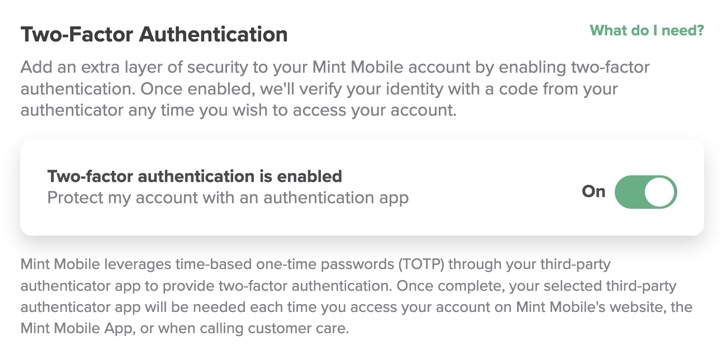
In order to better secure your Mint Mobile account overall, you should enable two-factor authentication (2FA) using a third-party TOTP Authenticator app. Examples include Google Authenticator, Authy, or 1Password. You can activate this either via the Mint app or at Mintmobile.com. Here are the official instructions from Mint: How do I set up and manage two-factor authentication?

To access your Mint Mobile account with 2FA enabled, you’ll need to provide a security code from a third-party authentication app to confirm that you’re the one logging into your account, not some weirdo trying to mess with your SIM.

Be sure to understand how to use your Authenticator app if you lose your phone. You will either want to have it cloud-based so you can get the 6-digit code via other methods, or have special backup codes printed out if staying offline.

Activate Number Lock

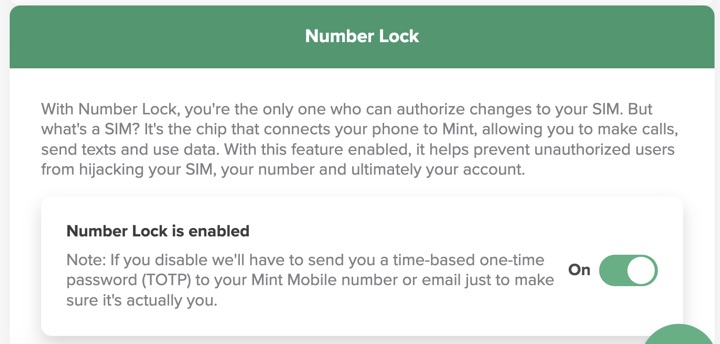
The Number Lock feature prevents the ability to request a “port out” of your number to another phone or carrier. This includes yourself if you wanted to switch carriers, so you’ll need to log into your account and disable it first if you want to do that. Note that as long as you can log into your Mint Mobile account, you can de-activate this feature. This makes the above 2FA even more important.

When Number Lock is turned on in your account, you won’t be able to activate a new SIM, order a replacement SIM or change phones. You’ll need to disable Number Lock whenever you wish to take any of these actions, but we recommend waiting until just before to do so.

Here are the official instructions from Mint: What is Number Lock?

Number Lock is a security feature that protects your SIM (physical SIM or eSIM) from unauthorized changes. Your SIM is the chip that connects your phone to the Mint Mobile network, allowing you to make calls, send texts and use mobile data. It stores your account information and your phone number. Enabling Number Lock helps prevent shady characters from hijacking your SIM, your phone number and ultimately your account.

IRS Identity Protection PIN: Opt-In to Prevent Tax Return Scams

The next step of my “hardening” against identity theft was to obtain an Identity Protection PIN (IP PIN) from the IRS. The common scam here is that someone with your name, address, and Social Security Number will file a tax return before you do, and then steal the resulting tax refund for themselves. In 2022, over 228,000 taxpayers filed IRS Form 14039, Identity Theft Affidavit, which asserts “I know or suspect that someone used my information to fraudulently file a federal tax return”.

Once you opt-in to the IP PIN program, the IRS will not accept any tax return filed during the current calendar year (even for prior years) without this unique six-digit number. Every calendar year, you’ll get assigned a new IP PIN. So I’ll need to get another one in January 2025, but getting one now will still prevent anyone from filing a fraudulent amended 2024 return during the rest of 2024.

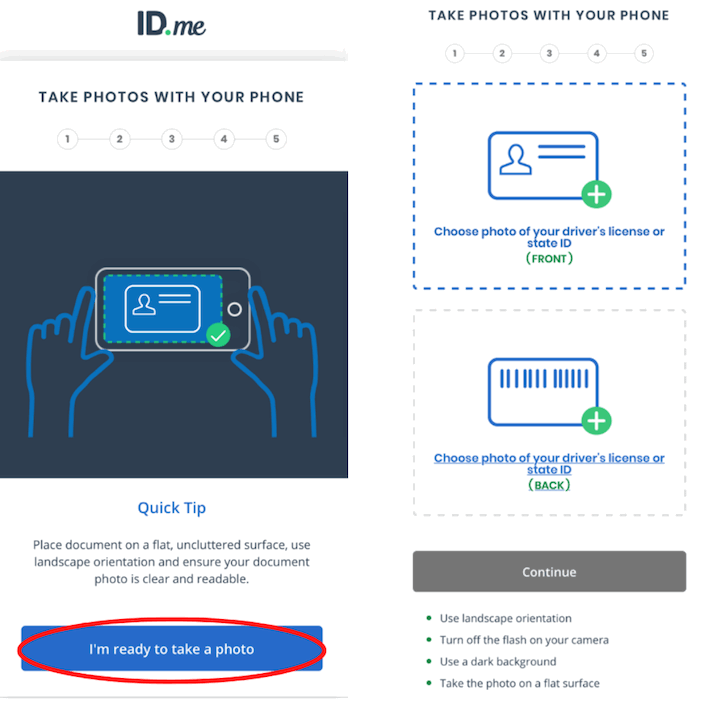
As with setting up credit freezes, this process was also a lot easier than in the past. Well, hopefully. To do it completely online, you’ll need an ID.me account, which is a third-party provider that the IRS trusts to verify your identity. From their page:

You can use either a self-service process that requires a photo of a government ID and selfie, or a live call with an ID.me video chat agent that doesn’t require biometric data.

I had already set up an ID.me account for another purpose years ago, but I do remember that the selfie method worked eventually for me but my wife had to go for the live video chat method. I’ve also had to deal with problems with rejected ID photos, too much glare, software crashes, etc.

If you forget your PIN, you can always sign back into your IRS.gov account and view it again under your Profile. This is another reason to take extra care with your ID.me/IRS.gov passwords and MFA methods. ID.me lets you set up a TOTP Authenticator app for MFA. Also set a reminder to use it when you eventually file taxes, so your return doesn’t get rejected.

More information at the IRS IP PIN FAQ page (that’s a lot of acronyms!).