Private Equity Creating Attractive Rates For MYGAs / Life Insurance?

One of the lessons from the 2025 Berkshire Hathaway Annual Meeting was that you never know where your next investment idea will come from, so you should “turn every page”. For example, I like to read the entire transcript of the Q&A session (thanks to Steady Compounding) instead of just reading the WSJ or CNBC articles. Take this question and answer came up from Ajit Jain, their head of insurance:

Becky Quick: This question is from Peter Shen in New Jersey. It’s for Mr. Buffett and Mr. Jain. In recent years, large private equity firms like Blackstone, Apollo, and KKR have aggressively expanded into insurance, raising permanent capital, managing float, and aiming to replicate the model that Berkshire pioneered decades ago. Given that these firms are now directly competing for insurance assets, often using higher leverage and more aggressive investment strategies, how do you view their impact on Berkshire’s insurance operations and underwriting discipline? Do you believe that the private equity model poses risks to policyholders in the broad financial system, and has this competition made it more challenging for Berkshire to find and price insurance opportunities safely and profitably today?

Ajit Jain: Part of the question is very easy. There’s no question the private equity firms have come into the space, and we are no longer competitive in the space. We used to do a fair amount in this space, but in the last 3-4 years, I don’t think we’ve done a single deal.

You should separate this whole segment into two parts: the property casualty end of the business and the life end of the business. The private equity firms you mentioned are all very active in the life end of the business, not the property casualty end.

You are right in identifying the risks these private equity firms are taking on both in terms of leverage and credit risk. While the economy is doing great and credit spreads are low, these firms have taken the assets from very conservative investments to ones where they get a lot more return. As long as the economy is good and credit spreads are low, they will make money – they’ll make a lot of money because of leverage.

However, there is always the danger that at some point the regulators might get cranky and say they’re taking too much risk on behalf of their policyholders, and that could end in tears. We do not like the risk-reward that these situations offer, and therefore we put up the white flag and said we can’t compete in this segment right now.

Basically, Berkshire can’t compete in life insurance right now because private equity firms are flush with money and are expanding into insurance and competing very aggressively on rates. The only real insurance-as-investment product that interests me (I do have term life insurance) are multi-year guaranteed annuity (MYGAs), so I decided to check the current rates.

Sure enough, a new name called Knighthead Life is at the top of the charts at Blueprint Income. Their rates will vary by state and investment amount, but I saw 7-year MYGAs at 6.80% and 5-year MYGAs at 6.55% (simple interest). Knighthead Life even has a relatively solid A- rating for financial strength from AM Best. Usually, the top rate will be offered by an insurer with a lower B++ rating.

Digging further, we find that private equity firm Knighthead Capital Management/Knighthead Insurance Group recently completed a $550 million capital raise, acquired Merit Life Insurance in January 2025, and quickly rebranded it as Knighthead Life.

Another top MYGA provider on the list, Revel One, was founded in 1980 and acquired by private equity firm Axar Capital in 2022.

I’m still trying to keep my investments simple, but these MYGA rates are a pretty significant 2%+ spread above current bank CD rates and Treasuries. They are not directly comparable, but they are comparable. MYGA are much more complicated and there are pitfalls to avoid. Please do your own research before investing.

In addition, perhaps this also makes it a good time to shop for term life insurance rates. I haven’t shopped around in a while. We got ours set up at a reasonable cost before having kids and I’m always happy to know that it is there for my family if they need it.

I wonder if looking back, this will have been an opportunity to take advantage of the consumer-friendly rates resulting from the current rush of money into private equity, or if the risks of “higher leverage and more aggressive investment strategies” will eventually create a crisis event if some of these insurance companies start to fail. (How long will that shiny A- rating last?)


Savings I Bonds May 2025: 1.10% Fixed Rate, 2.88% Inflation Rate (3.98% Total for First 6 Months)

Update: Savings I Bonds bought from May 1, 2025 through October 31, 2025 will have a fixed rate of 1.10% and inflation rate of 2.88%, for a total composite rate of 3.98% for the first 6 months. Compare the total rate with the current short-term Treasury yields (1-year @ ~3.9%), and compare the fixed rate with the short-term TIPS real yields (5-year @ ~1.5%).

Every existing I Bond will earn this inflation rate of ~2.88% eventually for 6 months; you will need to add your own fixed rate that was set based the initial purchase month. See you again in mid-October for the next early prediction for November 2025.

Original post from 4/11/25:

Savings I Bonds are a unique, low-risk investment backed by the US Treasury that pay out a variable interest rate linked to inflation. With a holding period from 12 months to 30 years, you could own them as an alternative to bank certificates of deposit (they are liquid after 12 months) or bonds in your portfolio.

New inflation numbers were just announced at BLS.gov, which allows us to make an early prediction of the May 2025 savings bond rates a couple of weeks before the official announcement on the 1st. This also allows the opportunity to know exactly what an April 2025 savings bond purchase will yield over the next 12 months, instead of just 6 months. You can then compare this against a May 2025 purchase.

New inflation rate prediction. September 2024 CPI-U was 315.301. May 2025 CPI-U was 319.799, for a semi-annual inflation rate of 1.43%. Using the official composite rate formula:

Composite rate formula: [Fixed rate + (2 x semiannual inflation rate) + (fixed rate x semiannual inflation rate)]

This results in the variable component of interest rate for the next 6 month cycle being ~2.86 to 2.88%, depending on the fixed rate.

Tips on purchase and redemption. You can’t redeem until after 12 months of ownership, and any redemptions within 5 years incur an interest penalty of the last 3 months of interest. A simple “trick” with I-Bonds is that if you buy at the end of the month, you’ll still get all the interest for the entire month – same as if you bought it in the beginning of the month. It’s best to give yourself a few business days of buffer time. If you miss the cutoff, your effective purchase date will be bumped into the next month. (You should always sell at the very beginning of the month.)

Buying in April 2025. If you buy before the end of April, the fixed rate portion of I-Bonds will be 1.20%. You will be guaranteed a total interest rate of 1.20 + 1.91 = 3.11% for the next 6 months. For the 6 months after that, the total rate will be 1.20 + 2.88 = 4.08%.

Buying in May 2025. If you buy in May 2025, you will get ~2.88% plus a newly-set fixed rate for the first 6 months. The new fixed rate is officially unknown, but is loosely linked to the real yield of short-term TIPS with some reductions. In the previous 10 days, 5-year TIPS real rates have ranged from 1.25% to 1.72%. That’s a nearly 50 basis point swing! If I had to guess, I’d put a new fixed rate somewhere between 1.0 to 1.3%, for a total rate of about 4%. Every six months after your purchase, your rate will adjust to your fixed rate (set at purchase) plus a variable rate based on inflation.

If you have an existing I-Bond, the rates reset every 6 months depending on your specific purchase month. Everyone will eventually get this variable rate. Your bond rate = your specific fixed rate (based on purchase month, look it up here) + variable rate (total bond rate has a minimum floor of 0%).

Buy now or wait? Between those two options, I’m actually not sure. In the short-term, the rates are no better than T-bills. If you are a long-term holder, you might grab the 1.2% fixed rate “bird in the hand”. But the inflation rate will be higher in May by nearly a whole 1%, and so I’d personally just wait and see what happens in mid-October to buy my limit.

Also consider that 30-year TIPS rates on 4/10/25 were at 2.68%! If you really intend to hold for 30 years, that might be a better deal. I plan to fill out my TIPS ladder a bit more if the rates stay this high.

Unique features and considerations. I have a separate post on reasons to own Series I Savings Bonds, including inflation protection, tax deferral, exemption from state income taxes, and potential tax benefits if used toward qualified educational expenses.

The main drawback is hassle. You can only buy new savings bonds through TreasuryDirect.gov, which is limited in its customer service resources and features. But as there is no option for paper tax forms nor statements, so your heirs may never know they exist! If they do find it, it may take them several months to close out all the estate paperwork. If your password is compromised, they will not replace any lost or stolen savings bonds. The juice may not be worth the squeeze when you can own individual Treasury bonds or TIPS within any full-service brokerage account.

Annual purchase limits. The annual purchase limit is now $10,000 in online I-bonds per Social Security Number. For a couple, that’s $20,000 per year. As of 2024. you can only buy online at TreasuryDirect.gov, after making sure you’re okay with their security protocols and user-friendliness. (No more tax refund savings bonds.) Technically, the purchase limits are per Social Security Number or Employer Identification Number. For those looking for another way to expand their purchasing power, that means you can also buy for a child, grandchild, LLC, or a trust.

Bottom line. Savings I bonds are a unique, low-risk investment that are linked to inflation and only available to individual investors. You can now only purchase them online at TreasuryDirect.gov. For more background, see the rest of my posts on savings bonds.

[Image: 1942 US Savings Bond poster – source]

AI Pioneer Divides Assets Across Multiple Banks and Brokerages

I’m trying (and failing) to keep up with AI developments, but inside this interview with AI pioneer Geoffrey Hinton (Wikipedia names him the Godfather of AI) was an interesting tidbit that relates to personal finance. Here is an excerpt from a transcript of the interview (emphasis mine):

GEOFFREY HINTON: Among the AI researchers, people are more aware of it. So the people I know who are kind of most depressed about it are serious AI researchers. I have started doing practical things because AI is going to be very good at designing cyber attacks. I don’t think the Canadian banks are safe anymore.

So Canadian banks are about as safe as you can get. They’re very well regulated compared with US banks. But over the next 10 years, I wouldn’t be at all surprised if there was a cyber attack that took down a Canadian bank.

BROOK SILVA-BRAGA: What does take down mean?

GEOFFREY HINTON: Suppose that the bank holds shares that I own. Right. Suppose the cyber attack sells those shares. Now my money’s gone. So I actually now spread my money between three banks. Okay. So that’s the first practical thing I’ve done because I think if a cyber attack takes down one Canadian bank, the others will get a lot more serious.

BROOK SILVA-BRAGA: Okay. Anything else like that? What else?

GEOFFREY HINTON: That’s the main thing. That’s where I noticed I actually did something practical that flowed from my belief that very scary times are coming.

In that context, Hinton is not just talking about separating his assets across multiple banks but also brokerage accounts that own shares of companies.

I believe this idea of keeping your assets separated into different silos is a good one. I plan to also avoid linking information from one brokerage account to another brokerage firm (either to initiate funds transfers, or to use in data-sharing services like “Full View”). Assume that any one major bank or brokerage firm may eventually go down in a complete mess, and it may take a very long time to clean up that mess. Hinton’s choice of three different places seems like a reasonable number.

It’s good to have some actionable advice, as opposed to pondering his concerns about bad actors using “lethal autonomous weapons”. 😨

Aven Advisor: Track Your Finances, Get $5 Starbucks Gift Card Every Week (Homeowners w/ 700+ Credit)

Update June 2025: This offer now appears to be severely limited very soon to occasional gift cards.

Update April 2025: I’ve continued to receive my $5 in SBUX credit every week with no issues, up to over $50 so far. Honestly, getting $5 worth of caffeine every week feels better than it should, no wonder Starbucks is effectively running its own currency. You do need to remember to log into the app every week (Fridays for me, not sure if same day for everyone). Now you can either sign up for Starbucks or Dunkin credit (thanks to DoC).

You can still get an additional one-time $5 cash bonus if you open through Aven.com/advisor and use my invite code JP25DJVG7K during the app sign-up. You’ll need to link a bank account via Plaid to get the $5 transferred to you.

Some caveats: Don’t accidentally sign-up for their credit card, it is not required to get this $5 weekly credit. They have also added new fine print that the offer is limited to residents of AL, AK, AZ, AR, CA, CO, FL, GA, ID, IL, IN, IA, KS, KY, LA, ME, MD, MI, MN, MS, NE, NH, NJ, NM, NC, ND, OH, OK, OR, PA, SD, TN, UT, VA, WI, WY. This was not the case originally.

Original post from 2/3/2025:

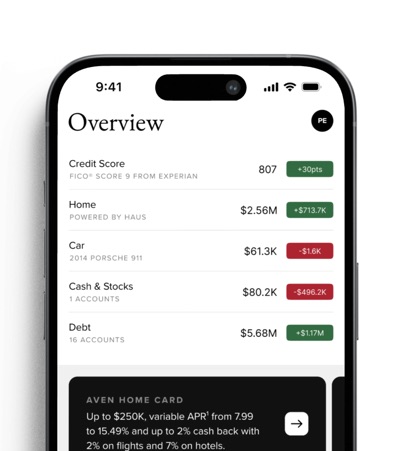
Aven Advisor is a new app that promises to help to track your financial situation. Kind of like the old Mint app, you have to give them your personal info and link up bank accounts/credit cards, and then they offer a unique mix of things:

  • Free weekly credit score (VantageScore 4.0 for me, even though some screenshots show FICO).
  • Find your hidden subscriptions by mining your transactions.
  • Track your home value, neighborhood home prices, and show you nearby house listings.
  • Get a free lien report on your property.
  • Track your bank balances, brokerage balances, and credit card debt.
  • Track the value of your car.
  • Shows you nearby Facebook Marketplace listing for cars and other random things.

So why give them your data? Well, if you are a homeowner with a good credit (700+), they will give you $5 in Starbucks credit once every week. You have to manually open the app and tap the link on every Monday (so they know you’re actively using it), but I’ve successfully gotten my credit. Loads right onto my Starbucks app, see screenshot below.

Join at Aven.com/advisor (remember, only homeowners get the Starbucks offer). You can also get an additional one-time $5 cash bonus with my referral code JP25DJVG7K. Thanks if you use it. You’ll have to link a bank account via Plaid to transfer the $5 into your account.

Best Interest Rates Survey: Savings Accounts, Treasuries, CDs, ETFs – April 2025

Here’s my monthly survey of the best interest rates on cash as of April, roughly sorted from shortest to longest maturities. Banks love taking advantage of our idle cash, and you can often earning more money while keeping the same level of safety by moving to another FDIC-insured bank or NCUA-insured credit union. Check out my Ultimate Rate-Chaser Calculator to see how much extra interest you could earn from switching. Rates listed are available to everyone nationwide. Rates checked as of 4/20/2025.

TL;DR: Short-term savings accounts dropped again slightly overall. Short-term T-Bill rates at around 4.3%. Top 5-year CD rates are ~4.25% APY, while 5-year Treasury rate is ~4%.

High-yield savings accounts*
Since the huge megabanks still pay essentially no interest, everyone should at least have a separate, no-fee online savings account to piggy-back onto your existing checking account. The interest rates on savings accounts can drop at any time, so I list the top rates as well as competitive rates from banks with a history of competitive rates and solid user experience. Some banks will bait you with a temporary top rate and then lower the rates in the hopes that you are too lazy to leave.

  • The top saving rate at the moment: Roger.bank is at 4.65% APY (no min), but does require an additional companion checking account. OnPath FCU has a new account paying 5.00% APY but requires $25,000 min. CIT Platinum Savings is now at 4.10% APY with $5,000+ balance, but also has a $225/$300 deposit bonus you can stack on top. There are many banks in between.
  • SoFi Bank is at 3.80% APY + up to $325 new account bonus with direct deposit. You must maintain a direct deposit of any amount (even $1) each month for the higher APY. SoFi has historically competitive rates and full banking features. See details at $25 + $300 SoFi Money new account and deposit bonus.
  • Here is a limited survey of high-yield savings accounts. They aren’t the top rates, but a group that have historically kept it relatively competitive such that I like to track their history.

Short-term guaranteed rates (1 year and under)
A common question is what to do with a big pile of cash that you’re waiting to deploy shortly (plan to buy a house soon, just sold your house, just sold your business, legal settlement, inheritance). My usual advice is to keep things simple and take your time. If not a savings account, then put it in a flexible short-term CD under the FDIC limits until you have a plan.

  • No Penalty CDs offer a fixed interest rate that can never go down, but you can still take out your money (once) without any fees if you want to use it elsewhere. Marcus has a 13mo No Penalty CD at 4.00% APY ($500 minimum deposit). Farmer’s Insurance FCU has 9-month No Penalty CD at 4.25% APY ($1,000 minimum deposit). Kinecta FCU has 9-month Liquid CD at 4.25% APY ($10,000 minimum) that allows for daily penalty-free withdrawals of up to 50% of the start of day balance. Consider opening multiple CDs in smaller increments for more flexibility.
  • Security State Bank has a 12-month certificate special at 4.65% APY ($25,000 min). Early withdrawal penalty is 180 days of interest.

Money market mutual funds
Many brokerage firms that pay out very little interest on their default cash sweep funds (and keep the difference for themselves). Note: Money market mutual funds are highly-regulated, but ultimately not FDIC-insured, so I would still stick with highly reputable firms.

  • Vanguard Federal Money Market Fund (VMFXX) is the default sweep option for Vanguard brokerage accounts, which has an SEC yield of 4.22% (changes daily, but also works out to a compound yield of 4.30%, which is better for comparing against APY). Odds are this is much higher than your own broker’s default cash sweep interest rate.
  • Vanguard Treasury Money Market Fund (VUSXX) is an alternative money market fund which you must manually purchase, but the interest will be mostly (100% for 2024 tax year) exempt from state and local income taxes because it comes from qualifying US government obligations. Current SEC yield of 4.23% (compound yield of 4.31%).

Treasury Bills and Ultra-short Treasury ETFs
Another option is to buy individual Treasury bills which come in a variety of maturities from 4-weeks to 52-weeks and are fully backed by the US government. You can also invest in ETFs that hold a rotating basket of short-term Treasury Bills for you, while charging a small management fee for doing so. T-bill interest is exempt from state and local income taxes, which can make a significant difference in your effective yield.

  • You can build your own T-Bill ladder at TreasuryDirect.gov or via a brokerage account with a bond desk like Vanguard and Fidelity. Here are the current Treasury Bill rates. As of 4/17/25, a new 4-week T-Bill had the equivalent of 4.32% annualized interest and a 52-week T-Bill had the equivalent of 3.99% annualized interest.
  • The iShares 0-3 Month Treasury Bond ETF (SGOV) has a 4.18% SEC yield (0.09% expense ratio) and effective duration of 0.09 years. SPDR Bloomberg Barclays 1-3 Month T-Bill ETF (BIL) has a 4.13% SEC yield (0.136% expense ratio) and effective duration of 0.15 years. The Vanguard 0-3 Month Treasury Bill ETF (VBIL) hasn’t been around long enough to generate an SEC yield (0.07% expense ratio).

US Savings Bonds
Series I Savings Bonds offer rates that are linked to inflation and backed by the US government. You must hold them for at least a year. If you redeem them within 5 years there is a penalty of the last 3 months of interest. The annual purchase limit for electronic I bonds is $10,000 per Social Security Number, available online at TreasuryDirect.gov.

  • “I Bonds” bought between November 2024 and April 2025 will earn a 3.11% rate for the first six months. The rate of the subsequent 6-month period will be based on inflation again. More on Savings Bonds here.
  • In mid-April 2025, the CPI will be announced and you will have a short period where you will have a very close estimate of the rate for the next 12 months. Read all the details about your options here.

Rewards checking accounts
These unique checking accounts pay above-average interest rates, but with unique risks. You have to jump through certain hoops which usually involve 10+ debit card purchases each cycle, a certain number of ACH/direct deposits, and/or a certain number of logins per month. If you make a mistake (or they judge that you did) you risk earning zero interest for that month. Some folks don’t mind the extra work and attention required, while others would rather not bother. Rates can also drop suddenly, leaving a “bait-and-switch” feeling.

  • OnPath Federal Credit Union (my review) pays 7.00% APY on up to $10,000 if you make 15 debit card purchases, opt into online statements, and login to online or mobile banking once per statement cycle. Anyone can join this credit union via $5 membership fee to join partner organization. You can also get a $100 Visa Reward card when you open a new account and make qualifying transactions.
  • Genisys Credit Union pays 6.75% APY on up to $7,500 if you make 10 debit card purchases of $5+ each per statement cycle, and opt into online statements. Anyone can join this credit union via $5 membership fee to join partner organization.
  • La Capitol Federal Credit Union pays 5.75% APY on up to $10,000 if you make 15 debit card purchases of at least $5 each per statement cycle. Anyone can join this credit union via partner organization, Louisiana Association for Personal Financial Achievement ($20).
  • First Southern Bank pays 5.50% APY on up to $25,000 if you make at least 15 debit card purchases, 1 ACH credit or payment transaction, and enroll in online statements.
  • Credit Union of New Jersey pays 6.00% APY on up to $25,000 if you make 12 debit card purchases, opt into online statements, and make at least 1 direct deposit, online bill payment, or automatic payment (ACH) per statement cycle. Anyone can join this credit union via $5 membership fee to join partner organization.
  • Andrews Federal Credit Union pays 5.50% APY (down from 6%) on up to $25,000 if you make 15 debit card purchases, opt into online statements, and make at least 1 direct deposit or ACH transaction per statement cycle. Anyone can join this credit union via partner organization.
  • Find a locally-restricted rewards checking account at DepositAccounts.

Certificates of deposit (greater than 1 year)
CDs offer higher rates, but come with an early withdrawal penalty. By finding a bank CD with a reasonable early withdrawal penalty, you can enjoy higher rates but maintain access in a true emergency. Alternatively, consider building a CD ladder of different maturity lengths (ex. 1/2/3/4/5-years) such that you have access to part of the ladder each year, but your blended interest rate is higher than a savings account. When one CD matures, use that money to buy another 5-year CD to keep the ladder going. Some CDs also offer “add-ons” where you can deposit more funds if rates drop.

  • KS State Bank has a 5-year certificate at 4.15% APY ($500 minimum), 4-year at 4.15% APY, 3-year at 4.15% APY, 2-year at 4.20% APY, and 1-year at 4.25% APY. $500 minimum. The early withdrawal penalty (EWP) for the 5-year is a huge 540 days of interest.
  • Mountain America Credit Union (MACU) has a 5-year certificate at 4.25% APY ($500 minimum), 4-year at 4.25% APY, 3-year at 4.25% APY, 2-year at 3.95% APY, and 1-year at 4.25% APY. Early withdrawal penalty for the 4-year and 5-year is 365 days of interest. Anyone can join this credit union via partner organization American Consumer Council for a one-time $5 fee (or try promo code “consumer”).
  • Lafayette Federal Credit Union (LFCU) has a 5/4/3/2/1-year certificates at 4.28% APY ($500 min). Slightly higher rates with jumbo $100,000+ balances. Note that the early withdrawal penalty for the 5-year is a relatively large 600 days of interest. Anyone nationwide can join LFCU by joining the Home Ownership Financial Literacy Council (HOFLC) for a one-time $10 fee.
  • You can buy certificates of deposit via the bond desks of Vanguard and Fidelity. You may need an account to see the rates. These “brokered CDs” offer FDIC insurance and easy laddering, but they don’t come with predictable early withdrawal penalties. Right now, I see a 5-year non-callable brokered CD at 4.00% APY (callable: no, call protection: yes). Be warned that both Vanguard and Fidelity will list higher rates from callable CDs, which importantly means they can call back your CD if rates drop later. (Issuers have indeed started calling some of their old 5%+ CDs during 2024.)

Longer-term Instruments
I’d use these with caution due to increased interest rate risk (tbh, I don’t use them at all), but I still track them to see the rest of the current yield curve.

  • Willing to lock up your money for 10 years? You can buy long-term certificates of deposit via the bond desks of Vanguard and Fidelity. These “brokered CDs” offer FDIC insurance, but they don’t come with predictable early withdrawal penalties. You might find something that pays more than your other brokerage cash and Treasury options. Right now, I see a 10-year CDs at [n/a] (non-callable) vs. 4.34% for a 10-year Treasury. Watch out for higher rates from callable CDs where they can call your CD back if interest rates drop.

All rates were checked as of 4/20/25.

* I no longer recommend fintech companies due to the possibility of loss due to poor recordkeeping and lack of government regulation. (Ex. Evergreen Wealth at 5% APY is a fintech.)

Photo by insung yoon on Unsplash

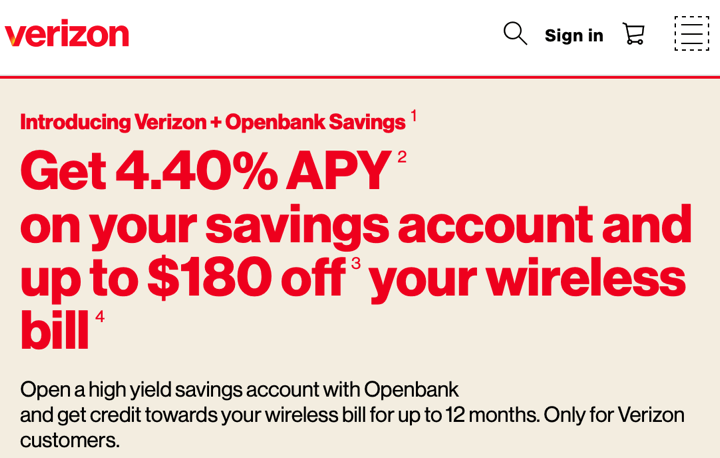
Verizon + Openbank Savings: 4.40% APY + Up to $180 in Bill Credits

Verizon and Openbank have partnered together such if that you open a high yield savings account with Openbank and maintain a qualifying balance, you’ll get up to $15 a month in Verizon bill credits for the first 12 months (total up to $180). You also get the standard APY, which is currently a competitive 4.40% APY. If you are a Verizon customer, it might be worth a look. Here are the tiers:

The Verizon Bill Credit is based on the monthly average daily balance of your High Yield Savings account and can range between $5, $10 or $15 a month according to the following:

– Get up to $60/year ($5/month) in Verizon Bill Credits if your average account balance is between $1,000 and $9,999.99. Offer valid for up to 12 consecutive months from the date you open the account.

– Get up to $120/year ($10/month) in Verizon Bill Credits if your average account balance is between $10,000 and $29,999.99. Offer valid for up to 12 consecutive months from the date you open the account.

– Get up to $180/year ($15/month) in Verizon Bill Credits if your balance is $30,000 or more. Offer valid for up to 12 consecutive months from the date you open the account.

Here are the details on qualifying Verizon accounts:

You’ll need an existing Verizon mobile account with up to 12 phone lines maximum (depending on your plan), 5G Home Internet or LTE Home Internet to be eligible to apply for the Verizon + Openbank Savings account. Verizon Prepaid, Verizon mobile Business, Verizon Fios and Verizon Fios Business accounts are not eligible for Verizon + Openbank Savings

Bonus calculations. There is a $500 minimum to open an account, and the bonus is based on the “monthly average daily balance”.

  • $1,000 balance earning $60/year in credits = 6.0% boost over a year.
  • $10,000 balance earning $120/year in credits = 1.2% boost over a year.
  • $30,000 balance earning $180/year in credits = 0.60% boost over a year.

As long as the base APY is relatively competitive, you could probably justify keeping up to $30,000 in this account, given that the bill credits are basically after-tax money. 4.40% + 0.60% = 5.00%, which is a top overall rate. This is assuming they don’t 1099 you for the bill credits, which I doubt they will considering they are a discount on a service.

However, if you just want the most bang for your buck, you could just keep $1,000 in there for a $60 total bonus. Or you could think of it as a ~10% APY savings account for a year.

This promotion would be a lot more attractive if the bill credits applied indefinitely, instead of only the first 12 months. As it is, it might be attractive if you already have Verizon wireless service.

Hat tip to Doctor of Credit.

Fidelity, Schwab Won’t Let You Trade Money Market ETFs (That Aren’t Theirs)

In case you aren’t aware that a huge profit source for every broker is your idle cash, Bloomberg reports that Fidelity and Schwab are blocking all new purchase trades of new money market ETFs (gift article) from Blackrock and Texas Capital. Here’s what Fidelity and Schwab say about it:

A Schwab spokesperson said its decision is consistent with the firm’s “long-standing approach” of only making available Schwab affiliate money-market mutual funds, while a Fidelity spokesperson said this is an extension of the company’s policy to “generally restrict” third-party money-market mutual funds.

The inflows to those new ETFs weren’t even that big, making this an interesting development:

Yet, the move stands out because trading platforms like Schwab and Fidelity typically don’t restrict exchange-traded funds, even if those funds are in competition with existing in-house offerings.

Indeed, I hope this doesn’t start a trend of more bans of competitor ETFs. Fidelity and Blackrock have worked very closely together in the past, so this is probably rather awkward.

For now, I still own lots of shares of iShares 0-3 Month Treasury Bond ETF (SGOV) and probably soon Vanguard 0-3 Month Treasury Bill ETF (VBIL). Fidelity and Schwab haven’t banned those, yet. Of course, Vanguard continues to not play funny games with their money market sweep funds. C’mon Vanguard, time for your own money market ETF to create even more tension…

I know that these brokers have to make their money somewhere, but they may have to become more transparent about it soon.

Best Interest Rates Survey: Savings Accounts, Treasuries, CDs, ETFs – March 2025

Here’s my monthly survey of the best interest rates on cash as of March, roughly sorted from shortest to longest maturities. Banks love taking advantage of our idle cash, and you can often earning more money while keeping the same level of safety by moving to another FDIC-insured bank or NCUA-insured credit union. Check out my Ultimate Rate-Chaser Calculator to see how much extra interest you could earn from switching. Rates listed are available to everyone nationwide. Rates checked as of 3/9/2024.

TL;DR: Short-term savings accounts dropped very slightly overall, with top rates varying widely from 3.7% to 5% APY. Short-term T-Bill rates at around 4.3%. Top 5-year CD rates are ~4.30% APY, while 5-year Treasury rate is ~4.1%.

High-yield savings accounts*
Since the huge megabanks still pay essentially no interest, everyone should at least have a separate, no-fee online savings account to piggy-back onto your existing checking account. The interest rates on savings accounts can drop at any time, so I list the top rates as well as competitive rates from banks with a history of competitive rates and solid user experience. Some banks will bait you with a temporary top rate and then lower the rates in the hopes that you are too lazy to leave.

  • The top saving rate at the moment: Roger.bank is at 5.00% APY (no min), but does require an additional companion checking account. CIT Platinum Savings is now at 4.30% APY with $5,000+ balance, but also has a $225/$300 deposit bonus you can stack on top.
  • SoFi Bank is at 3.80% APY + up to $325 new account bonus with direct deposit. You must maintain a direct deposit of any amount (even $1) each month for the higher APY. SoFi has historically competitive rates and full banking features. See details at $25 + $300 SoFi Money new account and deposit bonus.
  • Here is a limited survey of high-yield savings accounts. They aren’t the top rates, but a group that have historically kept it relatively competitive such that I like to track their history.

Short-term guaranteed rates (1 year and under)
A common question is what to do with a big pile of cash that you’re waiting to deploy shortly (plan to buy a house soon, just sold your house, just sold your business, legal settlement, inheritance). My usual advice is to keep things simple and take your time. If not a savings account, then put it in a flexible short-term CD under the FDIC limits until you have a plan.

  • No Penalty CDs offer a fixed interest rate that can never go down, but you can still take out your money (once) without any fees if you want to use it elsewhere. Marcus has a 13mo No Penalty CD at 4.15% APY ($500 minimum deposit). Farmer’s Insurance FCU has 9-month No Penalty CD at 4.25% APY ($1,000 minimum deposit). Credit Human has 12-month Liquid CD at 4.26% APY ($5,000 minimum) that allows unlimited deposits and two allowed withdrawals. Consider opening multiple CDs in smaller increments for more flexibility.
  • Security State Bank has a 12-month certificate special at 4.65% APY ($25,000 min). Early withdrawal penalty is 180 days of interest.

Money market mutual funds
Many brokerage firms that pay out very little interest on their default cash sweep funds (and keep the difference for themselves). Note: Money market mutual funds are highly-regulated, but ultimately not FDIC-insured, so I would still stick with highly reputable firms.

  • Vanguard Federal Money Market Fund (VMFXX) is the default sweep option for Vanguard brokerage accounts, which has an SEC yield of 4.24% (changes daily, but also works out to a compound yield of 4.32%, which is better for comparing against APY). Odds are this is much higher than your own broker’s default cash sweep interest rate.
  • Vanguard Treasury Money Market Fund (VUSXX) is an alternative money market fund which you must manually purchase, but the interest will be mostly (100% for 2024 tax year) exempt from state and local income taxes because it comes from qualifying US government obligations. Current SEC yield of 4.25% (compound yield of 4.33%).

Treasury Bills and Ultra-short Treasury ETFs
Another option is to buy individual Treasury bills which come in a variety of maturities from 4-weeks to 52-weeks and are fully backed by the US government. You can also invest in ETFs that hold a rotating basket of short-term Treasury Bills for you, while charging a small management fee for doing so. T-bill interest is exempt from state and local income taxes, which can make a significant difference in your effective yield.

  • You can build your own T-Bill ladder at TreasuryDirect.gov or via a brokerage account with a bond desk like Vanguard and Fidelity. Here are the current Treasury Bill rates. As of 3/7/25, a new 4-week T-Bill had the equivalent of 4.31% annualized interest and a 52-week T-Bill had the equivalent of 4.06% annualized interest.
  • The iShares 0-3 Month Treasury Bond ETF (SGOV) has a 4.20% SEC yield (0.09% expense ratio) and effective duration of 0.09 years. SPDR Bloomberg Barclays 1-3 Month T-Bill ETF (BIL) has a 4.13% SEC yield (0.136% expense ratio) and effective duration of 0.15 years. The Vanguard 0-3 Month Treasury Bill ETF (VBIL) hasn’t been around long enough to generate an SEC yield (0.07% expense ratio).

US Savings Bonds
Series I Savings Bonds offer rates that are linked to inflation and backed by the US government. You must hold them for at least a year. If you redeem them within 5 years there is a penalty of the last 3 months of interest. The annual purchase limit for electronic I bonds is $10,000 per Social Security Number, available online at TreasuryDirect.gov.

  • “I Bonds” bought between November 2024 and April 2025 will earn a 3.11% rate for the first six months. The rate of the subsequent 6-month period will be based on inflation again. More on Savings Bonds here.
  • In mid-April 2025, the CPI will be announced and you will have a short period where you will have a very close estimate of the rate for the next 12 months. I will have another post up at that time.

Rewards checking accounts
These unique checking accounts pay above-average interest rates, but with unique risks. You have to jump through certain hoops which usually involve 10+ debit card purchases each cycle, a certain number of ACH/direct deposits, and/or a certain number of logins per month. If you make a mistake (or they judge that you did) you risk earning zero interest for that month. Some folks don’t mind the extra work and attention required, while others would rather not bother. Rates can also drop suddenly, leaving a “bait-and-switch” feeling.

  • OnPath Federal Credit Union (my review) pays 7.00% APY on up to $10,000 if you make 15 debit card purchases, opt into online statements, and login to online or mobile banking once per statement cycle. Anyone can join this credit union via $5 membership fee to join partner organization. You can also get a $100 Visa Reward card when you open a new account and make qualifying transactions.
  • Genisys Credit Union pays 6.75% APY on up to $7,500 if you make 10 debit card purchases of $5+ each per statement cycle, and opt into online statements. Anyone can join this credit union via $5 membership fee to join partner organization.
  • La Capitol Federal Credit Union pays 5.75% APY (down from 6.25%) on up to $10,000 if you make 15 debit card purchases of at least $5 each per statement cycle. Anyone can join this credit union via partner organization, Louisiana Association for Personal Financial Achievement ($20).
  • (new) First Southern Bank pays 5.50% APY on up to $25,000 if you make at least 15 debit card purchases, 1 ACH credit or payment transaction, and enroll in online statements.
  • Credit Union of New Jersey pays 6.00% APY on up to $25,000 if you make 12 debit card purchases, opt into online statements, and make at least 1 direct deposit, online bill payment, or automatic payment (ACH) per statement cycle. Anyone can join this credit union via $5 membership fee to join partner organization.
  • Andrews Federal Credit Union pays 6.00% APY on up to $25,000 if you make 15 debit card purchases, opt into online statements, and make at least 1 direct deposit or ACH transaction per statement cycle. Anyone can join this credit union via partner organization.
  • Find a locally-restricted rewards checking account at DepositAccounts.

Certificates of deposit (greater than 1 year)
CDs offer higher rates, but come with an early withdrawal penalty. By finding a bank CD with a reasonable early withdrawal penalty, you can enjoy higher rates but maintain access in a true emergency. Alternatively, consider building a CD ladder of different maturity lengths (ex. 1/2/3/4/5-years) such that you have access to part of the ladder each year, but your blended interest rate is higher than a savings account. When one CD matures, use that money to buy another 5-year CD to keep the ladder going. Some CDs also offer “add-ons” where you can deposit more funds if rates drop.

  • KS State Bank has a 5-year certificate at 4.30% APY ($500 minimum), 4-year at 4.30% APY, 3-year at 4.30% APY, 2-year at 4.25% APY, and 1-year at 4.30% APY. $500 minimum. The early withdrawal penalty (EWP) for the 5-year is a huge 540 days of interest.
  • Mountain America Credit Union (MACU) has a 5-year certificate at 4.25% APY ($500 minimum), 4-year at 4.25% APY, 3-year at 4.25% APY, 2-year at 3.95% APY, and 1-year at 4.25% APY. Early withdrawal penalty for the 4-year and 5-year is 365 days of interest. Anyone can join this credit union via partner organization American Consumer Council for a one-time $5 fee (or try promo code “consumer”).
  • Lafayette Federal Credit Union (LFCU) has a 5/4/3/2/1-year certificates at 4.28% APY ($500 min). Slightly higher rates with jumbo $100,000+ balances. Note that the early withdrawal penalty for the 5-year is a relatively large 600 days of interest. Anyone nationwide can join LFCU by joining the Home Ownership Financial Literacy Council (HOFLC) for a one-time $10 fee.
  • You can buy certificates of deposit via the bond desks of Vanguard and Fidelity. You may need an account to see the rates. These “brokered CDs” offer FDIC insurance and easy laddering, but they don’t come with predictable early withdrawal penalties. Right now, I see a 5-year non-callable CD at 4.10% APY (callable: no, call protection: yes). Be warned that both Vanguard and Fidelity will list higher rates from callable CDs, which importantly means they can call back your CD if rates drop later. (Issuers have indeed started calling some of their old 5%+ CDs during 2024.)

Longer-term Instruments
I’d use these with caution due to increased interest rate risk (tbh, I don’t use them at all), but I still track them to see the rest of the current yield curve.

  • Willing to lock up your money for 10 years? You can buy long-term certificates of deposit via the bond desks of Vanguard and Fidelity. These “brokered CDs” offer FDIC insurance, but they don’t come with predictable early withdrawal penalties. You might find something that pays more than your other brokerage cash and Treasury options. Right now, I see a 10-year CDs at [n/a] (non-callable) vs. 4.32% for a 10-year Treasury. Watch out for higher rates from callable CDs where they can call your CD back if interest rates drop.

All rates were checked as of 3/9/25.

* I no longer recommend fintech companies due to the possibility of loss due to poor recordkeeping and lack of government regulation. (Ex. Evergreen Wealth at 5% APY is a fintech.)

Photo by insung yoon on Unsplash

Raisin Marketplace: Up to $400 Deposit Bonus (and Why I’m Skipping It)

Raisin is a financial marketplace that allows you to access high-interest certificates of deposit and savings accounts from multiple different banks and credit unions without having to open up a new account at each one. Right now, they have some new deposit bonuses that are pretty solid based on the bonus-to-deposit ratios and minimum holding periods. However, I will personally not be taking advantage of them due to their use of custodial FBO accounts. I think it’s most useful to both point out the existence of these bonuses and explain my take on them. Details below.

Here are the new bonuses:

  • New customer $250 bonus. Open a new account with promo code GET250, deposit $25,000 within 14 days, and maintain for 90 days for the $250 bonus.
  • Existing customer deposit bonus, up to $400. Must deposit $50,000 in new money. $200 on a 3–6 month CD. $300 on a 7–11 month CD. $400 for a 12+ month CD. Must maintain for full CD maturity period.

How Raisin works. The benefit of Raisin is that you can easily access aggressively high rates at a new bank or credit union without having to open yet another new account (and endure credit checks, identify verification hurdles, join partner organizations, leave funds in share savings accounts, etc). The price is added complexity, higher risk for miscommunication and errors, and a place in a regulatory shadow zone.

Instead of opening a direct account at a new partner bank, there are at least three different parties.

  • Raisin, which is the overall business (“financial technology company”) and not a bank and not a credit union. (Source #1)
  • There are the middlemen, Custodial Bank(s) and Service Bank. The Custodial Bank opens up FBO (For Benefit Of) accounts at each of the Partner Banks/Credit Unions in THEIR names. These FBO accounts are basically big pooled accounts, and the Custodial Bank is supposed to keep track of all the money going in and out for all the individual Raisin customers in their own virtual ledger. The Service Bank is in charge of moving your funds amongst the various banks. Central Bank of Kansas City (CBKC), Member FDIC, is the Service Bank. CBKC, Lewis & Clark Bank and Starion Bank, each Member FDIC, are the Custodial Banks. (Source #2)
  • There are the partner banks. These banks and credit unions are looking to grow deposits, but they have no idea who you are as an individual. They come and go on the Raisin platform. They only see that they opened a single, huge FBO account for the Custodial Bank. (Source #3)

While this setup appears to be perfectly legal (as far I can tell, I am not a lawyer), that doesn’t mean that there is someone to clean up the mess if something goes wrong. It’s like if someone steals your wallet and the cops are too busy with violent crime to track them down, it doesn’t matter if it’s illegal, you’re still not getting your money back.

The real-world example is what happened with Juno, Yotta, Synapse, and Evolve Bank & Trust. They had major disagreements about the ledger tracking all the deposits and withdrawals. They all blamed each other for the missing funds (~$50 million). Since no bank actually failed, the FDIC did not step in. No other regulatory agency stepped in. I was surprised. It was all left to a severely-underfunded bankruptcy court, and the mess still isn’t figured out. Someone ran off with tens of millions of dollars, and innocent individuals were left holding the bag.

Source #1:

Raisin is not a bank and your money is always handled by a federally regulated financial institution — whether in transit, stored in the Cash Account, or in an account at a partner bank. The Custodial Bank keeps records of all funds deposited through the Raisin platform for added security.

Source #2

Custodial accounts are accounts held on for the benefit of Raisin customers by a custodial bank at the banks and credit unions where customers deposit their money through Raisin. When a customer makes a deposit through the Raisin platform into a savings product offered by a given financial institution, the funds move from the customer’s external bank account (also referred to as their reference account) to a custodial account held by one of Raisin’s partner custodial banks at the financial institution offering the savings product. Central Bank of Kansas City (CBKC), Lewis & Clark Bank and Starion Bank, each Member FDIC, are the Custodial Banks.

Source #3:

An FDIC-supervised custodial bank opens the “For Benefit Of” account for each customer and agrees directly with Raisin’s customers to act as the custodian of their funds. This custodial bank is authorized by Raisin customers, as their agent, to hold their deposits at federally regulated banks and credit unions on their behalf in a custodial capacity. Customer funds are never co-mingled with Raisin funds.

Again, if everyone does what they say they will, then it’s all good. The problem is what happens when they don’t. If it happens with Raisin (or any of the parties involved, all relatively small institutions), it has the potential to be a complete mess that could take years to untangle. In today’s regulatory environment, I have zero interest in putting my cash into any sort of regulatory grey area.

In contrast, the CIT Bank $225/$300 deposit offer involves a simple, direct relationship with CIT Bank, an FDIC-insured bank, where you have an individual/joint account directly held in your name. There is a single system. There is no potential pointing of figures between multiple parties. There is a long, established history of the FDIC stepping in resolve a bank failure within days. It’s about as safe as it gets.

Bottom line. I’m doing the CIT bank offer, but not the Raisin offer.

SGOV, STIP, TIP iShares ETFs: Claim Your State Income Tax Exemption (2024/2025)

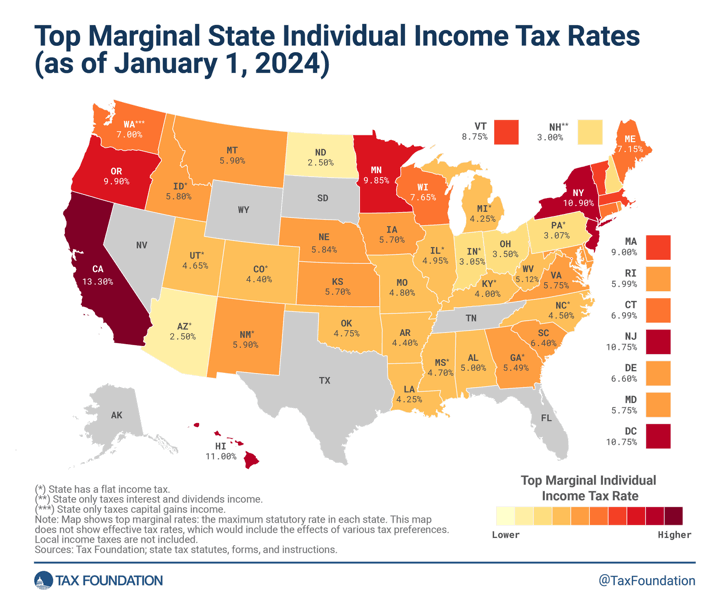
As a follow-up to my posts for Vanguard and Fidelity money market funds, iShares ETFs (Blackrock) has also recently released their US GOI percentages for 2024 tax year. US Government Obligation Interest (US GOI) like Treasury bills and bonds are generally exempt from state and local income taxes. However, in order to claim this exemption, you’ll likely have to manually enter it on your tax return after digging up a few extra details.

The tax document has a pretty good summary of the situation for all brokers:

The Form 1099-DIV (or substitute form) you received from your financial advisor or brokerage firm may include income derived from U.S. Government and agency obligations. This income may be excluded from state income tax (although in many states, only the income from Treasury obligations is exempt from personal state income tax). The information below is provided to assist with the completion of shareholder state income tax returns. The amount in Box 1a of 2024 IRS Form 1099-DIV should be multiplied by the applicable percentages below to obtain the dollar amount of income derived from the sources categorized below. Because the qualifications for exclusion vary by state (some states have investment threshold requirements), please consult your tax advisor for details.

It’s notable that even things like the iShares iBonds 20XX Term TIPS ETFs are not 100% US government obligations, so it’s important to reference this document and not assume. For iShares TIPS Bond ETF (TIP) and iShares 0-5 Year TIPS Bond ETF (STIP) the USGOI percentage for 2024 was indeed at 100.00%.

For iShares 0-3 Month Treasury Bond ETF (SGOV), the USGOI percentage for 2024 was 97.53%. This is pretty good and why SGOV is my default cash position at most brokers. The tax document also confirms that at least 50% of the assets of the fund were invested in Federal Obligations at the end of each quarter of the fiscal year. That means that SGOV met the minimum criteria for the dividend income to be exempt in the states of California, Connecticut, and New York.

Personal Finance Stack: Portfolio Simplification Progress for 2024

I recently found a handwritten note from early 2024 that outlined my goals to “SIMPLIFY!” my portfolio. The overall idea was to make things easier for my spouse to manage in case something happened to me. Even though I still have a rat’s nest of accounts overall, I wanted a streamlined “Core” group of accounts that held 99% of my portfolio. Here’s the current state of the investment side of my personal finance stack.

Vanguard. Vanguard still holds the majority of my investment portfolio, while at the same time has the least amount of transaction activity. The idea is to let it just grow, but also to avoid the need to deal with customer service. Vanguard has the best cash sweep if you don’t use automatic dividend reinvestment. I also want to give the new CEO a bit of time to see how things go.

In 2024, I did convert all my mutual funds into ETFs, so they are easily portable if I do want to move assets. In addition, perhaps the slightly lower ETF expense ratios will make a difference.

Fidelity. Fidelity holds the 2nd-largest total balance, and is where I keep my high-touch accounts. My Fidelity Cash Management Account (CMA) handles most of my monthly cashflows (direct deposit in; BillPay out). My Solo 401k with the manual contributions and ability to buy individual TIPS/Treasuries. My self-directed account with individual stock holdings. In the future, I plan on opening any custodial accounts for kids there.

TreasuryDirect (Sold all Savings Bonds!). A major reason to sell was to achieve simplification and no longer be reliant on the customer service of TreasuryDirect, mostly in for estate planning scenarios. In addition, their policy states that if my account is hacked, they maintain zero liability for any losses. I will miss the additional effective tax-deferred space of savings bonds, but it just wasn’t worth the additional hassle. I just don’t see things improving there in the future, it feels more like gradual decay. This was my 3rd largest balance.

Many of these savings bonds had fixed rates in the 0% to 1%; only a few were at higher fixed rates. The proceeds were reinvested into long-term TIPS (bought/held at Fidelity) with real yields of 2% to 2.6%. Finally, it worked out because the capital gains from this sale were offset from capital losses harvested from selling a bond fund previously when rates rose. (I did an ETF swap to harvest the tax losses while maintaining a similar bond holding without incurring a wash sale.)

Robinhood (setback!). In an unexpected setback for simplification, I ended up transferring my Vanguard IRAs to Robinhood in 2024 due to their 3% transfer promo. When the 5-year hold ends, my plan is to move them to Fidelity unless there is another lucrative offer. This was a new brokerage account to track, but I just couldn’t turn down an additional ~$18,000 in Roth IRA balances.

Utah My529. Thanks to some big early contributions and a very aggressive asset allocation, this is now my next largest investment account, although theoretically it should be completely obliterated within 12 years or so when the tuition bills hit. I consolidated 529 plans several years ago; it can be a lot of paperwork but it’s nice to have everything at one place. Utah seems to be on top of the game for 529 plans.

Bank of America/Merrill Edge to US Bank swap? I keep $100,000 in brokerage assets at Merrill Edge in order to qualify for the Bank of America Preferred Rewards Tier which essentially gets me a flat 2.625% cash back on all my purchases. However, in 2024, US Bank debuted their Smartly credit card that offers up to 4% cash back, also if you keep $100,000 in asset at their brokerage arm.

Should I set up yet another new account at US Bank to take advantage? Should I then close down BofA/Merrill Edge to offset? The problem is that I’m not convinced that US Bank will keep the 4% cash back for very long. US Bank has a history of rolling out new products and then shutting them down abruptly. On the other hand, they also have a history of sometimes keeping the existing perks for grandfathered customers. So maybe it’s best to get in early? Simplification vs. optimization. I didn’t take any action in 2024.

Honestly, as the now-5th largest balance, the BofA/Merrill Edge is the account that I should probably get rid of next, but it’s been so reliable with minimal hassles. I don’t like to mess with what works.

401k Custodians (consolidated with direct 401k-to-401k transfers). These are pre-tax accounts, so I didn’t want to go 401k-to-IRA since then I would have Pre-tax IRAs which would complicate my Backdoor Roth IRA conversions. This makes one less place I have to track my investments. Eventually, if/when our marginal tax brackets are lower, I’d plan to convert some of these accounts to Roth IRAs.

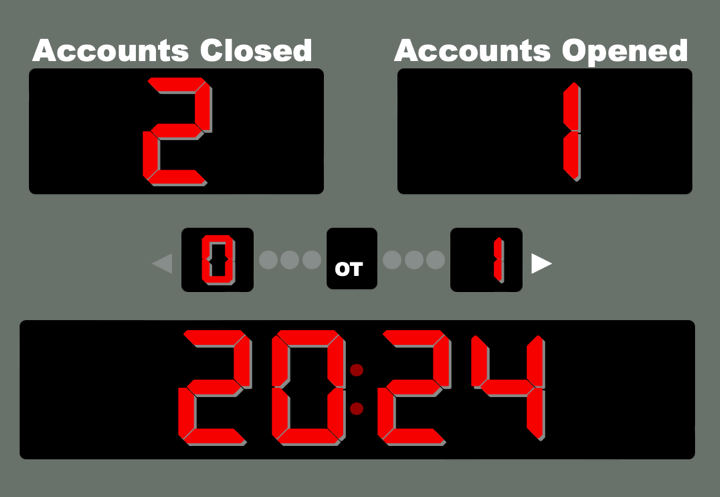
Final score: Two accounts closed (TreasuryDirect and 401k), one account opened (Robinhood).

Fidelity Money Market Funds: Claim Your State Income Tax Exemption (Updated 2025)

Updated. As the brokerage 1099 forms for the 2024 Tax Year are coming out, here is a quick reminder for those subject to state and/or local income taxes. If you earned interest from a money market fund, a significant portion of this interest may have come from “US Government Obligations” like Treasury bills and bonds, which are generally exempt from state and local income taxes. However, in order to claim this exemption, you’ll likely have to manually enter it on your tax return after digging up a few extra details.

(Note: California, Connecticut, and New York exempt dividend income only when the mutual fund has met certain minimum investments in U.S. government securities. They require that 50% of a mutual fund’s assets at each quarter-end within the tax year consist of U.S. government obligations.)

Fidelity has released US GOI percentages for 2024 on their institutional website, but it’s a little hard to read since it includes a lot of funds and share classes that are used by Fidelity-affiliated financial advisors and institutional portfolios. Their tax document page still says “Expected mid February” – Update 2/22: 2024 Percentage of Income from
U.S. Government Securities now available
. The numbers from both sources are the same, although rounded off differently for some reason.

Here are the results for the most popular core Fidelity money market funds:

  • Fidelity® Treasury Only Money Market Fund (FDLXX, CUSIP 31617H300) – 97.0032%.
  • Fidelity® Government Money Market Fund (SPAXX, CUSIP 31617H102) – 55.0877%.
  • Fidelity® Government Cash Reserves (FDRXX, CUSIP 316067107) – 57.1917%.
  • Fidelity® Treasury Money Market Fund* (FZFXX, CUSIP 316341304) – 50.5640%. *FZFXX did not meet the minimum investment in U.S. Government securities required to exempt the distribution from tax in California, Connecticut, and New York.
  • Fidelity® Government Money Market Fund Premium Class (FZCXX, CUSIP 31617H706) – 55.0877%. This fund has a $100,000 minimum, but also a lower expense ratio than SPAXX, which means it earns about 0.10% more yield annually as of this writing 2/20/25.

To find the portion of Fidelity dividends that may be exempt from your state income tax, multiply the amount of “ordinary dividends” reported in Box 1a of your Form 1099-DIV by the percentage listed in the PDF. For example, if you earned $1,000 in total interest from Fidelity Treasury Only Money Market Fund (FDLXX) in 2024, then $970.03 could possibly be exempt from state and local income taxes. If your marginal state income tax rate was 10% that would be a ~$97 tax savings for every $1,000 in total interest earned.

On a net after-tax basis, folks with a ~10% state income tax rate will likely find that FDLXX earns more interest than the default core holdings of SPAXX/FZFXX, even though the gross yield of SPAXX/FZFXX is higher than that of FDLXX.

To obtain these tax savings, you’ll have to manually adjust your state/local income tax return. I don’t believe that TurboTax, H&R Block, and other tax software will do this automatically for you, as they won’t have the required information on their own. (I’m also not sure if they ask about it in their interview process.) If you use an accountant, you should also double-check to make sure they use this information. Here is some information on how to enter this into TurboTax:

  • When you are entering the 1099-DIV Box 1a, 1b, and 2a – click the “My form has info in other boxes (this is uncommon)” checkbox.
  • Next, click on the option “A portion of these dividends is U.S. Government interest.”
  • On the next screen enter the Government interest amount. This will be subtracted from your state return.

Standard disclosure: Check with your state or local tax office or with your tax advisor to determine whether your state allows you to exclude some or all of the income you earn from mutual funds that invest in U.S. government obligations.

[Image credit – Tax Foundation]