Vanguard has a new research paper about global asset allocation. One of their findings was that market-cap-weighted indexed portfolios provided higher returns and lower volatility than the average actively managed fund. Thus, they suggest that a good starting point for all investors is a portfolio that is weighted according to the world’s relative market values.
However, in every country that they examined, investors on average had a home-country bias, tending to own more equity from the country they live in than the market-cap weighting would suggest. The chart below is rather striking. Found via Reformed Broker and Abnormal Returns.
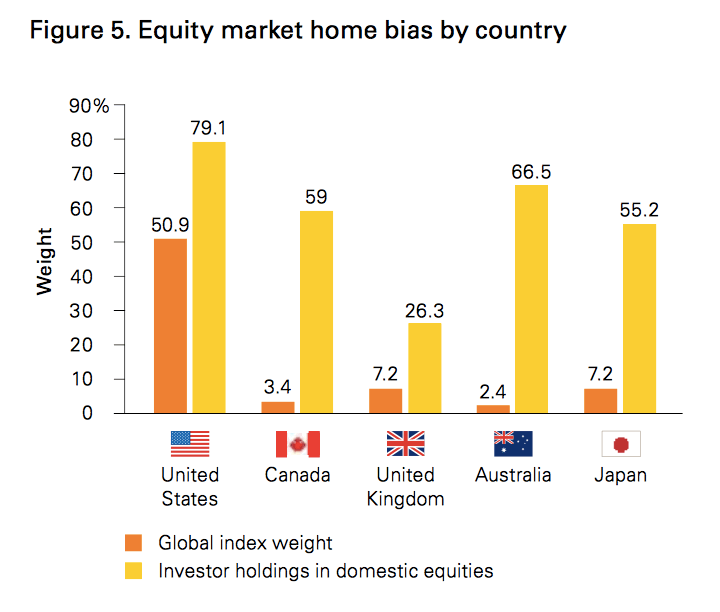

Americans on average hold roughly 80% in US stocks, while the US market makes up 50% of the global market. However, the average Canadian resident holds roughly 60% in Canadian stocks while only making up 3% of the global market. Australian residents hold roughly 66% in Australian stocks while only making up 2% of the global market. I find this very interesting.
This is where I should state proudly that my stock holdings are split 50% US and 50% International, with equal amounts of the Vanguard Total US ETF (VTI) and Vanguard Total International ETF (VXUS) or their mutual fund equivalents. However, I admit that I do worry about the political and economic environments of other countries, especially given current events. On the other hand, I worry that I am being influenced by recent past performance. I usually end up telling myself that I am buying the haystack and letting the markets work themselves out over the long run.
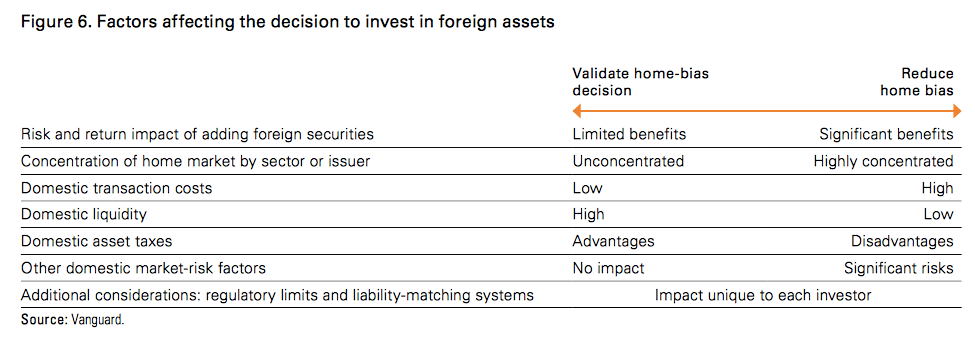
The Vanguard paper also offers a guide to weighing various factors in deciding the amount of your home bias. Here’s a summary chart:
 The Best Credit Card Bonus Offers – 2025
 Big List of Free Stocks from Brokerage Apps
 Best Interest Rates on Cash - 2025
 Free Credit Scores x 3 + Free Credit Monitoring
 Best No Fee 0% APR Balance Transfer Offers
 Little-Known Cellular Data Plans That Can Save Big Money
 How To Haggle Your Cable or Direct TV Bill
 Big List of Free Consumer Data Reports (Credit, Rent, Work)
This makes perfect sense. International equity introduces additional risk/volatility through exchange rates.
I also wonder, are international etfs treated differently come tax time?
I look at the top 10 holdings for VXUS and it shows companies like Nestle, Samsung, Toyota etc. Don’t these companies have a bunch of exposure to the US economy? I wonder in this age of globalization, what domestic and foreign mean anyway.
Interesting article Jonathn. I think that in an age where the world is so interconnected, it seems that things are very much correlated a lot. This will be the case, until something happens to cease those correlations. Given the global nature of things, I thought about the global flow of capital, people and ideas. And I asked Vanguard and Josh Brown the following questions on Twitter ( not to be a smart mouth, but to see how they think)
If I am a European, who works in North America for an Asian company, and I have 80% exposure to US stocks, am I biased or unbiased?
It would be more interested to know what the effect on actual long-term returns would be for say a Canadian vs. Australian. It might not be that much different perhaps even though the home bias is strong. For a US person, having a 60/40 or even 80/20 home bias might not mean much over the next 20 years. Or it might, I have no idea 🙂