 New inflation numbers for March 2009 were announced today, so it’s time for the usual semi-annual update:
New Inflation Rate
September 2008 CPI-U was 218.783. March 2009 CPI-U was 212.709, for a semi-annual decrease of 2.78%. Using this official formula, the variable interest rate for the next 6 months will be approximately -5.55%, depending on the fixed rate. What does this deflation mean for the investment returns for I-Bonds?
Buying Now = ~3.08% APR, 11-month investment
If you buy before the end of April, the fixed rate portion of I-Bonds will be 0.7%. You will be guaranteed an variable interest rate of 4.94% for the next 6 months, for a total rate of 5.64%. For the 6 months after that, the total rate will be zero, not -4.85%. This is due to the 0% floor on savings bond rates.
You can’t redeem until 12 months have gone by, and any redemptions within 5 years incur a 3-month interest penalty. However, a known “trick” with I-Bonds is that if you buy at the end of the month, you’ll still get all the interest for the entire month as if you bought it in the beginning of the month. Let’s say we buy at the end of this April, hold for the minimum of one year, and pay the 3-month interest penalty for redeeming within 5 years. You’ll be able to sell on April 1, 2010 for an actual holding period of 11 months.
This would leave you with a 5.64% return on your money for 6 months, and then nothing for 5 months. Overall, that’s a 3.08% annualized return, and you will be exempt from state income taxes on the interest as well. This is very competitive with current bank CD rates.
Buying Later? If you wait until May 1st, you will get a new unknown fixed rate minus 5.55%, for a virtually guaranteed composite rate of zero for the first 6 months. (The next 6 months will be based on an unknown rate based on future inflation.) Unless there is a big bump in the fixed rate that makes it a good long-term investment, sticking with banks or credit unions will likely give you a higher yield.
Low Purchase Limits
The annual purchase limit is now $5,000 in paper I-bonds and $5,000 in online I-bonds per Social Security Number. For a couple, that’s $20,000 per year. Buy online at TreasuryDirect.gov. As for paper, here is a post on how to buy paper savings bonds from your local bank. Some larger banks may have an electronic process.
For more background, see the rest of my posts on savings bonds.
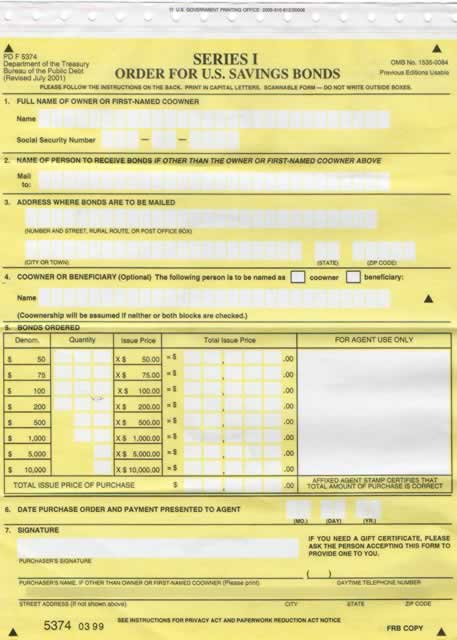
 If you earned any interest from Treasury Bills or Savings Bonds last year, and are subject to local or state income taxes, be sure note it on your tax returns! Interest from federal debt obligations such as these are subject to federal tax, but not state or local income taxes. Here are some tips and examples to make sure you file correctly and get all the money that’s owed to you.
 The Best Credit Card Bonus Offers – 2025
 Big List of Free Stocks from Brokerage Apps
 Best Interest Rates on Cash - 2025
 Free Credit Scores x 3 + Free Credit Monitoring
 Best No Fee 0% APR Balance Transfer Offers
 Little-Known Cellular Data Plans That Can Save Big Money
 How To Haggle Your Cable or Direct TV Bill
 Big List of Free Consumer Data Reports (Credit, Rent, Work)